Agricultural Genomics Scientist Resume

These Agricultural Genomics Scientist resume samples are designed to help you write a resume that gets noticed by hiring managers and passes applicant tracking systems (ATS) in Agricultural Sciences. Each example shows real formatting, section structure, and language you can adapt to your own background. When writing your own Agricultural Genomics Scientist resume, focus on highlighting crop physiology and agronomy, soil science and nutrient management and plant genetics and breeding. Recruiters scan for these qualifications first, so they should appear early in your summary and experience sections. Use strong action verbs such as "researched", "analyzed", "developed", "experimented" to describe your achievements, and quantify your impact wherever possible — percentages, dollar amounts, or time saved make your resume more convincing. A common mistake to avoid: writing a generic objective statement instead of a targeted agricultural genomics scientist professional summary. Tailor your resume to each Agricultural Genomics Scientist position you apply for rather than using one generic version.

Agricultural Genomics Scientist Resume Template
View PDF
0.0 (0 ratings)

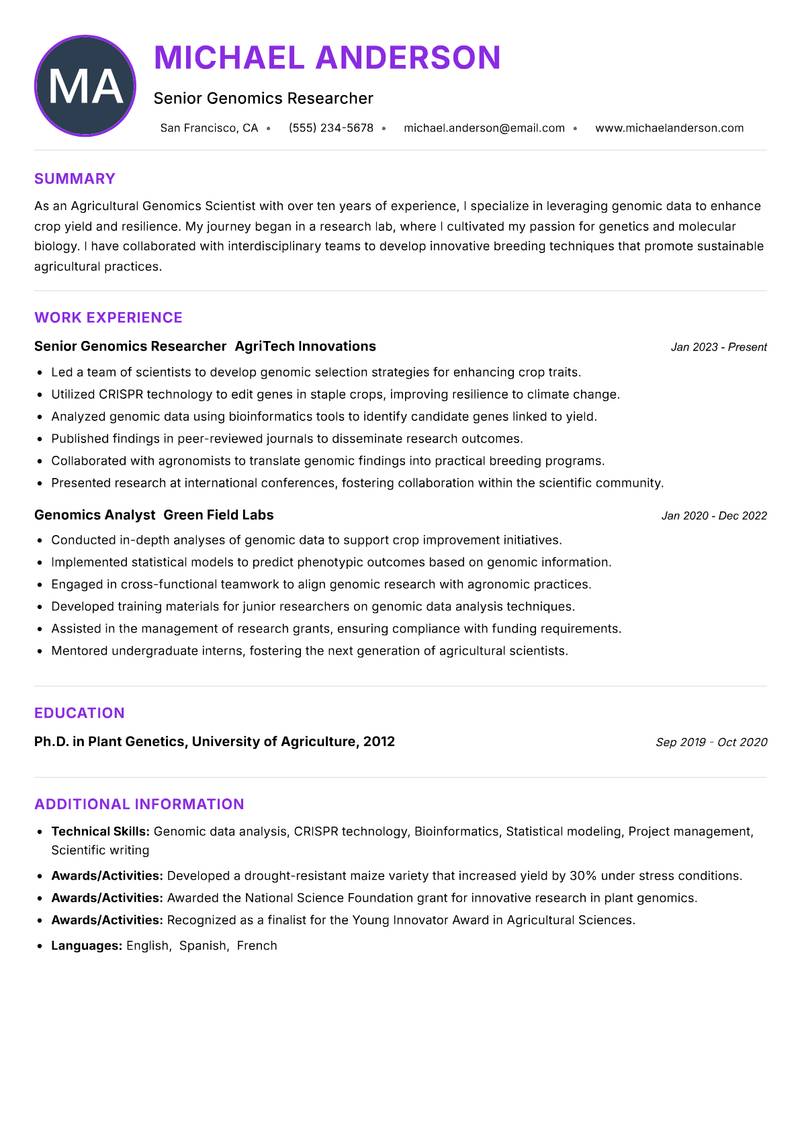
Senior Genomics Researcher Resume

As an Agricultural Genomics Scientist with over ten years of experience, I specialize in leveraging genomic data to enhance crop yield and resilience. My journey began in a research lab, where I cultivated my passion for genetics and molecular biology. I have collaborated with interdisciplinary teams to develop innovative breeding techniques that promote sustainable agricultural practices. My expertise lies in bioinformatics, where I analyze complex genomic datasets to identify key traits in various crops. I have successfully led projects that resulted in the introduction of genetically modified organisms that are drought-resistant and pest-resistant. Throughout my career, I have published numerous papers in high-impact journals, contributing to the scientific community's understanding of plant genomics. I am driven by a commitment to improving food security and promoting environmentally responsible farming methods. My proficiency in next-generation sequencing technologies and my ability to communicate scientific findings to diverse audiences make me a valuable asset to any agricultural research initiative.

Genomic data analysis CRISPR technology Bioinformatics Statistical modeling Project management Scientific writing
Agricultural Genomics Scientist Resume Preview Example
View PDF
  1. Led a team of scientists to develop genomic selection strategies for enhancing crop traits.
  2. Utilized CRISPR technology to edit genes in staple crops, improving resilience to climate change.
  3. Analyzed genomic data using bioinformatics tools to identify candidate genes linked to yield.
  4. Published findings in peer-reviewed journals to disseminate research outcomes.
  5. Collaborated with agronomists to translate genomic findings into practical breeding programs.
  6. Presented research at international conferences, fostering collaboration within the scientific community.
  1. Conducted in-depth analyses of genomic data to support crop improvement initiatives.
  2. Implemented statistical models to predict phenotypic outcomes based on genomic information.
  3. Engaged in cross-functional teamwork to align genomic research with agronomic practices.
  4. Developed training materials for junior researchers on genomic data analysis techniques.
  5. Assisted in the management of research grants, ensuring compliance with funding requirements.
  6. Mentored undergraduate interns, fostering the next generation of agricultural scientists.

Achievements

  • Developed a drought-resistant maize variety that increased yield by 30% under stress conditions.
  • Awarded the National Science Foundation grant for innovative research in plant genomics.
  • Recognized as a finalist for the Young Innovator Award in Agricultural Sciences.
⏱️
Experience
2-5 Years
📅
Level
Mid Level
🎓
Education
Ph.D. in Plant Genetics, Unive...

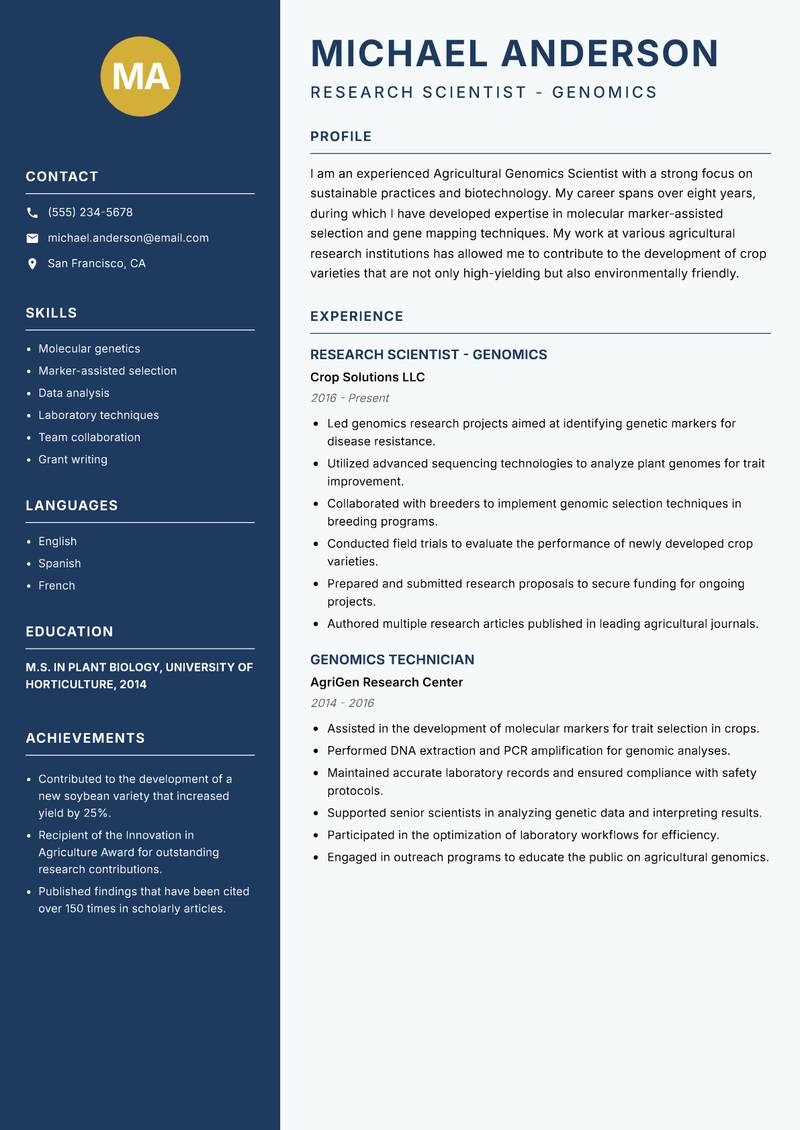
Research Scientist - Genomics Resume

I am an experienced Agricultural Genomics Scientist with a strong focus on sustainable practices and biotechnology. My career spans over eight years, during which I have developed expertise in molecular marker-assisted selection and gene mapping techniques. My work at various agricultural research institutions has allowed me to contribute to the development of crop varieties that are not only high-yielding but also environmentally friendly. I have a comprehensive understanding of plant genomics and a passion for applying my knowledge to enhance food security globally. My ability to work collaboratively within interdisciplinary teams has led to successful projects that have significantly improved the efficiency of breeding programs. I am adept at utilizing cutting-edge tools in genomics and bioinformatics to drive innovation and enhance agricultural productivity. My goal is to continue advancing the field of agricultural genomics through research and practical applications that benefit farmers and consumers alike.

Molecular genetics Marker-assisted selection Data analysis Laboratory techniques Team collaboration Grant writing
Agricultural Genomics Scientist Resume Preview Example
View PDF
  1. Led genomics research projects aimed at identifying genetic markers for disease resistance.
  2. Utilized advanced sequencing technologies to analyze plant genomes for trait improvement.
  3. Collaborated with breeders to implement genomic selection techniques in breeding programs.
  4. Conducted field trials to evaluate the performance of newly developed crop varieties.
  5. Prepared and submitted research proposals to secure funding for ongoing projects.
  6. Authored multiple research articles published in leading agricultural journals.
  1. Assisted in the development of molecular markers for trait selection in crops.
  2. Performed DNA extraction and PCR amplification for genomic analyses.
  3. Maintained accurate laboratory records and ensured compliance with safety protocols.
  4. Supported senior scientists in analyzing genetic data and interpreting results.
  5. Participated in the optimization of laboratory workflows for efficiency.
  6. Engaged in outreach programs to educate the public on agricultural genomics.

Achievements

  • Contributed to the development of a new soybean variety that increased yield by 25%.
  • Recipient of the Innovation in Agriculture Award for outstanding research contributions.
  • Published findings that have been cited over 150 times in scholarly articles.
⏱️
Experience
2-5 Years
📅
Level
Mid Level
🎓
Education
M.S. in Plant Biology, Univers...

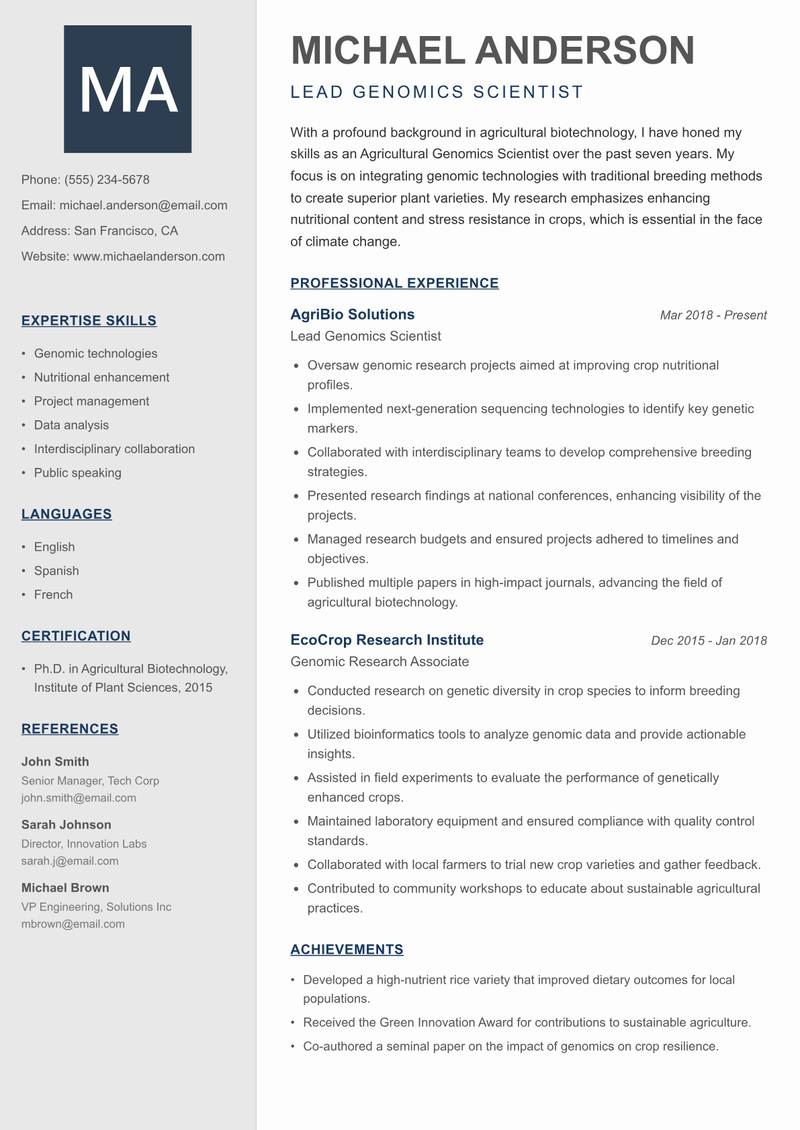
Lead Genomics Scientist Resume

With a profound background in agricultural biotechnology, I have honed my skills as an Agricultural Genomics Scientist over the past seven years. My focus is on integrating genomic technologies with traditional breeding methods to create superior plant varieties. My research emphasizes enhancing nutritional content and stress resistance in crops, which is essential in the face of climate change. I have successfully led teams in various projects that utilized next-generation sequencing to identify genetic variations linked to desirable phenotypes. My collaborative work with agronomists, biochemists, and environmental scientists has resulted in holistic solutions that benefit both the ecosystem and agricultural productivity. I am passionate about translating complex genomic data into practical applications that farmers can adopt to improve their livelihoods. My commitment to innovation in agriculture drives my work, and I am eager to contribute to groundbreaking research that addresses global food challenges.

Genomic technologies Nutritional enhancement Project management Data analysis Interdisciplinary collaboration Public speaking
Agricultural Genomics Scientist Resume Preview Example
View PDF
  1. Oversaw genomic research projects aimed at improving crop nutritional profiles.
  2. Implemented next-generation sequencing technologies to identify key genetic markers.
  3. Collaborated with interdisciplinary teams to develop comprehensive breeding strategies.
  4. Presented research findings at national conferences, enhancing visibility of the projects.
  5. Managed research budgets and ensured projects adhered to timelines and objectives.
  6. Published multiple papers in high-impact journals, advancing the field of agricultural biotechnology.
  1. Conducted research on genetic diversity in crop species to inform breeding decisions.
  2. Utilized bioinformatics tools to analyze genomic data and provide actionable insights.
  3. Assisted in field experiments to evaluate the performance of genetically enhanced crops.
  4. Maintained laboratory equipment and ensured compliance with quality control standards.
  5. Collaborated with local farmers to trial new crop varieties and gather feedback.
  6. Contributed to community workshops to educate about sustainable agricultural practices.

Achievements

  • Developed a high-nutrient rice variety that improved dietary outcomes for local populations.
  • Received the Green Innovation Award for contributions to sustainable agriculture.
  • Co-authored a seminal paper on the impact of genomics on crop resilience.
⏱️
Experience
2-5 Years
📅
Level
Mid Level
🎓
Education
Ph.D. in Agricultural Biotechn...

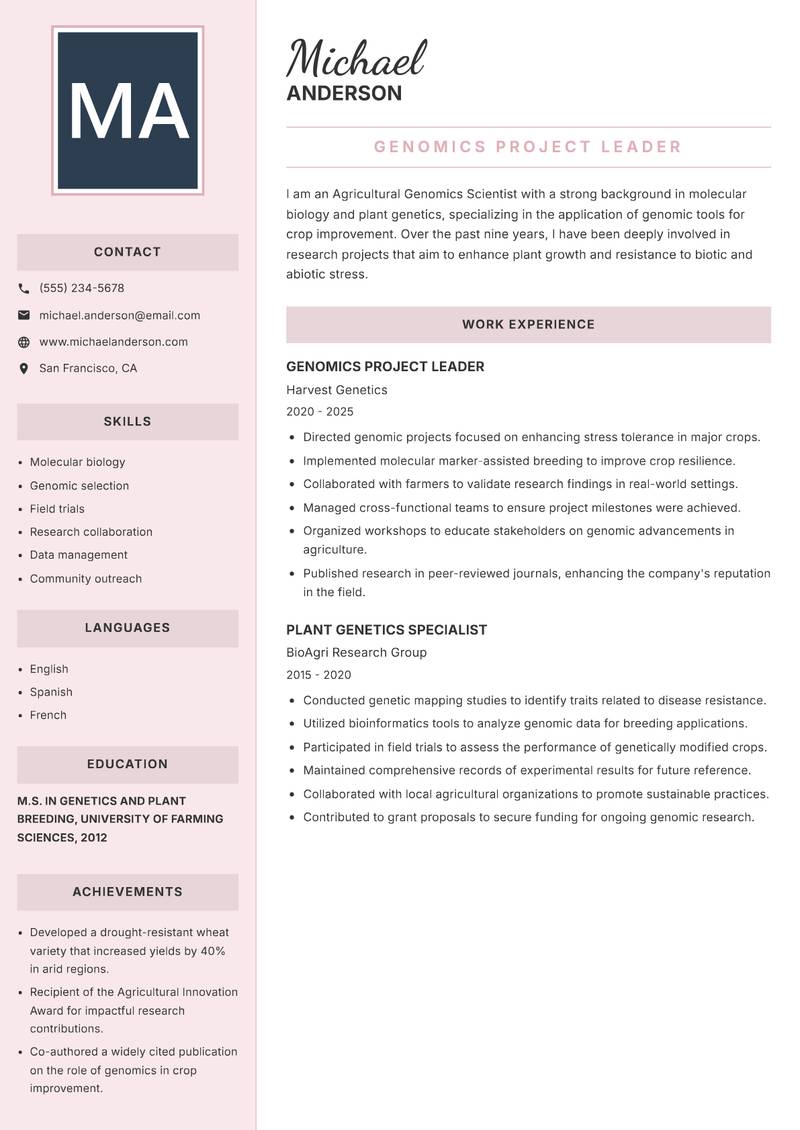
Genomics Project Leader Resume

I am an Agricultural Genomics Scientist with a strong background in molecular biology and plant genetics, specializing in the application of genomic tools for crop improvement. Over the past nine years, I have been deeply involved in research projects that aim to enhance plant growth and resistance to biotic and abiotic stress. My expertise includes the use of genomic selection techniques and the integration of molecular markers to accelerate breeding processes. I have a successful track record of collaborating with agricultural stakeholders, including farmers and agronomists, to implement research findings into practical applications. I am passionate about advancing sustainable agricultural practices and improving food security through science. My work has not only contributed to the development of superior crop varieties but has also focused on educating communities about the benefits of genomic technologies. I am committed to driving innovation in the field of agricultural genomics to meet the challenges of modern agriculture.

Molecular biology Genomic selection Field trials Research collaboration Data management Community outreach
Agricultural Genomics Scientist Resume Preview Example
View PDF
  1. Directed genomic projects focused on enhancing stress tolerance in major crops.
  2. Implemented molecular marker-assisted breeding to improve crop resilience.
  3. Collaborated with farmers to validate research findings in real-world settings.
  4. Managed cross-functional teams to ensure project milestones were achieved.
  5. Organized workshops to educate stakeholders on genomic advancements in agriculture.
  6. Published research in peer-reviewed journals, enhancing the company's reputation in the field.
  1. Conducted genetic mapping studies to identify traits related to disease resistance.
  2. Utilized bioinformatics tools to analyze genomic data for breeding applications.
  3. Participated in field trials to assess the performance of genetically modified crops.
  4. Maintained comprehensive records of experimental results for future reference.
  5. Collaborated with local agricultural organizations to promote sustainable practices.
  6. Contributed to grant proposals to secure funding for ongoing genomic research.

Achievements

  • Developed a drought-resistant wheat variety that increased yields by 40% in arid regions.
  • Recipient of the Agricultural Innovation Award for impactful research contributions.
  • Co-authored a widely cited publication on the role of genomics in crop improvement.
⏱️
Experience
2-5 Years
📅
Level
Mid Level
🎓
Education
M.S. in Genetics and Plant Bre...

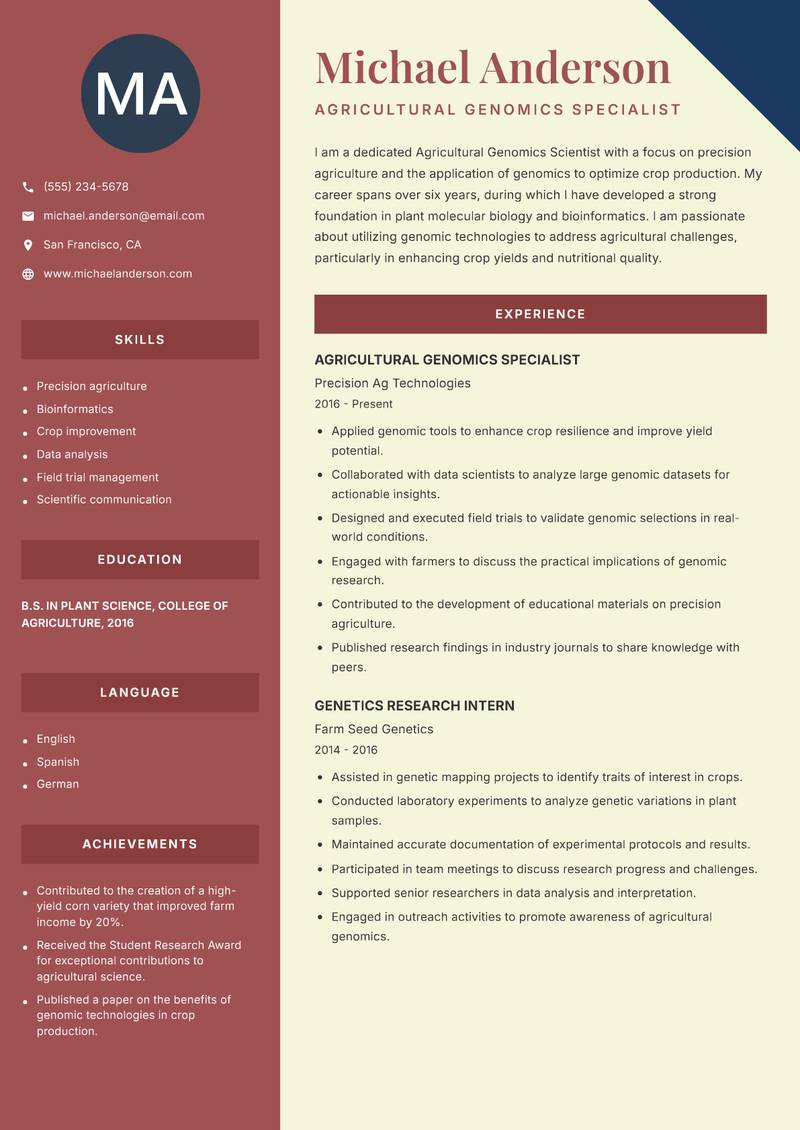
Agricultural Genomics Specialist Resume

I am a dedicated Agricultural Genomics Scientist with a focus on precision agriculture and the application of genomics to optimize crop production. My career spans over six years, during which I have developed a strong foundation in plant molecular biology and bioinformatics. I am passionate about utilizing genomic technologies to address agricultural challenges, particularly in enhancing crop yields and nutritional quality. My work involves collaborating with cross-disciplinary teams to integrate genomic data with agronomic practices, ensuring that research outcomes are actionable and beneficial for farmers. I have successfully managed projects that leverage advanced genomic tools to develop crop varieties that thrive in changing climates. I am committed to promoting sustainable agriculture through science and innovation. My ability to communicate complex genomic concepts to diverse audiences ensures that scientific advancements are accessible to all stakeholders in the agricultural sector.

Precision agriculture Bioinformatics Crop improvement Data analysis Field trial management Scientific communication
Agricultural Genomics Scientist Resume Preview Example
View PDF
  1. Applied genomic tools to enhance crop resilience and improve yield potential.
  2. Collaborated with data scientists to analyze large genomic datasets for actionable insights.
  3. Designed and executed field trials to validate genomic selections in real-world conditions.
  4. Engaged with farmers to discuss the practical implications of genomic research.
  5. Contributed to the development of educational materials on precision agriculture.
  6. Published research findings in industry journals to share knowledge with peers.
  1. Assisted in genetic mapping projects to identify traits of interest in crops.
  2. Conducted laboratory experiments to analyze genetic variations in plant samples.
  3. Maintained accurate documentation of experimental protocols and results.
  4. Participated in team meetings to discuss research progress and challenges.
  5. Supported senior researchers in data analysis and interpretation.
  6. Engaged in outreach activities to promote awareness of agricultural genomics.

Achievements

  • Contributed to the creation of a high-yield corn variety that improved farm income by 20%.
  • Received the Student Research Award for exceptional contributions to agricultural science.
  • Published a paper on the benefits of genomic technologies in crop production.
⏱️
Experience
2-5 Years
📅
Level
Mid Level
🎓
Education
B.S. in Plant Science, College...

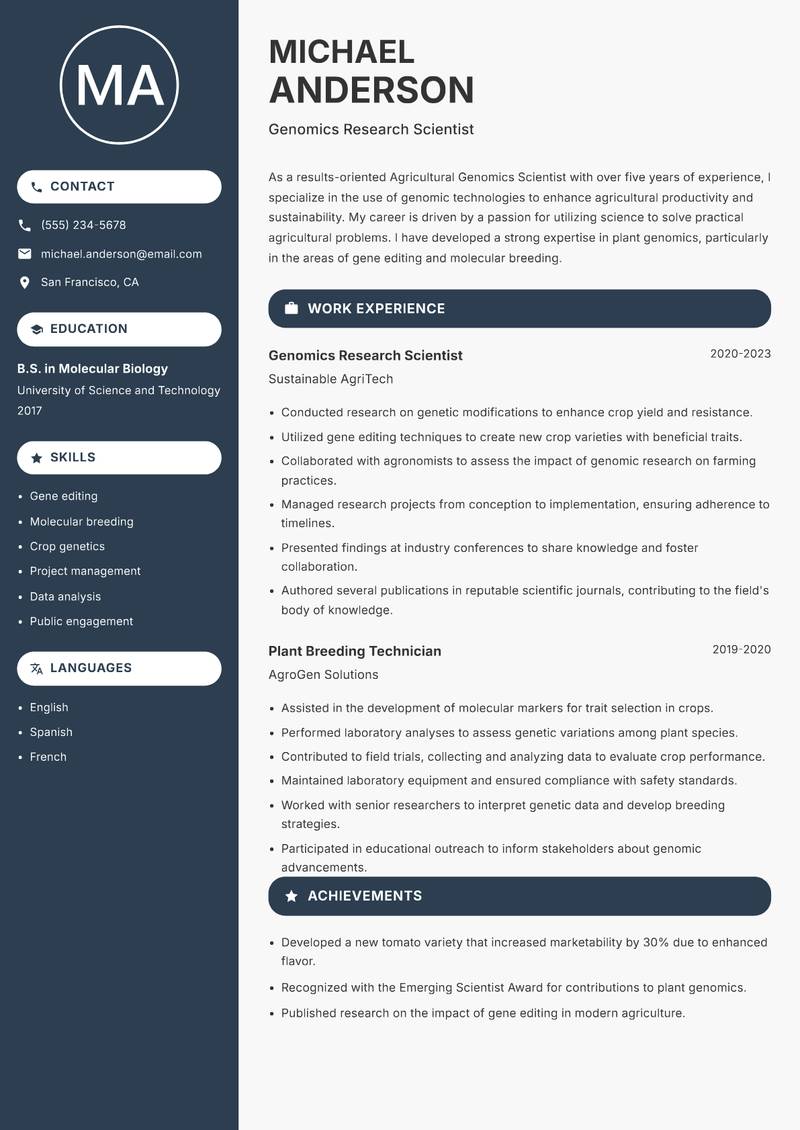
Genomics Research Scientist Resume

As a results-oriented Agricultural Genomics Scientist with over five years of experience, I specialize in the use of genomic technologies to enhance agricultural productivity and sustainability. My career is driven by a passion for utilizing science to solve practical agricultural problems. I have developed a strong expertise in plant genomics, particularly in the areas of gene editing and molecular breeding. I believe in the importance of integrating scientific research with real-world application, which has guided my work with various agricultural organizations. My ability to collaborate with diverse teams has allowed me to lead projects that successfully introduce new crop varieties with improved traits. I am dedicated to advancing agricultural practices through innovation and research, and I continuously seek opportunities to contribute to projects that address food security and environmental sustainability.

Gene editing Molecular breeding Crop genetics Project management Data analysis Public engagement
Agricultural Genomics Scientist Resume Preview Example
View PDF
  1. Conducted research on genetic modifications to enhance crop yield and resistance.
  2. Utilized gene editing techniques to create new crop varieties with beneficial traits.
  3. Collaborated with agronomists to assess the impact of genomic research on farming practices.
  4. Managed research projects from conception to implementation, ensuring adherence to timelines.
  5. Presented findings at industry conferences to share knowledge and foster collaboration.
  6. Authored several publications in reputable scientific journals, contributing to the field's body of knowledge.
  1. Assisted in the development of molecular markers for trait selection in crops.
  2. Performed laboratory analyses to assess genetic variations among plant species.
  3. Contributed to field trials, collecting and analyzing data to evaluate crop performance.
  4. Maintained laboratory equipment and ensured compliance with safety standards.
  5. Worked with senior researchers to interpret genetic data and develop breeding strategies.
  6. Participated in educational outreach to inform stakeholders about genomic advancements.

Achievements

  • Developed a new tomato variety that increased marketability by 30% due to enhanced flavor.
  • Recognized with the Emerging Scientist Award for contributions to plant genomics.
  • Published research on the impact of gene editing in modern agriculture.
⏱️
Experience
2-5 Years
📅
Level
Mid Level
🎓
Education
B.S. in Molecular Biology, Uni...

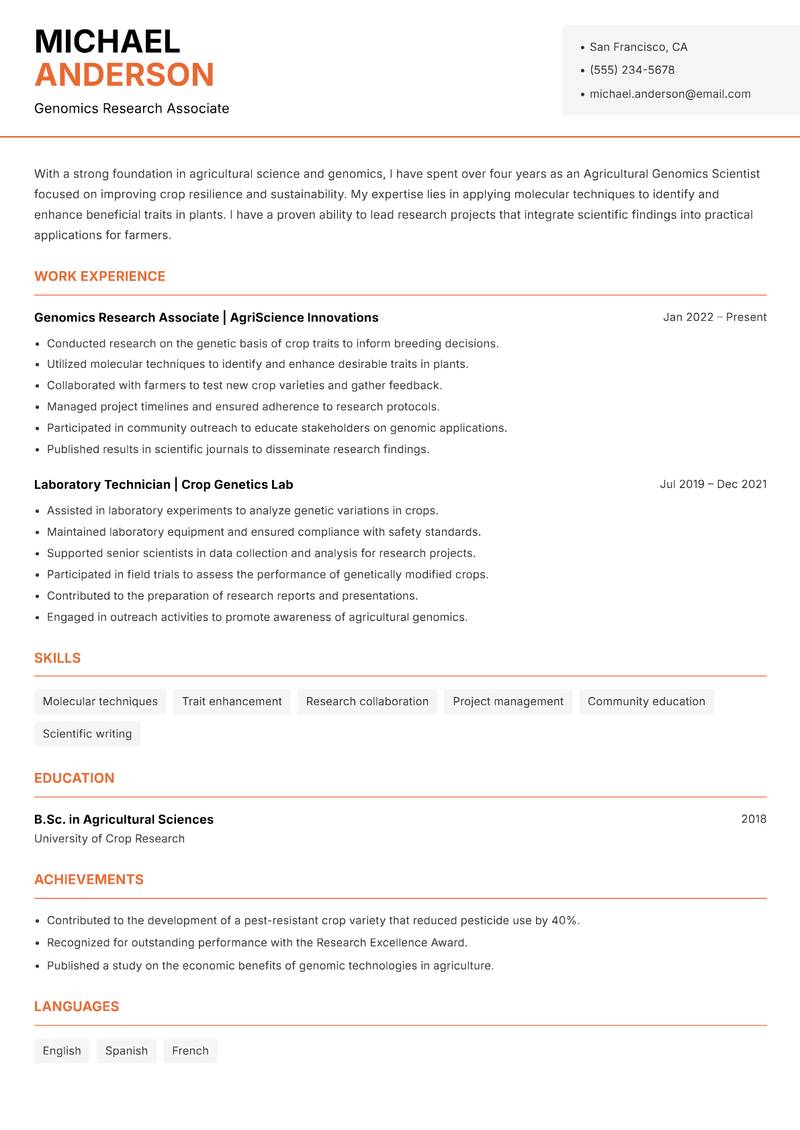
Genomics Research Associate Resume

With a strong foundation in agricultural science and genomics, I have spent over four years as an Agricultural Genomics Scientist focused on improving crop resilience and sustainability. My expertise lies in applying molecular techniques to identify and enhance beneficial traits in plants. I have a proven ability to lead research projects that integrate scientific findings into practical applications for farmers. My work has involved collaborating with multidisciplinary teams to address challenges in crop production and food security. I am passionate about using my skills to contribute to sustainable agricultural practices and ensure that scientific advancements are accessible to the agricultural community. I am committed to continuous learning and embracing new technologies to advance the field of agricultural genomics for the benefit of society.

Molecular techniques Trait enhancement Research collaboration Project management Community education Scientific writing
Agricultural Genomics Scientist Resume Preview Example
View PDF
  1. Conducted research on the genetic basis of crop traits to inform breeding decisions.
  2. Utilized molecular techniques to identify and enhance desirable traits in plants.
  3. Collaborated with farmers to test new crop varieties and gather feedback.
  4. Managed project timelines and ensured adherence to research protocols.
  5. Participated in community outreach to educate stakeholders on genomic applications.
  6. Published results in scientific journals to disseminate research findings.
  1. Assisted in laboratory experiments to analyze genetic variations in crops.
  2. Maintained laboratory equipment and ensured compliance with safety standards.
  3. Supported senior scientists in data collection and analysis for research projects.
  4. Participated in field trials to assess the performance of genetically modified crops.
  5. Contributed to the preparation of research reports and presentations.
  6. Engaged in outreach activities to promote awareness of agricultural genomics.

Achievements

  • Contributed to the development of a pest-resistant crop variety that reduced pesticide use by 40%.
  • Recognized for outstanding performance with the Research Excellence Award.
  • Published a study on the economic benefits of genomic technologies in agriculture.
⏱️
Experience
2-5 Years
📅
Level
Mid Level
🎓
Education
B.Sc. in Agricultural Sciences...

Key Skills for Agricultural Genomics Scientist Positions

Resume Tips for Agricultural Genomics Scientist Applications

Strong Action Verbs for Agricultural Genomics Scientist Resumes

Researched · Analyzed · Developed · Experimented · Evaluated · Validated · Published · Optimized · Investigated · Innovated · Achieved · Administered · Architected · Assessed

Common Mistakes to Avoid

Experience Levels

How to Write a Agricultural Genomics Scientist Resume

Browse Agricultural Genomics Scientist resume examples built around crop physiology and agronomy, tailored for Agricultural Sciences roles.

A strong Agricultural Genomics Scientist resume leads with a focused professional summary that names the exact role and your standout achievement. In the experience section, open every bullet with a strong action verb and quantify the result with numbers wherever possible. Highlight your most relevant competencies — especially Crop physiology and agronomy, Soil science and nutrient management, and Plant genetics and breeding — in a dedicated Skills section positioned early so ATS systems and hiring managers both find it immediately.

For format, most Agricultural Genomics Scientist roles suit a reverse-chronological layout: most recent position first, working backwards. Keep to one page for under five years of experience, or two pages for senior candidates with a rich project or leadership history. Use clean, ATS-safe fonts (10–12pt), standard section headings (Summary, Experience, Education, Skills), and avoid tables, text boxes, or multi-column layouts that applicant tracking systems cannot parse reliably.
Frequently Asked Questions

What makes a strong Agricultural Genomics Scientist resume stand out to employers?

A standout Agricultural Genomics Scientist resume combines role-specific skills with quantified achievements. Name the exact job title in your professional summary, mirror keywords from each job posting, and open every bullet point with a strong action verb followed by a measurable result. Certifications, tools, and domain experience specific to agricultural genomics scientist roles should appear prominently near the top.

What skills are most important to include on a Agricultural Sciences resume?

Recruiters hiring in Agricultural Sciences consistently look for Crop physiology and agronomy, Soil science and nutrient management, Plant genetics and breeding, Agricultural biotechnology techniques. List these in a dedicated Skills section near the top so both ATS systems and human reviewers spot them fast. Mirror the exact phrasing from each job posting wherever possible — many applicant tracking systems match literal strings rather than synonyms.

What is the best resume format for Agricultural Sciences professionals?

A reverse-chronological format is the standard choice for most Agricultural Sciences candidates — employers expect to see your most recent role first, working backwards. If you are transitioning into Agricultural Sciences from a related field, a hybrid format (brief skills summary at the top followed by chronological experience) can bridge the gap effectively. Keep the document to one page for under five years of experience, or two pages for senior specialists.

How do I make my Agricultural Sciences resume pass applicant tracking systems (ATS)?

Use standard section headings — Summary, Experience, Education, Skills — rather than creative labels that ATS parsers do not recognise. Embed domain keywords such as "Crop physiology and agronomy" and "Soil science and nutrient management" naturally inside your experience bullets rather than cramming them into a standalone keyword list. Avoid tables, multi-column layouts, text boxes, headers, footers, and images — these confuse most modern parsers and can cause your resume to be misread or rejected before a human sees it.

What mistakes do Agricultural Sciences professionals most commonly make on their resume?

The most frequent issue is listing academic qualifications without practical research impact. Beyond that, generic objective statements, unquantified achievements, and inconsistent date formatting appear across almost every Agricultural Sciences application. Fix these by replacing every vague claim with a measurable outcome — specific numbers and named projects add credibility that adjectives cannot.

How long should a Agricultural Sciences resume be?

One page is appropriate for candidates with under five years of relevant Agricultural Sciences experience. Two pages are acceptable — and sometimes expected — for senior specialists, managers, or professionals with a strong portfolio of projects, publications, or credentials. Avoid padding to reach a page count: every line should directly support your application for the specific role you are targeting.

Should I include a professional summary at the top of my Agricultural Sciences resume?

Yes — a two to three sentence summary is the first section most recruiters read. Open with your title and years of Agricultural Sciences experience, then name your most relevant achievement or specialisation. One proven approach: Highlight research outcomes such as yield improvement or disease resistance — this level of specificity signals genuine expertise before a recruiter reaches your experience section.

Scroll to view samples