Celestial Mechanics Scientist Resume

These Celestial Mechanics Scientist resume samples are designed to help you write a resume that gets noticed by hiring managers and passes applicant tracking systems (ATS) in Space Sciences. Each example shows real formatting, section structure, and language you can adapt to your own background. When writing your own Celestial Mechanics Scientist resume, focus on highlighting orbital mechanics & mission design, astrophysics & cosmological analysis and satellite design & systems engineering. Recruiters scan for these qualifications first, so they should appear early in your summary and experience sections. Use strong action verbs such as "launched", "modeled", "analyzed", "designed" to describe your achievements, and quantify your impact wherever possible — percentages, dollar amounts, or time saved make your resume more convincing. A common mistake to avoid: writing a generic objective statement instead of a targeted celestial mechanics scientist professional summary. Tailor your resume to each Celestial Mechanics Scientist position you apply for rather than using one generic version.

Celestial Mechanics Scientist Resume Template
View PDF
0.0 (0 ratings)

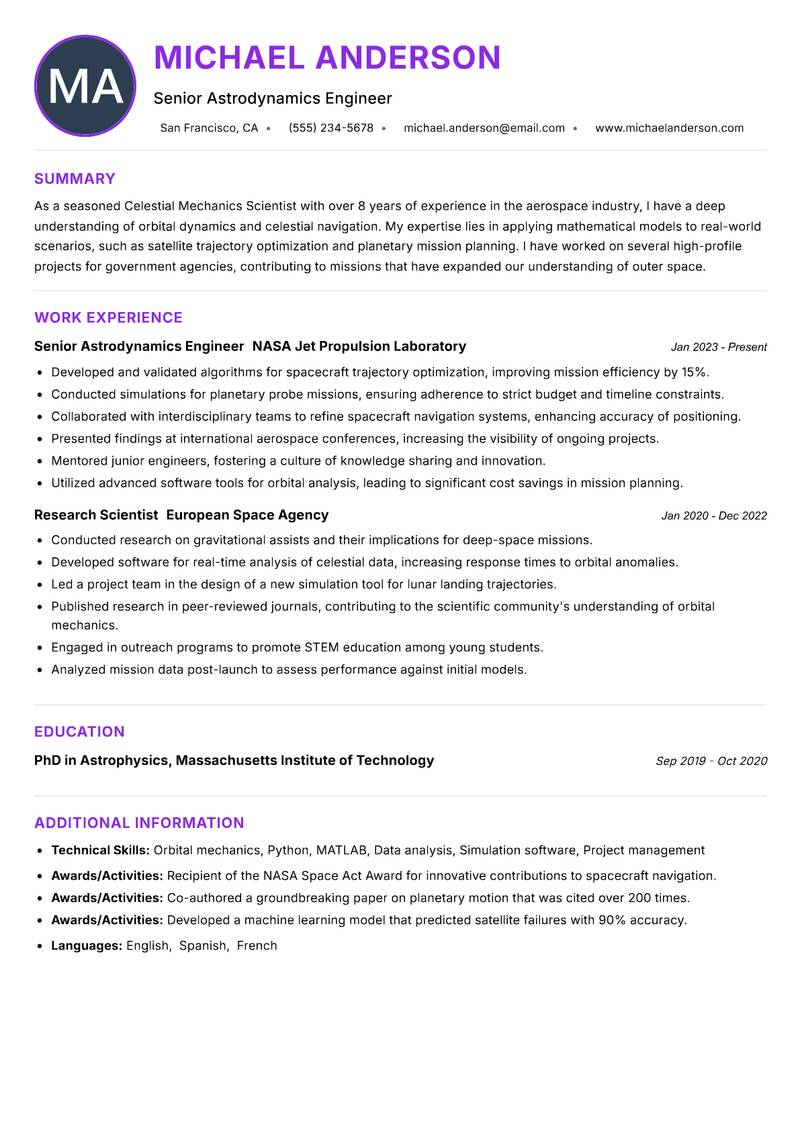
Senior Astrodynamics Engineer Resume

As a seasoned Celestial Mechanics Scientist with over 8 years of experience in the aerospace industry, I have a deep understanding of orbital dynamics and celestial navigation. My expertise lies in applying mathematical models to real-world scenarios, such as satellite trajectory optimization and planetary mission planning. I have worked on several high-profile projects for government agencies, contributing to missions that have expanded our understanding of outer space. My proficiency in programming languages such as Python and MATLAB has enabled me to develop algorithms that predict celestial events with high accuracy. I am passionate about advancing the field of astrodynamics and have published several papers in reputable journals. My collaborative nature and ability to communicate complex concepts effectively have allowed me to work successfully in multidisciplinary teams. I am eager to leverage my skills in a challenging new role that pushes the boundaries of celestial mechanics research.

Orbital mechanics Python MATLAB Data analysis Simulation software Project management
Celestial Mechanics Scientist Resume Preview Example
View PDF
  1. Developed and validated algorithms for spacecraft trajectory optimization, improving mission efficiency by 15%.
  2. Conducted simulations for planetary probe missions, ensuring adherence to strict budget and timeline constraints.
  3. Collaborated with interdisciplinary teams to refine spacecraft navigation systems, enhancing accuracy of positioning.
  4. Presented findings at international aerospace conferences, increasing the visibility of ongoing projects.
  5. Mentored junior engineers, fostering a culture of knowledge sharing and innovation.
  6. Utilized advanced software tools for orbital analysis, leading to significant cost savings in mission planning.
  1. Conducted research on gravitational assists and their implications for deep-space missions.
  2. Developed software for real-time analysis of celestial data, increasing response times to orbital anomalies.
  3. Led a project team in the design of a new simulation tool for lunar landing trajectories.
  4. Published research in peer-reviewed journals, contributing to the scientific community's understanding of orbital mechanics.
  5. Engaged in outreach programs to promote STEM education among young students.
  6. Analyzed mission data post-launch to assess performance against initial models.

Achievements

  • Recipient of the NASA Space Act Award for innovative contributions to spacecraft navigation.
  • Co-authored a groundbreaking paper on planetary motion that was cited over 200 times.
  • Developed a machine learning model that predicted satellite failures with 90% accuracy.
⏱️
Experience
2-5 Years
📅
Level
Mid Level
🎓
Education
PhD in Astrophysics, Massachus...

Lead Celestial Mechanics Analyst Resume

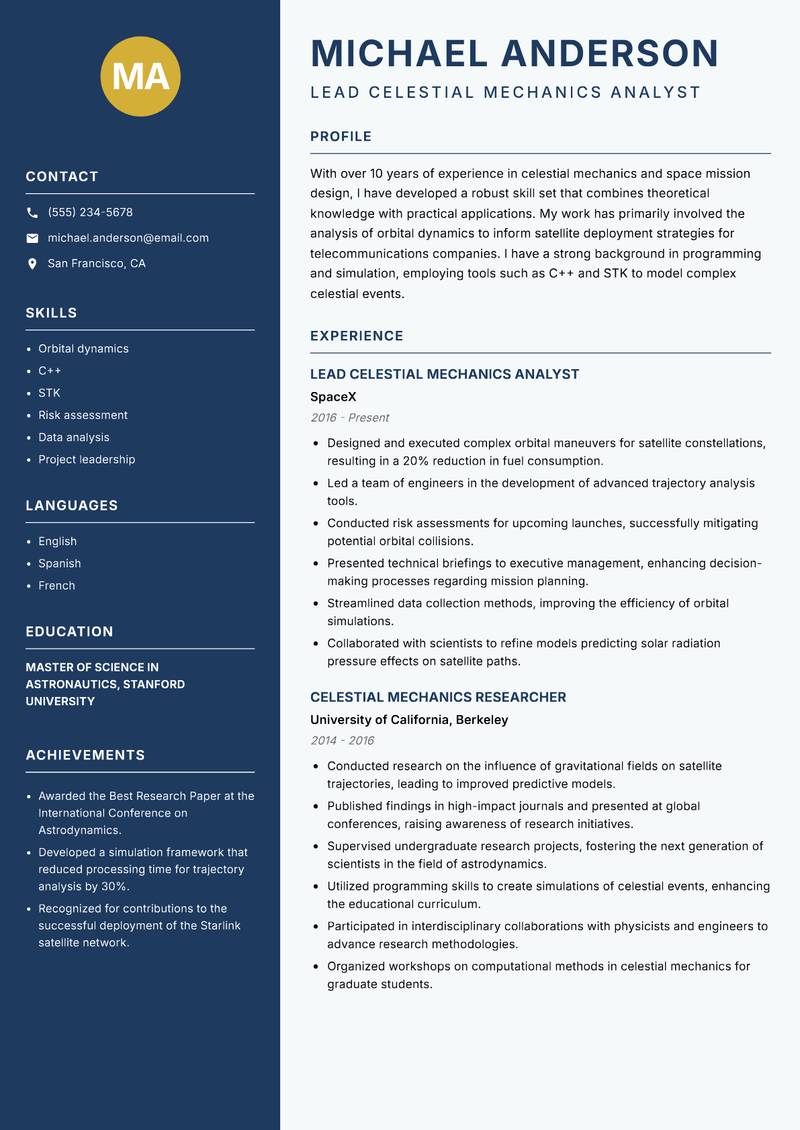
With over 10 years of experience in celestial mechanics and space mission design, I have developed a robust skill set that combines theoretical knowledge with practical applications. My work has primarily involved the analysis of orbital dynamics to inform satellite deployment strategies for telecommunications companies. I have a strong background in programming and simulation, employing tools such as C++ and STK to model complex celestial events. My experience working on international projects has honed my ability to communicate technical information to diverse stakeholders. I am committed to pushing the boundaries of space exploration and am particularly interested in the intersection of celestial mechanics and artificial intelligence, as I believe this could revolutionize how we approach space travel and satellite management. I am seeking a role that allows me to leverage my expertise in a forward-thinking organization.

Orbital dynamics C++ STK Risk assessment Data analysis Project leadership
Celestial Mechanics Scientist Resume Preview Example
View PDF
  1. Designed and executed complex orbital maneuvers for satellite constellations, resulting in a 20% reduction in fuel consumption.
  2. Led a team of engineers in the development of advanced trajectory analysis tools.
  3. Conducted risk assessments for upcoming launches, successfully mitigating potential orbital collisions.
  4. Presented technical briefings to executive management, enhancing decision-making processes regarding mission planning.
  5. Streamlined data collection methods, improving the efficiency of orbital simulations.
  6. Collaborated with scientists to refine models predicting solar radiation pressure effects on satellite paths.
  1. Conducted research on the influence of gravitational fields on satellite trajectories, leading to improved predictive models.
  2. Published findings in high-impact journals and presented at global conferences, raising awareness of research initiatives.
  3. Supervised undergraduate research projects, fostering the next generation of scientists in the field of astrodynamics.
  4. Utilized programming skills to create simulations of celestial events, enhancing the educational curriculum.
  5. Participated in interdisciplinary collaborations with physicists and engineers to advance research methodologies.
  6. Organized workshops on computational methods in celestial mechanics for graduate students.

Achievements

  • Awarded the Best Research Paper at the International Conference on Astrodynamics.
  • Developed a simulation framework that reduced processing time for trajectory analysis by 30%.
  • Recognized for contributions to the successful deployment of the Starlink satellite network.
⏱️
Experience
2-5 Years
📅
Level
Mid Level
🎓
Education
Master of Science in Astronaut...

Space Debris Analyst Resume

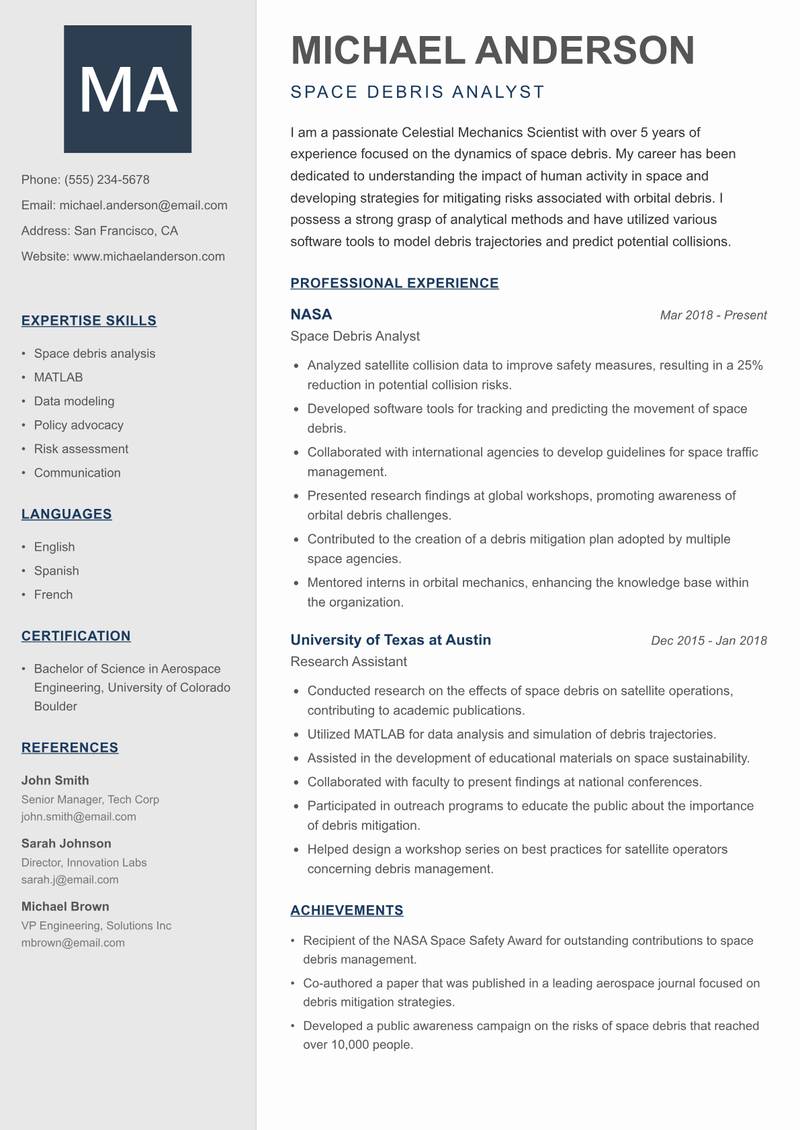
I am a passionate Celestial Mechanics Scientist with over 5 years of experience focused on the dynamics of space debris. My career has been dedicated to understanding the impact of human activity in space and developing strategies for mitigating risks associated with orbital debris. I possess a strong grasp of analytical methods and have utilized various software tools to model debris trajectories and predict potential collisions. My analytical skills are complemented by my ability to communicate complex technical information to a broad audience, making me an effective advocate for sustainable space practices. I have contributed to multiple international projects aimed at improving safety protocols for satellite operations and have been involved in policy discussions regarding space traffic management. I am eager to contribute my expertise to a dynamic team that prioritizes innovation and sustainability in space exploration.

Space debris analysis MATLAB Data modeling Policy advocacy Risk assessment Communication
Celestial Mechanics Scientist Resume Preview Example
View PDF
  1. Analyzed satellite collision data to improve safety measures, resulting in a 25% reduction in potential collision risks.
  2. Developed software tools for tracking and predicting the movement of space debris.
  3. Collaborated with international agencies to develop guidelines for space traffic management.
  4. Presented research findings at global workshops, promoting awareness of orbital debris challenges.
  5. Contributed to the creation of a debris mitigation plan adopted by multiple space agencies.
  6. Mentored interns in orbital mechanics, enhancing the knowledge base within the organization.
  1. Conducted research on the effects of space debris on satellite operations, contributing to academic publications.
  2. Utilized MATLAB for data analysis and simulation of debris trajectories.
  3. Assisted in the development of educational materials on space sustainability.
  4. Collaborated with faculty to present findings at national conferences.
  5. Participated in outreach programs to educate the public about the importance of debris mitigation.
  6. Helped design a workshop series on best practices for satellite operators concerning debris management.

Achievements

  • Recipient of the NASA Space Safety Award for outstanding contributions to space debris management.
  • Co-authored a paper that was published in a leading aerospace journal focused on debris mitigation strategies.
  • Developed a public awareness campaign on the risks of space debris that reached over 10,000 people.
⏱️
Experience
2-5 Years
📅
Level
Mid Level
🎓
Education
Bachelor of Science in Aerospa...

Junior Celestial Mechanics Engineer Resume

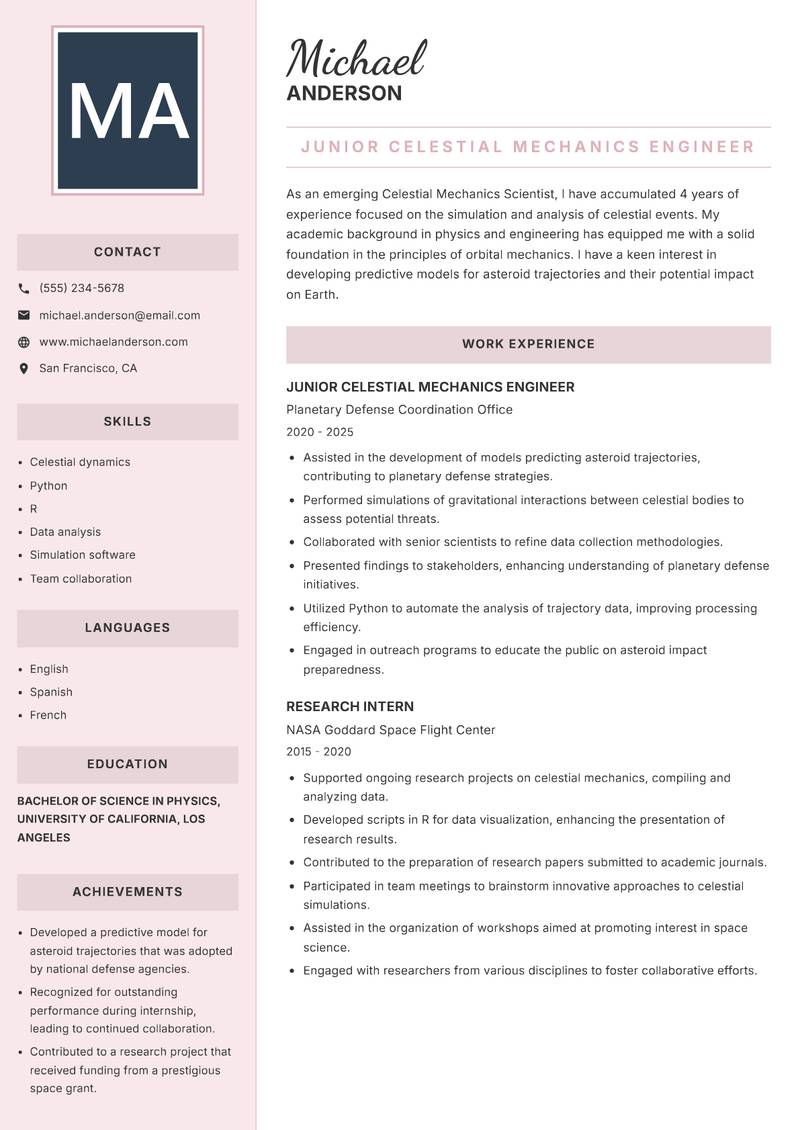
As an emerging Celestial Mechanics Scientist, I have accumulated 4 years of experience focused on the simulation and analysis of celestial events. My academic background in physics and engineering has equipped me with a solid foundation in the principles of orbital mechanics. I have a keen interest in developing predictive models for asteroid trajectories and their potential impact on Earth. My work has involved using advanced simulation software to analyze gravitational interactions and develop mitigation strategies for potential threats. I am proficient in programming languages such as Python and R, which I have used to automate data analysis processes. I thrive in collaborative environments and have participated in several interdisciplinary research projects that aim to address pressing challenges in planetary defense. I am looking forward to expanding my expertise in a role that emphasizes innovation and research in celestial mechanics.

Celestial dynamics Python R Data analysis Simulation software Team collaboration
Celestial Mechanics Scientist Resume Preview Example
View PDF
  1. Assisted in the development of models predicting asteroid trajectories, contributing to planetary defense strategies.
  2. Performed simulations of gravitational interactions between celestial bodies to assess potential threats.
  3. Collaborated with senior scientists to refine data collection methodologies.
  4. Presented findings to stakeholders, enhancing understanding of planetary defense initiatives.
  5. Utilized Python to automate the analysis of trajectory data, improving processing efficiency.
  6. Engaged in outreach programs to educate the public on asteroid impact preparedness.
  1. Supported ongoing research projects on celestial mechanics, compiling and analyzing data.
  2. Developed scripts in R for data visualization, enhancing the presentation of research results.
  3. Contributed to the preparation of research papers submitted to academic journals.
  4. Participated in team meetings to brainstorm innovative approaches to celestial simulations.
  5. Assisted in the organization of workshops aimed at promoting interest in space science.
  6. Engaged with researchers from various disciplines to foster collaborative efforts.

Achievements

  • Developed a predictive model for asteroid trajectories that was adopted by national defense agencies.
  • Recognized for outstanding performance during internship, leading to continued collaboration.
  • Contributed to a research project that received funding from a prestigious space grant.
⏱️
Experience
2-5 Years
📅
Level
Mid Level
🎓
Education
Bachelor of Science in Physics...

Orbital Analyst Resume

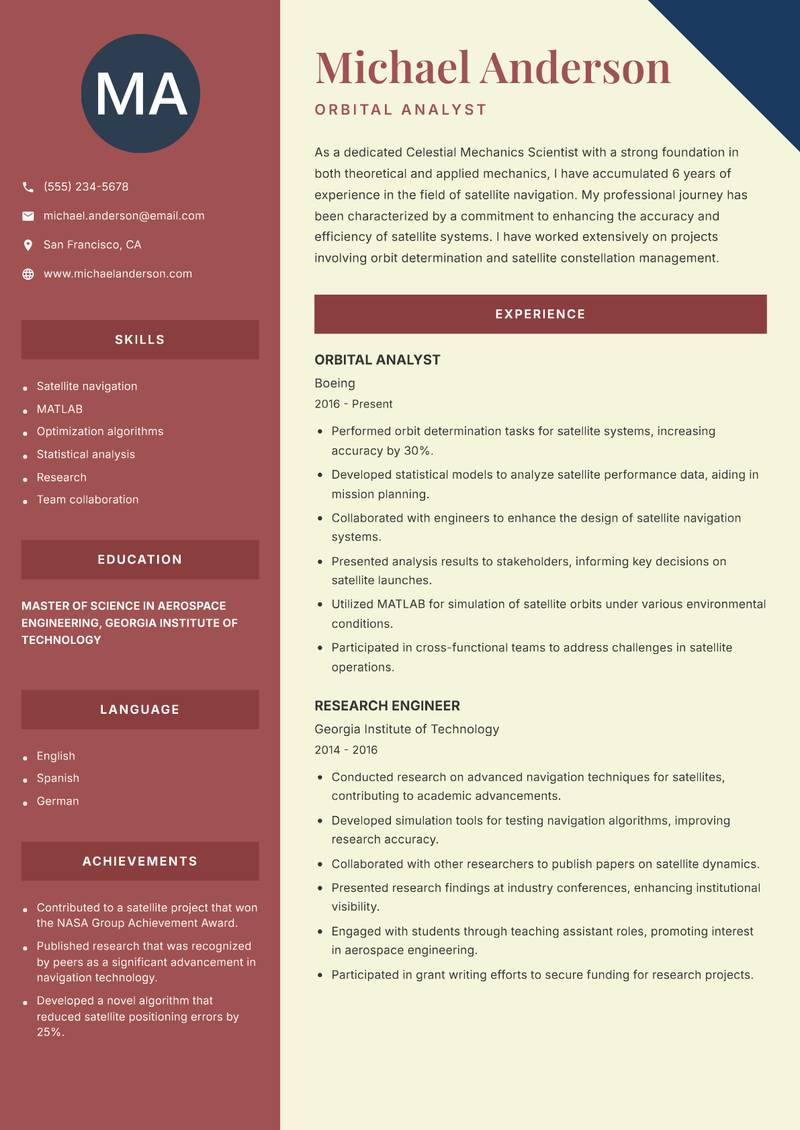
As a dedicated Celestial Mechanics Scientist with a strong foundation in both theoretical and applied mechanics, I have accumulated 6 years of experience in the field of satellite navigation. My professional journey has been characterized by a commitment to enhancing the accuracy and efficiency of satellite systems. I have worked extensively on projects involving orbit determination and satellite constellation management. My technical skills include proficiency in optimization algorithms and statistical analysis, allowing me to contribute significantly to mission success. I am adept at using software tools like MATLAB and Python for modeling and simulations. My passion for space exploration drives my desire to be at the forefront of innovative research, and I am eager to bring my expertise to a progressive organization focused on satellite technology advancements.

Satellite navigation MATLAB Optimization algorithms Statistical analysis Research Team collaboration
Celestial Mechanics Scientist Resume Preview Example
View PDF
  1. Performed orbit determination tasks for satellite systems, increasing accuracy by 30%.
  2. Developed statistical models to analyze satellite performance data, aiding in mission planning.
  3. Collaborated with engineers to enhance the design of satellite navigation systems.
  4. Presented analysis results to stakeholders, informing key decisions on satellite launches.
  5. Utilized MATLAB for simulation of satellite orbits under various environmental conditions.
  6. Participated in cross-functional teams to address challenges in satellite operations.
  1. Conducted research on advanced navigation techniques for satellites, contributing to academic advancements.
  2. Developed simulation tools for testing navigation algorithms, improving research accuracy.
  3. Collaborated with other researchers to publish papers on satellite dynamics.
  4. Presented research findings at industry conferences, enhancing institutional visibility.
  5. Engaged with students through teaching assistant roles, promoting interest in aerospace engineering.
  6. Participated in grant writing efforts to secure funding for research projects.

Achievements

  • Contributed to a satellite project that won the NASA Group Achievement Award.
  • Published research that was recognized by peers as a significant advancement in navigation technology.
  • Developed a novel algorithm that reduced satellite positioning errors by 25%.
⏱️
Experience
2-5 Years
📅
Level
Mid Level
🎓
Education
Master of Science in Aerospace...

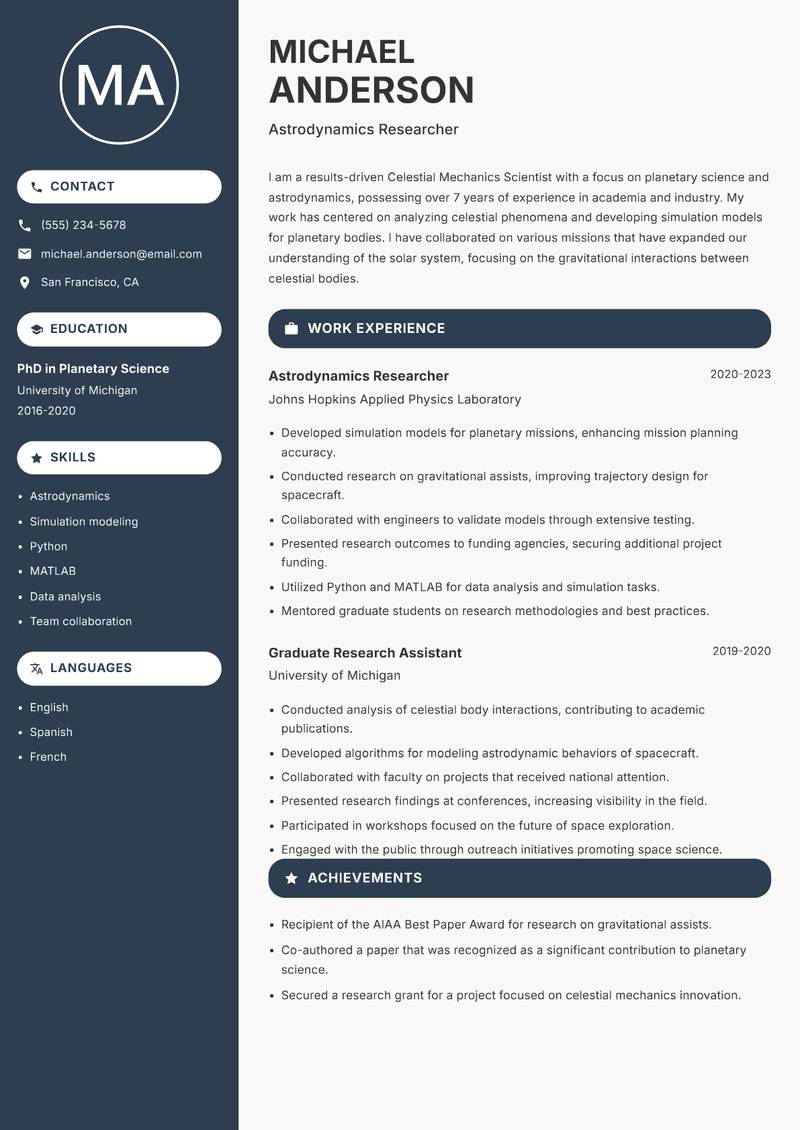
Astrodynamics Researcher Resume

I am a results-driven Celestial Mechanics Scientist with a focus on planetary science and astrodynamics, possessing over 7 years of experience in academia and industry. My work has centered on analyzing celestial phenomena and developing simulation models for planetary bodies. I have collaborated on various missions that have expanded our understanding of the solar system, focusing on the gravitational interactions between celestial bodies. My strong analytical skills, combined with my ability to communicate complex concepts clearly, have enabled me to work effectively with multidisciplinary teams. I am proficient in using simulation software and programming languages to carry out extensive data analysis. I am passionate about contributing to groundbreaking research that could lead to new discoveries in planetary science and am seeking a challenging role that allows me to explore innovative approaches to celestial mechanics.

Astrodynamics Simulation modeling Python MATLAB Data analysis Team collaboration
Celestial Mechanics Scientist Resume Preview Example
View PDF
  1. Developed simulation models for planetary missions, enhancing mission planning accuracy.
  2. Conducted research on gravitational assists, improving trajectory design for spacecraft.
  3. Collaborated with engineers to validate models through extensive testing.
  4. Presented research outcomes to funding agencies, securing additional project funding.
  5. Utilized Python and MATLAB for data analysis and simulation tasks.
  6. Mentored graduate students on research methodologies and best practices.
  1. Conducted analysis of celestial body interactions, contributing to academic publications.
  2. Developed algorithms for modeling astrodynamic behaviors of spacecraft.
  3. Collaborated with faculty on projects that received national attention.
  4. Presented research findings at conferences, increasing visibility in the field.
  5. Participated in workshops focused on the future of space exploration.
  6. Engaged with the public through outreach initiatives promoting space science.

Achievements

  • Recipient of the AIAA Best Paper Award for research on gravitational assists.
  • Co-authored a paper that was recognized as a significant contribution to planetary science.
  • Secured a research grant for a project focused on celestial mechanics innovation.
⏱️
Experience
2-5 Years
📅
Level
Mid Level
🎓
Education
PhD in Planetary Science, Univ...

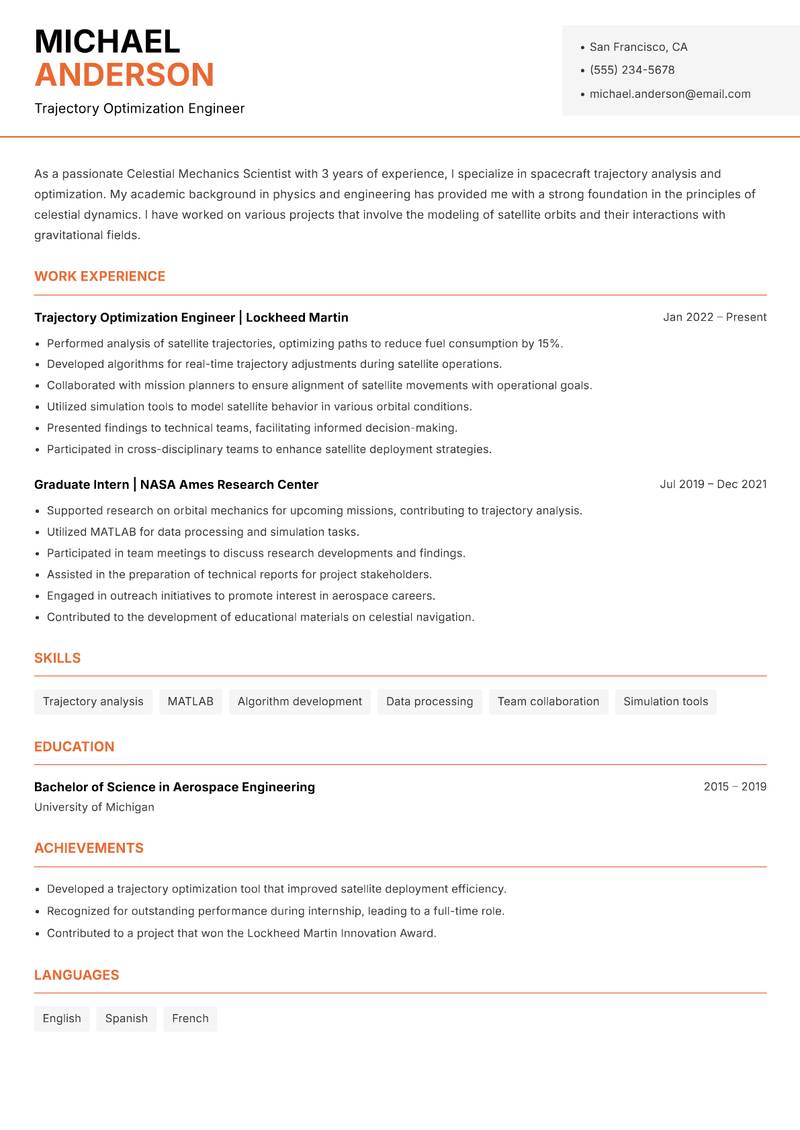
Trajectory Optimization Engineer Resume

As a passionate Celestial Mechanics Scientist with 3 years of experience, I specialize in spacecraft trajectory analysis and optimization. My academic background in physics and engineering has provided me with a strong foundation in the principles of celestial dynamics. I have worked on various projects that involve the modeling of satellite orbits and their interactions with gravitational fields. My technical skills include proficiency in simulation software and programming languages, allowing me to develop efficient algorithms for trajectory optimization. I am motivated by the challenge of working in a fast-paced environment and thrive in collaborative teams. I am eager to contribute my skills to a dynamic organization focused on advancing space exploration technologies.

Trajectory analysis MATLAB Algorithm development Data processing Team collaboration Simulation tools
Celestial Mechanics Scientist Resume Preview Example
View PDF
  1. Performed analysis of satellite trajectories, optimizing paths to reduce fuel consumption by 15%.
  2. Developed algorithms for real-time trajectory adjustments during satellite operations.
  3. Collaborated with mission planners to ensure alignment of satellite movements with operational goals.
  4. Utilized simulation tools to model satellite behavior in various orbital conditions.
  5. Presented findings to technical teams, facilitating informed decision-making.
  6. Participated in cross-disciplinary teams to enhance satellite deployment strategies.
  1. Supported research on orbital mechanics for upcoming missions, contributing to trajectory analysis.
  2. Utilized MATLAB for data processing and simulation tasks.
  3. Participated in team meetings to discuss research developments and findings.
  4. Assisted in the preparation of technical reports for project stakeholders.
  5. Engaged in outreach initiatives to promote interest in aerospace careers.
  6. Contributed to the development of educational materials on celestial navigation.

Achievements

  • Developed a trajectory optimization tool that improved satellite deployment efficiency.
  • Recognized for outstanding performance during internship, leading to a full-time role.
  • Contributed to a project that won the Lockheed Martin Innovation Award.
⏱️
Experience
2-5 Years
📅
Level
Mid Level
🎓
Education
Bachelor of Science in Aerospa...

Key Skills for Celestial Mechanics Scientist Positions

Resume Tips for Celestial Mechanics Scientist Applications

Strong Action Verbs for Celestial Mechanics Scientist Resumes

Launched · Modeled · Analyzed · Designed · Operated · Published · Tracked · Calibrated · Simulated · Investigated · Achieved · Administered · Architected · Assessed

Common Mistakes to Avoid

Experience Levels

How to Write a Celestial Mechanics Scientist Resume

Browse Celestial Mechanics Scientist resume examples built around astrophysics & cosmological analysis, tailored for Space Sciences roles.

A strong Celestial Mechanics Scientist resume leads with a focused professional summary that names the exact role and your standout achievement. In the experience section, open every bullet with a strong action verb and quantify the result with numbers wherever possible. Highlight your most relevant competencies — especially Orbital Mechanics & Mission Design, Astrophysics & Cosmological Analysis, and Satellite Design & Systems Engineering — in a dedicated Skills section positioned early so ATS systems and hiring managers both find it immediately.

For format, most Celestial Mechanics Scientist roles suit a reverse-chronological layout: most recent position first, working backwards. Keep to one page for under five years of experience, or two pages for senior candidates with a rich project or leadership history. Use clean, ATS-safe fonts (10–12pt), standard section headings (Summary, Experience, Education, Skills), and avoid tables, text boxes, or multi-column layouts that applicant tracking systems cannot parse reliably.
Frequently Asked Questions

What makes a strong Celestial Mechanics Scientist resume stand out to employers?

A standout Celestial Mechanics Scientist resume combines role-specific skills with quantified achievements. Name the exact job title in your professional summary, mirror keywords from each job posting, and open every bullet point with a strong action verb followed by a measurable result. Certifications, tools, and domain experience specific to celestial mechanics scientist roles should appear prominently near the top.

What skills are most important to include on a Space Sciences resume?

Recruiters hiring in Space Sciences consistently look for Orbital Mechanics & Mission Design, Astrophysics & Cosmological Analysis, Satellite Design & Systems Engineering, Remote Sensing & Earth Observation. List these in a dedicated Skills section near the top so both ATS systems and human reviewers spot them fast. Mirror the exact phrasing from each job posting wherever possible — many applicant tracking systems match literal strings rather than synonyms.

What is the best resume format for Space Sciences professionals?

A reverse-chronological format is the standard choice for most Space Sciences candidates — employers expect to see your most recent role first, working backwards. If you are transitioning into Space Sciences from a related field, a hybrid format (brief skills summary at the top followed by chronological experience) can bridge the gap effectively. Keep the document to one page for under five years of experience, or two pages for senior specialists.

How do I make my Space Sciences resume pass applicant tracking systems (ATS)?

Use standard section headings — Summary, Experience, Education, Skills — rather than creative labels that ATS parsers do not recognise. Embed domain keywords such as "Orbital Mechanics & Mission Design" and "Astrophysics & Cosmological Analysis" naturally inside your experience bullets rather than cramming them into a standalone keyword list. Avoid tables, multi-column layouts, text boxes, headers, footers, and images — these confuse most modern parsers and can cause your resume to be misread or rejected before a human sees it.

What mistakes do Space Sciences professionals most commonly make on their resume?

The most frequent issue is not naming specific missions or programs — generic space science experience is far less compelling. Beyond that, generic objective statements, unquantified achievements, and inconsistent date formatting appear across almost every Space Sciences application. Fix these by replacing every vague claim with a measurable outcome — specific numbers and named projects add credibility that adjectives cannot.

How long should a Space Sciences resume be?

One page is appropriate for candidates with under five years of relevant Space Sciences experience. Two pages are acceptable — and sometimes expected — for senior specialists, managers, or professionals with a strong portfolio of projects, publications, or credentials. Avoid padding to reach a page count: every line should directly support your application for the specific role you are targeting.

Should I include a professional summary at the top of my Space Sciences resume?

Yes — a two to three sentence summary is the first section most recruiters read. Open with your title and years of Space Sciences experience, then name your most relevant achievement or specialisation. One proven approach: Named mission involvement (e.g., Hubble, James Webb, Sentinel) is the gold standard credential — lead with it — this level of specificity signals genuine expertise before a recruiter reaches your experience section.

Scroll to view samples