Clinical Mental Health Researcher Resume

These Clinical Mental Health Researcher resume samples are designed to help you write a resume that gets noticed by hiring managers and passes applicant tracking systems (ATS) in Mental Health. Each example shows real formatting, section structure, and language you can adapt to your own background. When writing your own Clinical Mental Health Researcher resume, focus on highlighting Evidence-Based psychotherapy (CBT, DBT, ACT, EMDR), psychiatric assessment & diagnosis (DSM-5, ICD-11) and crisis intervention & risk assessment. Recruiters scan for these qualifications first, so they should appear early in your summary and experience sections. Use strong action verbs such as "assessed", "treated", "facilitated", "coordinated" to describe your achievements, and quantify your impact wherever possible — percentages, dollar amounts, or time saved make your resume more convincing. A common mistake to avoid: writing a generic objective statement instead of a targeted clinical mental health researcher professional summary. Tailor your resume to each Clinical Mental Health Researcher position you apply for rather than using one generic version.

Clinical Mental Health Researcher Resume Template
View PDF
0.0 (0 ratings)

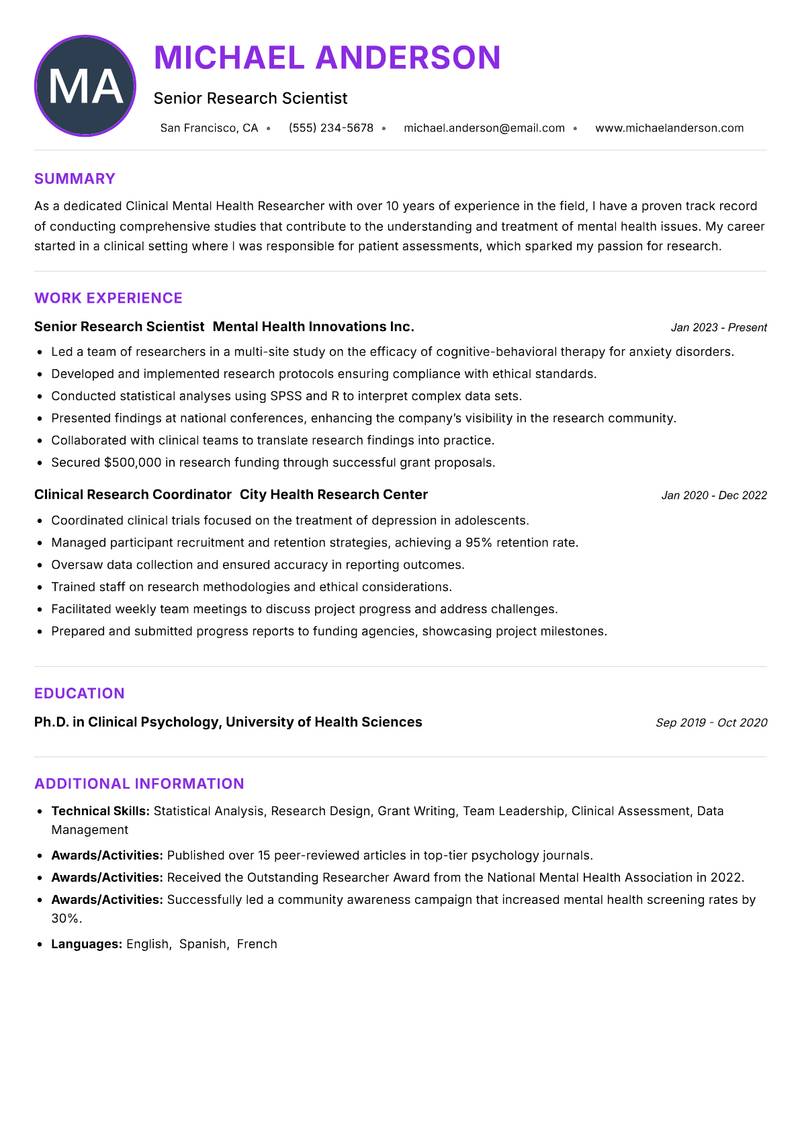
Senior Research Scientist Resume

As a dedicated Clinical Mental Health Researcher with over 10 years of experience in the field, I have a proven track record of conducting comprehensive studies that contribute to the understanding and treatment of mental health issues. My career started in a clinical setting where I was responsible for patient assessments, which sparked my passion for research. I transitioned into academic research, focusing on the impacts of various therapies on mental health outcomes. I have authored multiple peer-reviewed publications and presented my findings at international conferences. My strong analytical skills, combined with my ability to collaborate with interdisciplinary teams, have enabled me to lead successful research projects that have influenced clinical practice. I am proficient in statistical analysis software and have experience in grant writing, securing funding for innovative mental health initiatives. With a commitment to improving mental health services, I aim to advance knowledge in this vital area through rigorous research and community engagement.

Statistical Analysis Research Design Grant Writing Team Leadership Clinical Assessment Data Management
Clinical Mental Health Researcher Resume Preview Example
View PDF
  1. Led a team of researchers in a multi-site study on the efficacy of cognitive-behavioral therapy for anxiety disorders.
  2. Developed and implemented research protocols ensuring compliance with ethical standards.
  3. Conducted statistical analyses using SPSS and R to interpret complex data sets.
  4. Presented findings at national conferences, enhancing the company’s visibility in the research community.
  5. Collaborated with clinical teams to translate research findings into practice.
  6. Secured $500,000 in research funding through successful grant proposals.
  1. Coordinated clinical trials focused on the treatment of depression in adolescents.
  2. Managed participant recruitment and retention strategies, achieving a 95% retention rate.
  3. Oversaw data collection and ensured accuracy in reporting outcomes.
  4. Trained staff on research methodologies and ethical considerations.
  5. Facilitated weekly team meetings to discuss project progress and address challenges.
  6. Prepared and submitted progress reports to funding agencies, showcasing project milestones.

Achievements

  • Published over 15 peer-reviewed articles in top-tier psychology journals.
  • Received the Outstanding Researcher Award from the National Mental Health Association in 2022.
  • Successfully led a community awareness campaign that increased mental health screening rates by 30%.
⏱️
Experience
2-5 Years
📅
Level
Mid Level
🎓
Education
Ph.D. in Clinical Psychology, ...

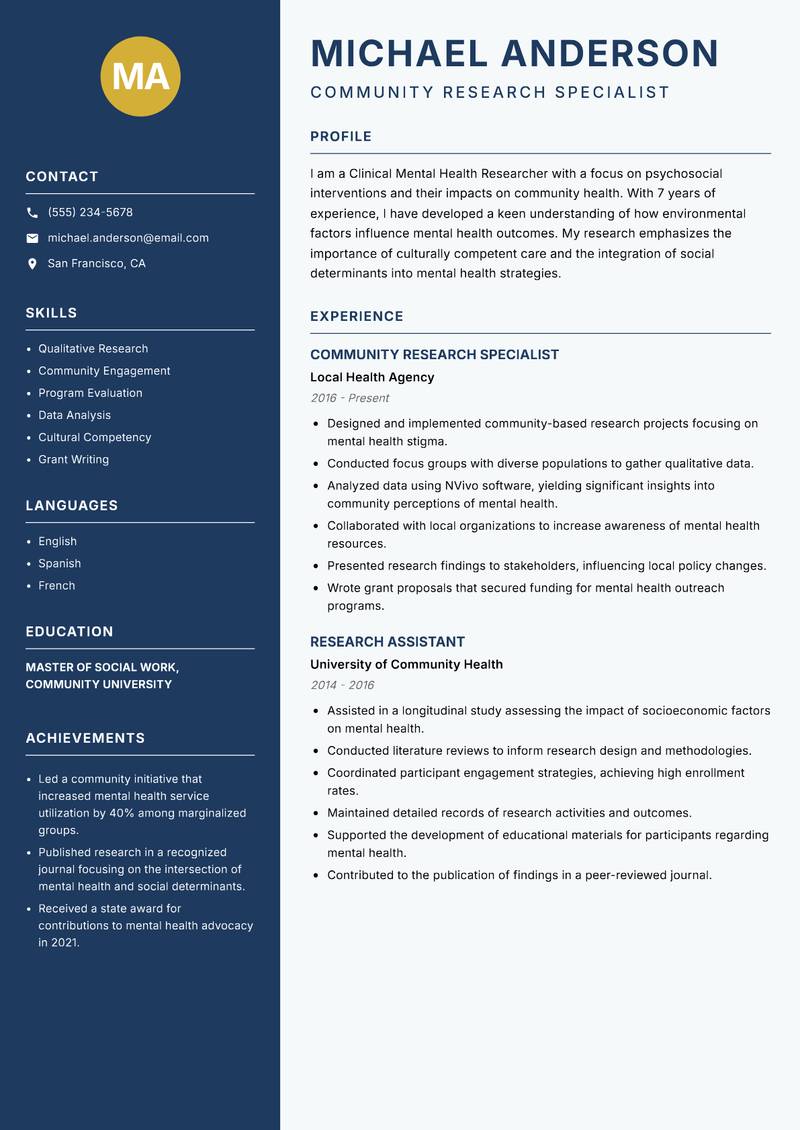
Community Research Specialist Resume

I am a Clinical Mental Health Researcher with a focus on psychosocial interventions and their impacts on community health. With 7 years of experience, I have developed a keen understanding of how environmental factors influence mental health outcomes. My research emphasizes the importance of culturally competent care and the integration of social determinants into mental health strategies. I have successfully conducted studies that evaluate the effectiveness of community-based programs aimed at reducing stigma and improving access to mental health services. My background in social work complements my research, enabling me to engage effectively with diverse populations. I am skilled in qualitative research methodologies, utilizing interviews and focus groups to gather in-depth data. My goal is to bridge the gap between research and practice, advocating for policies that support mental health initiatives at the community level.

Qualitative Research Community Engagement Program Evaluation Data Analysis Cultural Competency Grant Writing
Clinical Mental Health Researcher Resume Preview Example
View PDF
  1. Designed and implemented community-based research projects focusing on mental health stigma.
  2. Conducted focus groups with diverse populations to gather qualitative data.
  3. Analyzed data using NVivo software, yielding significant insights into community perceptions of mental health.
  4. Collaborated with local organizations to increase awareness of mental health resources.
  5. Presented research findings to stakeholders, influencing local policy changes.
  6. Wrote grant proposals that secured funding for mental health outreach programs.
  1. Assisted in a longitudinal study assessing the impact of socioeconomic factors on mental health.
  2. Conducted literature reviews to inform research design and methodologies.
  3. Coordinated participant engagement strategies, achieving high enrollment rates.
  4. Maintained detailed records of research activities and outcomes.
  5. Supported the development of educational materials for participants regarding mental health.
  6. Contributed to the publication of findings in a peer-reviewed journal.

Achievements

  • Led a community initiative that increased mental health service utilization by 40% among marginalized groups.
  • Published research in a recognized journal focusing on the intersection of mental health and social determinants.
  • Received a state award for contributions to mental health advocacy in 2021.
⏱️
Experience
2-5 Years
📅
Level
Mid Level
🎓
Education
Master of Social Work, Communi...

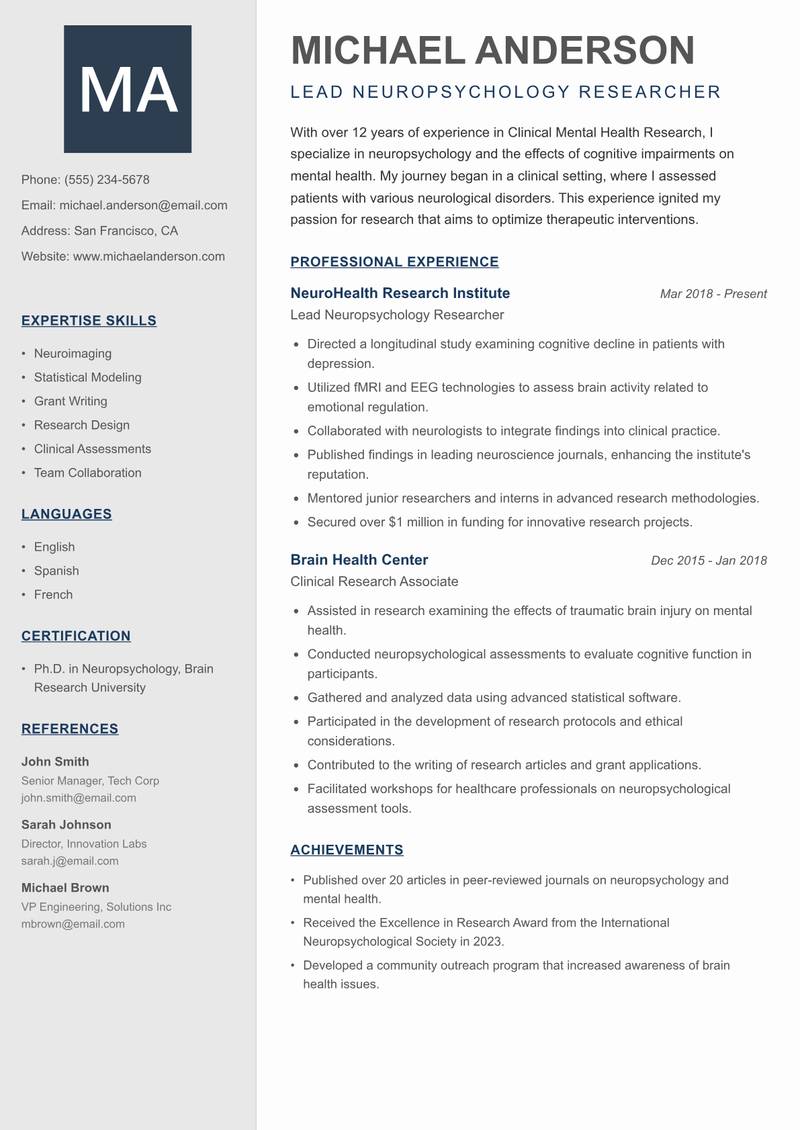
Lead Neuropsychology Researcher Resume

With over 12 years of experience in Clinical Mental Health Research, I specialize in neuropsychology and the effects of cognitive impairments on mental health. My journey began in a clinical setting, where I assessed patients with various neurological disorders. This experience ignited my passion for research that aims to optimize therapeutic interventions. I have successfully led multiple NIH-funded studies that investigate the relationship between brain function and mental health outcomes. As a result, I have published extensively in high-impact journals and presented my findings at international neuroscience conferences. My research not only advances academic knowledge but also has practical implications for treatment protocols in clinical settings. I possess advanced skills in neuroimaging techniques and statistical modeling, making me an asset in any research team focused on mental health.

Neuroimaging Statistical Modeling Grant Writing Research Design Clinical Assessments Team Collaboration
Clinical Mental Health Researcher Resume Preview Example
View PDF
  1. Directed a longitudinal study examining cognitive decline in patients with depression.
  2. Utilized fMRI and EEG technologies to assess brain activity related to emotional regulation.
  3. Collaborated with neurologists to integrate findings into clinical practice.
  4. Published findings in leading neuroscience journals, enhancing the institute's reputation.
  5. Mentored junior researchers and interns in advanced research methodologies.
  6. Secured over $1 million in funding for innovative research projects.
  1. Assisted in research examining the effects of traumatic brain injury on mental health.
  2. Conducted neuropsychological assessments to evaluate cognitive function in participants.
  3. Gathered and analyzed data using advanced statistical software.
  4. Participated in the development of research protocols and ethical considerations.
  5. Contributed to the writing of research articles and grant applications.
  6. Facilitated workshops for healthcare professionals on neuropsychological assessment tools.

Achievements

  • Published over 20 articles in peer-reviewed journals on neuropsychology and mental health.
  • Received the Excellence in Research Award from the International Neuropsychological Society in 2023.
  • Developed a community outreach program that increased awareness of brain health issues.
⏱️
Experience
2-5 Years
📅
Level
Mid Level
🎓
Education
Ph.D. in Neuropsychology, Brai...

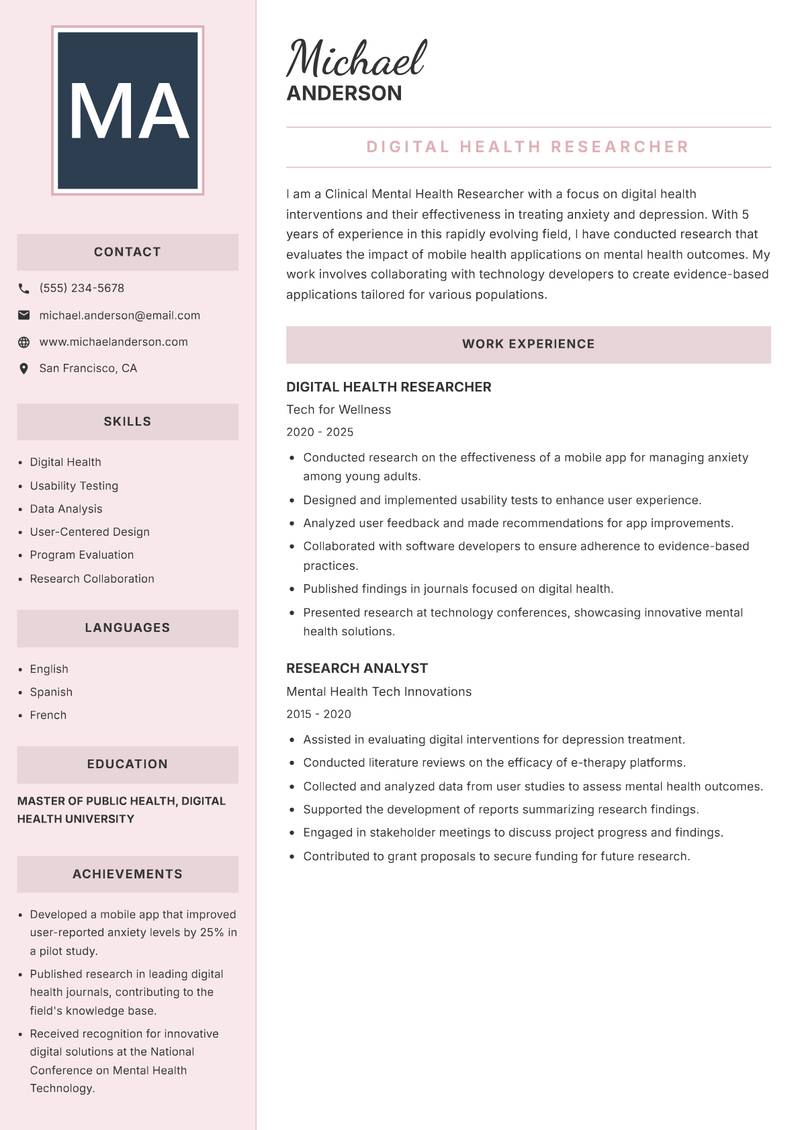
Digital Health Researcher Resume

I am a Clinical Mental Health Researcher with a focus on digital health interventions and their effectiveness in treating anxiety and depression. With 5 years of experience in this rapidly evolving field, I have conducted research that evaluates the impact of mobile health applications on mental health outcomes. My work involves collaborating with technology developers to create evidence-based applications tailored for various populations. I excel in usability testing and user-centered design, ensuring that digital interventions are accessible and effective. I am passionate about leveraging technology to improve mental health services, making them more accessible to underserved communities. My goal is to continue innovating in the digital health space by conducting rigorous research that informs best practices and guides future developments in mental health technology.

Digital Health Usability Testing Data Analysis User-Centered Design Program Evaluation Research Collaboration
Clinical Mental Health Researcher Resume Preview Example
View PDF
  1. Conducted research on the effectiveness of a mobile app for managing anxiety among young adults.
  2. Designed and implemented usability tests to enhance user experience.
  3. Analyzed user feedback and made recommendations for app improvements.
  4. Collaborated with software developers to ensure adherence to evidence-based practices.
  5. Published findings in journals focused on digital health.
  6. Presented research at technology conferences, showcasing innovative mental health solutions.
  1. Assisted in evaluating digital interventions for depression treatment.
  2. Conducted literature reviews on the efficacy of e-therapy platforms.
  3. Collected and analyzed data from user studies to assess mental health outcomes.
  4. Supported the development of reports summarizing research findings.
  5. Engaged in stakeholder meetings to discuss project progress and findings.
  6. Contributed to grant proposals to secure funding for future research.

Achievements

  • Developed a mobile app that improved user-reported anxiety levels by 25% in a pilot study.
  • Published research in leading digital health journals, contributing to the field's knowledge base.
  • Received recognition for innovative digital solutions at the National Conference on Mental Health Technology.
⏱️
Experience
2-5 Years
📅
Level
Mid Level
🎓
Education
Master of Public Health, Digit...

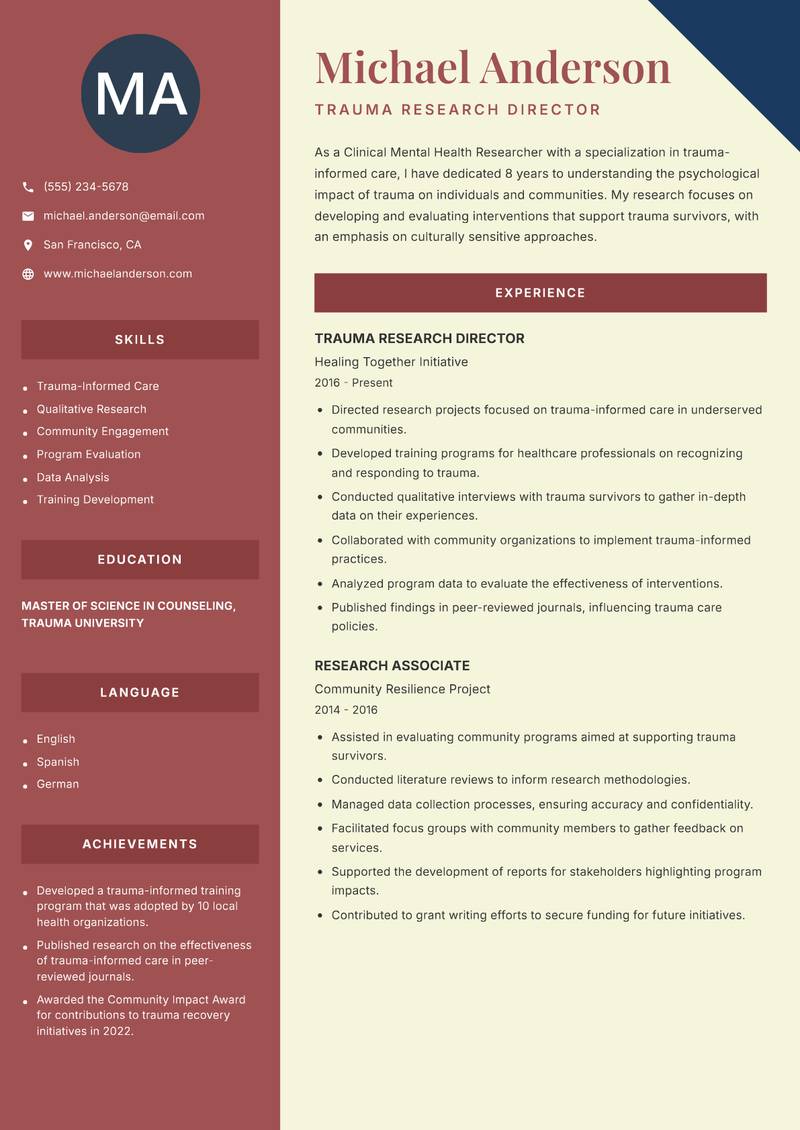
Trauma Research Director Resume

As a Clinical Mental Health Researcher with a specialization in trauma-informed care, I have dedicated 8 years to understanding the psychological impact of trauma on individuals and communities. My research focuses on developing and evaluating interventions that support trauma survivors, with an emphasis on culturally sensitive approaches. I have successfully led projects that provide training for healthcare providers on trauma-informed practices, ensuring that mental health services are responsive to the needs of trauma-affected populations. My commitment to community engagement is evident in my work, where I actively collaborate with local organizations to foster environments of healing and recovery. My skills in qualitative research and program evaluation enable me to assess the effectiveness of interventions, ultimately contributing to improved mental health outcomes for vulnerable groups.

Trauma-Informed Care Qualitative Research Community Engagement Program Evaluation Data Analysis Training Development
Clinical Mental Health Researcher Resume Preview Example
View PDF
  1. Directed research projects focused on trauma-informed care in underserved communities.
  2. Developed training programs for healthcare professionals on recognizing and responding to trauma.
  3. Conducted qualitative interviews with trauma survivors to gather in-depth data on their experiences.
  4. Collaborated with community organizations to implement trauma-informed practices.
  5. Analyzed program data to evaluate the effectiveness of interventions.
  6. Published findings in peer-reviewed journals, influencing trauma care policies.
  1. Assisted in evaluating community programs aimed at supporting trauma survivors.
  2. Conducted literature reviews to inform research methodologies.
  3. Managed data collection processes, ensuring accuracy and confidentiality.
  4. Facilitated focus groups with community members to gather feedback on services.
  5. Supported the development of reports for stakeholders highlighting program impacts.
  6. Contributed to grant writing efforts to secure funding for future initiatives.

Achievements

  • Developed a trauma-informed training program that was adopted by 10 local health organizations.
  • Published research on the effectiveness of trauma-informed care in peer-reviewed journals.
  • Awarded the Community Impact Award for contributions to trauma recovery initiatives in 2022.
⏱️
Experience
2-5 Years
📅
Level
Mid Level
🎓
Education
Master of Science in Counselin...

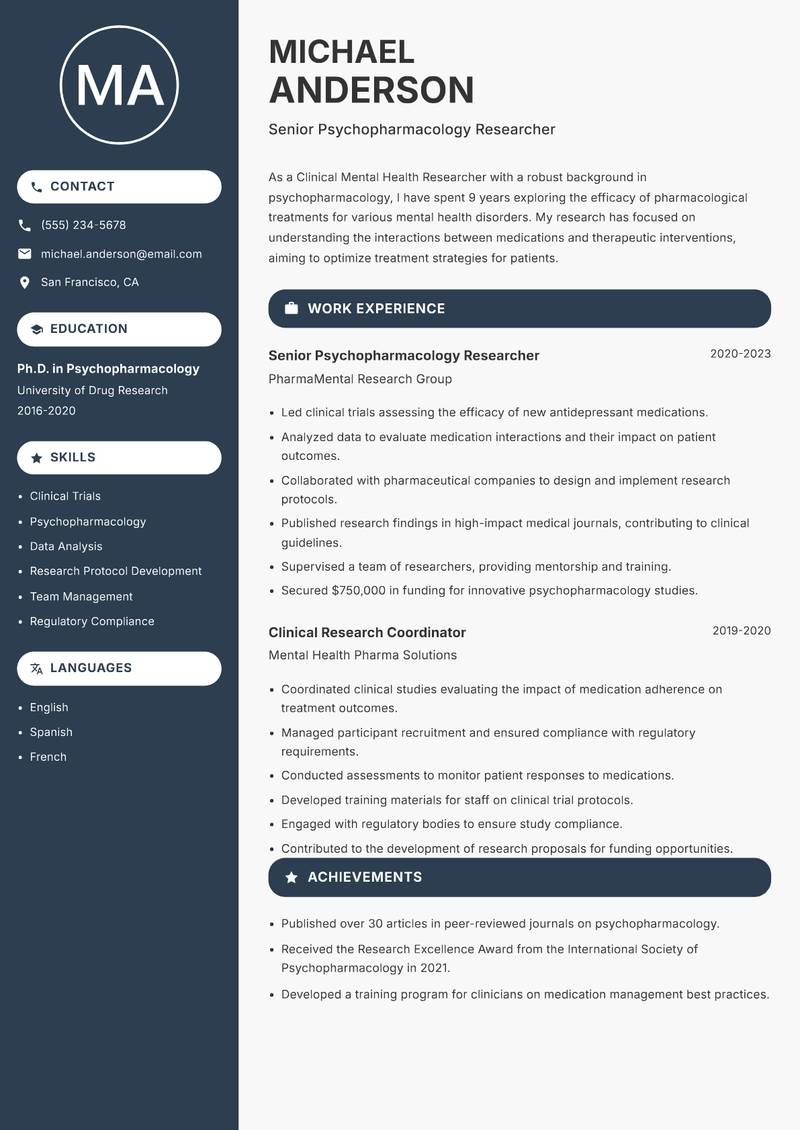
Senior Psychopharmacology Researcher Resume

As a Clinical Mental Health Researcher with a robust background in psychopharmacology, I have spent 9 years exploring the efficacy of pharmacological treatments for various mental health disorders. My research has focused on understanding the interactions between medications and therapeutic interventions, aiming to optimize treatment strategies for patients. I have led studies that investigate the impact of medication adherence on treatment outcomes, and my work has been instrumental in developing guidelines for best practices in medication management. My expertise in clinical trials has enabled me to collaborate effectively with pharmaceutical companies and regulatory bodies, ensuring compliance with industry standards. I am dedicated to advancing the field of psychopharmacology through rigorous research and a commitment to patient-centered care.

Clinical Trials Psychopharmacology Data Analysis Research Protocol Development Team Management Regulatory Compliance
Clinical Mental Health Researcher Resume Preview Example
View PDF
  1. Led clinical trials assessing the efficacy of new antidepressant medications.
  2. Analyzed data to evaluate medication interactions and their impact on patient outcomes.
  3. Collaborated with pharmaceutical companies to design and implement research protocols.
  4. Published research findings in high-impact medical journals, contributing to clinical guidelines.
  5. Supervised a team of researchers, providing mentorship and training.
  6. Secured $750,000 in funding for innovative psychopharmacology studies.
  1. Coordinated clinical studies evaluating the impact of medication adherence on treatment outcomes.
  2. Managed participant recruitment and ensured compliance with regulatory requirements.
  3. Conducted assessments to monitor patient responses to medications.
  4. Developed training materials for staff on clinical trial protocols.
  5. Engaged with regulatory bodies to ensure study compliance.
  6. Contributed to the development of research proposals for funding opportunities.

Achievements

  • Published over 30 articles in peer-reviewed journals on psychopharmacology.
  • Received the Research Excellence Award from the International Society of Psychopharmacology in 2021.
  • Developed a training program for clinicians on medication management best practices.
⏱️
Experience
2-5 Years
📅
Level
Mid Level
🎓
Education
Ph.D. in Psychopharmacology, U...

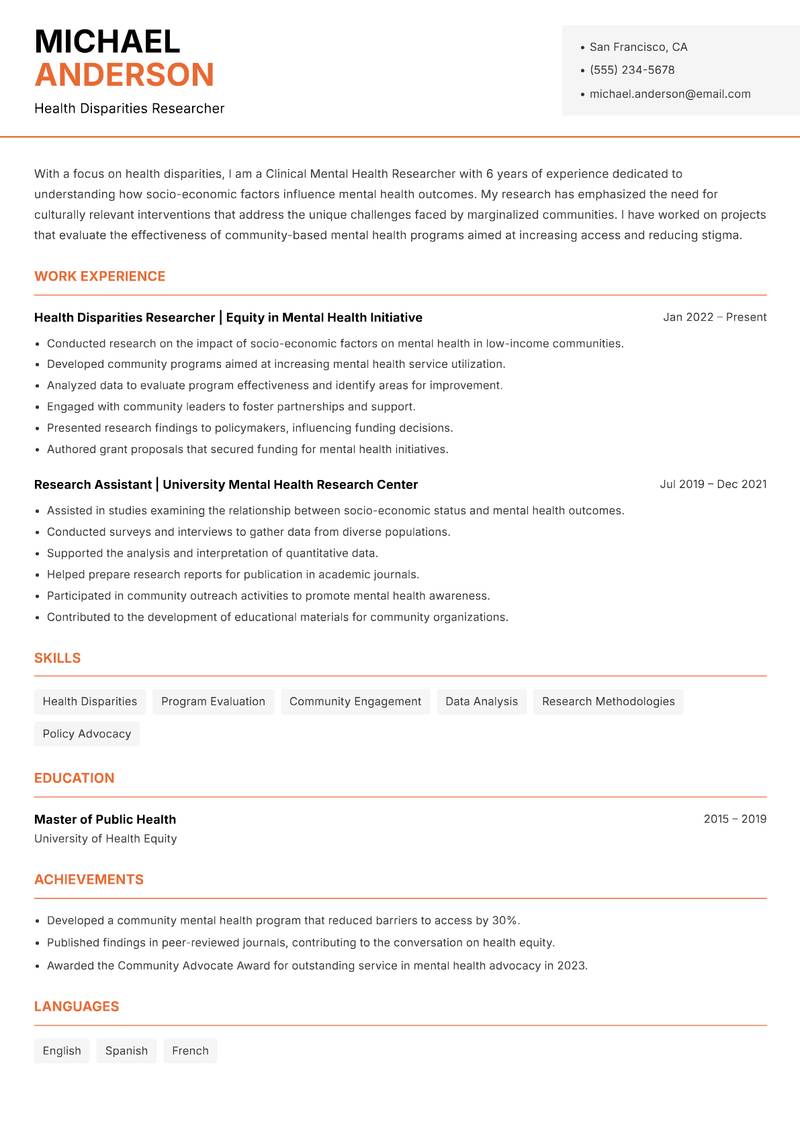
Health Disparities Researcher Resume

With a focus on health disparities, I am a Clinical Mental Health Researcher with 6 years of experience dedicated to understanding how socio-economic factors influence mental health outcomes. My research has emphasized the need for culturally relevant interventions that address the unique challenges faced by marginalized communities. I have worked on projects that evaluate the effectiveness of community-based mental health programs aimed at increasing access and reducing stigma. My efforts have contributed to the creation of policies that support mental health initiatives at the local and state levels. I am skilled in both qualitative and quantitative research methodologies, allowing me to gather comprehensive data that informs effective interventions. My goal is to continue advocating for mental health equity and improving services for underserved populations.

Health Disparities Program Evaluation Community Engagement Data Analysis Research Methodologies Policy Advocacy
Clinical Mental Health Researcher Resume Preview Example
View PDF
  1. Conducted research on the impact of socio-economic factors on mental health in low-income communities.
  2. Developed community programs aimed at increasing mental health service utilization.
  3. Analyzed data to evaluate program effectiveness and identify areas for improvement.
  4. Engaged with community leaders to foster partnerships and support.
  5. Presented research findings to policymakers, influencing funding decisions.
  6. Authored grant proposals that secured funding for mental health initiatives.
  1. Assisted in studies examining the relationship between socio-economic status and mental health outcomes.
  2. Conducted surveys and interviews to gather data from diverse populations.
  3. Supported the analysis and interpretation of quantitative data.
  4. Helped prepare research reports for publication in academic journals.
  5. Participated in community outreach activities to promote mental health awareness.
  6. Contributed to the development of educational materials for community organizations.

Achievements

  • Developed a community mental health program that reduced barriers to access by 30%.
  • Published findings in peer-reviewed journals, contributing to the conversation on health equity.
  • Awarded the Community Advocate Award for outstanding service in mental health advocacy in 2023.
⏱️
Experience
2-5 Years
📅
Level
Mid Level
🎓
Education
Master of Public Health, Unive...

Key Skills for Clinical Mental Health Researcher Positions

Resume Tips for Clinical Mental Health Researcher Applications

Strong Action Verbs for Clinical Mental Health Researcher Resumes

Assessed · Treated · Facilitated · Coordinated · Supervised · Documented · Intervened · Advocated · Therapized · Consulted · Achieved · Administered · Analyzed · Architected

Common Mistakes to Avoid

Experience Levels

How to Write a Clinical Mental Health Researcher Resume

Browse Clinical Mental Health Researcher resume examples built around Evidence-Based psychotherapy (CBT, DBT, ACT, EMDR), tailored for Mental Health roles.

A strong Clinical Mental Health Researcher resume leads with a focused professional summary that names the exact role and your standout achievement. In the experience section, open every bullet with a strong action verb and quantify the result with numbers wherever possible. Highlight your most relevant competencies — especially Evidence-Based Psychotherapy (CBT, DBT, ACT, EMDR), Psychiatric Assessment & Diagnosis (DSM-5, ICD-11), and Crisis Intervention & Risk Assessment — in a dedicated Skills section positioned early so ATS systems and hiring managers both find it immediately.

For format, most Clinical Mental Health Researcher roles suit a reverse-chronological layout: most recent position first, working backwards. Keep to one page for under five years of experience, or two pages for senior candidates with a rich project or leadership history. Use clean, ATS-safe fonts (10–12pt), standard section headings (Summary, Experience, Education, Skills), and avoid tables, text boxes, or multi-column layouts that applicant tracking systems cannot parse reliably.
Frequently Asked Questions

What makes a strong Clinical Mental Health Researcher resume stand out to employers?

A standout Clinical Mental Health Researcher resume combines role-specific skills with quantified achievements. Name the exact job title in your professional summary, mirror keywords from each job posting, and open every bullet point with a strong action verb followed by a measurable result. Certifications, tools, and domain experience specific to clinical mental health researcher roles should appear prominently near the top.

What skills are most important to include on a Mental Health resume?

Recruiters hiring in Mental Health consistently look for Evidence-Based Psychotherapy (CBT, DBT, ACT, EMDR), Psychiatric Assessment & Diagnosis (DSM-5, ICD-11), Crisis Intervention & Risk Assessment, Case Management & Care Coordination. List these in a dedicated Skills section near the top so both ATS systems and human reviewers spot them fast. Mirror the exact phrasing from each job posting wherever possible — many applicant tracking systems match literal strings rather than synonyms.

What is the best resume format for Mental Health professionals?

A reverse-chronological format is the standard choice for most Mental Health candidates — employers expect to see your most recent role first, working backwards. If you are transitioning into Mental Health from a related field, a hybrid format (brief skills summary at the top followed by chronological experience) can bridge the gap effectively. Keep the document to one page for under five years of experience, or two pages for senior specialists.

How do I make my Mental Health resume pass applicant tracking systems (ATS)?

Use standard section headings — Summary, Experience, Education, Skills — rather than creative labels that ATS parsers do not recognise. Embed domain keywords such as "Evidence-Based Psychotherapy (CBT, DBT, ACT, EMDR)" and "Psychiatric Assessment & Diagnosis (DSM-5, ICD-11)" naturally inside your experience bullets rather than cramming them into a standalone keyword list. Avoid tables, multi-column layouts, text boxes, headers, footers, and images — these confuse most modern parsers and can cause your resume to be misread or rejected before a human sees it.

What mistakes do Mental Health professionals most commonly make on their resume?

The most frequent issue is omitting licensure details — scope of practice varies enormously by credential, so employers need this. Beyond that, generic objective statements, unquantified achievements, and inconsistent date formatting appear across almost every Mental Health application. Fix these by replacing every vague claim with a measurable outcome — specific numbers and named projects add credibility that adjectives cannot.

How long should a Mental Health resume be?

One page is appropriate for candidates with under five years of relevant Mental Health experience. Two pages are acceptable — and sometimes expected — for senior specialists, managers, or professionals with a strong portfolio of projects, publications, or credentials. Avoid padding to reach a page count: every line should directly support your application for the specific role you are targeting.

Should I include a professional summary at the top of my Mental Health resume?

Yes — a two to three sentence summary is the first section most recruiters read. Open with your title and years of Mental Health experience, then name your most relevant achievement or specialisation. One proven approach: Lead with licensure: LCSW, LPC, PhD, PsyD, MBBCh (Psychiatry) — it determines your legal scope of practice — this level of specificity signals genuine expertise before a recruiter reaches your experience section.

Scroll to view samples