Cognitive Science Researcher Resume

These Cognitive Science Researcher resume samples are designed to help you write a resume that gets noticed by hiring managers and passes applicant tracking systems (ATS) in Behavioral Sciences. Each example shows real formatting, section structure, and language you can adapt to your own background. When writing your own Cognitive Science Researcher resume, focus on highlighting research design (Experimental, survey, ethnographic), statistical analysis (SPSS, r, python) and psychological assessment & testing. Recruiters scan for these qualifications first, so they should appear early in your summary and experience sections. Use strong action verbs such as "researched", "analyzed", "designed", "published" to describe your achievements, and quantify your impact wherever possible — percentages, dollar amounts, or time saved make your resume more convincing. A common mistake to avoid: writing a generic objective statement instead of a targeted cognitive science researcher professional summary. Tailor your resume to each Cognitive Science Researcher position you apply for rather than using one generic version.

Cognitive Science Researcher Resume Template
View PDF
0.0 (0 ratings)

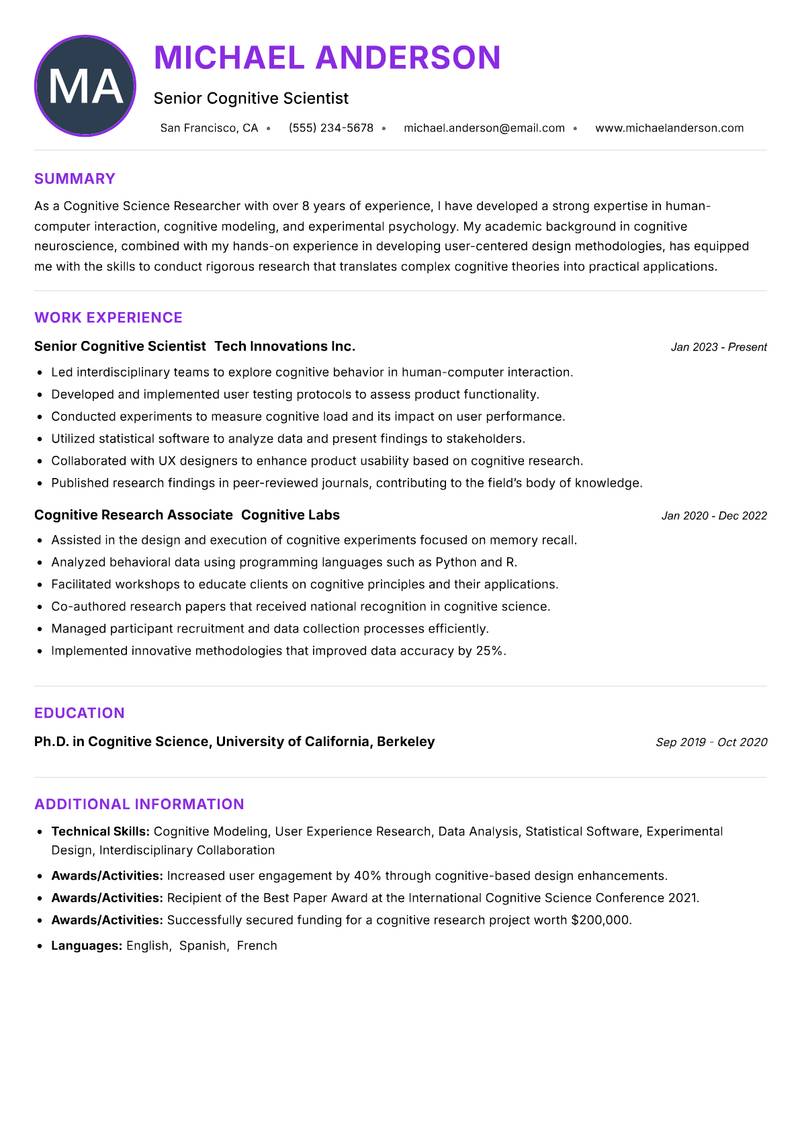
Senior Cognitive Scientist Resume

As a Cognitive Science Researcher with over 8 years of experience, I have developed a strong expertise in human-computer interaction, cognitive modeling, and experimental psychology. My academic background in cognitive neuroscience, combined with my hands-on experience in developing user-centered design methodologies, has equipped me with the skills to conduct rigorous research that translates complex cognitive theories into practical applications. I have collaborated with multidisciplinary teams to design and execute experiments that inform the development of educational software and cognitive training programs. My previous role at a leading tech firm involved analyzing user behavior to enhance product usability, leading to a significant increase in user engagement. My commitment to advancing the field of cognitive science drives my passion for research and innovation, making me a valuable asset to any organization focused on understanding and improving cognitive processes. I am eager to contribute my skills to projects that push the boundaries of cognitive science and its applications in technology.

Cognitive Modeling User Experience Research Data Analysis Statistical Software Experimental Design Interdisciplinary Collaboration
Cognitive Science Researcher Resume Preview Example
View PDF
  1. Led interdisciplinary teams to explore cognitive behavior in human-computer interaction.
  2. Developed and implemented user testing protocols to assess product functionality.
  3. Conducted experiments to measure cognitive load and its impact on user performance.
  4. Utilized statistical software to analyze data and present findings to stakeholders.
  5. Collaborated with UX designers to enhance product usability based on cognitive research.
  6. Published research findings in peer-reviewed journals, contributing to the field’s body of knowledge.
  1. Assisted in the design and execution of cognitive experiments focused on memory recall.
  2. Analyzed behavioral data using programming languages such as Python and R.
  3. Facilitated workshops to educate clients on cognitive principles and their applications.
  4. Co-authored research papers that received national recognition in cognitive science.
  5. Managed participant recruitment and data collection processes efficiently.
  6. Implemented innovative methodologies that improved data accuracy by 25%.

Achievements

  • Increased user engagement by 40% through cognitive-based design enhancements.
  • Recipient of the Best Paper Award at the International Cognitive Science Conference 2021.
  • Successfully secured funding for a cognitive research project worth $200,000.
⏱️
Experience
2-5 Years
📅
Level
Mid Level
🎓
Education
Ph.D. in Cognitive Science, Un...

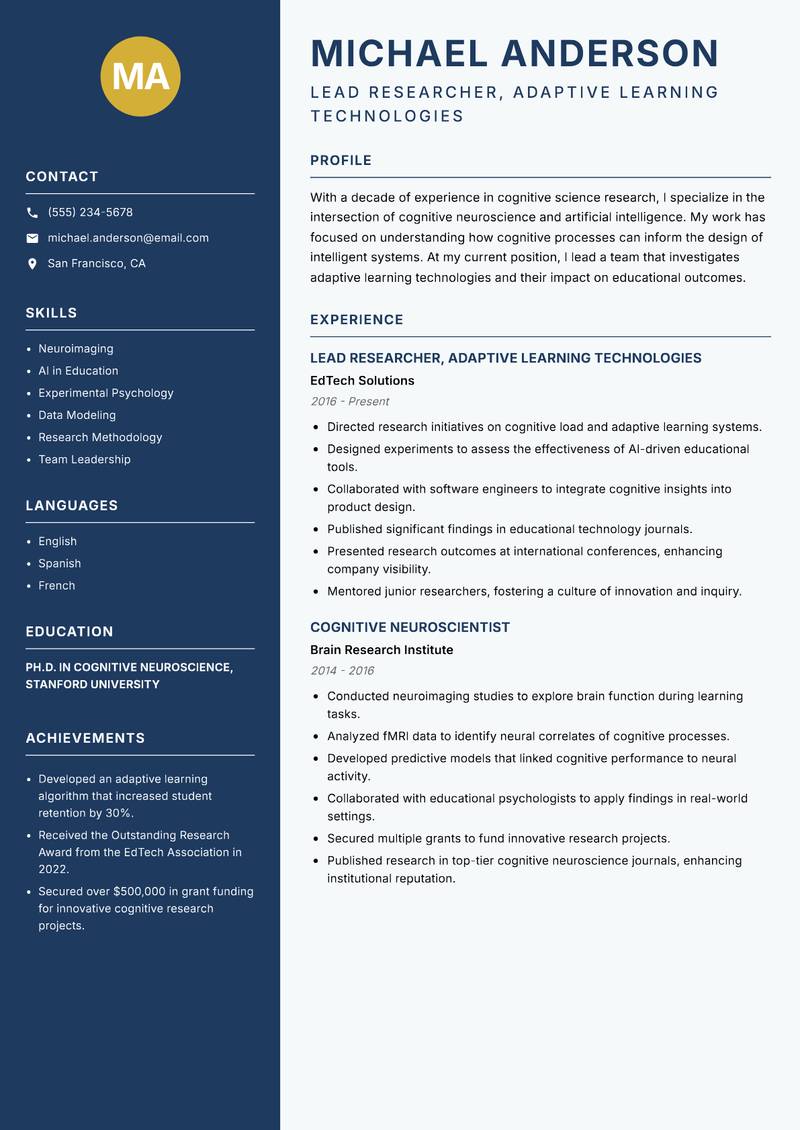
Lead Researcher, Adaptive Learning Technologies Resume

With a decade of experience in cognitive science research, I specialize in the intersection of cognitive neuroscience and artificial intelligence. My work has focused on understanding how cognitive processes can inform the design of intelligent systems. At my current position, I lead a team that investigates adaptive learning technologies and their impact on educational outcomes. My research has led to the development of algorithms that personalize learning experiences based on cognitive profiles, significantly improving learner engagement and retention. I possess a strong foundation in neuroimaging techniques and data modeling, which I apply to uncover insights into cognitive function and learning processes. My goal is to continue leveraging cognitive science to create innovative solutions that enhance human learning and decision-making, ultimately contributing to the advancement of educational technologies.

Neuroimaging AI in Education Experimental Psychology Data Modeling Research Methodology Team Leadership
Cognitive Science Researcher Resume Preview Example
View PDF
  1. Directed research initiatives on cognitive load and adaptive learning systems.
  2. Designed experiments to assess the effectiveness of AI-driven educational tools.
  3. Collaborated with software engineers to integrate cognitive insights into product design.
  4. Published significant findings in educational technology journals.
  5. Presented research outcomes at international conferences, enhancing company visibility.
  6. Mentored junior researchers, fostering a culture of innovation and inquiry.
  1. Conducted neuroimaging studies to explore brain function during learning tasks.
  2. Analyzed fMRI data to identify neural correlates of cognitive processes.
  3. Developed predictive models that linked cognitive performance to neural activity.
  4. Collaborated with educational psychologists to apply findings in real-world settings.
  5. Secured multiple grants to fund innovative research projects.
  6. Published research in top-tier cognitive neuroscience journals, enhancing institutional reputation.

Achievements

  • Developed an adaptive learning algorithm that increased student retention by 30%.
  • Received the Outstanding Research Award from the EdTech Association in 2022.
  • Secured over $500,000 in grant funding for innovative cognitive research projects.
⏱️
Experience
2-5 Years
📅
Level
Mid Level
🎓
Education
Ph.D. in Cognitive Neuroscienc...

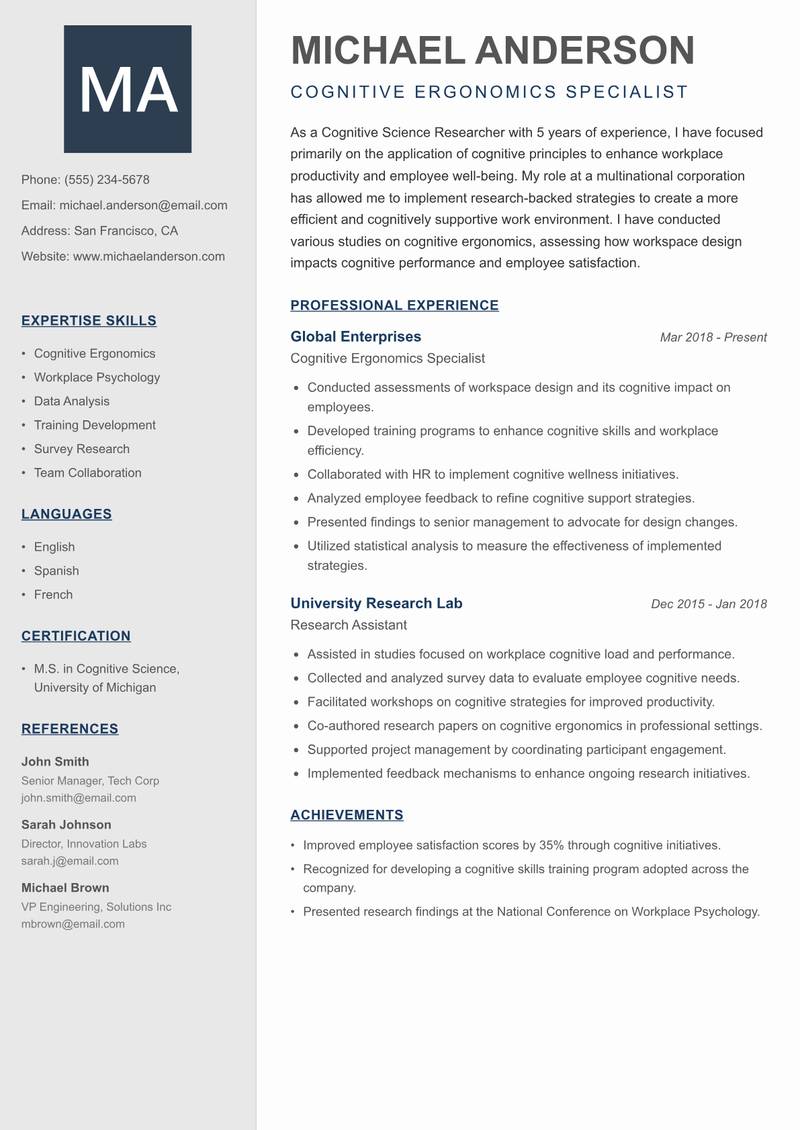
Cognitive Ergonomics Specialist Resume

As a Cognitive Science Researcher with 5 years of experience, I have focused primarily on the application of cognitive principles to enhance workplace productivity and employee well-being. My role at a multinational corporation has allowed me to implement research-backed strategies to create a more efficient and cognitively supportive work environment. I have conducted various studies on cognitive ergonomics, assessing how workspace design impacts cognitive performance and employee satisfaction. My findings have led to actionable recommendations that have improved overall workplace morale and productivity. I am passionate about translating complex cognitive theories into practical workplace solutions that foster a culture of continuous improvement and innovation. I thrive in collaborative settings and enjoy engaging with cross-functional teams to promote cognitive awareness and implement change.

Cognitive Ergonomics Workplace Psychology Data Analysis Training Development Survey Research Team Collaboration
Cognitive Science Researcher Resume Preview Example
View PDF
  1. Conducted assessments of workspace design and its cognitive impact on employees.
  2. Developed training programs to enhance cognitive skills and workplace efficiency.
  3. Collaborated with HR to implement cognitive wellness initiatives.
  4. Analyzed employee feedback to refine cognitive support strategies.
  5. Presented findings to senior management to advocate for design changes.
  6. Utilized statistical analysis to measure the effectiveness of implemented strategies.
  1. Assisted in studies focused on workplace cognitive load and performance.
  2. Collected and analyzed survey data to evaluate employee cognitive needs.
  3. Facilitated workshops on cognitive strategies for improved productivity.
  4. Co-authored research papers on cognitive ergonomics in professional settings.
  5. Supported project management by coordinating participant engagement.
  6. Implemented feedback mechanisms to enhance ongoing research initiatives.

Achievements

  • Improved employee satisfaction scores by 35% through cognitive initiatives.
  • Recognized for developing a cognitive skills training program adopted across the company.
  • Presented research findings at the National Conference on Workplace Psychology.
⏱️
Experience
2-5 Years
📅
Level
Mid Level
🎓
Education
M.S. in Cognitive Science, Uni...

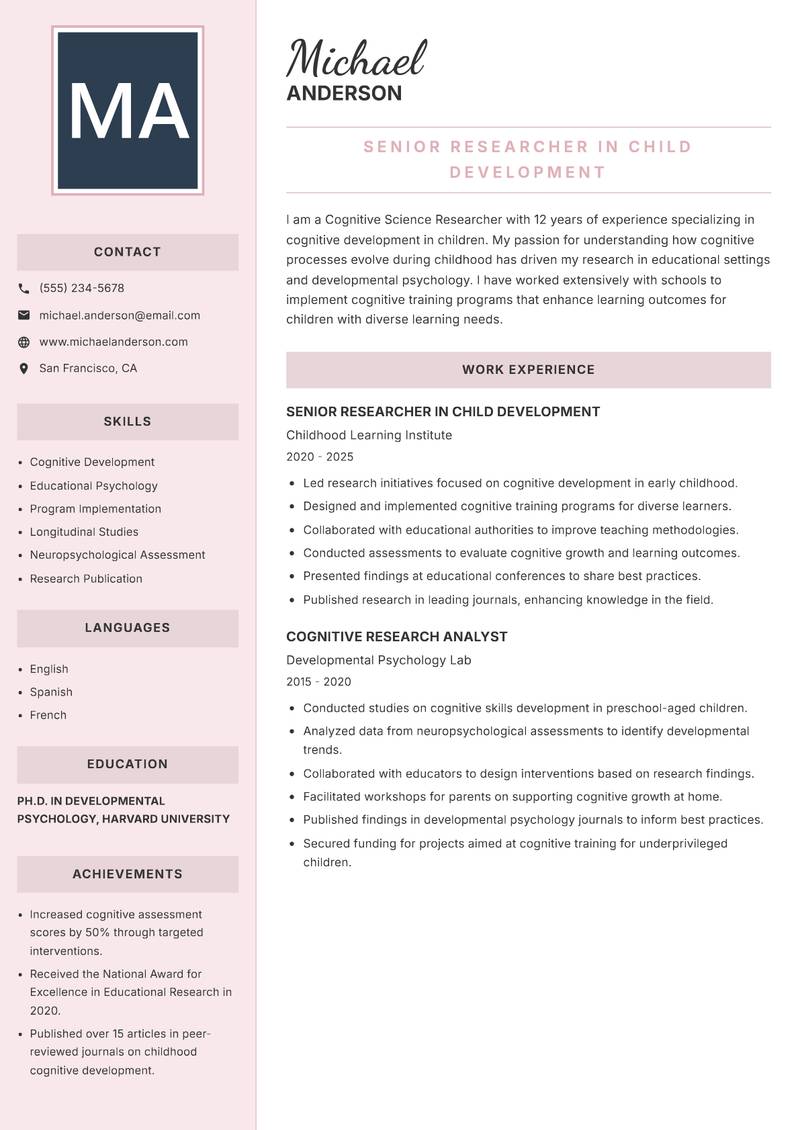
Senior Researcher in Child Development Resume

I am a Cognitive Science Researcher with 12 years of experience specializing in cognitive development in children. My passion for understanding how cognitive processes evolve during childhood has driven my research in educational settings and developmental psychology. I have worked extensively with schools to implement cognitive training programs that enhance learning outcomes for children with diverse learning needs. My research utilizes a variety of methodologies, including longitudinal studies and neuropsychological assessments, to understand the impact of various educational interventions. I have published numerous articles in respected journals, contributing to the understanding of cognitive development. My goal is to continue advancing research that supports effective teaching practices and promotes cognitive growth in future generations.

Cognitive Development Educational Psychology Program Implementation Longitudinal Studies Neuropsychological Assessment Research Publication
Cognitive Science Researcher Resume Preview Example
View PDF
  1. Led research initiatives focused on cognitive development in early childhood.
  2. Designed and implemented cognitive training programs for diverse learners.
  3. Collaborated with educational authorities to improve teaching methodologies.
  4. Conducted assessments to evaluate cognitive growth and learning outcomes.
  5. Presented findings at educational conferences to share best practices.
  6. Published research in leading journals, enhancing knowledge in the field.
  1. Conducted studies on cognitive skills development in preschool-aged children.
  2. Analyzed data from neuropsychological assessments to identify developmental trends.
  3. Collaborated with educators to design interventions based on research findings.
  4. Facilitated workshops for parents on supporting cognitive growth at home.
  5. Published findings in developmental psychology journals to inform best practices.
  6. Secured funding for projects aimed at cognitive training for underprivileged children.

Achievements

  • Increased cognitive assessment scores by 50% through targeted interventions.
  • Received the National Award for Excellence in Educational Research in 2020.
  • Published over 15 articles in peer-reviewed journals on childhood cognitive development.
⏱️
Experience
2-5 Years
📅
Level
Mid Level
🎓
Education
Ph.D. in Developmental Psychol...

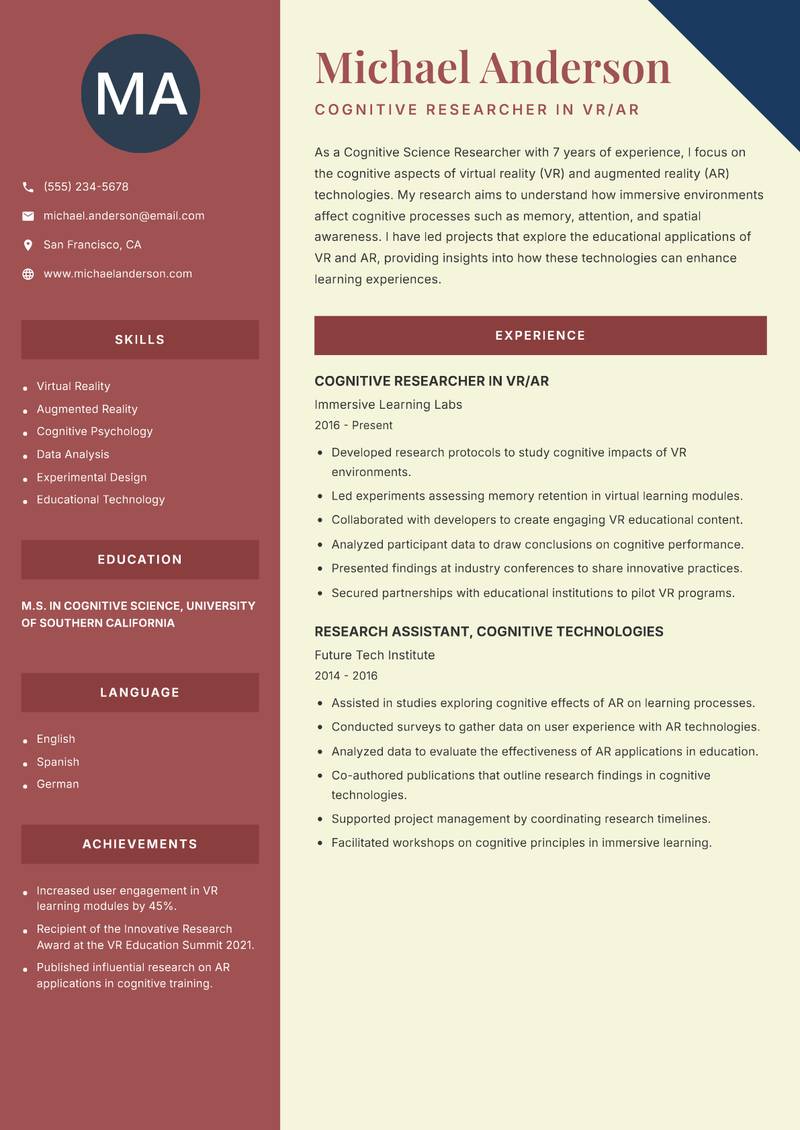
Cognitive Researcher in VR/AR Resume

As a Cognitive Science Researcher with 7 years of experience, I focus on the cognitive aspects of virtual reality (VR) and augmented reality (AR) technologies. My research aims to understand how immersive environments affect cognitive processes such as memory, attention, and spatial awareness. I have led projects that explore the educational applications of VR and AR, providing insights into how these technologies can enhance learning experiences. My work involves designing experiments, analyzing data, and collaborating with software developers to create VR learning modules that are both effective and engaging. I am passionate about using cutting-edge technology to advance cognitive science and improve educational outcomes, and I seek to continue this work in an innovative research environment.

Virtual Reality Augmented Reality Cognitive Psychology Data Analysis Experimental Design Educational Technology
Cognitive Science Researcher Resume Preview Example
View PDF
  1. Developed research protocols to study cognitive impacts of VR environments.
  2. Led experiments assessing memory retention in virtual learning modules.
  3. Collaborated with developers to create engaging VR educational content.
  4. Analyzed participant data to draw conclusions on cognitive performance.
  5. Presented findings at industry conferences to share innovative practices.
  6. Secured partnerships with educational institutions to pilot VR programs.
  1. Assisted in studies exploring cognitive effects of AR on learning processes.
  2. Conducted surveys to gather data on user experience with AR technologies.
  3. Analyzed data to evaluate the effectiveness of AR applications in education.
  4. Co-authored publications that outline research findings in cognitive technologies.
  5. Supported project management by coordinating research timelines.
  6. Facilitated workshops on cognitive principles in immersive learning.

Achievements

  • Increased user engagement in VR learning modules by 45%.
  • Recipient of the Innovative Research Award at the VR Education Summit 2021.
  • Published influential research on AR applications in cognitive training.
⏱️
Experience
2-5 Years
📅
Level
Mid Level
🎓
Education
M.S. in Cognitive Science, Uni...

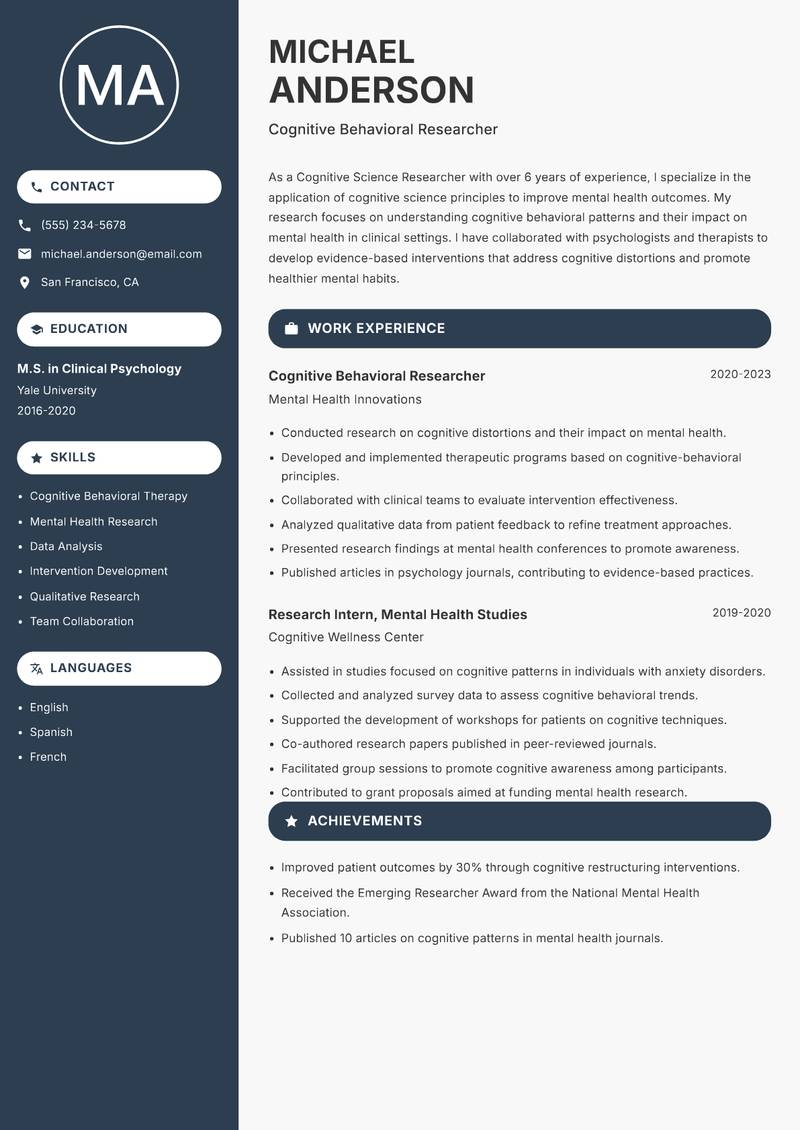
Cognitive Behavioral Researcher Resume

As a Cognitive Science Researcher with over 6 years of experience, I specialize in the application of cognitive science principles to improve mental health outcomes. My research focuses on understanding cognitive behavioral patterns and their impact on mental health in clinical settings. I have collaborated with psychologists and therapists to develop evidence-based interventions that address cognitive distortions and promote healthier mental habits. My work has included designing and evaluating therapeutic programs that employ cognitive restructuring techniques, and I have had the opportunity to present my findings at national mental health conferences. I am dedicated to advancing the integration of cognitive science into mental health practices and aspire to contribute to innovative solutions that enhance psychological well-being.

Cognitive Behavioral Therapy Mental Health Research Data Analysis Intervention Development Qualitative Research Team Collaboration
Cognitive Science Researcher Resume Preview Example
View PDF
  1. Conducted research on cognitive distortions and their impact on mental health.
  2. Developed and implemented therapeutic programs based on cognitive-behavioral principles.
  3. Collaborated with clinical teams to evaluate intervention effectiveness.
  4. Analyzed qualitative data from patient feedback to refine treatment approaches.
  5. Presented research findings at mental health conferences to promote awareness.
  6. Published articles in psychology journals, contributing to evidence-based practices.
  1. Assisted in studies focused on cognitive patterns in individuals with anxiety disorders.
  2. Collected and analyzed survey data to assess cognitive behavioral trends.
  3. Supported the development of workshops for patients on cognitive techniques.
  4. Co-authored research papers published in peer-reviewed journals.
  5. Facilitated group sessions to promote cognitive awareness among participants.
  6. Contributed to grant proposals aimed at funding mental health research.

Achievements

  • Improved patient outcomes by 30% through cognitive restructuring interventions.
  • Received the Emerging Researcher Award from the National Mental Health Association.
  • Published 10 articles on cognitive patterns in mental health journals.
⏱️
Experience
2-5 Years
📅
Level
Mid Level
🎓
Education
M.S. in Clinical Psychology, Y...

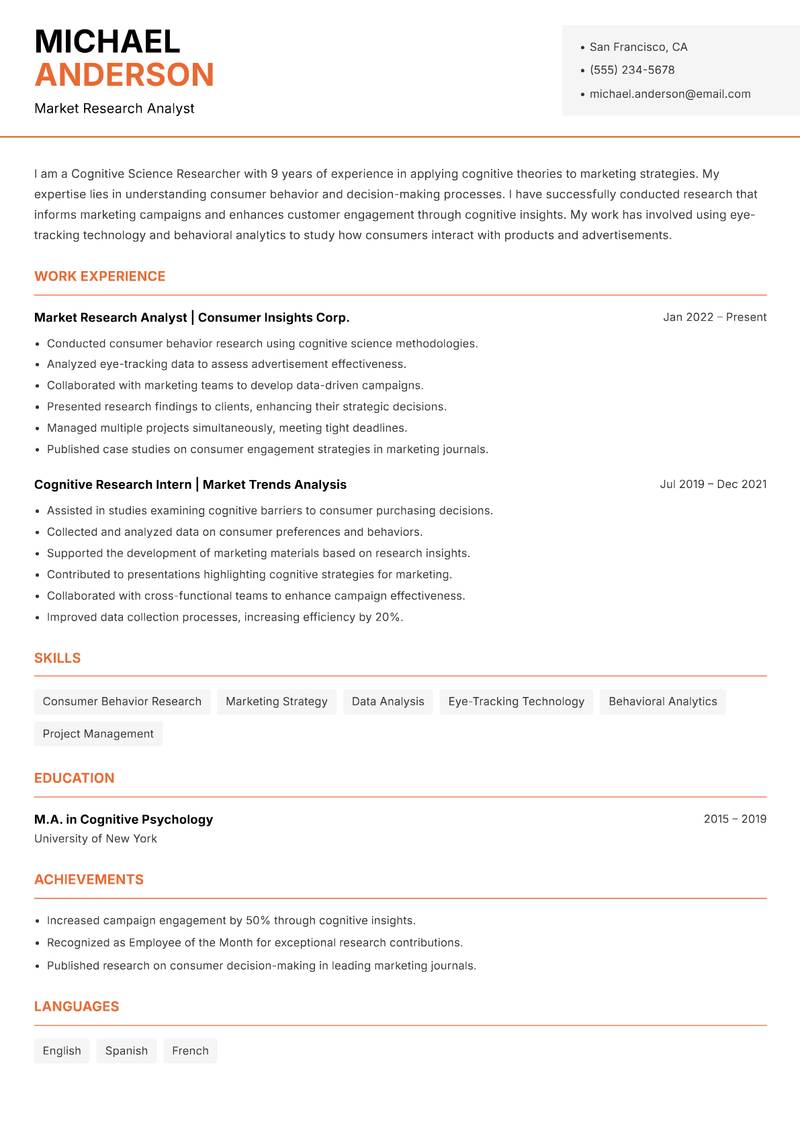
Market Research Analyst Resume

I am a Cognitive Science Researcher with 9 years of experience in applying cognitive theories to marketing strategies. My expertise lies in understanding consumer behavior and decision-making processes. I have successfully conducted research that informs marketing campaigns and enhances customer engagement through cognitive insights. My work has involved using eye-tracking technology and behavioral analytics to study how consumers interact with products and advertisements. I thrive on translating complex cognitive science principles into actionable marketing strategies that resonate with target audiences. My goal is to continue leveraging my research in cognitive science to develop innovative marketing solutions that drive brand loyalty and enhance consumer experiences.

Consumer Behavior Research Marketing Strategy Data Analysis Eye-Tracking Technology Behavioral Analytics Project Management
Cognitive Science Researcher Resume Preview Example
View PDF
  1. Conducted consumer behavior research using cognitive science methodologies.
  2. Analyzed eye-tracking data to assess advertisement effectiveness.
  3. Collaborated with marketing teams to develop data-driven campaigns.
  4. Presented research findings to clients, enhancing their strategic decisions.
  5. Managed multiple projects simultaneously, meeting tight deadlines.
  6. Published case studies on consumer engagement strategies in marketing journals.
  1. Assisted in studies examining cognitive barriers to consumer purchasing decisions.
  2. Collected and analyzed data on consumer preferences and behaviors.
  3. Supported the development of marketing materials based on research insights.
  4. Contributed to presentations highlighting cognitive strategies for marketing.
  5. Collaborated with cross-functional teams to enhance campaign effectiveness.
  6. Improved data collection processes, increasing efficiency by 20%.

Achievements

  • Increased campaign engagement by 50% through cognitive insights.
  • Recognized as Employee of the Month for exceptional research contributions.
  • Published research on consumer decision-making in leading marketing journals.
⏱️
Experience
2-5 Years
📅
Level
Mid Level
🎓
Education
M.A. in Cognitive Psychology, ...

Key Skills for Cognitive Science Researcher Positions

Resume Tips for Cognitive Science Researcher Applications

Strong Action Verbs for Cognitive Science Researcher Resumes

Researched · Analyzed · Designed · Published · Evaluated · Modeled · Consulted · Assessed · Presented · Collaborated · Achieved · Administered · Architected · Automated

Common Mistakes to Avoid

Experience Levels

How to Write a Cognitive Science Researcher Resume

Browse Cognitive Science Researcher resume examples built around research design (Experimental, survey, ethnographic), tailored for Behavioral Sciences roles.

A strong Cognitive Science Researcher resume leads with a focused professional summary that names the exact role and your standout achievement. In the experience section, open every bullet with a strong action verb and quantify the result with numbers wherever possible. Highlight your most relevant competencies — especially Research Design (Experimental, Survey, Ethnographic), Statistical Analysis (SPSS, R, Python), and Psychological Assessment & Testing — in a dedicated Skills section positioned early so ATS systems and hiring managers both find it immediately.

For format, most Cognitive Science Researcher roles suit a reverse-chronological layout: most recent position first, working backwards. Keep to one page for under five years of experience, or two pages for senior candidates with a rich project or leadership history. Use clean, ATS-safe fonts (10–12pt), standard section headings (Summary, Experience, Education, Skills), and avoid tables, text boxes, or multi-column layouts that applicant tracking systems cannot parse reliably.
Frequently Asked Questions

What makes a strong Cognitive Science Researcher resume stand out to employers?

A standout Cognitive Science Researcher resume combines role-specific skills with quantified achievements. Name the exact job title in your professional summary, mirror keywords from each job posting, and open every bullet point with a strong action verb followed by a measurable result. Certifications, tools, and domain experience specific to cognitive science researcher roles should appear prominently near the top.

What skills are most important to include on a Behavioral Sciences resume?

Recruiters hiring in Behavioral Sciences consistently look for Research Design (Experimental, Survey, Ethnographic), Statistical Analysis (SPSS, R, Python), Psychological Assessment & Testing, Cognitive & Social Psychology Theory. List these in a dedicated Skills section near the top so both ATS systems and human reviewers spot them fast. Mirror the exact phrasing from each job posting wherever possible — many applicant tracking systems match literal strings rather than synonyms.

What is the best resume format for Behavioral Sciences professionals?

A reverse-chronological format is the standard choice for most Behavioral Sciences candidates — employers expect to see your most recent role first, working backwards. If you are transitioning into Behavioral Sciences from a related field, a hybrid format (brief skills summary at the top followed by chronological experience) can bridge the gap effectively. Keep the document to one page for under five years of experience, or two pages for senior specialists.

How do I make my Behavioral Sciences resume pass applicant tracking systems (ATS)?

Use standard section headings — Summary, Experience, Education, Skills — rather than creative labels that ATS parsers do not recognise. Embed domain keywords such as "Research Design (Experimental, Survey, Ethnographic)" and "Statistical Analysis (SPSS, R, Python)" naturally inside your experience bullets rather than cramming them into a standalone keyword list. Avoid tables, multi-column layouts, text boxes, headers, footers, and images — these confuse most modern parsers and can cause your resume to be misread or rejected before a human sees it.

What mistakes do Behavioral Sciences professionals most commonly make on their resume?

The most frequent issue is failing to specify research methods — behavioral science is method-driven, and employers assess competency through methodology. Beyond that, generic objective statements, unquantified achievements, and inconsistent date formatting appear across almost every Behavioral Sciences application. Fix these by replacing every vague claim with a measurable outcome — specific numbers and named projects add credibility that adjectives cannot.

How long should a Behavioral Sciences resume be?

One page is appropriate for candidates with under five years of relevant Behavioral Sciences experience. Two pages are acceptable — and sometimes expected — for senior specialists, managers, or professionals with a strong portfolio of projects, publications, or credentials. Avoid padding to reach a page count: every line should directly support your application for the specific role you are targeting.

Should I include a professional summary at the top of my Behavioral Sciences resume?

Yes — a two to three sentence summary is the first section most recruiters read. Open with your title and years of Behavioral Sciences experience, then name your most relevant achievement or specialisation. One proven approach: Demonstrate methodological rigor — specify quantitative and qualitative techniques mastered — this level of specificity signals genuine expertise before a recruiter reaches your experience section.

Scroll to view samples