Deep Sea Fisheries Specialist Resume

These Deep Sea Fisheries Specialist resume samples are designed to help you write a resume that gets noticed by hiring managers and passes applicant tracking systems (ATS) in Fisheries. Each example shows real formatting, section structure, and language you can adapt to your own background. When writing your own Deep Sea Fisheries Specialist resume, focus on highlighting stock assessment & population modeling, fisheries management & quota setting and aquatic ecology & species biology. Recruiters scan for these qualifications first, so they should appear early in your summary and experience sections. Use strong action verbs such as "assessed", "managed", "monitored", "enforced" to describe your achievements, and quantify your impact wherever possible — percentages, dollar amounts, or time saved make your resume more convincing. A common mistake to avoid: writing a generic objective statement instead of a targeted deep sea fisheries specialist professional summary. Tailor your resume to each Deep Sea Fisheries Specialist position you apply for rather than using one generic version.

Deep Sea Fisheries Specialist Resume Template
View PDF
0.0 (0 ratings)

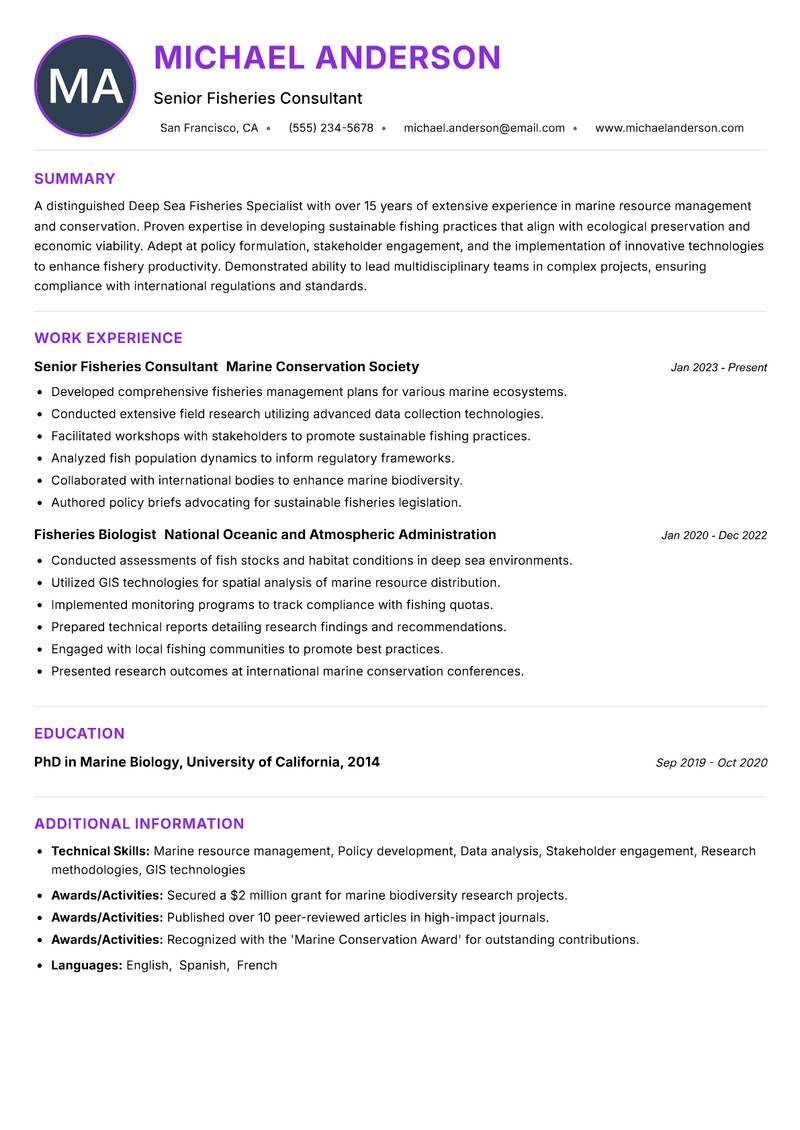
Senior Fisheries Consultant Resume

A distinguished Deep Sea Fisheries Specialist with over 15 years of extensive experience in marine resource management and conservation. Proven expertise in developing sustainable fishing practices that align with ecological preservation and economic viability. Adept at policy formulation, stakeholder engagement, and the implementation of innovative technologies to enhance fishery productivity. Demonstrated ability to lead multidisciplinary teams in complex projects, ensuring compliance with international regulations and standards. Recognized for contributions to scientific research and the promotion of biodiversity in marine ecosystems. A strategic thinker with a strong commitment to the sustainable use of ocean resources, driving initiatives that foster resilience among fishing communities. Strong communicator skilled in liaising with governmental agencies, NGOs, and the private sector to achieve common goals in marine conservation.

Marine resource management Policy development Data analysis Stakeholder engagement Research methodologies GIS technologies
Deep Sea Fisheries Specialist Resume Preview Example
View PDF
  1. Developed comprehensive fisheries management plans for various marine ecosystems.
  2. Conducted extensive field research utilizing advanced data collection technologies.
  3. Facilitated workshops with stakeholders to promote sustainable fishing practices.
  4. Analyzed fish population dynamics to inform regulatory frameworks.
  5. Collaborated with international bodies to enhance marine biodiversity.
  6. Authored policy briefs advocating for sustainable fisheries legislation.
  1. Conducted assessments of fish stocks and habitat conditions in deep sea environments.
  2. Utilized GIS technologies for spatial analysis of marine resource distribution.
  3. Implemented monitoring programs to track compliance with fishing quotas.
  4. Prepared technical reports detailing research findings and recommendations.
  5. Engaged with local fishing communities to promote best practices.
  6. Presented research outcomes at international marine conservation conferences.

Achievements

  • Secured a $2 million grant for marine biodiversity research projects.
  • Published over 10 peer-reviewed articles in high-impact journals.
  • Recognized with the 'Marine Conservation Award' for outstanding contributions.
⏱️
Experience
2-5 Years
📅
Level
Mid Level
🎓
Education
PhD in Marine Biology, Univers...

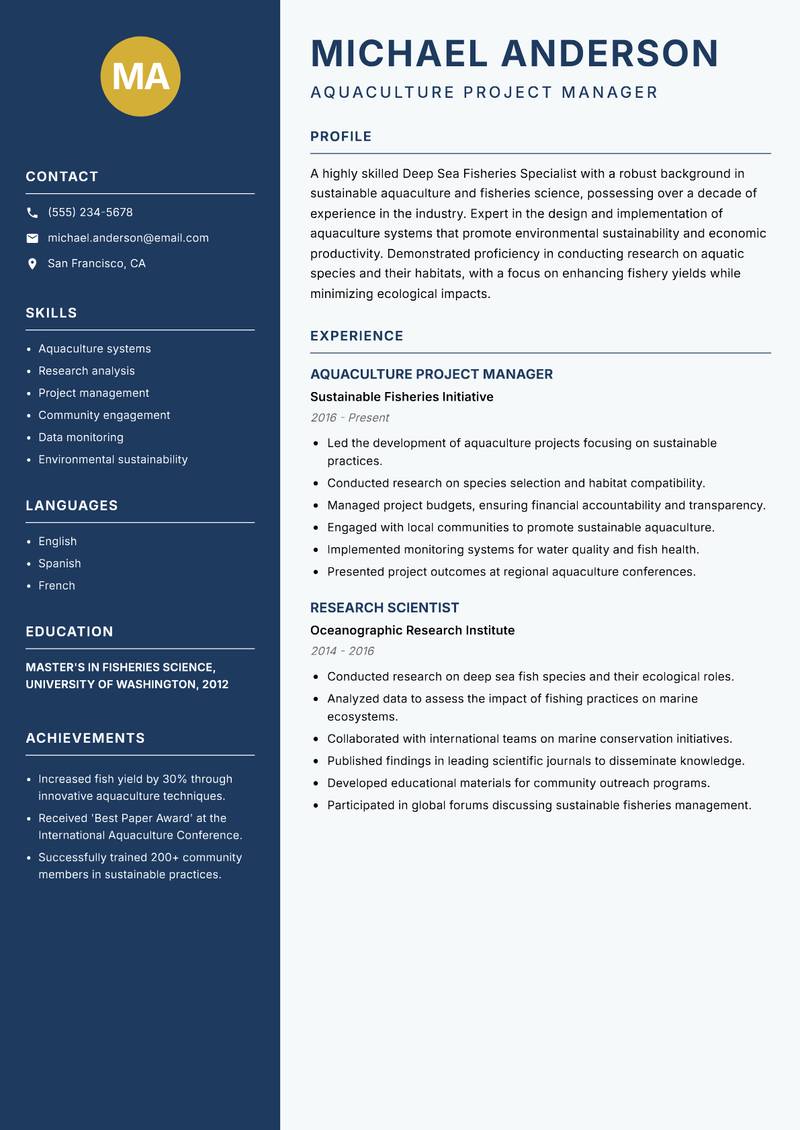
Aquaculture Project Manager Resume

A highly skilled Deep Sea Fisheries Specialist with a robust background in sustainable aquaculture and fisheries science, possessing over a decade of experience in the industry. Expert in the design and implementation of aquaculture systems that promote environmental sustainability and economic productivity. Demonstrated proficiency in conducting research on aquatic species and their habitats, with a focus on enhancing fishery yields while minimizing ecological impacts. Recognized for innovative approaches to resource management, including the application of technology in monitoring and data collection. Proven ability to collaborate with diverse teams and stakeholders to drive strategic initiatives in fisheries development. Committed to educating communities about sustainable practices and the importance of preserving marine ecosystems for future generations.

Aquaculture systems Research analysis Project management Community engagement Data monitoring Environmental sustainability
Deep Sea Fisheries Specialist Resume Preview Example
View PDF
  1. Led the development of aquaculture projects focusing on sustainable practices.
  2. Conducted research on species selection and habitat compatibility.
  3. Managed project budgets, ensuring financial accountability and transparency.
  4. Engaged with local communities to promote sustainable aquaculture.
  5. Implemented monitoring systems for water quality and fish health.
  6. Presented project outcomes at regional aquaculture conferences.
  1. Conducted research on deep sea fish species and their ecological roles.
  2. Analyzed data to assess the impact of fishing practices on marine ecosystems.
  3. Collaborated with international teams on marine conservation initiatives.
  4. Published findings in leading scientific journals to disseminate knowledge.
  5. Developed educational materials for community outreach programs.
  6. Participated in global forums discussing sustainable fisheries management.

Achievements

  • Increased fish yield by 30% through innovative aquaculture techniques.
  • Received 'Best Paper Award' at the International Aquaculture Conference.
  • Successfully trained 200+ community members in sustainable practices.
⏱️
Experience
2-5 Years
📅
Level
Mid Level
🎓
Education
Master's in Fisheries Science,...

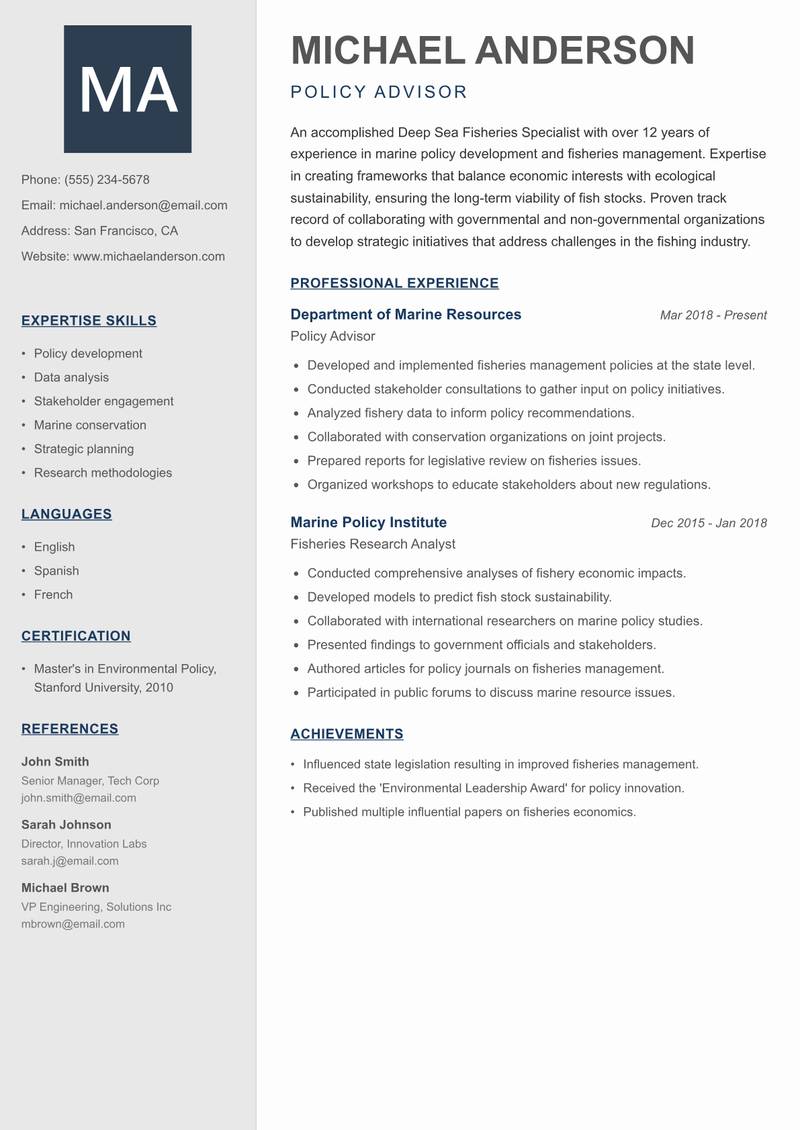
Policy Advisor Resume

An accomplished Deep Sea Fisheries Specialist with over 12 years of experience in marine policy development and fisheries management. Expertise in creating frameworks that balance economic interests with ecological sustainability, ensuring the long-term viability of fish stocks. Proven track record of collaborating with governmental and non-governmental organizations to develop strategic initiatives that address challenges in the fishing industry. Skilled in data analysis and ecological assessments, with a strong focus on evidence-based decision-making. Committed to fostering partnerships that promote responsible fishing practices and marine conservation. Recognized for leadership in advancing policies that protect marine ecosystems while supporting local fishing economies. A results-oriented professional dedicated to creating a sustainable future for marine resources.

Policy development Data analysis Stakeholder engagement Marine conservation Strategic planning Research methodologies
Deep Sea Fisheries Specialist Resume Preview Example
View PDF
  1. Developed and implemented fisheries management policies at the state level.
  2. Conducted stakeholder consultations to gather input on policy initiatives.
  3. Analyzed fishery data to inform policy recommendations.
  4. Collaborated with conservation organizations on joint projects.
  5. Prepared reports for legislative review on fisheries issues.
  6. Organized workshops to educate stakeholders about new regulations.
  1. Conducted comprehensive analyses of fishery economic impacts.
  2. Developed models to predict fish stock sustainability.
  3. Collaborated with international researchers on marine policy studies.
  4. Presented findings to government officials and stakeholders.
  5. Authored articles for policy journals on fisheries management.
  6. Participated in public forums to discuss marine resource issues.

Achievements

  • Influenced state legislation resulting in improved fisheries management.
  • Received the 'Environmental Leadership Award' for policy innovation.
  • Published multiple influential papers on fisheries economics.
⏱️
Experience
2-5 Years
📅
Level
Mid Level
🎓
Education
Master's in Environmental Poli...

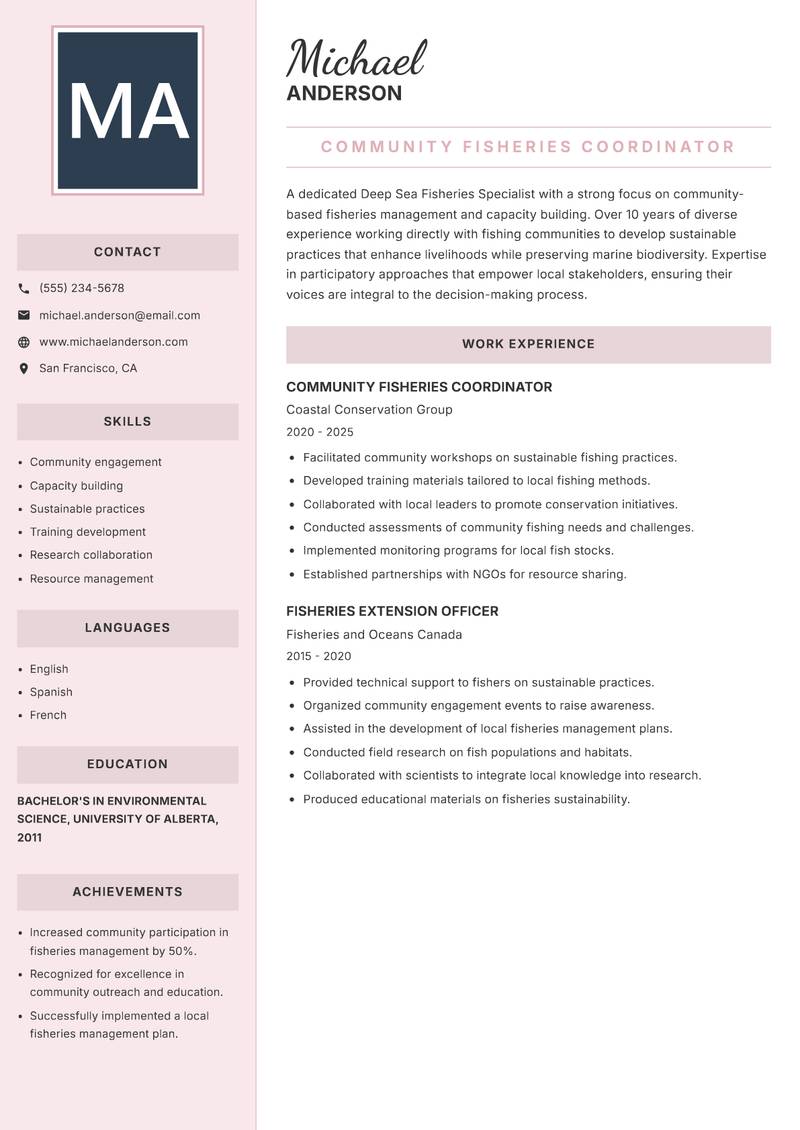
Community Fisheries Coordinator Resume

A dedicated Deep Sea Fisheries Specialist with a strong focus on community-based fisheries management and capacity building. Over 10 years of diverse experience working directly with fishing communities to develop sustainable practices that enhance livelihoods while preserving marine biodiversity. Expertise in participatory approaches that empower local stakeholders, ensuring their voices are integral to the decision-making process. A strong advocate for the integration of traditional knowledge with scientific research to create holistic management strategies. Proven ability to facilitate training programs and workshops that educate communities about sustainable fishing techniques and conservation practices. Committed to fostering resilience in coastal communities through sustainable resource management and engagement.

Community engagement Capacity building Sustainable practices Training development Research collaboration Resource management
Deep Sea Fisheries Specialist Resume Preview Example
View PDF
  1. Facilitated community workshops on sustainable fishing practices.
  2. Developed training materials tailored to local fishing methods.
  3. Collaborated with local leaders to promote conservation initiatives.
  4. Conducted assessments of community fishing needs and challenges.
  5. Implemented monitoring programs for local fish stocks.
  6. Established partnerships with NGOs for resource sharing.
  1. Provided technical support to fishers on sustainable practices.
  2. Organized community engagement events to raise awareness.
  3. Assisted in the development of local fisheries management plans.
  4. Conducted field research on fish populations and habitats.
  5. Collaborated with scientists to integrate local knowledge into research.
  6. Produced educational materials on fisheries sustainability.

Achievements

  • Increased community participation in fisheries management by 50%.
  • Recognized for excellence in community outreach and education.
  • Successfully implemented a local fisheries management plan.
⏱️
Experience
2-5 Years
📅
Level
Mid Level
🎓
Education
Bachelor's in Environmental Sc...

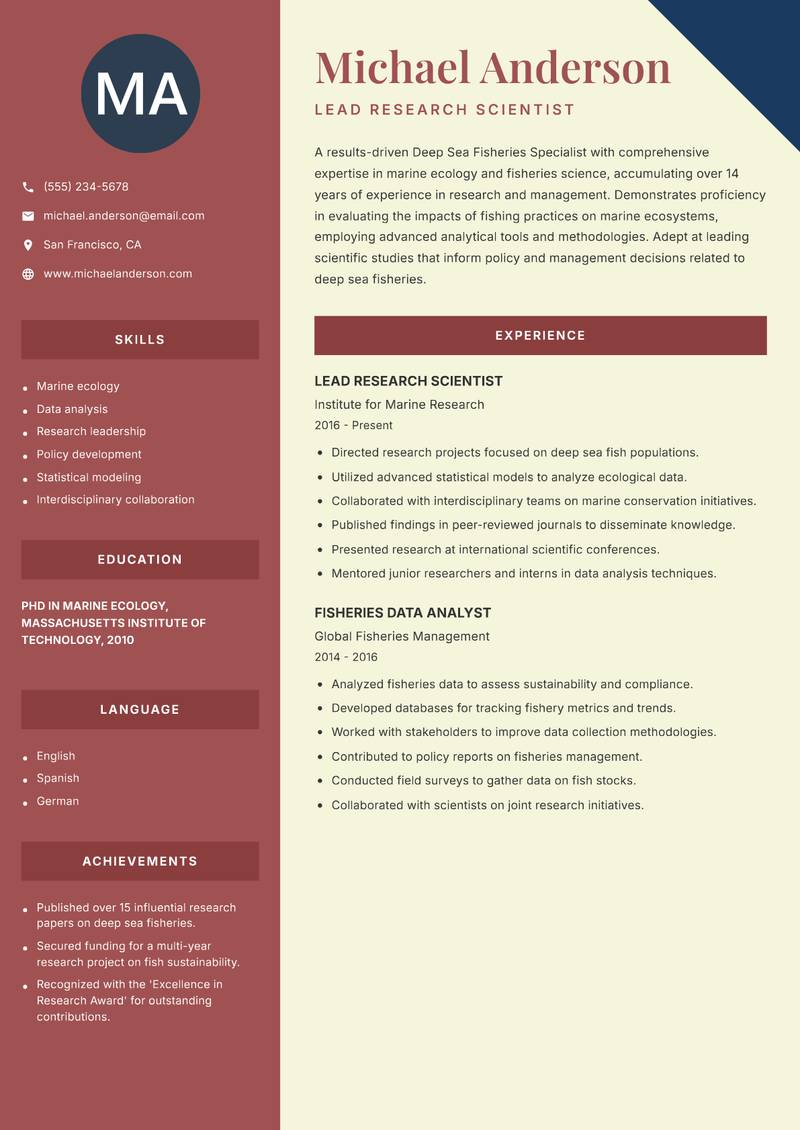
Lead Research Scientist Resume

A results-driven Deep Sea Fisheries Specialist with comprehensive expertise in marine ecology and fisheries science, accumulating over 14 years of experience in research and management. Demonstrates proficiency in evaluating the impacts of fishing practices on marine ecosystems, employing advanced analytical tools and methodologies. Adept at leading scientific studies that inform policy and management decisions related to deep sea fisheries. Recognized for innovative approaches in data collection and analysis, contributing to improved sustainability outcomes. Strong background in collaborating with academic institutions, governmental agencies, and industry stakeholders to promote responsible fishing practices. Committed to advancing the understanding of marine ecosystems and the effects of anthropogenic activities on fish populations.

Marine ecology Data analysis Research leadership Policy development Statistical modeling Interdisciplinary collaboration
Deep Sea Fisheries Specialist Resume Preview Example
View PDF
  1. Directed research projects focused on deep sea fish populations.
  2. Utilized advanced statistical models to analyze ecological data.
  3. Collaborated with interdisciplinary teams on marine conservation initiatives.
  4. Published findings in peer-reviewed journals to disseminate knowledge.
  5. Presented research at international scientific conferences.
  6. Mentored junior researchers and interns in data analysis techniques.
  1. Analyzed fisheries data to assess sustainability and compliance.
  2. Developed databases for tracking fishery metrics and trends.
  3. Worked with stakeholders to improve data collection methodologies.
  4. Contributed to policy reports on fisheries management.
  5. Conducted field surveys to gather data on fish stocks.
  6. Collaborated with scientists on joint research initiatives.

Achievements

  • Published over 15 influential research papers on deep sea fisheries.
  • Secured funding for a multi-year research project on fish sustainability.
  • Recognized with the 'Excellence in Research Award' for outstanding contributions.
⏱️
Experience
2-5 Years
📅
Level
Mid Level
🎓
Education
PhD in Marine Ecology, Massach...

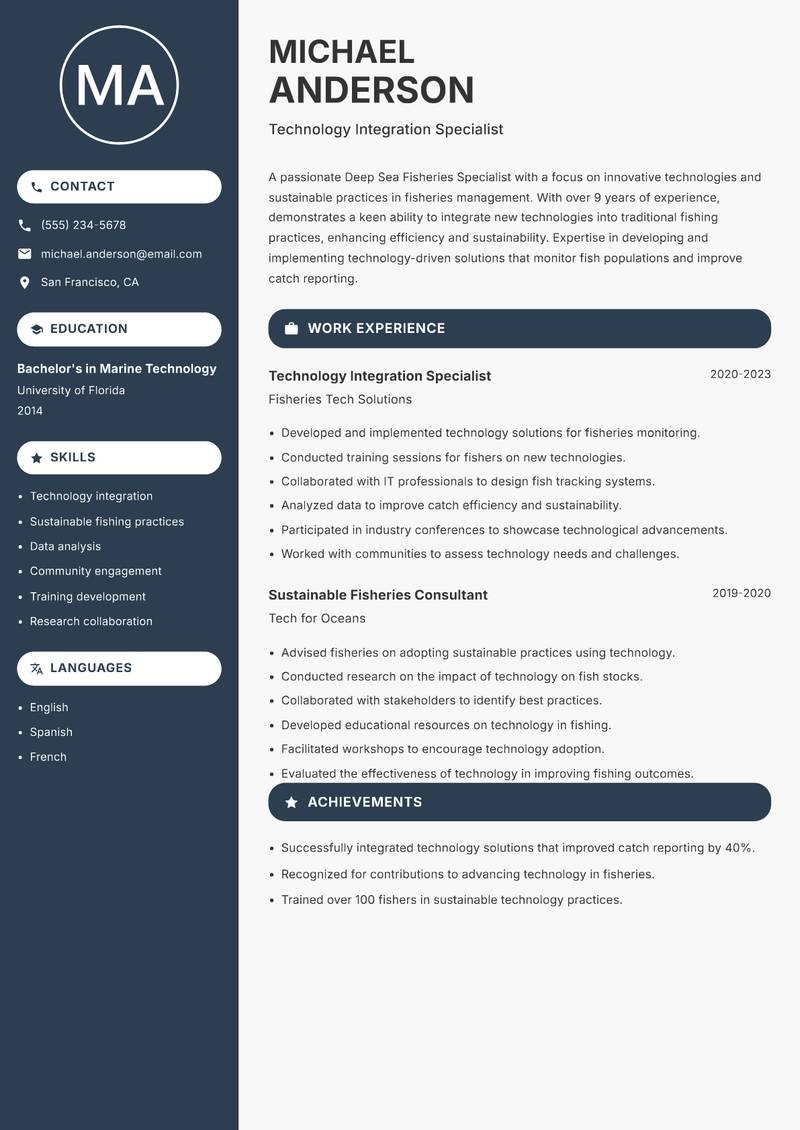
Technology Integration Specialist Resume

A passionate Deep Sea Fisheries Specialist with a focus on innovative technologies and sustainable practices in fisheries management. With over 9 years of experience, demonstrates a keen ability to integrate new technologies into traditional fishing practices, enhancing efficiency and sustainability. Expertise in developing and implementing technology-driven solutions that monitor fish populations and improve catch reporting. Committed to promoting marine conservation and engaging with fishing communities to adopt sustainable practices. Proven track record of working collaboratively with industry partners to advance technology adoption in fisheries. Adept at conducting training sessions and workshops to educate stakeholders on the benefits of technological advancements in the marine industry.

Technology integration Sustainable fishing practices Data analysis Community engagement Training development Research collaboration
Deep Sea Fisheries Specialist Resume Preview Example
View PDF
  1. Developed and implemented technology solutions for fisheries monitoring.
  2. Conducted training sessions for fishers on new technologies.
  3. Collaborated with IT professionals to design fish tracking systems.
  4. Analyzed data to improve catch efficiency and sustainability.
  5. Participated in industry conferences to showcase technological advancements.
  6. Worked with communities to assess technology needs and challenges.
  1. Advised fisheries on adopting sustainable practices using technology.
  2. Conducted research on the impact of technology on fish stocks.
  3. Collaborated with stakeholders to identify best practices.
  4. Developed educational resources on technology in fishing.
  5. Facilitated workshops to encourage technology adoption.
  6. Evaluated the effectiveness of technology in improving fishing outcomes.

Achievements

  • Successfully integrated technology solutions that improved catch reporting by 40%.
  • Recognized for contributions to advancing technology in fisheries.
  • Trained over 100 fishers in sustainable technology practices.
⏱️
Experience
2-5 Years
📅
Level
Mid Level
🎓
Education
Bachelor's in Marine Technolog...

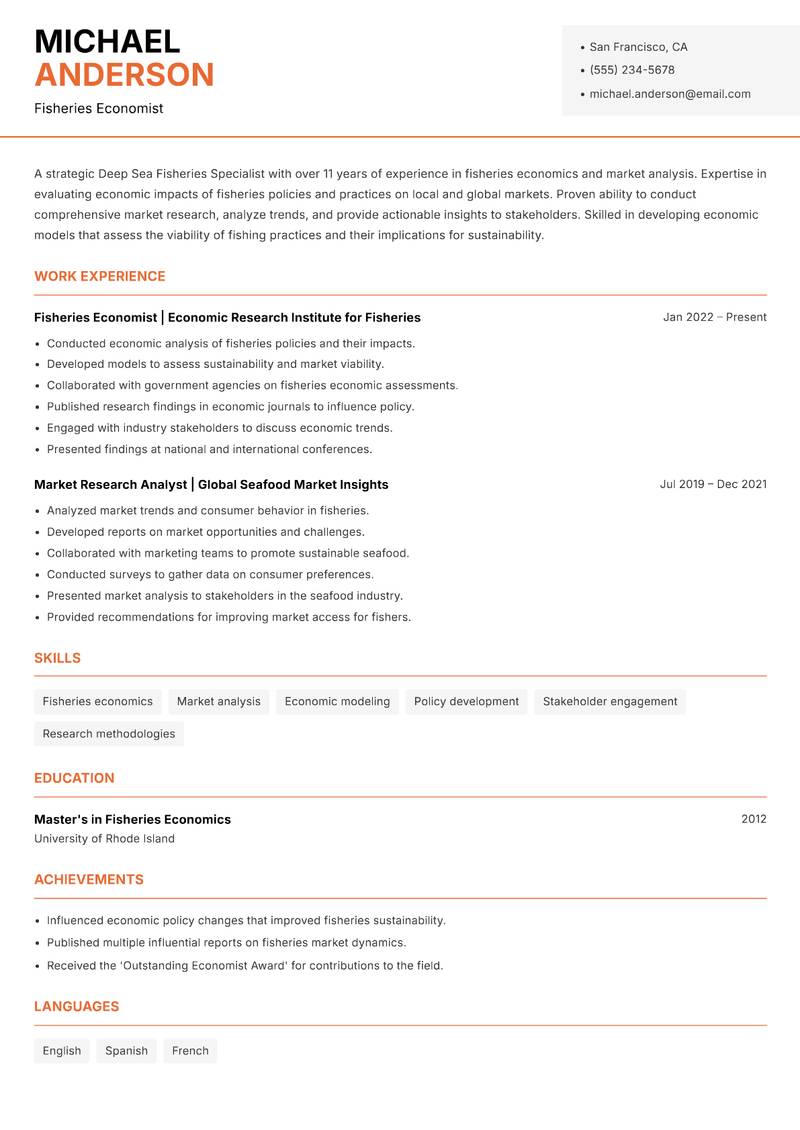
Fisheries Economist Resume

A strategic Deep Sea Fisheries Specialist with over 11 years of experience in fisheries economics and market analysis. Expertise in evaluating economic impacts of fisheries policies and practices on local and global markets. Proven ability to conduct comprehensive market research, analyze trends, and provide actionable insights to stakeholders. Skilled in developing economic models that assess the viability of fishing practices and their implications for sustainability. Committed to promoting responsible fisheries management that supports economic growth while ensuring environmental stewardship. Recognized for contributions to economic policy development and advocacy for sustainable fisheries practices. Strong communicator and collaborator with a track record of engaging diverse stakeholders in the fisheries sector.

Fisheries economics Market analysis Economic modeling Policy development Stakeholder engagement Research methodologies
Deep Sea Fisheries Specialist Resume Preview Example
View PDF
  1. Conducted economic analysis of fisheries policies and their impacts.
  2. Developed models to assess sustainability and market viability.
  3. Collaborated with government agencies on fisheries economic assessments.
  4. Published research findings in economic journals to influence policy.
  5. Engaged with industry stakeholders to discuss economic trends.
  6. Presented findings at national and international conferences.
  1. Analyzed market trends and consumer behavior in fisheries.
  2. Developed reports on market opportunities and challenges.
  3. Collaborated with marketing teams to promote sustainable seafood.
  4. Conducted surveys to gather data on consumer preferences.
  5. Presented market analysis to stakeholders in the seafood industry.
  6. Provided recommendations for improving market access for fishers.

Achievements

  • Influenced economic policy changes that improved fisheries sustainability.
  • Published multiple influential reports on fisheries market dynamics.
  • Received the 'Outstanding Economist Award' for contributions to the field.
⏱️
Experience
2-5 Years
📅
Level
Mid Level
🎓
Education
Master's in Fisheries Economic...

Key Skills for Deep Sea Fisheries Specialist Positions

Resume Tips for Deep Sea Fisheries Specialist Applications

Strong Action Verbs for Deep Sea Fisheries Specialist Resumes

Assessed · Managed · Monitored · Enforced · Analyzed · Surveyed · Conserved · Negotiated · Recommended · Collected · Achieved · Administered · Architected · Automated

Common Mistakes to Avoid

Experience Levels

How to Write a Deep Sea Fisheries Specialist Resume

Browse Deep Sea Fisheries Specialist resume examples built around stock assessment & population modeling, tailored for Fisheries roles.

A strong Deep Sea Fisheries Specialist resume leads with a focused professional summary that names the exact role and your standout achievement. In the experience section, open every bullet with a strong action verb and quantify the result with numbers wherever possible. Highlight your most relevant competencies — especially Stock Assessment & Population Modeling, Fisheries Management & Quota Setting, and Aquatic Ecology & Species Biology — in a dedicated Skills section positioned early so ATS systems and hiring managers both find it immediately.

For format, most Deep Sea Fisheries Specialist roles suit a reverse-chronological layout: most recent position first, working backwards. Keep to one page for under five years of experience, or two pages for senior candidates with a rich project or leadership history. Use clean, ATS-safe fonts (10–12pt), standard section headings (Summary, Experience, Education, Skills), and avoid tables, text boxes, or multi-column layouts that applicant tracking systems cannot parse reliably.
Frequently Asked Questions

What makes a strong Deep Sea Fisheries Specialist resume stand out to employers?

A standout Deep Sea Fisheries Specialist resume combines role-specific skills with quantified achievements. Name the exact job title in your professional summary, mirror keywords from each job posting, and open every bullet point with a strong action verb followed by a measurable result. Certifications, tools, and domain experience specific to deep sea fisheries specialist roles should appear prominently near the top.

What skills are most important to include on a Fisheries resume?

Recruiters hiring in Fisheries consistently look for Stock Assessment & Population Modeling, Fisheries Management & Quota Setting, Aquatic Ecology & Species Biology, Fisheries Compliance & Enforcement. List these in a dedicated Skills section near the top so both ATS systems and human reviewers spot them fast. Mirror the exact phrasing from each job posting wherever possible — many applicant tracking systems match literal strings rather than synonyms.

What is the best resume format for Fisheries professionals?

A reverse-chronological format is the standard choice for most Fisheries candidates — employers expect to see your most recent role first, working backwards. If you are transitioning into Fisheries from a related field, a hybrid format (brief skills summary at the top followed by chronological experience) can bridge the gap effectively. Keep the document to one page for under five years of experience, or two pages for senior specialists.

How do I make my Fisheries resume pass applicant tracking systems (ATS)?

Use standard section headings — Summary, Experience, Education, Skills — rather than creative labels that ATS parsers do not recognise. Embed domain keywords such as "Stock Assessment & Population Modeling" and "Fisheries Management & Quota Setting" naturally inside your experience bullets rather than cramming them into a standalone keyword list. Avoid tables, multi-column layouts, text boxes, headers, footers, and images — these confuse most modern parsers and can cause your resume to be misread or rejected before a human sees it.

What mistakes do Fisheries professionals most commonly make on their resume?

The most frequent issue is not demonstrating stock assessment methodology — it is the technical foundation of fisheries science. Beyond that, generic objective statements, unquantified achievements, and inconsistent date formatting appear across almost every Fisheries application. Fix these by replacing every vague claim with a measurable outcome — specific numbers and named projects add credibility that adjectives cannot.

How long should a Fisheries resume be?

One page is appropriate for candidates with under five years of relevant Fisheries experience. Two pages are acceptable — and sometimes expected — for senior specialists, managers, or professionals with a strong portfolio of projects, publications, or credentials. Avoid padding to reach a page count: every line should directly support your application for the specific role you are targeting.

Should I include a professional summary at the top of my Fisheries resume?

Yes — a two to three sentence summary is the first section most recruiters read. Open with your title and years of Fisheries experience, then name your most relevant achievement or specialisation. One proven approach: Demonstrate stock assessment methodology: VPA, SPR analysis, or ecosystem-based fisheries management — this level of specificity signals genuine expertise before a recruiter reaches your experience section.

Scroll to view samples