Forensic Officer Resume

These Forensic Officer resume samples are designed to help you write a resume that gets noticed by hiring managers and passes applicant tracking systems (ATS) in Law Enforcement. Each example shows real formatting, section structure, and language you can adapt to your own background. When writing your own Forensic Officer resume, focus on highlighting criminal investigations\, surveillance & intelligence\ and evidence collection & management\. Recruiters scan for these qualifications first, so they should appear early in your summary and experience sections. Use strong action verbs such as "investigated\", "arrested\", "prosecuted\", "surveilled\" to describe your achievements, and quantify your impact wherever possible — percentages, dollar amounts, or time saved make your resume more convincing. A common mistake to avoid: writing a generic objective statement instead of a targeted forensic officer professional summary. Tailor your resume to each Forensic Officer position you apply for rather than using one generic version.

Forensic Officer Resume Template
View PDF
0.0 (0 ratings)

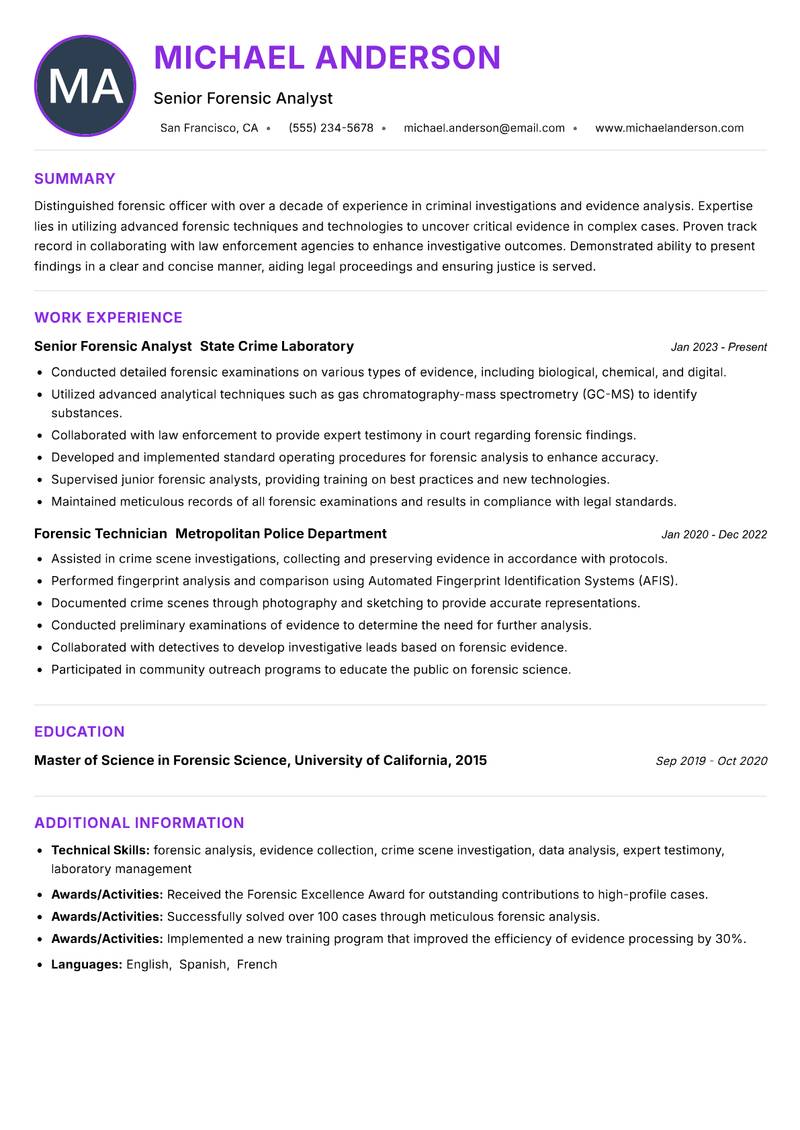
Senior Forensic Analyst Resume

Distinguished forensic officer with over a decade of experience in criminal investigations and evidence analysis. Expertise lies in utilizing advanced forensic techniques and technologies to uncover critical evidence in complex cases. Proven track record in collaborating with law enforcement agencies to enhance investigative outcomes. Demonstrated ability to present findings in a clear and concise manner, aiding legal proceedings and ensuring justice is served. Strong analytical skills complemented by a meticulous attention to detail, ensuring that all evidence is thoroughly examined and documented. Committed to continuous professional development and staying abreast of the latest advancements in forensic science.

forensic analysis evidence collection crime scene investigation data analysis expert testimony laboratory management
Forensic Officer Resume Preview Example
View PDF
  1. Conducted detailed forensic examinations on various types of evidence, including biological, chemical, and digital.
  2. Utilized advanced analytical techniques such as gas chromatography-mass spectrometry (GC-MS) to identify substances.
  3. Collaborated with law enforcement to provide expert testimony in court regarding forensic findings.
  4. Developed and implemented standard operating procedures for forensic analysis to enhance accuracy.
  5. Supervised junior forensic analysts, providing training on best practices and new technologies.
  6. Maintained meticulous records of all forensic examinations and results in compliance with legal standards.
  1. Assisted in crime scene investigations, collecting and preserving evidence in accordance with protocols.
  2. Performed fingerprint analysis and comparison using Automated Fingerprint Identification Systems (AFIS).
  3. Documented crime scenes through photography and sketching to provide accurate representations.
  4. Conducted preliminary examinations of evidence to determine the need for further analysis.
  5. Collaborated with detectives to develop investigative leads based on forensic evidence.
  6. Participated in community outreach programs to educate the public on forensic science.

Achievements

  • Received the Forensic Excellence Award for outstanding contributions to high-profile cases.
  • Successfully solved over 100 cases through meticulous forensic analysis.
  • Implemented a new training program that improved the efficiency of evidence processing by 30%.
⏱️
Experience
2-5 Years
📅
Level
Mid Level
🎓
Education
Master of Science in Forensic ...

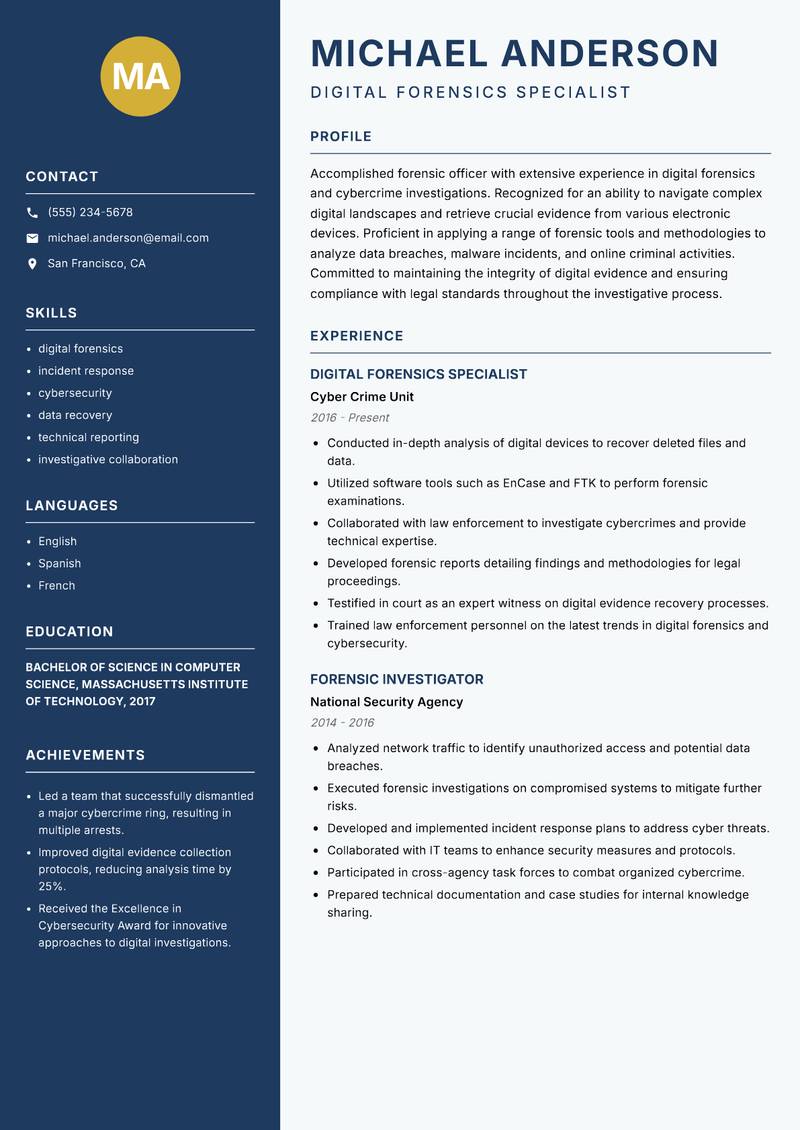
Digital Forensics Specialist Resume

Accomplished forensic officer with extensive experience in digital forensics and cybercrime investigations. Recognized for an ability to navigate complex digital landscapes and retrieve crucial evidence from various electronic devices. Proficient in applying a range of forensic tools and methodologies to analyze data breaches, malware incidents, and online criminal activities. Committed to maintaining the integrity of digital evidence and ensuring compliance with legal standards throughout the investigative process. Adept at communicating technical findings to non-technical stakeholders, facilitating informed decision-making in legal contexts. Passionate about advancing the field of digital forensics through continuous learning and collaboration.

digital forensics incident response cybersecurity data recovery technical reporting investigative collaboration
Forensic Officer Resume Preview Example
View PDF
  1. Conducted in-depth analysis of digital devices to recover deleted files and data.
  2. Utilized software tools such as EnCase and FTK to perform forensic examinations.
  3. Collaborated with law enforcement to investigate cybercrimes and provide technical expertise.
  4. Developed forensic reports detailing findings and methodologies for legal proceedings.
  5. Testified in court as an expert witness on digital evidence recovery processes.
  6. Trained law enforcement personnel on the latest trends in digital forensics and cybersecurity.
  1. Analyzed network traffic to identify unauthorized access and potential data breaches.
  2. Executed forensic investigations on compromised systems to mitigate further risks.
  3. Developed and implemented incident response plans to address cyber threats.
  4. Collaborated with IT teams to enhance security measures and protocols.
  5. Participated in cross-agency task forces to combat organized cybercrime.
  6. Prepared technical documentation and case studies for internal knowledge sharing.

Achievements

  • Led a team that successfully dismantled a major cybercrime ring, resulting in multiple arrests.
  • Improved digital evidence collection protocols, reducing analysis time by 25%.
  • Received the Excellence in Cybersecurity Award for innovative approaches to digital investigations.
⏱️
Experience
2-5 Years
📅
Level
Mid Level
🎓
Education
Bachelor of Science in Compute...

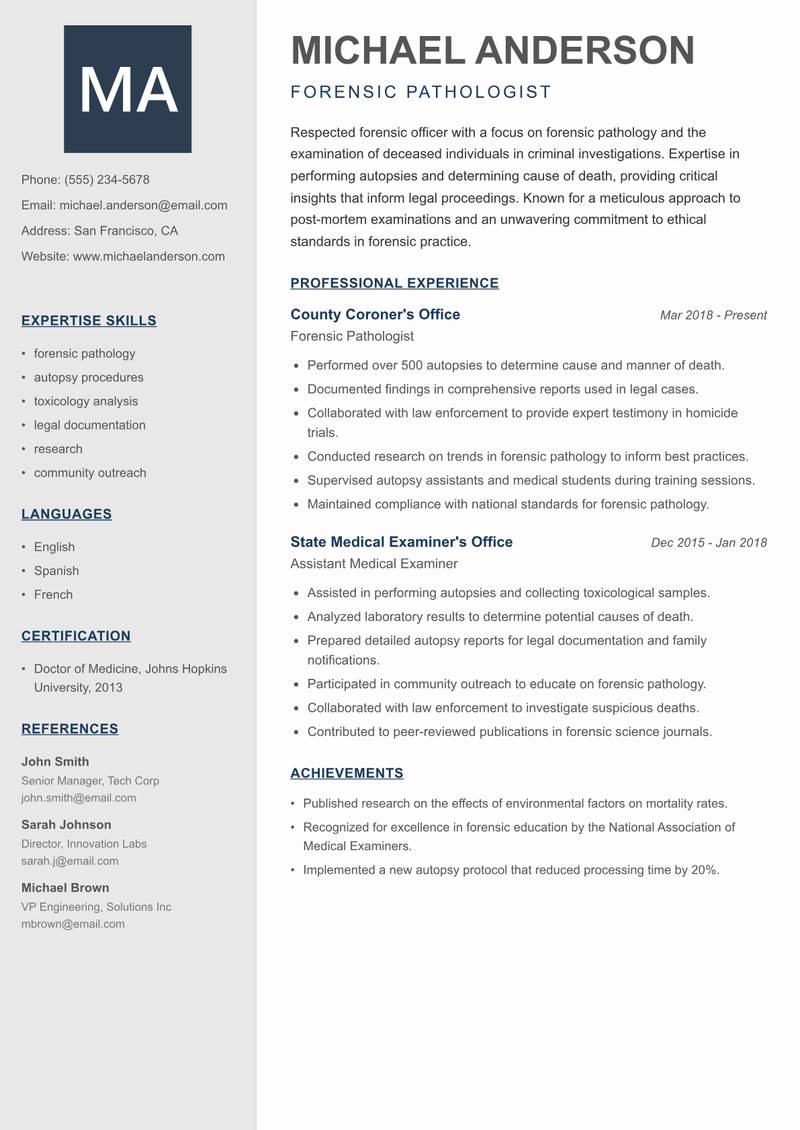
Forensic Pathologist Resume

Respected forensic officer with a focus on forensic pathology and the examination of deceased individuals in criminal investigations. Expertise in performing autopsies and determining cause of death, providing critical insights that inform legal proceedings. Known for a meticulous approach to post-mortem examinations and an unwavering commitment to ethical standards in forensic practice. Proven ability to collaborate effectively with law enforcement and legal professionals to present findings clearly and accurately. Strong background in research and teaching, contributing to the advancement of forensic pathology knowledge and practices. Dedicated to enhancing public trust in forensic science through transparency and accountability.

forensic pathology autopsy procedures toxicology analysis legal documentation research community outreach
Forensic Officer Resume Preview Example
View PDF
  1. Performed over 500 autopsies to determine cause and manner of death.
  2. Documented findings in comprehensive reports used in legal cases.
  3. Collaborated with law enforcement to provide expert testimony in homicide trials.
  4. Conducted research on trends in forensic pathology to inform best practices.
  5. Supervised autopsy assistants and medical students during training sessions.
  6. Maintained compliance with national standards for forensic pathology.
  1. Assisted in performing autopsies and collecting toxicological samples.
  2. Analyzed laboratory results to determine potential causes of death.
  3. Prepared detailed autopsy reports for legal documentation and family notifications.
  4. Participated in community outreach to educate on forensic pathology.
  5. Collaborated with law enforcement to investigate suspicious deaths.
  6. Contributed to peer-reviewed publications in forensic science journals.

Achievements

  • Published research on the effects of environmental factors on mortality rates.
  • Recognized for excellence in forensic education by the National Association of Medical Examiners.
  • Implemented a new autopsy protocol that reduced processing time by 20%.
⏱️
Experience
2-5 Years
📅
Level
Mid Level
🎓
Education
Doctor of Medicine, Johns Hopk...

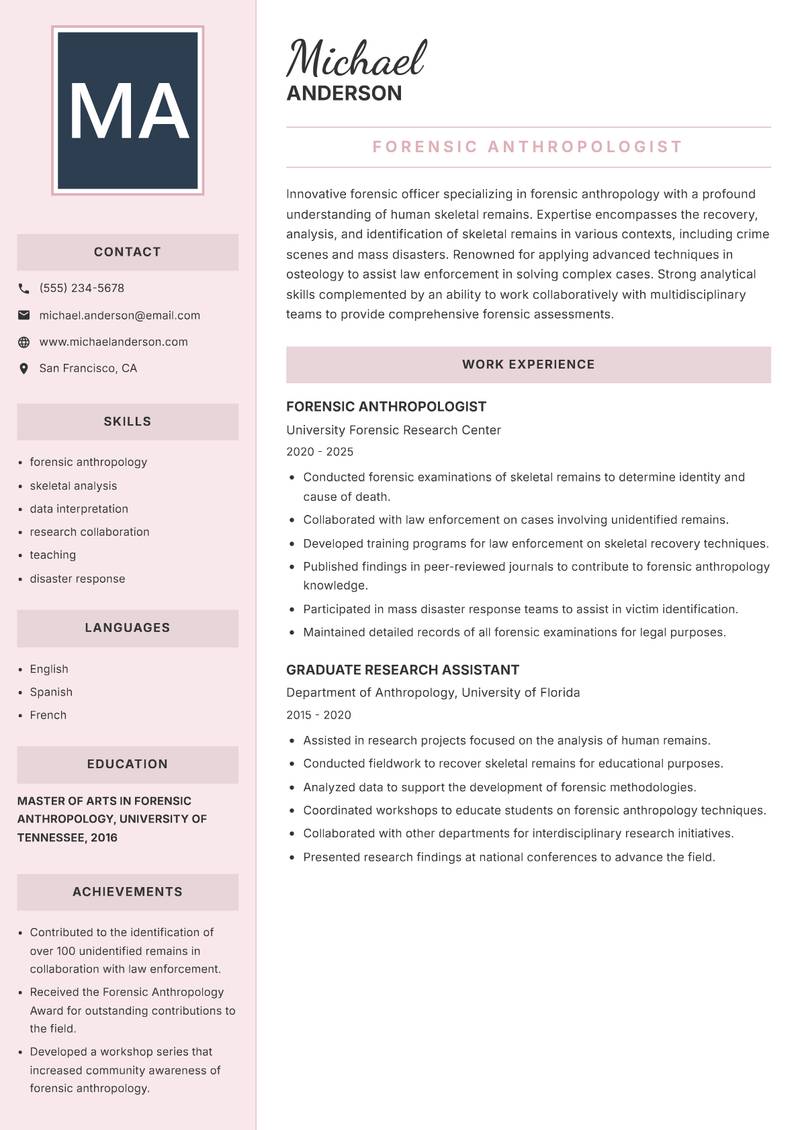
Forensic Anthropologist Resume

Innovative forensic officer specializing in forensic anthropology with a profound understanding of human skeletal remains. Expertise encompasses the recovery, analysis, and identification of skeletal remains in various contexts, including crime scenes and mass disasters. Renowned for applying advanced techniques in osteology to assist law enforcement in solving complex cases. Strong analytical skills complemented by an ability to work collaboratively with multidisciplinary teams to provide comprehensive forensic assessments. Committed to advancing the field of forensic anthropology through research and education, ensuring the highest standards of practice. Passionate about advocating for victims and their families through meticulous forensic work.

forensic anthropology skeletal analysis data interpretation research collaboration teaching disaster response
Forensic Officer Resume Preview Example
View PDF
  1. Conducted forensic examinations of skeletal remains to determine identity and cause of death.
  2. Collaborated with law enforcement on cases involving unidentified remains.
  3. Developed training programs for law enforcement on skeletal recovery techniques.
  4. Published findings in peer-reviewed journals to contribute to forensic anthropology knowledge.
  5. Participated in mass disaster response teams to assist in victim identification.
  6. Maintained detailed records of all forensic examinations for legal purposes.
  1. Assisted in research projects focused on the analysis of human remains.
  2. Conducted fieldwork to recover skeletal remains for educational purposes.
  3. Analyzed data to support the development of forensic methodologies.
  4. Coordinated workshops to educate students on forensic anthropology techniques.
  5. Collaborated with other departments for interdisciplinary research initiatives.
  6. Presented research findings at national conferences to advance the field.

Achievements

  • Contributed to the identification of over 100 unidentified remains in collaboration with law enforcement.
  • Received the Forensic Anthropology Award for outstanding contributions to the field.
  • Developed a workshop series that increased community awareness of forensic anthropology.
⏱️
Experience
2-5 Years
📅
Level
Mid Level
🎓
Education
Master of Arts in Forensic Ant...

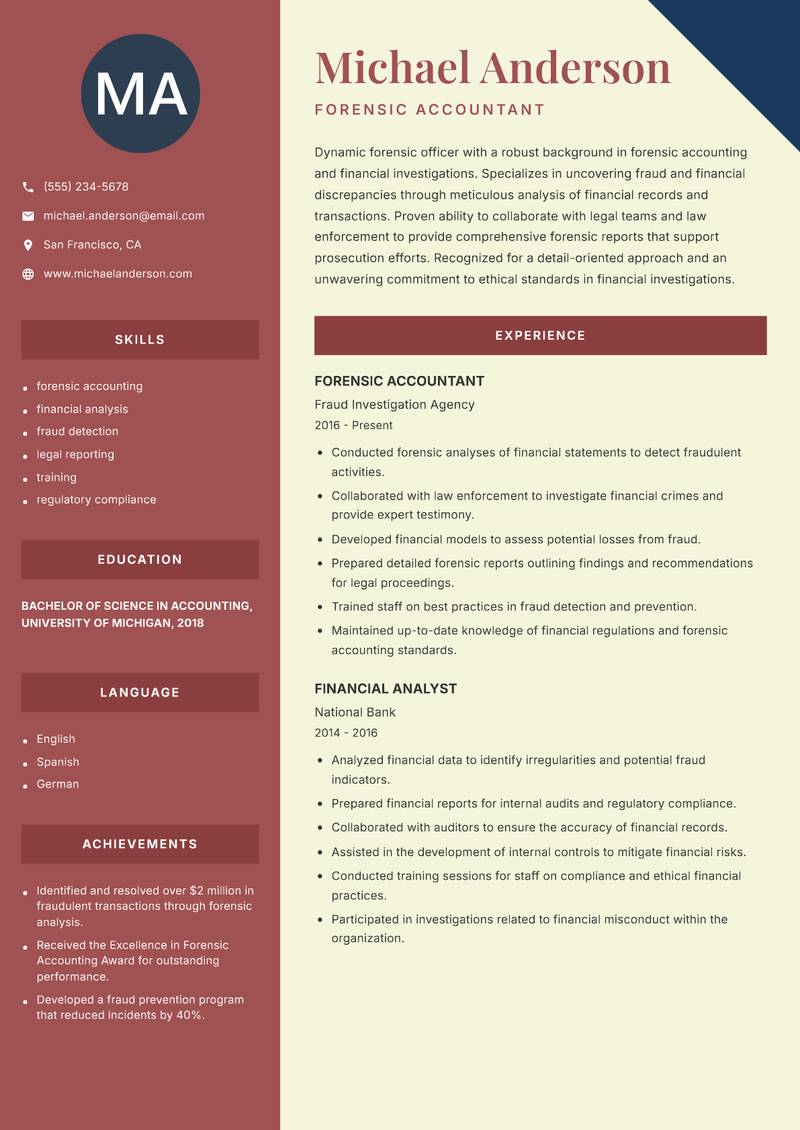
Forensic Accountant Resume

Dynamic forensic officer with a robust background in forensic accounting and financial investigations. Specializes in uncovering fraud and financial discrepancies through meticulous analysis of financial records and transactions. Proven ability to collaborate with legal teams and law enforcement to provide comprehensive forensic reports that support prosecution efforts. Recognized for a detail-oriented approach and an unwavering commitment to ethical standards in financial investigations. Adept at utilizing advanced forensic accounting software to analyze complex financial data. Passionate about educating clients and stakeholders on risk management and fraud prevention strategies.

forensic accounting financial analysis fraud detection legal reporting training regulatory compliance
Forensic Officer Resume Preview Example
View PDF
  1. Conducted forensic analyses of financial statements to detect fraudulent activities.
  2. Collaborated with law enforcement to investigate financial crimes and provide expert testimony.
  3. Developed financial models to assess potential losses from fraud.
  4. Prepared detailed forensic reports outlining findings and recommendations for legal proceedings.
  5. Trained staff on best practices in fraud detection and prevention.
  6. Maintained up-to-date knowledge of financial regulations and forensic accounting standards.
  1. Analyzed financial data to identify irregularities and potential fraud indicators.
  2. Prepared financial reports for internal audits and regulatory compliance.
  3. Collaborated with auditors to ensure the accuracy of financial records.
  4. Assisted in the development of internal controls to mitigate financial risks.
  5. Conducted training sessions for staff on compliance and ethical financial practices.
  6. Participated in investigations related to financial misconduct within the organization.

Achievements

  • Identified and resolved over $2 million in fraudulent transactions through forensic analysis.
  • Received the Excellence in Forensic Accounting Award for outstanding performance.
  • Developed a fraud prevention program that reduced incidents by 40%.
⏱️
Experience
2-5 Years
📅
Level
Mid Level
🎓
Education
Bachelor of Science in Account...

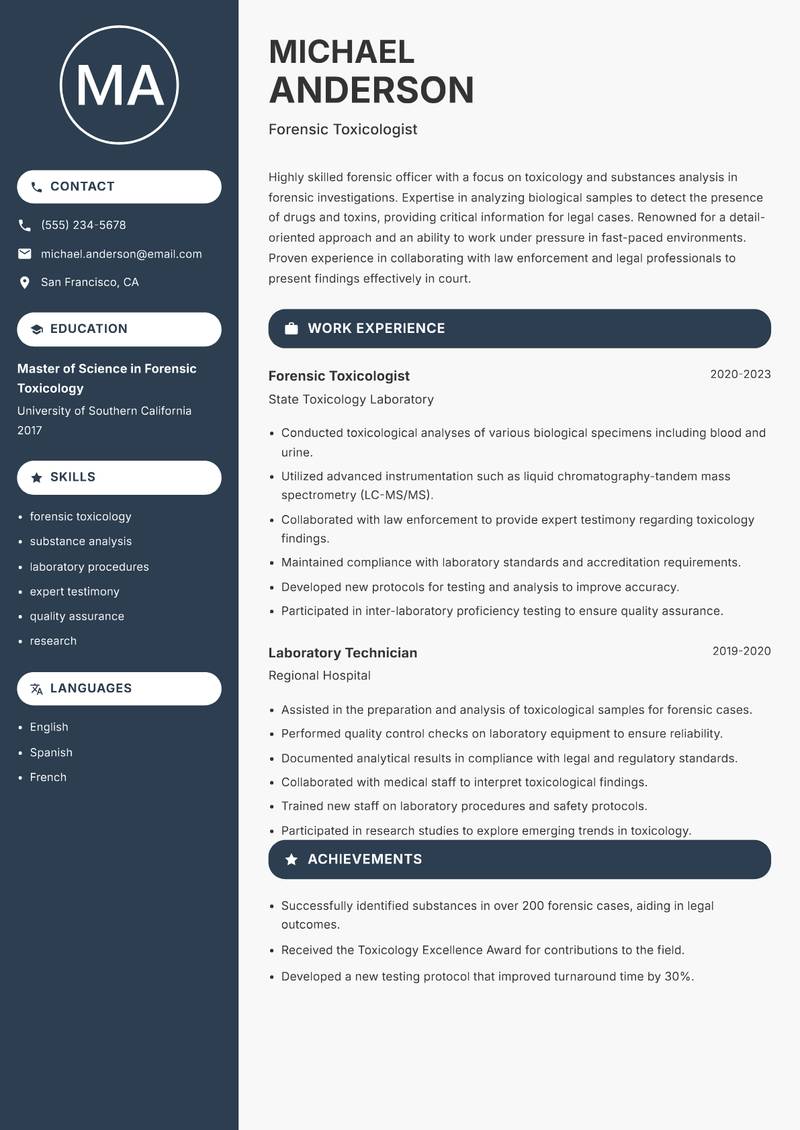
Forensic Toxicologist Resume

Highly skilled forensic officer with a focus on toxicology and substances analysis in forensic investigations. Expertise in analyzing biological samples to detect the presence of drugs and toxins, providing critical information for legal cases. Renowned for a detail-oriented approach and an ability to work under pressure in fast-paced environments. Proven experience in collaborating with law enforcement and legal professionals to present findings effectively in court. Committed to maintaining the integrity of forensic processes and ensuring compliance with regulatory standards. Passionate about advancing the field of toxicology through research and continuous education.

forensic toxicology substance analysis laboratory procedures expert testimony quality assurance research
Forensic Officer Resume Preview Example
View PDF
  1. Conducted toxicological analyses of various biological specimens including blood and urine.
  2. Utilized advanced instrumentation such as liquid chromatography-tandem mass spectrometry (LC-MS/MS).
  3. Collaborated with law enforcement to provide expert testimony regarding toxicology findings.
  4. Maintained compliance with laboratory standards and accreditation requirements.
  5. Developed new protocols for testing and analysis to improve accuracy.
  6. Participated in inter-laboratory proficiency testing to ensure quality assurance.
  1. Assisted in the preparation and analysis of toxicological samples for forensic cases.
  2. Performed quality control checks on laboratory equipment to ensure reliability.
  3. Documented analytical results in compliance with legal and regulatory standards.
  4. Collaborated with medical staff to interpret toxicological findings.
  5. Trained new staff on laboratory procedures and safety protocols.
  6. Participated in research studies to explore emerging trends in toxicology.

Achievements

  • Successfully identified substances in over 200 forensic cases, aiding in legal outcomes.
  • Received the Toxicology Excellence Award for contributions to the field.
  • Developed a new testing protocol that improved turnaround time by 30%.
⏱️
Experience
2-5 Years
📅
Level
Mid Level
🎓
Education
Master of Science in Forensic ...

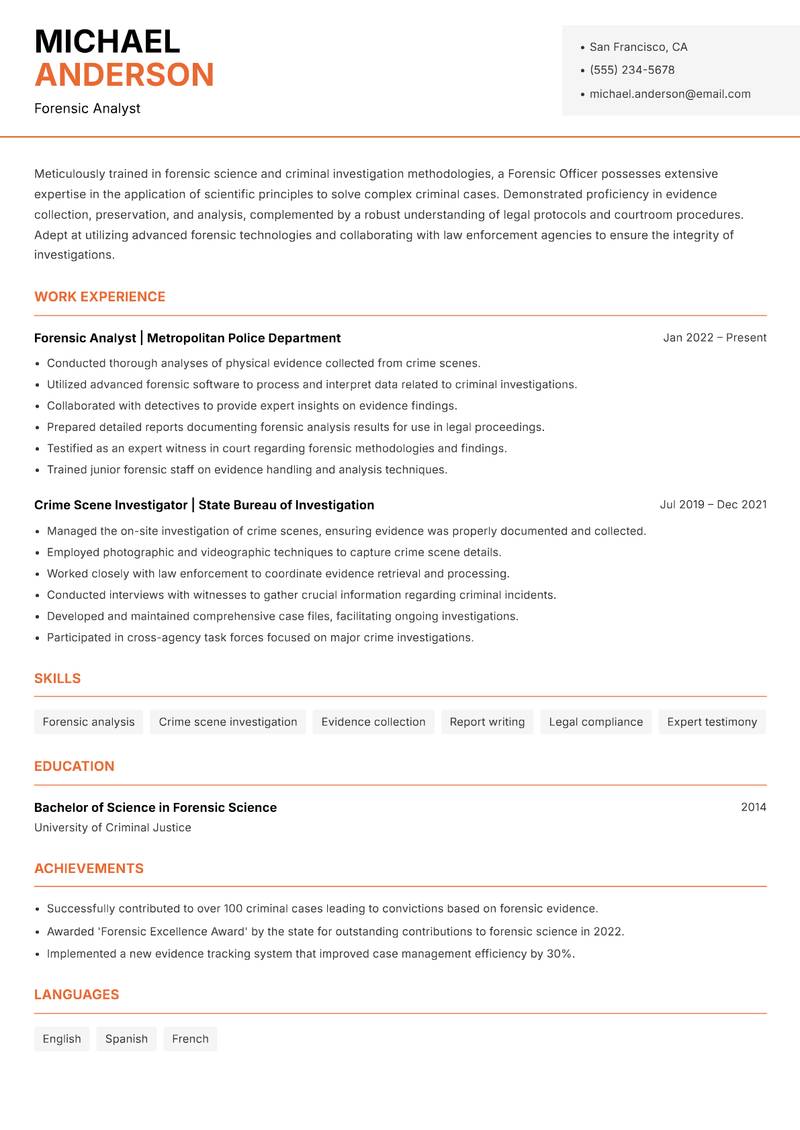
Forensic Analyst Resume

Meticulously trained in forensic science and criminal investigation methodologies, a Forensic Officer possesses extensive expertise in the application of scientific principles to solve complex criminal cases. Demonstrated proficiency in evidence collection, preservation, and analysis, complemented by a robust understanding of legal protocols and courtroom procedures. Adept at utilizing advanced forensic technologies and collaborating with law enforcement agencies to ensure the integrity of investigations. A commitment to continuous professional development, leveraging the latest advancements in forensic techniques to enhance investigative outcomes. Proven ability to communicate complex technical findings to diverse audiences, including legal professionals and jurors, ensuring clarity and comprehension. With a strong foundation in both theoretical knowledge and practical application, an exemplary career is characterized by a dedication to justice and the pursuit of truth within the forensic domain.

Forensic analysis Crime scene investigation Evidence collection Report writing Legal compliance Expert testimony
Forensic Officer Resume Preview Example
View PDF
  1. Conducted thorough analyses of physical evidence collected from crime scenes.
  2. Utilized advanced forensic software to process and interpret data related to criminal investigations.
  3. Collaborated with detectives to provide expert insights on evidence findings.
  4. Prepared detailed reports documenting forensic analysis results for use in legal proceedings.
  5. Testified as an expert witness in court regarding forensic methodologies and findings.
  6. Trained junior forensic staff on evidence handling and analysis techniques.
  1. Managed the on-site investigation of crime scenes, ensuring evidence was properly documented and collected.
  2. Employed photographic and videographic techniques to capture crime scene details.
  3. Worked closely with law enforcement to coordinate evidence retrieval and processing.
  4. Conducted interviews with witnesses to gather crucial information regarding criminal incidents.
  5. Developed and maintained comprehensive case files, facilitating ongoing investigations.
  6. Participated in cross-agency task forces focused on major crime investigations.

Achievements

  • Successfully contributed to over 100 criminal cases leading to convictions based on forensic evidence.
  • Awarded 'Forensic Excellence Award' by the state for outstanding contributions to forensic science in 2022.
  • Implemented a new evidence tracking system that improved case management efficiency by 30%.
⏱️
Experience
2-5 Years
📅
Level
Mid Level
🎓
Education
Bachelor of Science in Forensi...

Key Skills for Forensic Officer Positions

Resume Tips for Forensic Officer Applications

Strong Action Verbs for Forensic Officer Resumes

Investigated · Arrested · Prosecuted · Surveilled · Coordinated · Interviewed · Collected · Reported · Led · Secured · Updated · Achieved · Administered · Analyzed · Architected · Assessed

Common Mistakes to Avoid

Experience Levels

How to Write a Forensic Officer Resume

Browse Forensic Officer resume examples built around criminal investigations\, tailored for Law Enforcement roles.

A strong Forensic Officer resume leads with a focused professional summary that names the exact role and your standout achievement. In the experience section, open every bullet with a strong action verb and quantify the result with numbers wherever possible. Highlight your most relevant competencies — especially Criminal Investigations, Surveillance & Intelligence, and Evidence Collection & Management — in a dedicated Skills section positioned early so ATS systems and hiring managers both find it immediately.

For format, most Forensic Officer roles suit a reverse-chronological layout: most recent position first, working backwards. Keep to one page for under five years of experience, or two pages for senior candidates with a rich project or leadership history. Use clean, ATS-safe fonts (10–12pt), standard section headings (Summary, Experience, Education, Skills), and avoid tables, text boxes, or multi-column layouts that applicant tracking systems cannot parse reliably.
Frequently Asked Questions

What makes a strong Forensic Officer resume stand out to employers?

A standout Forensic Officer resume combines role-specific skills with quantified achievements. Name the exact job title in your professional summary, mirror keywords from each job posting, and open every bullet point with a strong action verb followed by a measurable result. Certifications, tools, and domain experience specific to forensic officer roles should appear prominently near the top.

What skills are most important to include on a Law Enforcement resume?

Recruiters hiring in Law Enforcement consistently look for Criminal Investigations, Surveillance & Intelligence, Evidence Collection & Management, Legal Procedures & Prosecution. List these in a dedicated Skills section near the top so both ATS systems and human reviewers spot them fast. Mirror the exact phrasing from each job posting wherever possible — many applicant tracking systems match literal strings rather than synonyms.

What is the best resume format for Law Enforcement professionals?

A reverse-chronological format is the standard choice for most Law Enforcement candidates — employers expect to see your most recent role first, working backwards. If you are transitioning into Law Enforcement from a related field, a hybrid format (brief skills summary at the top followed by chronological experience) can bridge the gap effectively. Keep the document to one page for under five years of experience, or two pages for senior specialists.

How do I make my Law Enforcement resume pass applicant tracking systems (ATS)?

Use standard section headings — Summary, Experience, Education, Skills — rather than creative labels that ATS parsers do not recognise. Embed domain keywords such as "Criminal Investigations" and "Surveillance & Intelligence" naturally inside your experience bullets rather than cramming them into a standalone keyword list. Avoid tables, multi-column layouts, text boxes, headers, footers, and images — these confuse most modern parsers and can cause your resume to be misread or rejected before a human sees it.

What mistakes do Law Enforcement professionals most commonly make on their resume?

The most frequent issue is being vague about specialisation and case types. Beyond that, generic objective statements, unquantified achievements, and inconsistent date formatting appear across almost every Law Enforcement application. Fix these by replacing every vague claim with a measurable outcome — specific numbers and named projects add credibility that adjectives cannot.

How long should a Law Enforcement resume be?

One page is appropriate for candidates with under five years of relevant Law Enforcement experience. Two pages are acceptable — and sometimes expected — for senior specialists, managers, or professionals with a strong portfolio of projects, publications, or credentials. Avoid padding to reach a page count: every line should directly support your application for the specific role you are targeting.

Should I include a professional summary at the top of my Law Enforcement resume?

Yes — a two to three sentence summary is the first section most recruiters read. Open with your title and years of Law Enforcement experience, then name your most relevant achievement or specialisation. One proven approach: Highlight your area of specialisation (homicide, fraud, cybercrime, counter-terrorism). Quantify casework — investigations completed, successful prosecutions supported, arrest rates. Mention commendations, awards, or distinguished service recognitions. Include certifications in forensics, crisis negotiation, or digital investigation — this level of specificity signals genuine expertise before a recruiter reaches your experience section.

Scroll to view samples