Forest Health Specialist Resume

These Forest Health Specialist resume samples are designed to help you write a resume that gets noticed by hiring managers and passes applicant tracking systems (ATS) in Forestry. Each example shows real formatting, section structure, and language you can adapt to your own background. When writing your own Forest Health Specialist resume, focus on highlighting silviculture & stand management, forest inventory & timber cruising and GIS & remote sensing (ArcGIS, LiDAR). Recruiters scan for these qualifications first, so they should appear early in your summary and experience sections. Use strong action verbs such as "managed", "inventoried", "mapped", "prescribed" to describe your achievements, and quantify your impact wherever possible — percentages, dollar amounts, or time saved make your resume more convincing. A common mistake to avoid: writing a generic objective statement instead of a targeted forest health specialist professional summary. Tailor your resume to each Forest Health Specialist position you apply for rather than using one generic version.

Forest Health Specialist Resume Template
View PDF
0.0 (0 ratings)

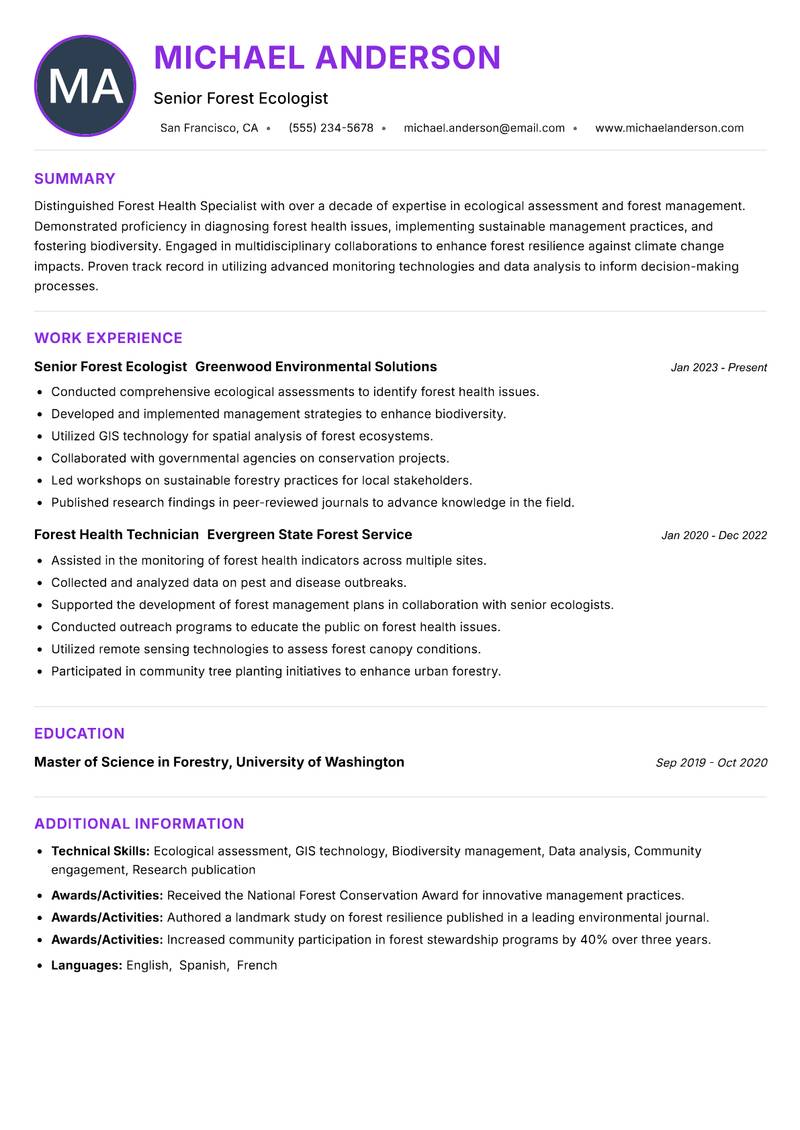
Senior Forest Ecologist Resume

Distinguished Forest Health Specialist with over a decade of expertise in ecological assessment and forest management. Demonstrated proficiency in diagnosing forest health issues, implementing sustainable management practices, and fostering biodiversity. Engaged in multidisciplinary collaborations to enhance forest resilience against climate change impacts. Proven track record in utilizing advanced monitoring technologies and data analysis to inform decision-making processes. Adept at developing comprehensive forest health programs that align with governmental and organizational policies. Committed to promoting educational initiatives and community engagement for forest stewardship.

Ecological assessment GIS technology Biodiversity management Data analysis Community engagement Research publication
Forest Health Specialist Resume Preview Example
View PDF
  1. Conducted comprehensive ecological assessments to identify forest health issues.
  2. Developed and implemented management strategies to enhance biodiversity.
  3. Utilized GIS technology for spatial analysis of forest ecosystems.
  4. Collaborated with governmental agencies on conservation projects.
  5. Led workshops on sustainable forestry practices for local stakeholders.
  6. Published research findings in peer-reviewed journals to advance knowledge in the field.
  1. Assisted in the monitoring of forest health indicators across multiple sites.
  2. Collected and analyzed data on pest and disease outbreaks.
  3. Supported the development of forest management plans in collaboration with senior ecologists.
  4. Conducted outreach programs to educate the public on forest health issues.
  5. Utilized remote sensing technologies to assess forest canopy conditions.
  6. Participated in community tree planting initiatives to enhance urban forestry.

Achievements

  • Received the National Forest Conservation Award for innovative management practices.
  • Authored a landmark study on forest resilience published in a leading environmental journal.
  • Increased community participation in forest stewardship programs by 40% over three years.
⏱️
Experience
2-5 Years
📅
Level
Mid Level
🎓
Education
Master of Science in Forestry,...

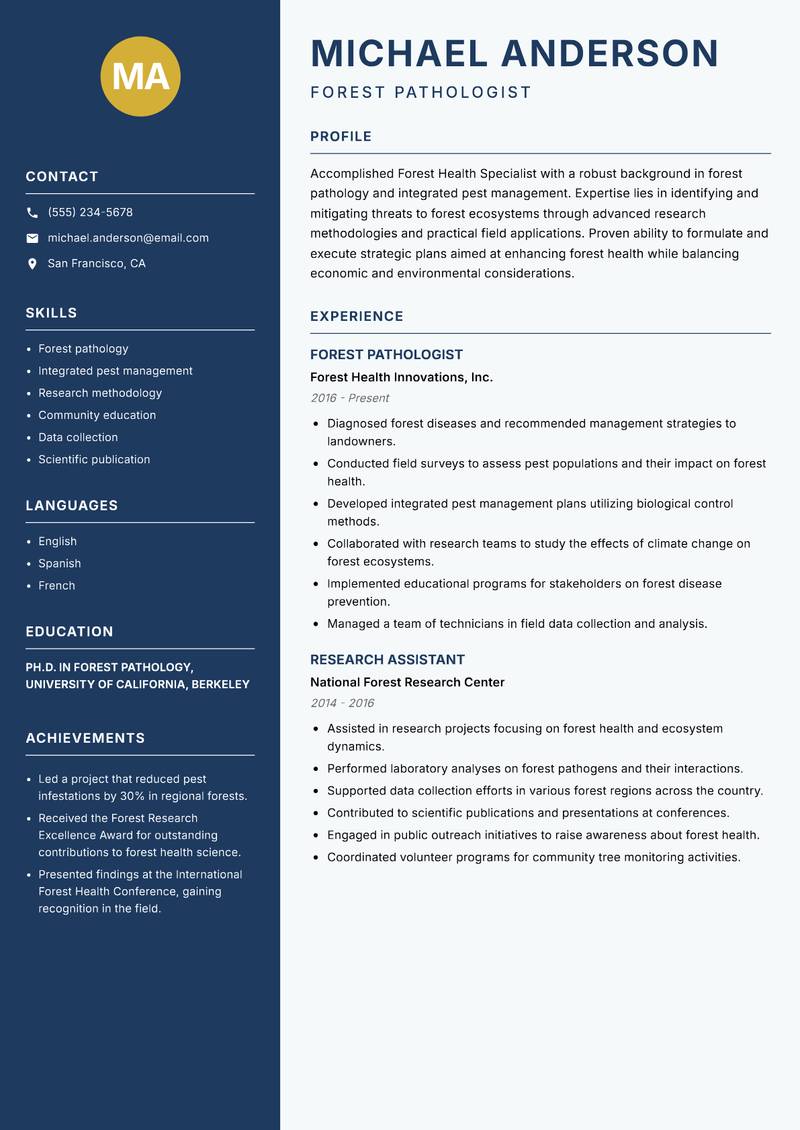
Forest Pathologist Resume

Accomplished Forest Health Specialist with a robust background in forest pathology and integrated pest management. Expertise lies in identifying and mitigating threats to forest ecosystems through advanced research methodologies and practical field applications. Proven ability to formulate and execute strategic plans aimed at enhancing forest health while balancing economic and environmental considerations. Strong advocate for sustainable forestry practices and community education initiatives. Recognized for developing innovative solutions that address complex ecological challenges and promote long-term forest viability.

Forest pathology Integrated pest management Research methodology Community education Data collection Scientific publication
Forest Health Specialist Resume Preview Example
View PDF
  1. Diagnosed forest diseases and recommended management strategies to landowners.
  2. Conducted field surveys to assess pest populations and their impact on forest health.
  3. Developed integrated pest management plans utilizing biological control methods.
  4. Collaborated with research teams to study the effects of climate change on forest ecosystems.
  5. Implemented educational programs for stakeholders on forest disease prevention.
  6. Managed a team of technicians in field data collection and analysis.
  1. Assisted in research projects focusing on forest health and ecosystem dynamics.
  2. Performed laboratory analyses on forest pathogens and their interactions.
  3. Supported data collection efforts in various forest regions across the country.
  4. Contributed to scientific publications and presentations at conferences.
  5. Engaged in public outreach initiatives to raise awareness about forest health.
  6. Coordinated volunteer programs for community tree monitoring activities.

Achievements

  • Led a project that reduced pest infestations by 30% in regional forests.
  • Received the Forest Research Excellence Award for outstanding contributions to forest health science.
  • Presented findings at the International Forest Health Conference, gaining recognition in the field.
⏱️
Experience
2-5 Years
📅
Level
Mid Level
🎓
Education
Ph.D. in Forest Pathology, Uni...

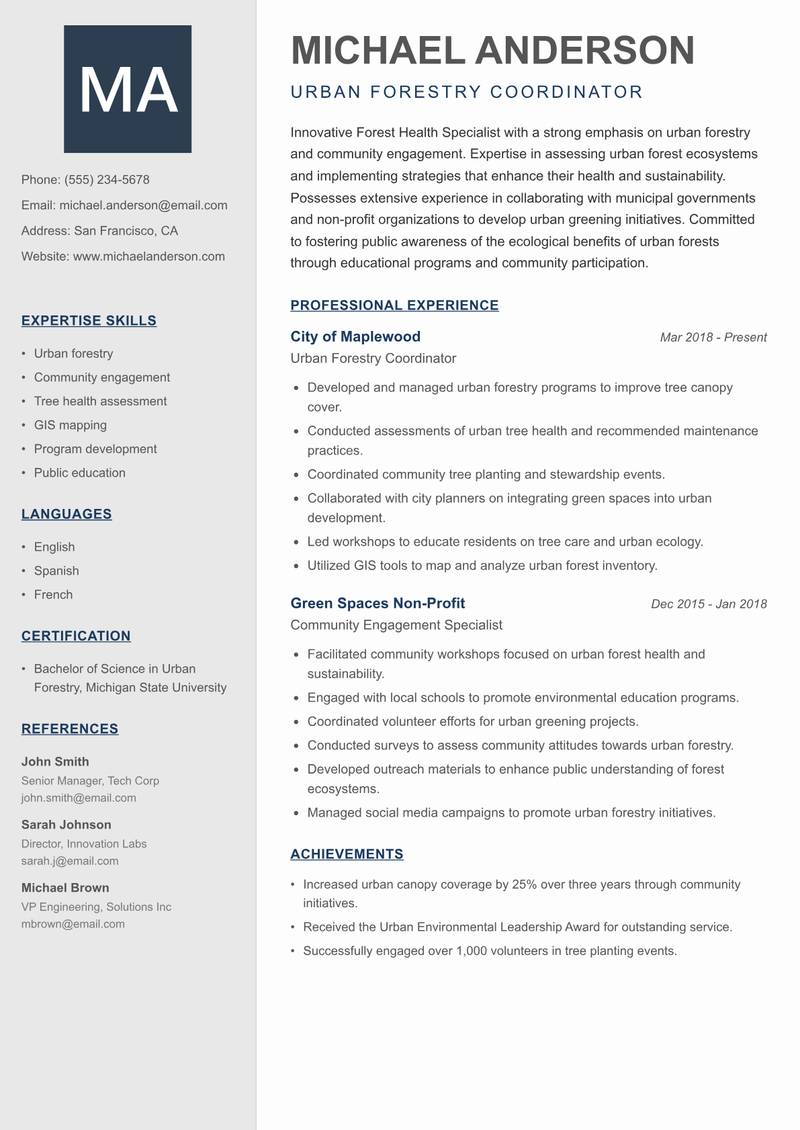
Urban Forestry Coordinator Resume

Innovative Forest Health Specialist with a strong emphasis on urban forestry and community engagement. Expertise in assessing urban forest ecosystems and implementing strategies that enhance their health and sustainability. Possesses extensive experience in collaborating with municipal governments and non-profit organizations to develop urban greening initiatives. Committed to fostering public awareness of the ecological benefits of urban forests through educational programs and community participation. Recognized for the ability to create actionable plans that address urban environmental challenges while promoting biodiversity.

Urban forestry Community engagement Tree health assessment GIS mapping Program development Public education
Forest Health Specialist Resume Preview Example
View PDF
  1. Developed and managed urban forestry programs to improve tree canopy cover.
  2. Conducted assessments of urban tree health and recommended maintenance practices.
  3. Coordinated community tree planting and stewardship events.
  4. Collaborated with city planners on integrating green spaces into urban development.
  5. Led workshops to educate residents on tree care and urban ecology.
  6. Utilized GIS tools to map and analyze urban forest inventory.
  1. Facilitated community workshops focused on urban forest health and sustainability.
  2. Engaged with local schools to promote environmental education programs.
  3. Coordinated volunteer efforts for urban greening projects.
  4. Conducted surveys to assess community attitudes towards urban forestry.
  5. Developed outreach materials to enhance public understanding of forest ecosystems.
  6. Managed social media campaigns to promote urban forestry initiatives.

Achievements

  • Increased urban canopy coverage by 25% over three years through community initiatives.
  • Received the Urban Environmental Leadership Award for outstanding service.
  • Successfully engaged over 1,000 volunteers in tree planting events.
⏱️
Experience
2-5 Years
📅
Level
Mid Level
🎓
Education
Bachelor of Science in Urban F...

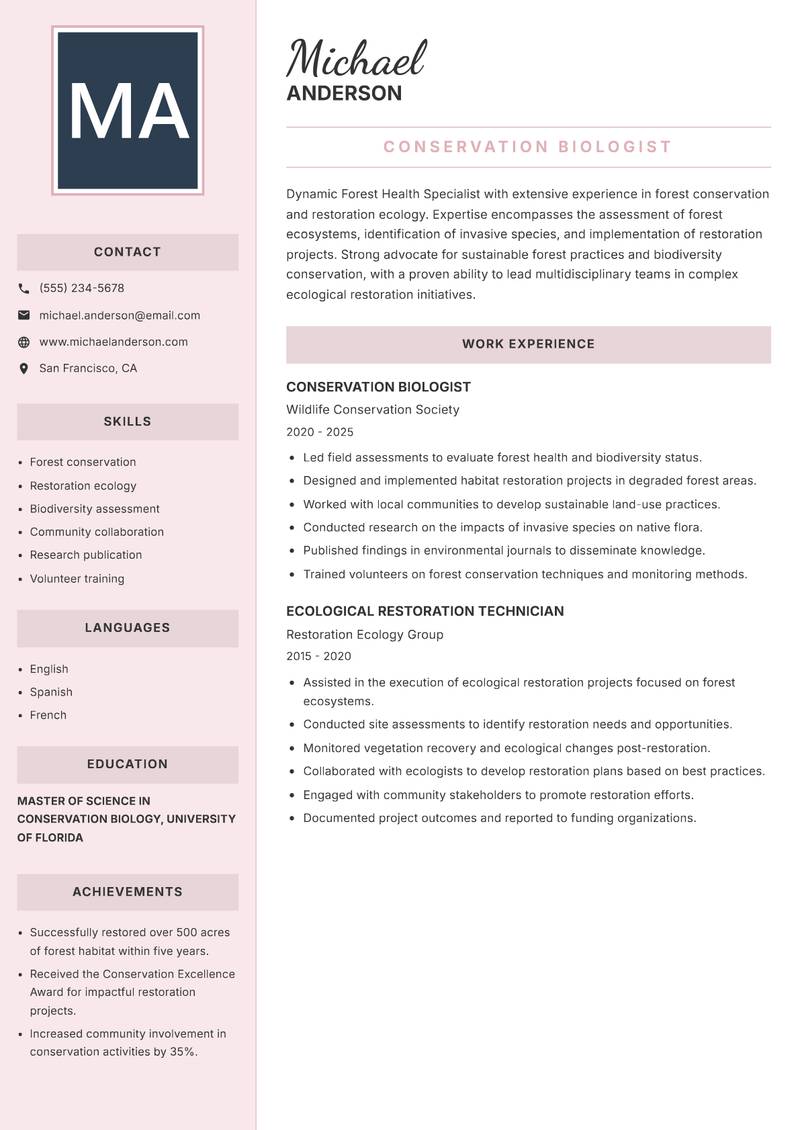
Conservation Biologist Resume

Dynamic Forest Health Specialist with extensive experience in forest conservation and restoration ecology. Expertise encompasses the assessment of forest ecosystems, identification of invasive species, and implementation of restoration projects. Strong advocate for sustainable forest practices and biodiversity conservation, with a proven ability to lead multidisciplinary teams in complex ecological restoration initiatives. Recognized for innovative approaches that engage local communities in conservation efforts, fostering a collaborative spirit toward forest health management. Committed to advancing scientific knowledge through research and applied practices.

Forest conservation Restoration ecology Biodiversity assessment Community collaboration Research publication Volunteer training
Forest Health Specialist Resume Preview Example
View PDF
  1. Led field assessments to evaluate forest health and biodiversity status.
  2. Designed and implemented habitat restoration projects in degraded forest areas.
  3. Worked with local communities to develop sustainable land-use practices.
  4. Conducted research on the impacts of invasive species on native flora.
  5. Published findings in environmental journals to disseminate knowledge.
  6. Trained volunteers on forest conservation techniques and monitoring methods.
  1. Assisted in the execution of ecological restoration projects focused on forest ecosystems.
  2. Conducted site assessments to identify restoration needs and opportunities.
  3. Monitored vegetation recovery and ecological changes post-restoration.
  4. Collaborated with ecologists to develop restoration plans based on best practices.
  5. Engaged with community stakeholders to promote restoration efforts.
  6. Documented project outcomes and reported to funding organizations.

Achievements

  • Successfully restored over 500 acres of forest habitat within five years.
  • Received the Conservation Excellence Award for impactful restoration projects.
  • Increased community involvement in conservation activities by 35%.
⏱️
Experience
2-5 Years
📅
Level
Mid Level
🎓
Education
Master of Science in Conservat...

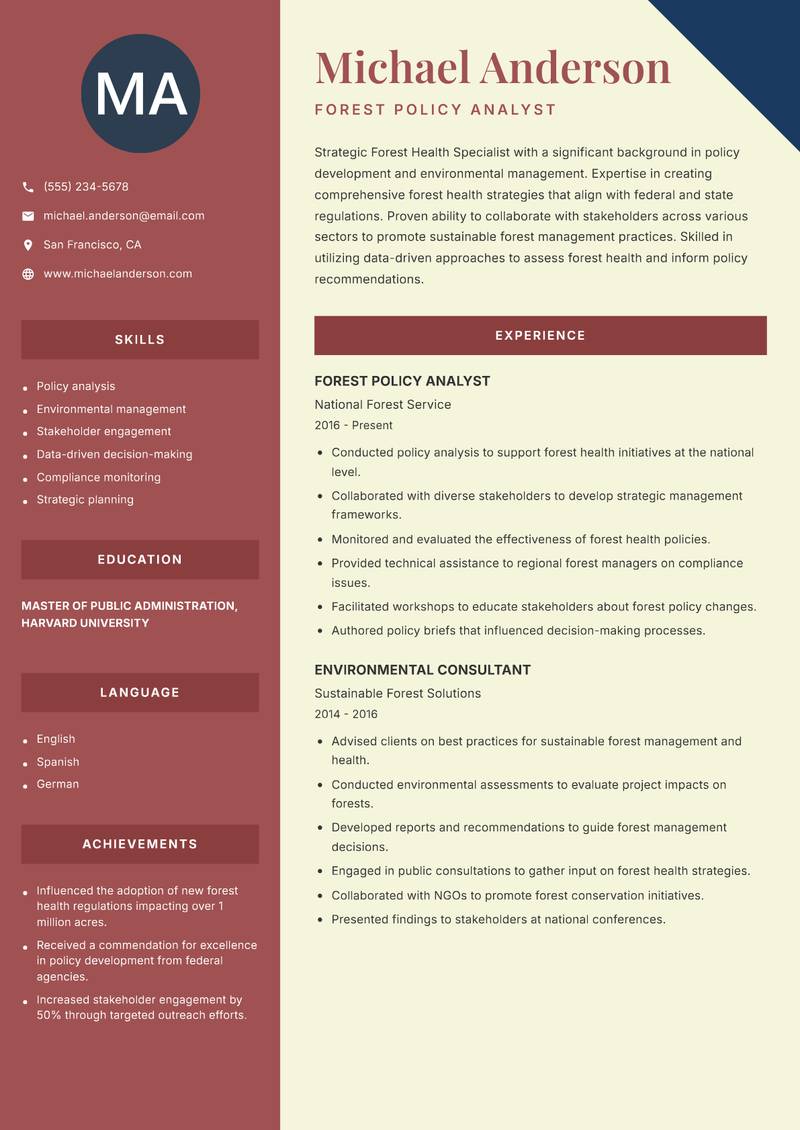
Forest Policy Analyst Resume

Strategic Forest Health Specialist with a significant background in policy development and environmental management. Expertise in creating comprehensive forest health strategies that align with federal and state regulations. Proven ability to collaborate with stakeholders across various sectors to promote sustainable forest management practices. Skilled in utilizing data-driven approaches to assess forest health and inform policy recommendations. Committed to advancing the integration of science and policy to enhance forest ecosystem resilience. Recognized for leadership in developing frameworks that support forest health initiatives.

Policy analysis Environmental management Stakeholder engagement Data-driven decision-making Compliance monitoring Strategic planning
Forest Health Specialist Resume Preview Example
View PDF
  1. Conducted policy analysis to support forest health initiatives at the national level.
  2. Collaborated with diverse stakeholders to develop strategic management frameworks.
  3. Monitored and evaluated the effectiveness of forest health policies.
  4. Provided technical assistance to regional forest managers on compliance issues.
  5. Facilitated workshops to educate stakeholders about forest policy changes.
  6. Authored policy briefs that influenced decision-making processes.
  1. Advised clients on best practices for sustainable forest management and health.
  2. Conducted environmental assessments to evaluate project impacts on forests.
  3. Developed reports and recommendations to guide forest management decisions.
  4. Engaged in public consultations to gather input on forest health strategies.
  5. Collaborated with NGOs to promote forest conservation initiatives.
  6. Presented findings to stakeholders at national conferences.

Achievements

  • Influenced the adoption of new forest health regulations impacting over 1 million acres.
  • Received a commendation for excellence in policy development from federal agencies.
  • Increased stakeholder engagement by 50% through targeted outreach efforts.
⏱️
Experience
2-5 Years
📅
Level
Mid Level
🎓
Education
Master of Public Administratio...

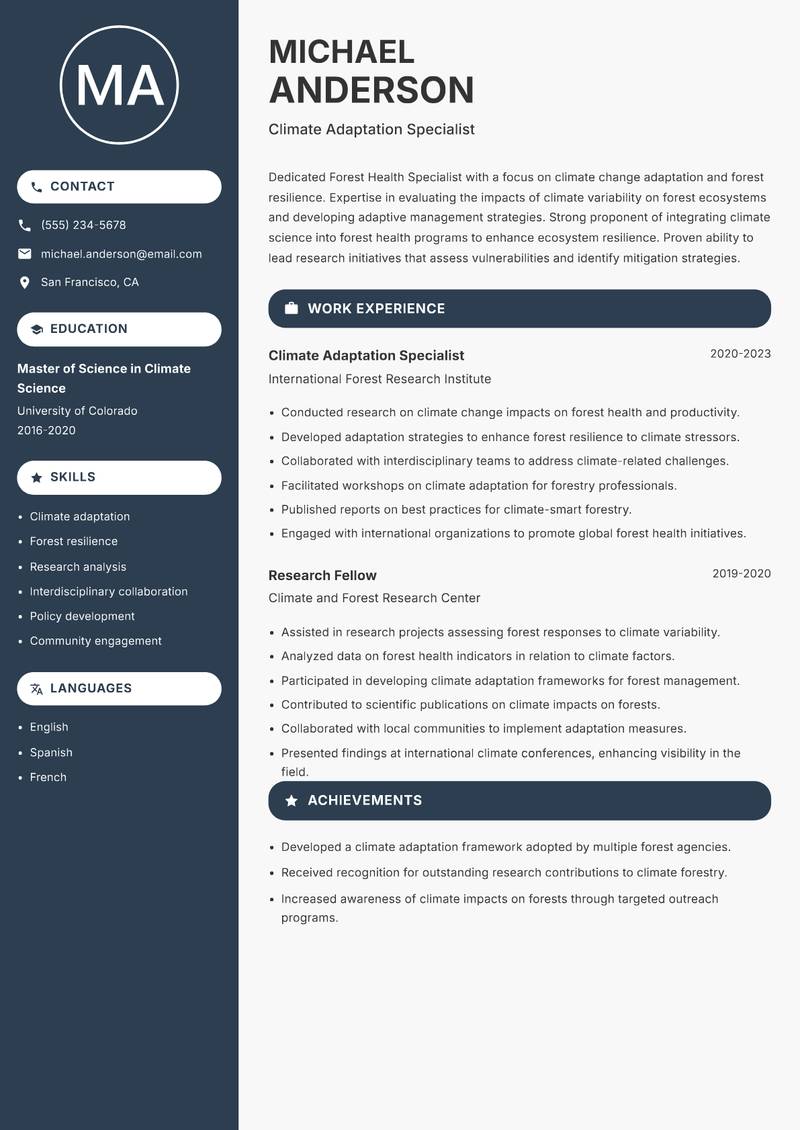
Climate Adaptation Specialist Resume

Dedicated Forest Health Specialist with a focus on climate change adaptation and forest resilience. Expertise in evaluating the impacts of climate variability on forest ecosystems and developing adaptive management strategies. Strong proponent of integrating climate science into forest health programs to enhance ecosystem resilience. Proven ability to lead research initiatives that assess vulnerabilities and identify mitigation strategies. Committed to fostering collaboration among scientists, policymakers, and land managers to promote adaptive forestry practices. Recognized for contributions to advancing knowledge on forest responses to climate change.

Climate adaptation Forest resilience Research analysis Interdisciplinary collaboration Policy development Community engagement
Forest Health Specialist Resume Preview Example
View PDF
  1. Conducted research on climate change impacts on forest health and productivity.
  2. Developed adaptation strategies to enhance forest resilience to climate stressors.
  3. Collaborated with interdisciplinary teams to address climate-related challenges.
  4. Facilitated workshops on climate adaptation for forestry professionals.
  5. Published reports on best practices for climate-smart forestry.
  6. Engaged with international organizations to promote global forest health initiatives.
  1. Assisted in research projects assessing forest responses to climate variability.
  2. Analyzed data on forest health indicators in relation to climate factors.
  3. Participated in developing climate adaptation frameworks for forest management.
  4. Contributed to scientific publications on climate impacts on forests.
  5. Collaborated with local communities to implement adaptation measures.
  6. Presented findings at international climate conferences, enhancing visibility in the field.

Achievements

  • Developed a climate adaptation framework adopted by multiple forest agencies.
  • Received recognition for outstanding research contributions to climate forestry.
  • Increased awareness of climate impacts on forests through targeted outreach programs.
⏱️
Experience
2-5 Years
📅
Level
Mid Level
🎓
Education
Master of Science in Climate S...

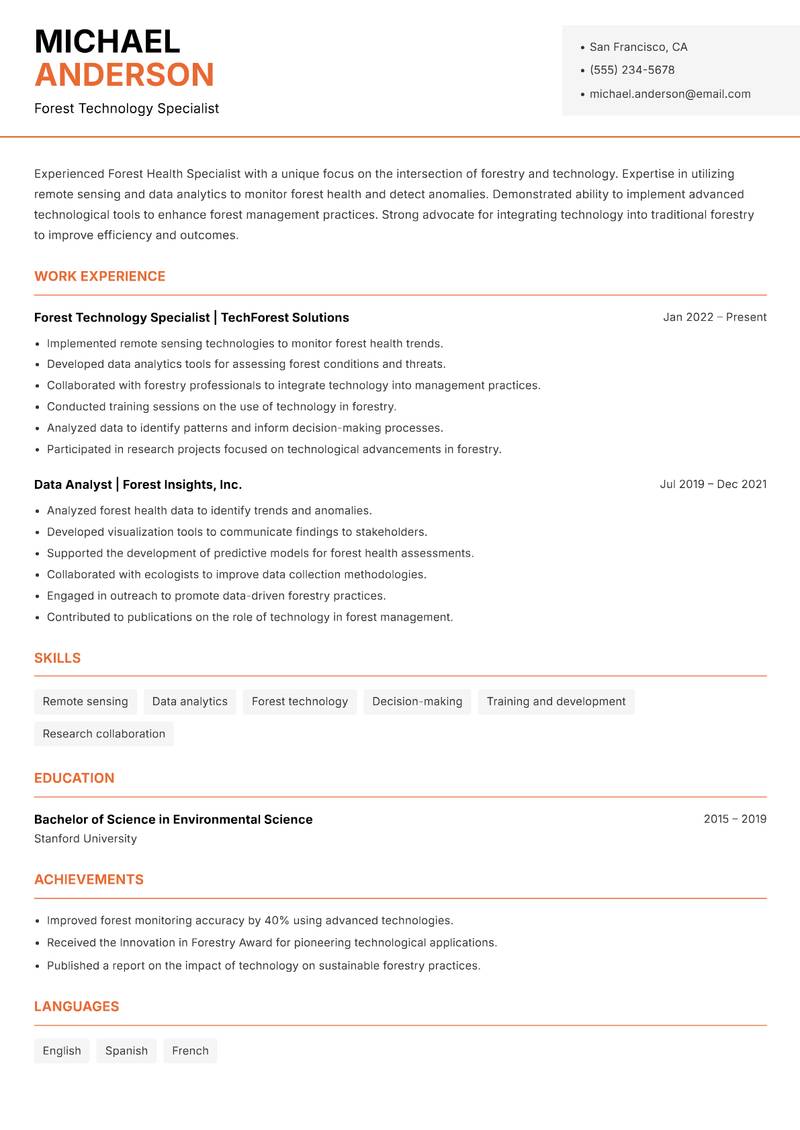
Forest Technology Specialist Resume

Experienced Forest Health Specialist with a unique focus on the intersection of forestry and technology. Expertise in utilizing remote sensing and data analytics to monitor forest health and detect anomalies. Demonstrated ability to implement advanced technological tools to enhance forest management practices. Strong advocate for integrating technology into traditional forestry to improve efficiency and outcomes. Recognized for contributions to developing innovative solutions that leverage technology for sustainable forestry practices. Committed to continuous learning and adaptation in the rapidly evolving field of forest health.

Remote sensing Data analytics Forest technology Decision-making Training and development Research collaboration
Forest Health Specialist Resume Preview Example
View PDF
  1. Implemented remote sensing technologies to monitor forest health trends.
  2. Developed data analytics tools for assessing forest conditions and threats.
  3. Collaborated with forestry professionals to integrate technology into management practices.
  4. Conducted training sessions on the use of technology in forestry.
  5. Analyzed data to identify patterns and inform decision-making processes.
  6. Participated in research projects focused on technological advancements in forestry.
  1. Analyzed forest health data to identify trends and anomalies.
  2. Developed visualization tools to communicate findings to stakeholders.
  3. Supported the development of predictive models for forest health assessments.
  4. Collaborated with ecologists to improve data collection methodologies.
  5. Engaged in outreach to promote data-driven forestry practices.
  6. Contributed to publications on the role of technology in forest management.

Achievements

  • Improved forest monitoring accuracy by 40% using advanced technologies.
  • Received the Innovation in Forestry Award for pioneering technological applications.
  • Published a report on the impact of technology on sustainable forestry practices.
⏱️
Experience
2-5 Years
📅
Level
Mid Level
🎓
Education
Bachelor of Science in Environ...

Key Skills for Forest Health Specialist Positions

Resume Tips for Forest Health Specialist Applications

Strong Action Verbs for Forest Health Specialist Resumes

Managed · Inventoried · Mapped · Prescribed · Harvested · Restored · Monitored · Surveyed · Certified · Planted · Achieved · Administered · Analyzed · Architected

Common Mistakes to Avoid

Experience Levels

How to Write a Forest Health Specialist Resume

Browse Forest Health Specialist resume examples built around silviculture & stand management, tailored for Forestry roles.

A strong Forest Health Specialist resume leads with a focused professional summary that names the exact role and your standout achievement. In the experience section, open every bullet with a strong action verb and quantify the result with numbers wherever possible. Highlight your most relevant competencies — especially Silviculture & Stand Management, Forest Inventory & Timber Cruising, and GIS & Remote Sensing (ArcGIS, LiDAR) — in a dedicated Skills section positioned early so ATS systems and hiring managers both find it immediately.

For format, most Forest Health Specialist roles suit a reverse-chronological layout: most recent position first, working backwards. Keep to one page for under five years of experience, or two pages for senior candidates with a rich project or leadership history. Use clean, ATS-safe fonts (10–12pt), standard section headings (Summary, Experience, Education, Skills), and avoid tables, text boxes, or multi-column layouts that applicant tracking systems cannot parse reliably.
Frequently Asked Questions

What makes a strong Forest Health Specialist resume stand out to employers?

A standout Forest Health Specialist resume combines role-specific skills with quantified achievements. Name the exact job title in your professional summary, mirror keywords from each job posting, and open every bullet point with a strong action verb followed by a measurable result. Certifications, tools, and domain experience specific to forest health specialist roles should appear prominently near the top.

What skills are most important to include on a Forestry resume?

Recruiters hiring in Forestry consistently look for Silviculture & Stand Management, Forest Inventory & Timber Cruising, GIS & Remote Sensing (ArcGIS, LiDAR), Forest Fire Management & Prevention. List these in a dedicated Skills section near the top so both ATS systems and human reviewers spot them fast. Mirror the exact phrasing from each job posting wherever possible — many applicant tracking systems match literal strings rather than synonyms.

What is the best resume format for Forestry professionals?

A reverse-chronological format is the standard choice for most Forestry candidates — employers expect to see your most recent role first, working backwards. If you are transitioning into Forestry from a related field, a hybrid format (brief skills summary at the top followed by chronological experience) can bridge the gap effectively. Keep the document to one page for under five years of experience, or two pages for senior specialists.

How do I make my Forestry resume pass applicant tracking systems (ATS)?

Use standard section headings — Summary, Experience, Education, Skills — rather than creative labels that ATS parsers do not recognise. Embed domain keywords such as "Silviculture & Stand Management" and "Forest Inventory & Timber Cruising" naturally inside your experience bullets rather than cramming them into a standalone keyword list. Avoid tables, multi-column layouts, text boxes, headers, footers, and images — these confuse most modern parsers and can cause your resume to be misread or rejected before a human sees it.

What mistakes do Forestry professionals most commonly make on their resume?

The most frequent issue is not demonstrating GIS proficiency — modern forestry is fundamentally spatial. Beyond that, generic objective statements, unquantified achievements, and inconsistent date formatting appear across almost every Forestry application. Fix these by replacing every vague claim with a measurable outcome — specific numbers and named projects add credibility that adjectives cannot.

How long should a Forestry resume be?

One page is appropriate for candidates with under five years of relevant Forestry experience. Two pages are acceptable — and sometimes expected — for senior specialists, managers, or professionals with a strong portfolio of projects, publications, or credentials. Avoid padding to reach a page count: every line should directly support your application for the specific role you are targeting.

Should I include a professional summary at the top of my Forestry resume?

Yes — a two to three sentence summary is the first section most recruiters read. Open with your title and years of Forestry experience, then name your most relevant achievement or specialisation. One proven approach: List species identification competency by forest type and geography — regional expertise matters — this level of specificity signals genuine expertise before a recruiter reaches your experience section.

Scroll to view samples