Human Factors Scientist Resume

These Human Factors Scientist resume samples are designed to help you write a resume that gets noticed by hiring managers and passes applicant tracking systems (ATS) in Behavioral Sciences. Each example shows real formatting, section structure, and language you can adapt to your own background. When writing your own Human Factors Scientist resume, focus on highlighting research design (Experimental, survey, ethnographic), statistical analysis (SPSS, r, python) and psychological assessment & testing. Recruiters scan for these qualifications first, so they should appear early in your summary and experience sections. Use strong action verbs such as "researched", "analyzed", "designed", "published" to describe your achievements, and quantify your impact wherever possible — percentages, dollar amounts, or time saved make your resume more convincing. A common mistake to avoid: writing a generic objective statement instead of a targeted human factors scientist professional summary. Tailor your resume to each Human Factors Scientist position you apply for rather than using one generic version.

Human Factors Scientist Resume Template
View PDF
0.0 (0 ratings)

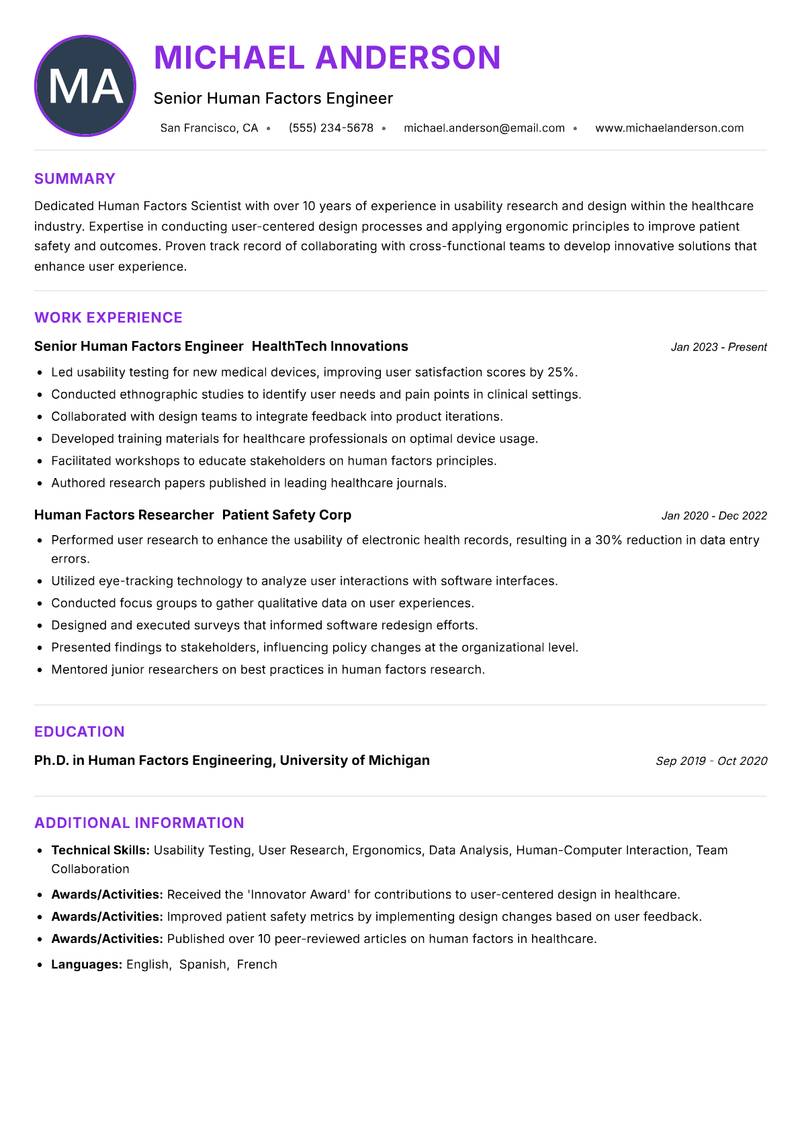
Senior Human Factors Engineer Resume

Dedicated Human Factors Scientist with over 10 years of experience in usability research and design within the healthcare industry. Expertise in conducting user-centered design processes and applying ergonomic principles to improve patient safety and outcomes. Proven track record of collaborating with cross-functional teams to develop innovative solutions that enhance user experience. Adept at utilizing qualitative and quantitative research methods to inform product development and policy recommendations. Committed to advocating for users and ensuring their needs are met through rigorous testing and evaluation. Strong communicator with the ability to present findings to diverse stakeholders, fostering a culture of user-centered thinking. Passionate about leveraging technology to improve healthcare delivery and patient engagement.

Usability Testing User Research Ergonomics Data Analysis Human-Computer Interaction Team Collaboration
Human Factors Scientist Resume Preview Example
View PDF
  1. Led usability testing for new medical devices, improving user satisfaction scores by 25%.
  2. Conducted ethnographic studies to identify user needs and pain points in clinical settings.
  3. Collaborated with design teams to integrate feedback into product iterations.
  4. Developed training materials for healthcare professionals on optimal device usage.
  5. Facilitated workshops to educate stakeholders on human factors principles.
  6. Authored research papers published in leading healthcare journals.
  1. Performed user research to enhance the usability of electronic health records, resulting in a 30% reduction in data entry errors.
  2. Utilized eye-tracking technology to analyze user interactions with software interfaces.
  3. Conducted focus groups to gather qualitative data on user experiences.
  4. Designed and executed surveys that informed software redesign efforts.
  5. Presented findings to stakeholders, influencing policy changes at the organizational level.
  6. Mentored junior researchers on best practices in human factors research.

Achievements

  • Received the 'Innovator Award' for contributions to user-centered design in healthcare.
  • Improved patient safety metrics by implementing design changes based on user feedback.
  • Published over 10 peer-reviewed articles on human factors in healthcare.
⏱️
Experience
2-5 Years
📅
Level
Mid Level
🎓
Education
Ph.D. in Human Factors Enginee...

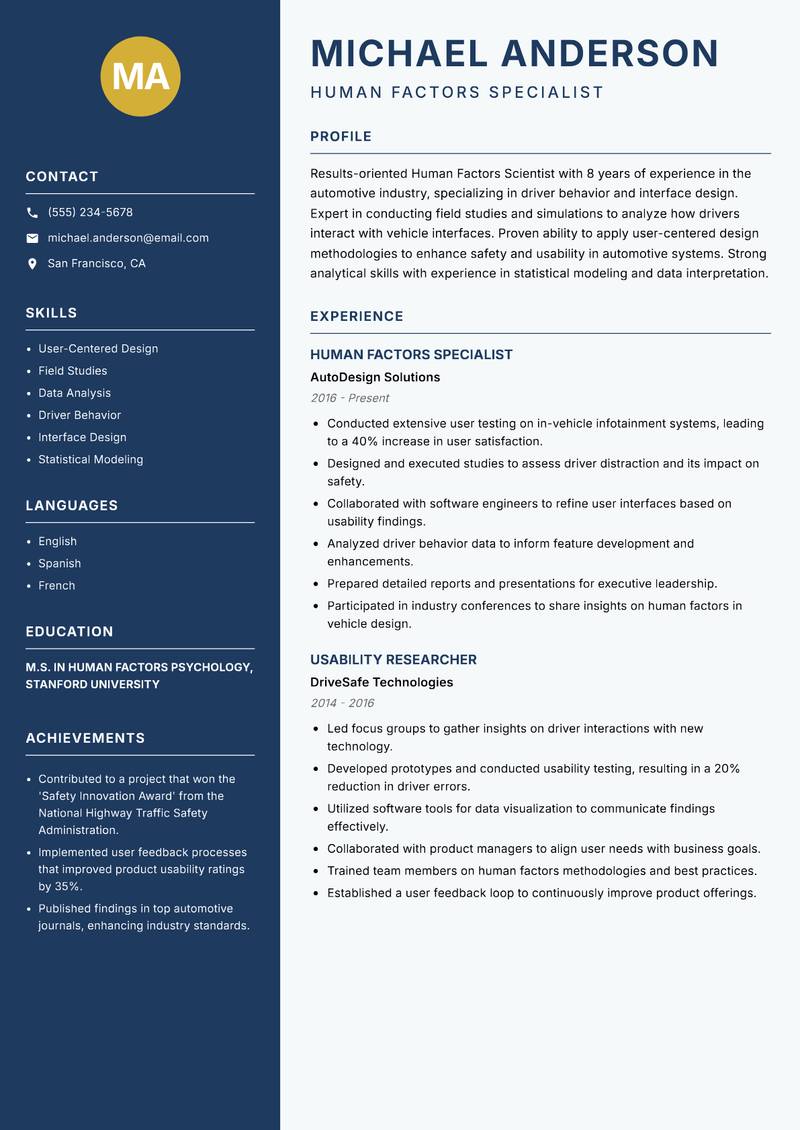
Human Factors Specialist Resume

Accomplished Human Factors Scientist with 8 years of experience in the automotive industry, specializing in driver behavior and interface design. Expert in conducting field studies and simulations to analyze how drivers interact with vehicle interfaces. Proven ability to apply user-centered design methodologies to enhance safety and usability in automotive systems. Strong analytical skills with experience in statistical modeling and data interpretation. Adept at collaborating with engineering teams to ensure that human factors are integrated into product development from the onset. Passionate about advancing automotive technology while prioritizing user safety and satisfaction. Excellent communicator with a knack for presenting complex findings in an accessible manner.

User-Centered Design Field Studies Data Analysis Driver Behavior Interface Design Statistical Modeling
Human Factors Scientist Resume Preview Example
View PDF
  1. Conducted extensive user testing on in-vehicle infotainment systems, leading to a 40% increase in user satisfaction.
  2. Designed and executed studies to assess driver distraction and its impact on safety.
  3. Collaborated with software engineers to refine user interfaces based on usability findings.
  4. Analyzed driver behavior data to inform feature development and enhancements.
  5. Prepared detailed reports and presentations for executive leadership.
  6. Participated in industry conferences to share insights on human factors in vehicle design.
  1. Led focus groups to gather insights on driver interactions with new technology.
  2. Developed prototypes and conducted usability testing, resulting in a 20% reduction in driver errors.
  3. Utilized software tools for data visualization to communicate findings effectively.
  4. Collaborated with product managers to align user needs with business goals.
  5. Trained team members on human factors methodologies and best practices.
  6. Established a user feedback loop to continuously improve product offerings.

Achievements

  • Contributed to a project that won the 'Safety Innovation Award' from the National Highway Traffic Safety Administration.
  • Implemented user feedback processes that improved product usability ratings by 35%.
  • Published findings in top automotive journals, enhancing industry standards.
⏱️
Experience
2-5 Years
📅
Level
Mid Level
🎓
Education
M.S. in Human Factors Psycholo...

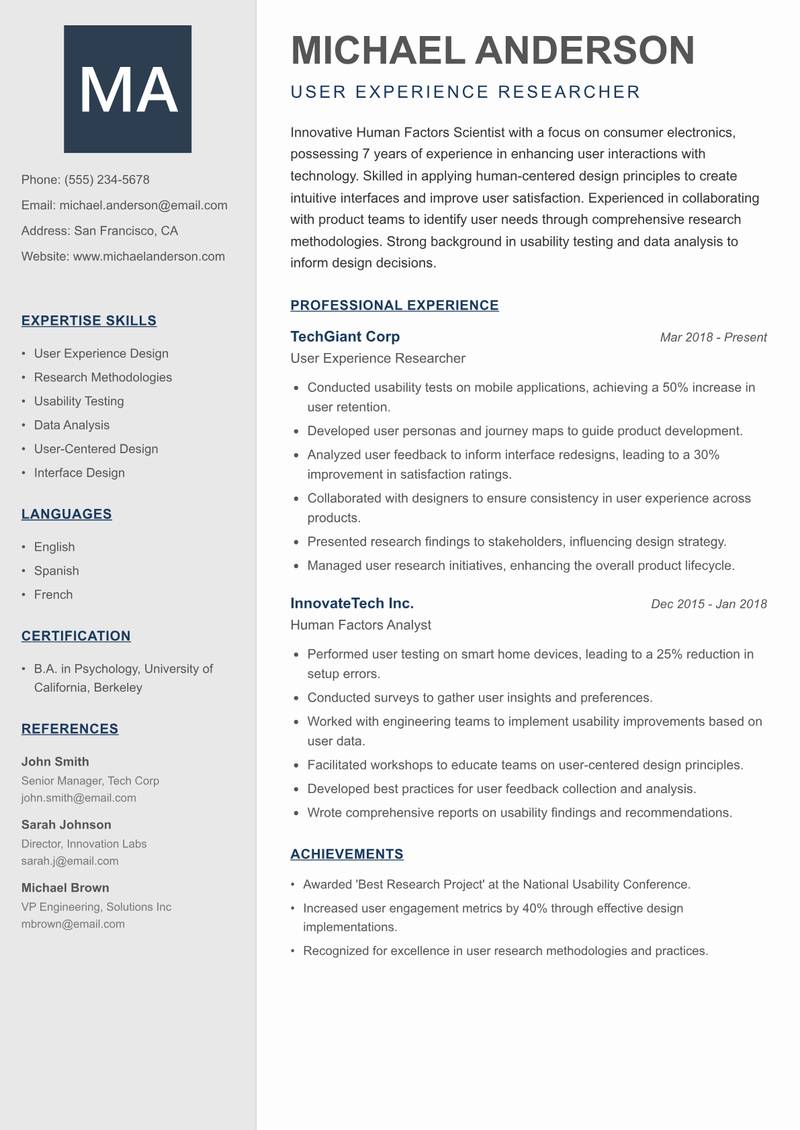
User Experience Researcher Resume

Innovative Human Factors Scientist with a focus on consumer electronics, possessing 7 years of experience in enhancing user interactions with technology. Skilled in applying human-centered design principles to create intuitive interfaces and improve user satisfaction. Experienced in collaborating with product teams to identify user needs through comprehensive research methodologies. Strong background in usability testing and data analysis to inform design decisions. Committed to delivering high-quality products that resonate with users and drive engagement. Excellent interpersonal skills, adept at working with diverse teams and stakeholders. Passionate about emerging technologies and their potential to transform user experiences.

User Experience Design Research Methodologies Usability Testing Data Analysis User-Centered Design Interface Design
Human Factors Scientist Resume Preview Example
View PDF
  1. Conducted usability tests on mobile applications, achieving a 50% increase in user retention.
  2. Developed user personas and journey maps to guide product development.
  3. Analyzed user feedback to inform interface redesigns, leading to a 30% improvement in satisfaction ratings.
  4. Collaborated with designers to ensure consistency in user experience across products.
  5. Presented research findings to stakeholders, influencing design strategy.
  6. Managed user research initiatives, enhancing the overall product lifecycle.
  1. Performed user testing on smart home devices, leading to a 25% reduction in setup errors.
  2. Conducted surveys to gather user insights and preferences.
  3. Worked with engineering teams to implement usability improvements based on user data.
  4. Facilitated workshops to educate teams on user-centered design principles.
  5. Developed best practices for user feedback collection and analysis.
  6. Wrote comprehensive reports on usability findings and recommendations.

Achievements

  • Awarded 'Best Research Project' at the National Usability Conference.
  • Increased user engagement metrics by 40% through effective design implementations.
  • Recognized for excellence in user research methodologies and practices.
⏱️
Experience
2-5 Years
📅
Level
Mid Level
🎓
Education
B.A. in Psychology, University...

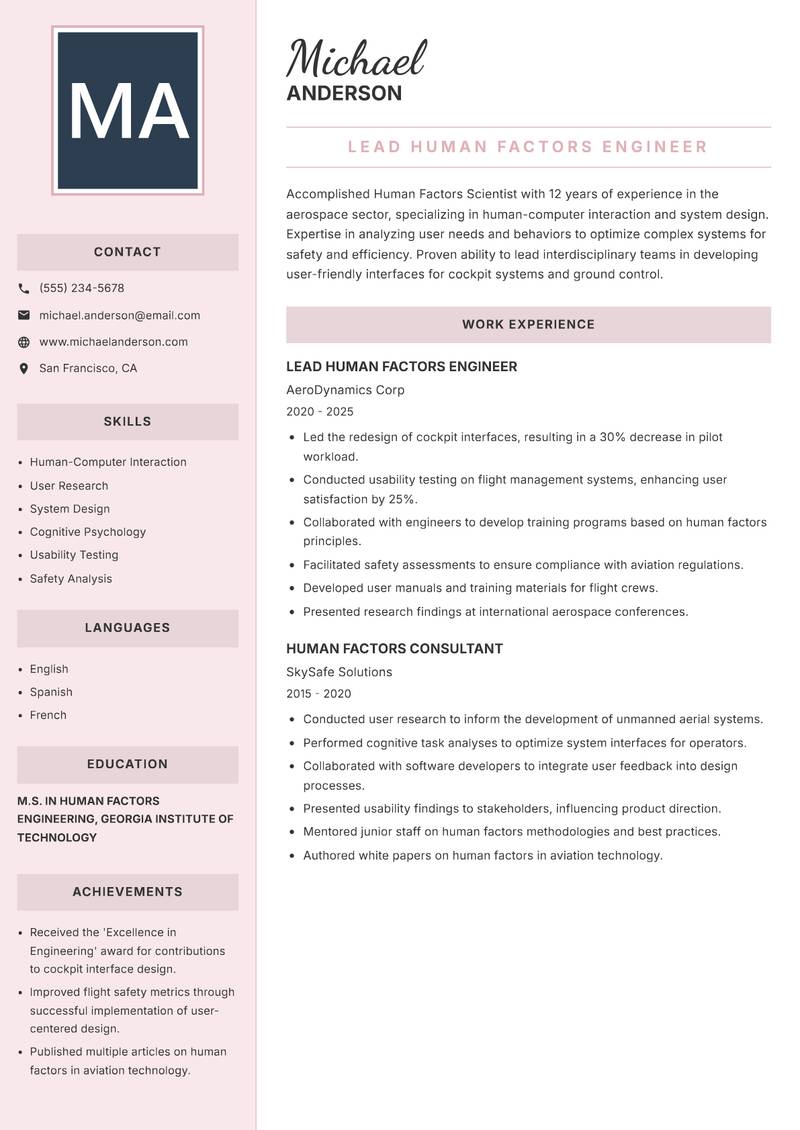
Lead Human Factors Engineer Resume

Accomplished Human Factors Scientist with 12 years of experience in the aerospace sector, specializing in human-computer interaction and system design. Expertise in analyzing user needs and behaviors to optimize complex systems for safety and efficiency. Proven ability to lead interdisciplinary teams in developing user-friendly interfaces for cockpit systems and ground control. Strong background in cognitive psychology, enabling a deep understanding of human capabilities and limitations. Committed to improving aviation safety through rigorous research and user testing. Excellent communicator with a talent for translating technical information for diverse audiences. Passionate about fostering a culture of safety and innovation in aerospace.

Human-Computer Interaction User Research System Design Cognitive Psychology Usability Testing Safety Analysis
Human Factors Scientist Resume Preview Example
View PDF
  1. Led the redesign of cockpit interfaces, resulting in a 30% decrease in pilot workload.
  2. Conducted usability testing on flight management systems, enhancing user satisfaction by 25%.
  3. Collaborated with engineers to develop training programs based on human factors principles.
  4. Facilitated safety assessments to ensure compliance with aviation regulations.
  5. Developed user manuals and training materials for flight crews.
  6. Presented research findings at international aerospace conferences.
  1. Conducted user research to inform the development of unmanned aerial systems.
  2. Performed cognitive task analyses to optimize system interfaces for operators.
  3. Collaborated with software developers to integrate user feedback into design processes.
  4. Presented usability findings to stakeholders, influencing product direction.
  5. Mentored junior staff on human factors methodologies and best practices.
  6. Authored white papers on human factors in aviation technology.

Achievements

  • Received the 'Excellence in Engineering' award for contributions to cockpit interface design.
  • Improved flight safety metrics through successful implementation of user-centered design.
  • Published multiple articles on human factors in aviation technology.
⏱️
Experience
2-5 Years
📅
Level
Mid Level
🎓
Education
M.S. in Human Factors Engineer...

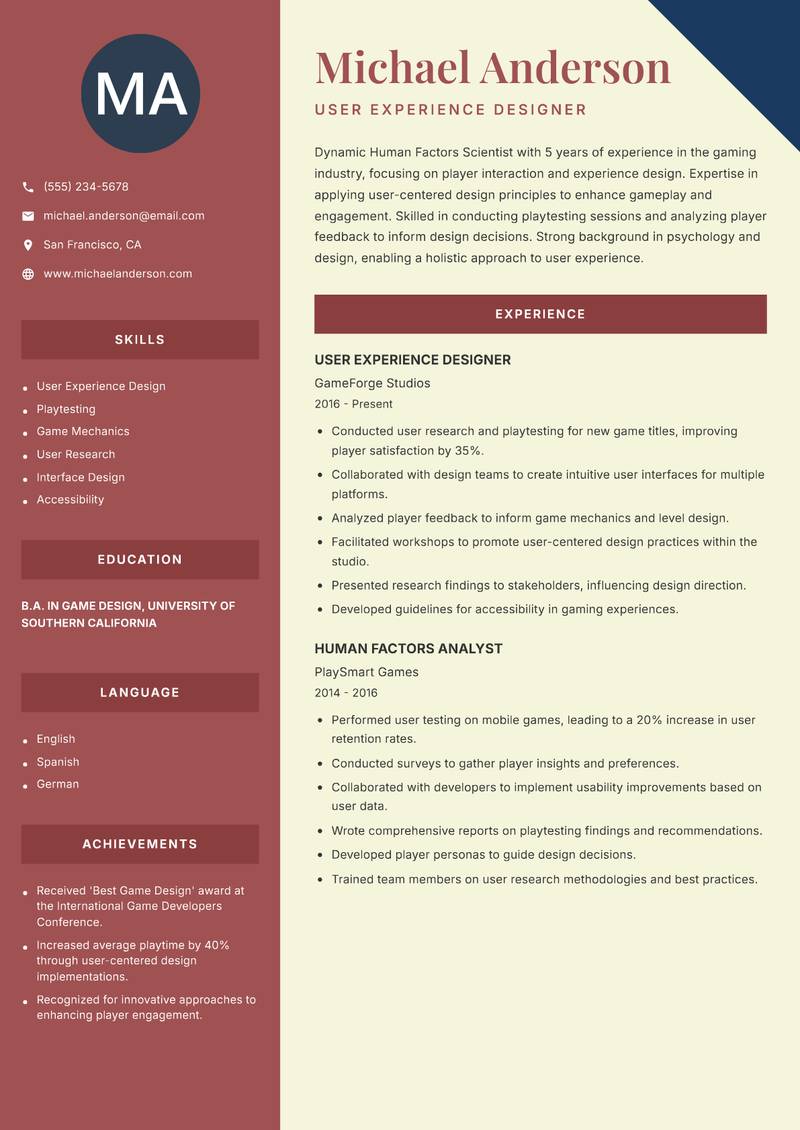
User Experience Designer Resume

Dynamic Human Factors Scientist with 5 years of experience in the gaming industry, focusing on player interaction and experience design. Expertise in applying user-centered design principles to enhance gameplay and engagement. Skilled in conducting playtesting sessions and analyzing player feedback to inform design decisions. Strong background in psychology and design, enabling a holistic approach to user experience. Committed to creating immersive gaming experiences that resonate with players. Excellent collaborative skills, working closely with developers, artists, and product managers to ensure a seamless user experience. Passionate about the intersection of technology and entertainment, driving innovation in game design.

User Experience Design Playtesting Game Mechanics User Research Interface Design Accessibility
Human Factors Scientist Resume Preview Example
View PDF
  1. Conducted user research and playtesting for new game titles, improving player satisfaction by 35%.
  2. Collaborated with design teams to create intuitive user interfaces for multiple platforms.
  3. Analyzed player feedback to inform game mechanics and level design.
  4. Facilitated workshops to promote user-centered design practices within the studio.
  5. Presented research findings to stakeholders, influencing design direction.
  6. Developed guidelines for accessibility in gaming experiences.
  1. Performed user testing on mobile games, leading to a 20% increase in user retention rates.
  2. Conducted surveys to gather player insights and preferences.
  3. Collaborated with developers to implement usability improvements based on user data.
  4. Wrote comprehensive reports on playtesting findings and recommendations.
  5. Developed player personas to guide design decisions.
  6. Trained team members on user research methodologies and best practices.

Achievements

  • Received 'Best Game Design' award at the International Game Developers Conference.
  • Increased average playtime by 40% through user-centered design implementations.
  • Recognized for innovative approaches to enhancing player engagement.
⏱️
Experience
2-5 Years
📅
Level
Mid Level
🎓
Education
B.A. in Game Design, Universit...

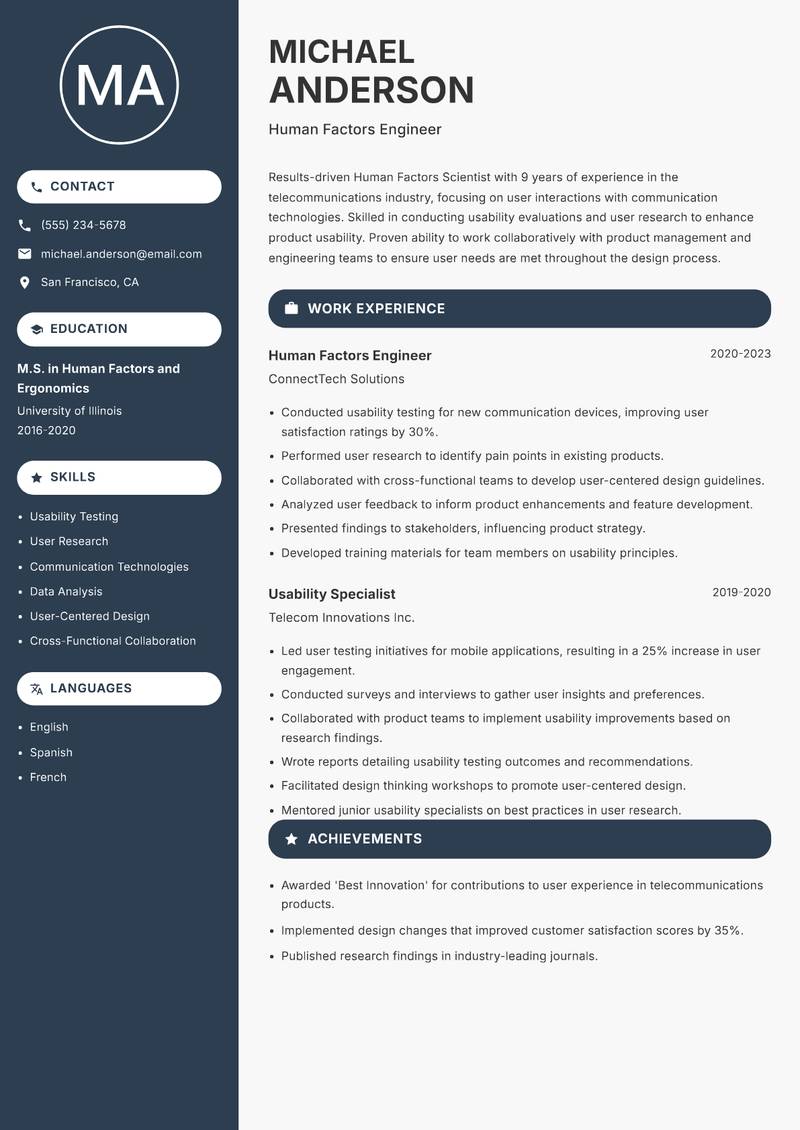
Human Factors Engineer Resume

Experienced Human Factors Scientist with 9 years of experience in the telecommunications industry, focusing on user interactions with communication technologies. Skilled in conducting usability evaluations and user research to enhance product usability. Proven ability to work collaboratively with product management and engineering teams to ensure user needs are met throughout the design process. Strong analytical skills, proficient in using various research and testing methodologies to inform design decisions. Committed to improving user satisfaction and engagement with communication products. Excellent presentation skills, capable of conveying complex findings to technical and non-technical audiences. Passionate about the role of human factors in advancing communication technologies.

Usability Testing User Research Communication Technologies Data Analysis User-Centered Design Cross-Functional Collaboration
Human Factors Scientist Resume Preview Example
View PDF
  1. Conducted usability testing for new communication devices, improving user satisfaction ratings by 30%.
  2. Performed user research to identify pain points in existing products.
  3. Collaborated with cross-functional teams to develop user-centered design guidelines.
  4. Analyzed user feedback to inform product enhancements and feature development.
  5. Presented findings to stakeholders, influencing product strategy.
  6. Developed training materials for team members on usability principles.
  1. Led user testing initiatives for mobile applications, resulting in a 25% increase in user engagement.
  2. Conducted surveys and interviews to gather user insights and preferences.
  3. Collaborated with product teams to implement usability improvements based on research findings.
  4. Wrote reports detailing usability testing outcomes and recommendations.
  5. Facilitated design thinking workshops to promote user-centered design.
  6. Mentored junior usability specialists on best practices in user research.

Achievements

  • Awarded 'Best Innovation' for contributions to user experience in telecommunications products.
  • Implemented design changes that improved customer satisfaction scores by 35%.
  • Published research findings in industry-leading journals.
⏱️
Experience
2-5 Years
📅
Level
Mid Level
🎓
Education
M.S. in Human Factors and Ergo...

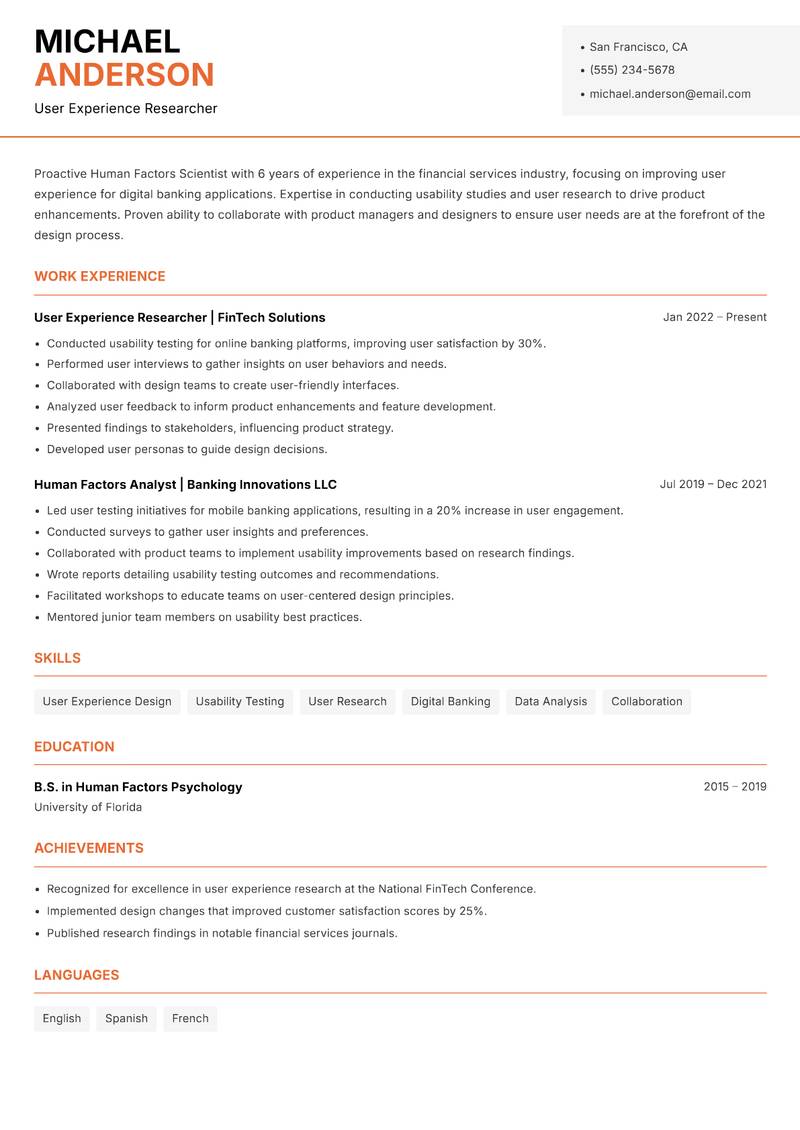
User Experience Researcher Resume

Driven Human Factors Scientist with 6 years of experience in the financial services industry, focusing on improving user experience for digital banking applications. Expertise in conducting usability studies and user research to drive product enhancements. Proven ability to collaborate with product managers and designers to ensure user needs are at the forefront of the design process. Strong analytical skills with experience in interpreting user data to inform design decisions. Committed to delivering a seamless user experience that fosters trust and satisfaction in financial products. Excellent communication skills, capable of presenting findings to diverse stakeholders. Passionate about leveraging technology to improve financial services and user engagement.

User Experience Design Usability Testing User Research Digital Banking Data Analysis Collaboration
Human Factors Scientist Resume Preview Example
View PDF
  1. Conducted usability testing for online banking platforms, improving user satisfaction by 30%.
  2. Performed user interviews to gather insights on user behaviors and needs.
  3. Collaborated with design teams to create user-friendly interfaces.
  4. Analyzed user feedback to inform product enhancements and feature development.
  5. Presented findings to stakeholders, influencing product strategy.
  6. Developed user personas to guide design decisions.
  1. Led user testing initiatives for mobile banking applications, resulting in a 20% increase in user engagement.
  2. Conducted surveys to gather user insights and preferences.
  3. Collaborated with product teams to implement usability improvements based on research findings.
  4. Wrote reports detailing usability testing outcomes and recommendations.
  5. Facilitated workshops to educate teams on user-centered design principles.
  6. Mentored junior team members on usability best practices.

Achievements

  • Recognized for excellence in user experience research at the National FinTech Conference.
  • Implemented design changes that improved customer satisfaction scores by 25%.
  • Published research findings in notable financial services journals.
⏱️
Experience
2-5 Years
📅
Level
Mid Level
🎓
Education
B.S. in Human Factors Psycholo...

Key Skills for Human Factors Scientist Positions

Resume Tips for Human Factors Scientist Applications

Strong Action Verbs for Human Factors Scientist Resumes

Researched · Analyzed · Designed · Published · Evaluated · Modeled · Consulted · Assessed · Presented · Collaborated · Achieved · Administered · Architected · Automated

Common Mistakes to Avoid

Experience Levels

How to Write a Human Factors Scientist Resume

Browse Human Factors Scientist resume examples built around research design (Experimental, survey, ethnographic), tailored for Behavioral Sciences roles.

A strong Human Factors Scientist resume leads with a focused professional summary that names the exact role and your standout achievement. In the experience section, open every bullet with a strong action verb and quantify the result with numbers wherever possible. Highlight your most relevant competencies — especially Research Design (Experimental, Survey, Ethnographic), Statistical Analysis (SPSS, R, Python), and Psychological Assessment & Testing — in a dedicated Skills section positioned early so ATS systems and hiring managers both find it immediately.

For format, most Human Factors Scientist roles suit a reverse-chronological layout: most recent position first, working backwards. Keep to one page for under five years of experience, or two pages for senior candidates with a rich project or leadership history. Use clean, ATS-safe fonts (10–12pt), standard section headings (Summary, Experience, Education, Skills), and avoid tables, text boxes, or multi-column layouts that applicant tracking systems cannot parse reliably.
Frequently Asked Questions

What makes a strong Human Factors Scientist resume stand out to employers?

A standout Human Factors Scientist resume combines role-specific skills with quantified achievements. Name the exact job title in your professional summary, mirror keywords from each job posting, and open every bullet point with a strong action verb followed by a measurable result. Certifications, tools, and domain experience specific to human factors scientist roles should appear prominently near the top.

What skills are most important to include on a Behavioral Sciences resume?

Recruiters hiring in Behavioral Sciences consistently look for Research Design (Experimental, Survey, Ethnographic), Statistical Analysis (SPSS, R, Python), Psychological Assessment & Testing, Cognitive & Social Psychology Theory. List these in a dedicated Skills section near the top so both ATS systems and human reviewers spot them fast. Mirror the exact phrasing from each job posting wherever possible — many applicant tracking systems match literal strings rather than synonyms.

What is the best resume format for Behavioral Sciences professionals?

A reverse-chronological format is the standard choice for most Behavioral Sciences candidates — employers expect to see your most recent role first, working backwards. If you are transitioning into Behavioral Sciences from a related field, a hybrid format (brief skills summary at the top followed by chronological experience) can bridge the gap effectively. Keep the document to one page for under five years of experience, or two pages for senior specialists.

How do I make my Behavioral Sciences resume pass applicant tracking systems (ATS)?

Use standard section headings — Summary, Experience, Education, Skills — rather than creative labels that ATS parsers do not recognise. Embed domain keywords such as "Research Design (Experimental, Survey, Ethnographic)" and "Statistical Analysis (SPSS, R, Python)" naturally inside your experience bullets rather than cramming them into a standalone keyword list. Avoid tables, multi-column layouts, text boxes, headers, footers, and images — these confuse most modern parsers and can cause your resume to be misread or rejected before a human sees it.

What mistakes do Behavioral Sciences professionals most commonly make on their resume?

The most frequent issue is failing to specify research methods — behavioral science is method-driven, and employers assess competency through methodology. Beyond that, generic objective statements, unquantified achievements, and inconsistent date formatting appear across almost every Behavioral Sciences application. Fix these by replacing every vague claim with a measurable outcome — specific numbers and named projects add credibility that adjectives cannot.

How long should a Behavioral Sciences resume be?

One page is appropriate for candidates with under five years of relevant Behavioral Sciences experience. Two pages are acceptable — and sometimes expected — for senior specialists, managers, or professionals with a strong portfolio of projects, publications, or credentials. Avoid padding to reach a page count: every line should directly support your application for the specific role you are targeting.

Should I include a professional summary at the top of my Behavioral Sciences resume?

Yes — a two to three sentence summary is the first section most recruiters read. Open with your title and years of Behavioral Sciences experience, then name your most relevant achievement or specialisation. One proven approach: Demonstrate methodological rigor — specify quantitative and qualitative techniques mastered — this level of specificity signals genuine expertise before a recruiter reaches your experience section.

Scroll to view samples