Incident Commander Resume

These Incident Commander resume samples are designed to help you write a resume that gets noticed by hiring managers and passes applicant tracking systems (ATS) in Emergency Services. Each example shows real formatting, section structure, and language you can adapt to your own background. When writing your own Incident Commander resume, focus on highlighting the overall management of emergency incidents, emergency medical response\ and incident command systems (ICS)\. Recruiters scan for these qualifications first, so they should appear early in your summary and experience sections. Use strong action verbs such as "responded\", "coordinated\", "led\", "managed\" to describe your achievements, and quantify your impact wherever possible — percentages, dollar amounts, or time saved make your resume more convincing. A common mistake to avoid: writing a generic objective statement instead of a targeted incident commander professional summary. Tailor your resume to each Incident Commander position you apply for rather than using one generic version.

Incident Commander Resume Template
View PDF
0.0 (0 ratings)

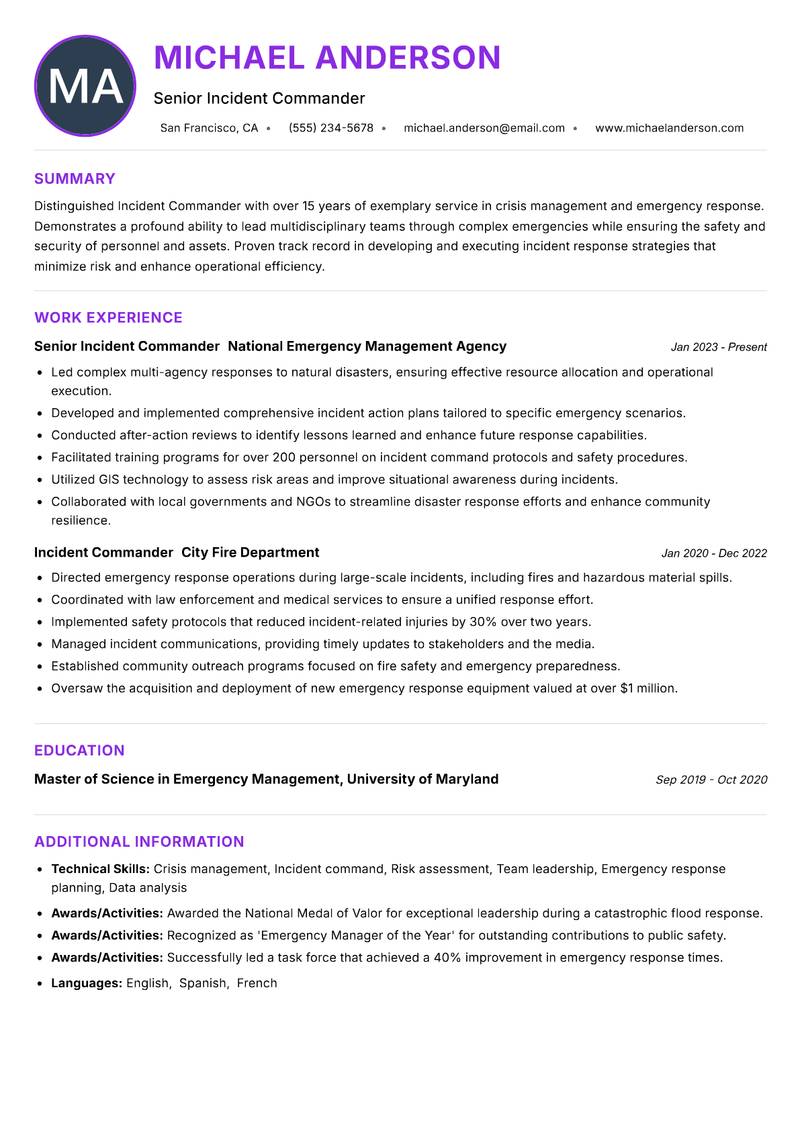
Senior Incident Commander Resume

Distinguished Incident Commander with over 15 years of exemplary service in crisis management and emergency response. Demonstrates a profound ability to lead multidisciplinary teams through complex emergencies while ensuring the safety and security of personnel and assets. Proven track record in developing and executing incident response strategies that minimize risk and enhance operational efficiency. Adept at stakeholder engagement and inter-agency coordination, fostering collaborative environments to achieve mission objectives. Expertise in the utilization of advanced incident command systems and real-time data analytics to inform decision-making processes. Committed to continuous improvement through training, drills, and post-incident evaluations, thereby elevating organizational preparedness and resilience. Recognized for exceptional leadership qualities and unwavering dedication to public safety and community service.

Crisis management Incident command Risk assessment Team leadership Emergency response planning Data analysis
Incident Commander Resume Preview Example
View PDF
  1. Led complex multi-agency responses to natural disasters, ensuring effective resource allocation and operational execution.
  2. Developed and implemented comprehensive incident action plans tailored to specific emergency scenarios.
  3. Conducted after-action reviews to identify lessons learned and enhance future response capabilities.
  4. Facilitated training programs for over 200 personnel on incident command protocols and safety procedures.
  5. Utilized GIS technology to assess risk areas and improve situational awareness during incidents.
  6. Collaborated with local governments and NGOs to streamline disaster response efforts and enhance community resilience.
  1. Directed emergency response operations during large-scale incidents, including fires and hazardous material spills.
  2. Coordinated with law enforcement and medical services to ensure a unified response effort.
  3. Implemented safety protocols that reduced incident-related injuries by 30% over two years.
  4. Managed incident communications, providing timely updates to stakeholders and the media.
  5. Established community outreach programs focused on fire safety and emergency preparedness.
  6. Oversaw the acquisition and deployment of new emergency response equipment valued at over $1 million.

Achievements

  • Awarded the National Medal of Valor for exceptional leadership during a catastrophic flood response.
  • Recognized as 'Emergency Manager of the Year' for outstanding contributions to public safety.
  • Successfully led a task force that achieved a 40% improvement in emergency response times.
⏱️
Experience
2-5 Years
📅
Level
Mid Level
🎓
Education
Master of Science in Emergency...

Incident Commander Resume

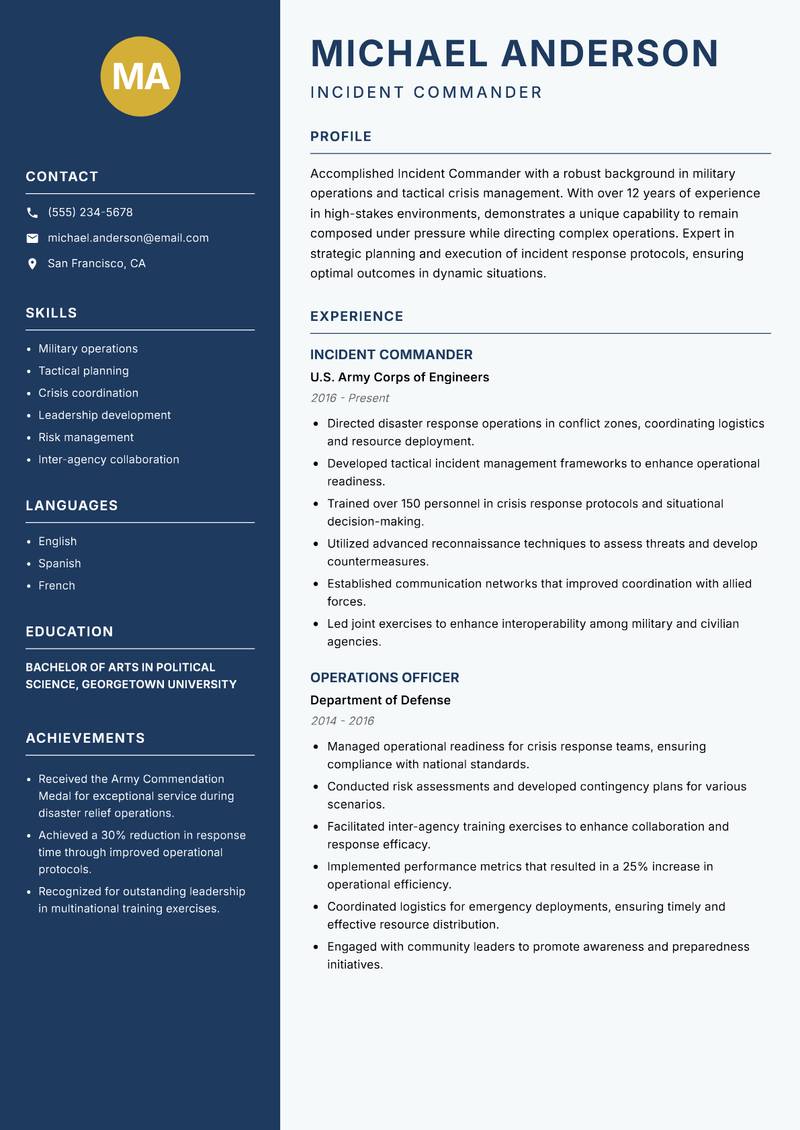
Accomplished Incident Commander with a robust background in military operations and tactical crisis management. With over 12 years of experience in high-stakes environments, demonstrates a unique capability to remain composed under pressure while directing complex operations. Expert in strategic planning and execution of incident response protocols, ensuring optimal outcomes in dynamic situations. Proficient in leveraging advanced communication systems and technology to enhance situational awareness and team coordination. Dedicated to fostering a culture of safety and preparedness through rigorous training and development initiatives. Acknowledged for exemplary performance and leadership in both domestic and international missions, reflecting a commitment to excellence in public service. Holds a reputation for decisive action and innovative problem-solving in challenging scenarios.

Military operations Tactical planning Crisis coordination Leadership development Risk management Inter-agency collaboration
Incident Commander Resume Preview Example
View PDF
  1. Directed disaster response operations in conflict zones, coordinating logistics and resource deployment.
  2. Developed tactical incident management frameworks to enhance operational readiness.
  3. Trained over 150 personnel in crisis response protocols and situational decision-making.
  4. Utilized advanced reconnaissance techniques to assess threats and develop countermeasures.
  5. Established communication networks that improved coordination with allied forces.
  6. Led joint exercises to enhance interoperability among military and civilian agencies.
  1. Managed operational readiness for crisis response teams, ensuring compliance with national standards.
  2. Conducted risk assessments and developed contingency plans for various scenarios.
  3. Facilitated inter-agency training exercises to enhance collaboration and response efficacy.
  4. Implemented performance metrics that resulted in a 25% increase in operational efficiency.
  5. Coordinated logistics for emergency deployments, ensuring timely and effective resource distribution.
  6. Engaged with community leaders to promote awareness and preparedness initiatives.

Achievements

  • Received the Army Commendation Medal for exceptional service during disaster relief operations.
  • Achieved a 30% reduction in response time through improved operational protocols.
  • Recognized for outstanding leadership in multinational training exercises.
⏱️
Experience
2-5 Years
📅
Level
Mid Level
🎓
Education
Bachelor of Arts in Political ...

Corporate Incident Commander Resume

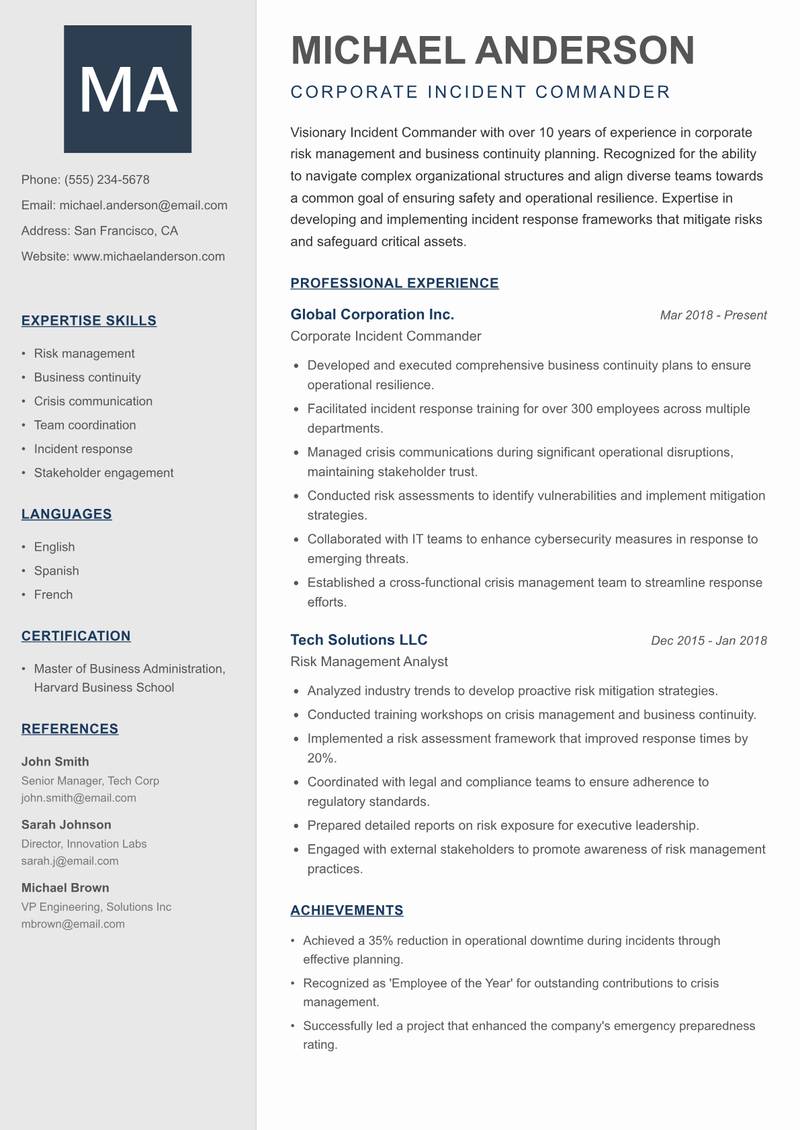
Visionary Incident Commander with over 10 years of experience in corporate risk management and business continuity planning. Recognized for the ability to navigate complex organizational structures and align diverse teams towards a common goal of ensuring safety and operational resilience. Expertise in developing and implementing incident response frameworks that mitigate risks and safeguard critical assets. Proficient in conducting comprehensive risk assessments and establishing robust communication protocols during incidents. Committed to fostering a culture of preparedness through strategic training initiatives and stakeholder engagement. Proven success in leading cross-functional teams to effectively manage crises while minimizing impact on business operations. Holds a strong reputation for innovative thinking and decisive leadership in corporate environments.

Risk management Business continuity Crisis communication Team coordination Incident response Stakeholder engagement
Incident Commander Resume Preview Example
View PDF
  1. Developed and executed comprehensive business continuity plans to ensure operational resilience.
  2. Facilitated incident response training for over 300 employees across multiple departments.
  3. Managed crisis communications during significant operational disruptions, maintaining stakeholder trust.
  4. Conducted risk assessments to identify vulnerabilities and implement mitigation strategies.
  5. Collaborated with IT teams to enhance cybersecurity measures in response to emerging threats.
  6. Established a cross-functional crisis management team to streamline response efforts.
  1. Analyzed industry trends to develop proactive risk mitigation strategies.
  2. Conducted training workshops on crisis management and business continuity.
  3. Implemented a risk assessment framework that improved response times by 20%.
  4. Coordinated with legal and compliance teams to ensure adherence to regulatory standards.
  5. Prepared detailed reports on risk exposure for executive leadership.
  6. Engaged with external stakeholders to promote awareness of risk management practices.

Achievements

  • Achieved a 35% reduction in operational downtime during incidents through effective planning.
  • Recognized as 'Employee of the Year' for outstanding contributions to crisis management.
  • Successfully led a project that enhanced the company's emergency preparedness rating.
⏱️
Experience
2-5 Years
📅
Level
Mid Level
🎓
Education
Master of Business Administrat...

Public Health Incident Commander Resume

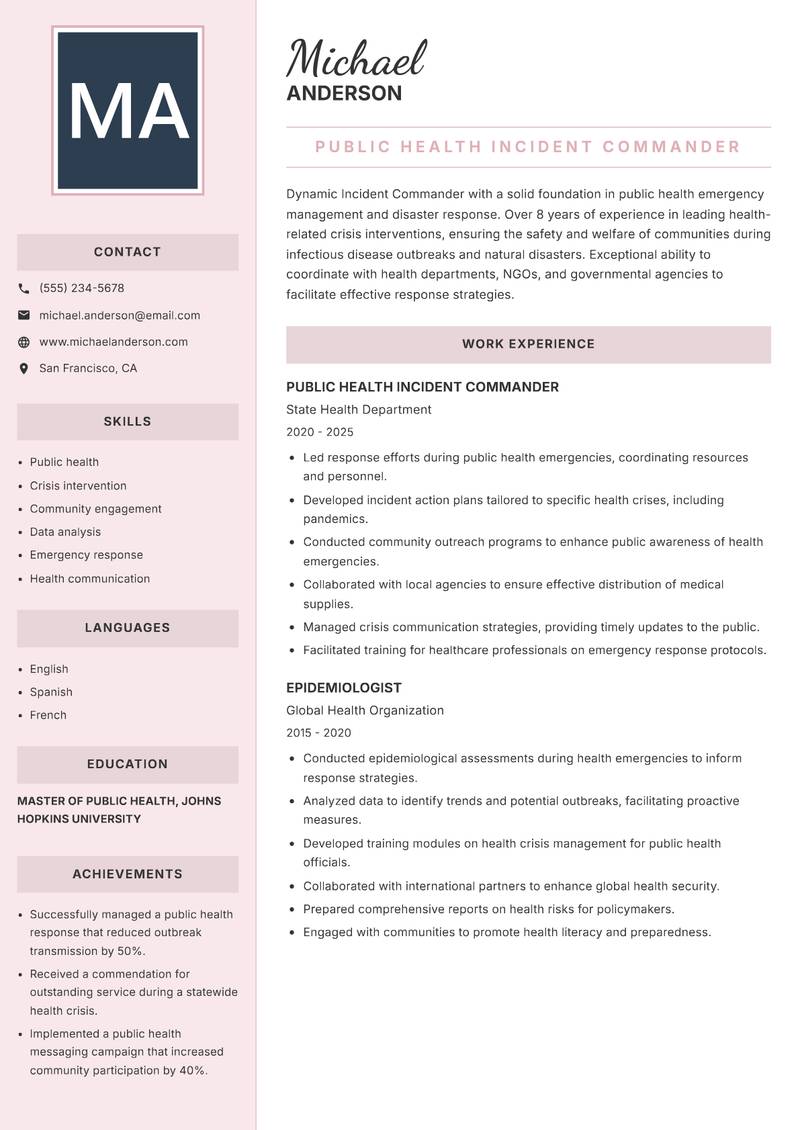
Dynamic Incident Commander with a solid foundation in public health emergency management and disaster response. Over 8 years of experience in leading health-related crisis interventions, ensuring the safety and welfare of communities during infectious disease outbreaks and natural disasters. Exceptional ability to coordinate with health departments, NGOs, and governmental agencies to facilitate effective response strategies. Expertise in developing public health messaging and community engagement initiatives that promote awareness and preparedness. Committed to continuous professional development and staying abreast of emerging trends in public health and emergency management. Recognized for strong analytical skills and the ability to make data-driven decisions in high-pressure environments. Maintains a steadfast dedication to enhancing community health and safety through proactive crisis management.

Public health Crisis intervention Community engagement Data analysis Emergency response Health communication
Incident Commander Resume Preview Example
View PDF
  1. Led response efforts during public health emergencies, coordinating resources and personnel.
  2. Developed incident action plans tailored to specific health crises, including pandemics.
  3. Conducted community outreach programs to enhance public awareness of health emergencies.
  4. Collaborated with local agencies to ensure effective distribution of medical supplies.
  5. Managed crisis communication strategies, providing timely updates to the public.
  6. Facilitated training for healthcare professionals on emergency response protocols.
  1. Conducted epidemiological assessments during health emergencies to inform response strategies.
  2. Analyzed data to identify trends and potential outbreaks, facilitating proactive measures.
  3. Developed training modules on health crisis management for public health officials.
  4. Collaborated with international partners to enhance global health security.
  5. Prepared comprehensive reports on health risks for policymakers.
  6. Engaged with communities to promote health literacy and preparedness.

Achievements

  • Successfully managed a public health response that reduced outbreak transmission by 50%.
  • Received a commendation for outstanding service during a statewide health crisis.
  • Implemented a public health messaging campaign that increased community participation by 40%.
⏱️
Experience
2-5 Years
📅
Level
Mid Level
🎓
Education
Master of Public Health, Johns...

Urban Incident Commander Resume

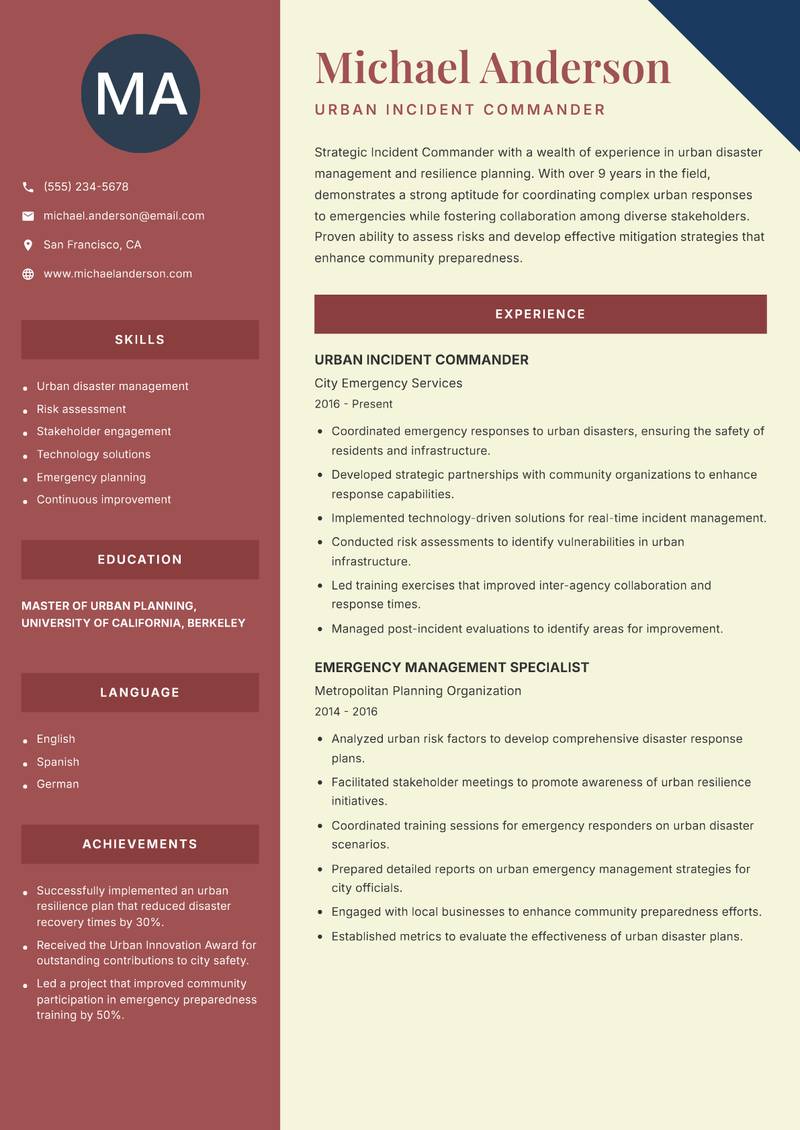
Strategic Incident Commander with a wealth of experience in urban disaster management and resilience planning. With over 9 years in the field, demonstrates a strong aptitude for coordinating complex urban responses to emergencies while fostering collaboration among diverse stakeholders. Proven ability to assess risks and develop effective mitigation strategies that enhance community preparedness. Expert in leveraging technology and data analytics to inform decision-making and improve operational efficiencies. Committed to fostering a culture of continuous improvement through training, simulations, and stakeholder engagement. Recognized for exceptional problem-solving skills and the ability to maintain composure in high-pressure situations. Holds a reputation for driving innovative solutions in urban emergency management.

Urban disaster management Risk assessment Stakeholder engagement Technology solutions Emergency planning Continuous improvement
Incident Commander Resume Preview Example
View PDF
  1. Coordinated emergency responses to urban disasters, ensuring the safety of residents and infrastructure.
  2. Developed strategic partnerships with community organizations to enhance response capabilities.
  3. Implemented technology-driven solutions for real-time incident management.
  4. Conducted risk assessments to identify vulnerabilities in urban infrastructure.
  5. Led training exercises that improved inter-agency collaboration and response times.
  6. Managed post-incident evaluations to identify areas for improvement.
  1. Analyzed urban risk factors to develop comprehensive disaster response plans.
  2. Facilitated stakeholder meetings to promote awareness of urban resilience initiatives.
  3. Coordinated training sessions for emergency responders on urban disaster scenarios.
  4. Prepared detailed reports on urban emergency management strategies for city officials.
  5. Engaged with local businesses to enhance community preparedness efforts.
  6. Established metrics to evaluate the effectiveness of urban disaster plans.

Achievements

  • Successfully implemented an urban resilience plan that reduced disaster recovery times by 30%.
  • Received the Urban Innovation Award for outstanding contributions to city safety.
  • Led a project that improved community participation in emergency preparedness training by 50%.
⏱️
Experience
2-5 Years
📅
Level
Mid Level
🎓
Education
Master of Urban Planning, Univ...

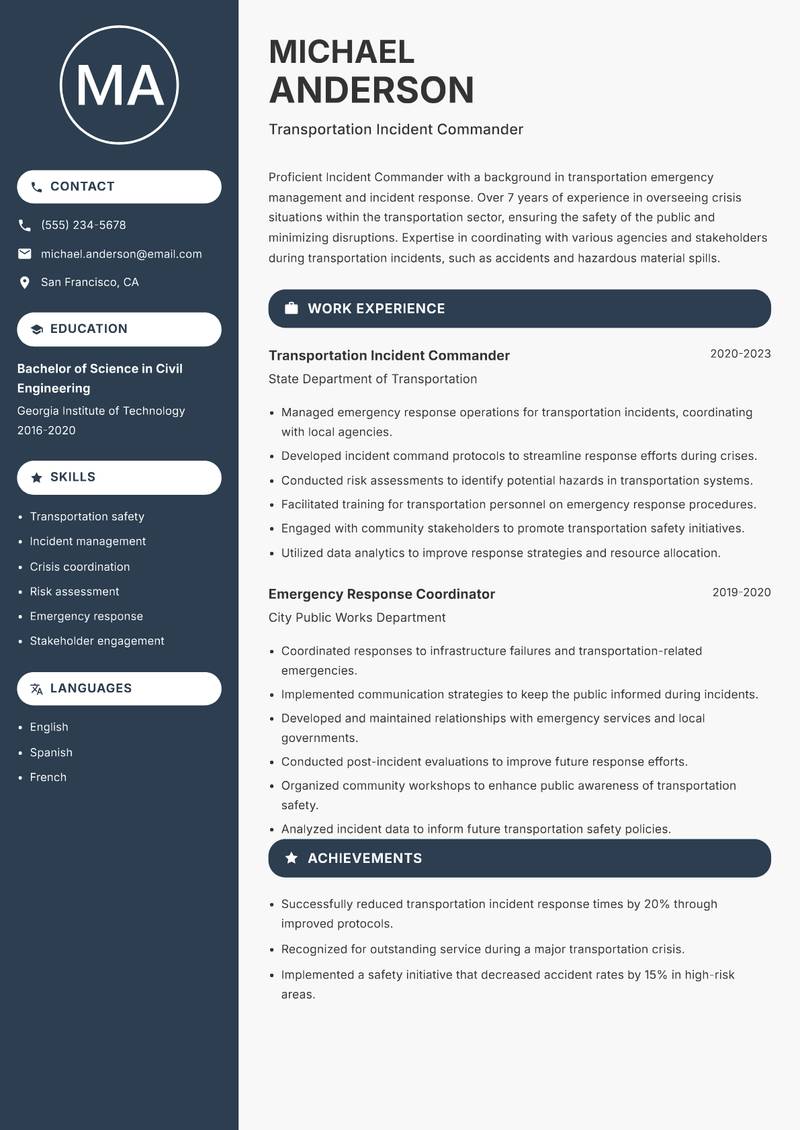
Transportation Incident Commander Resume

Proficient Incident Commander with a background in transportation emergency management and incident response. Over 7 years of experience in overseeing crisis situations within the transportation sector, ensuring the safety of the public and minimizing disruptions. Expertise in coordinating with various agencies and stakeholders during transportation incidents, such as accidents and hazardous material spills. Adept at developing and implementing response protocols that enhance operational efficiency and safety. Committed to continuous improvement through training and simulation exercises, ensuring readiness for diverse emergency scenarios. Recognized for strong leadership and communication skills, fostering collaborative environments to achieve successful outcomes. Holds a proven track record of effectively managing transportation-related emergencies while maintaining a focus on public safety.

Transportation safety Incident management Crisis coordination Risk assessment Emergency response Stakeholder engagement
Incident Commander Resume Preview Example
View PDF
  1. Managed emergency response operations for transportation incidents, coordinating with local agencies.
  2. Developed incident command protocols to streamline response efforts during crises.
  3. Conducted risk assessments to identify potential hazards in transportation systems.
  4. Facilitated training for transportation personnel on emergency response procedures.
  5. Engaged with community stakeholders to promote transportation safety initiatives.
  6. Utilized data analytics to improve response strategies and resource allocation.
  1. Coordinated responses to infrastructure failures and transportation-related emergencies.
  2. Implemented communication strategies to keep the public informed during incidents.
  3. Developed and maintained relationships with emergency services and local governments.
  4. Conducted post-incident evaluations to improve future response efforts.
  5. Organized community workshops to enhance public awareness of transportation safety.
  6. Analyzed incident data to inform future transportation safety policies.

Achievements

  • Successfully reduced transportation incident response times by 20% through improved protocols.
  • Recognized for outstanding service during a major transportation crisis.
  • Implemented a safety initiative that decreased accident rates by 15% in high-risk areas.
⏱️
Experience
2-5 Years
📅
Level
Mid Level
🎓
Education
Bachelor of Science in Civil E...

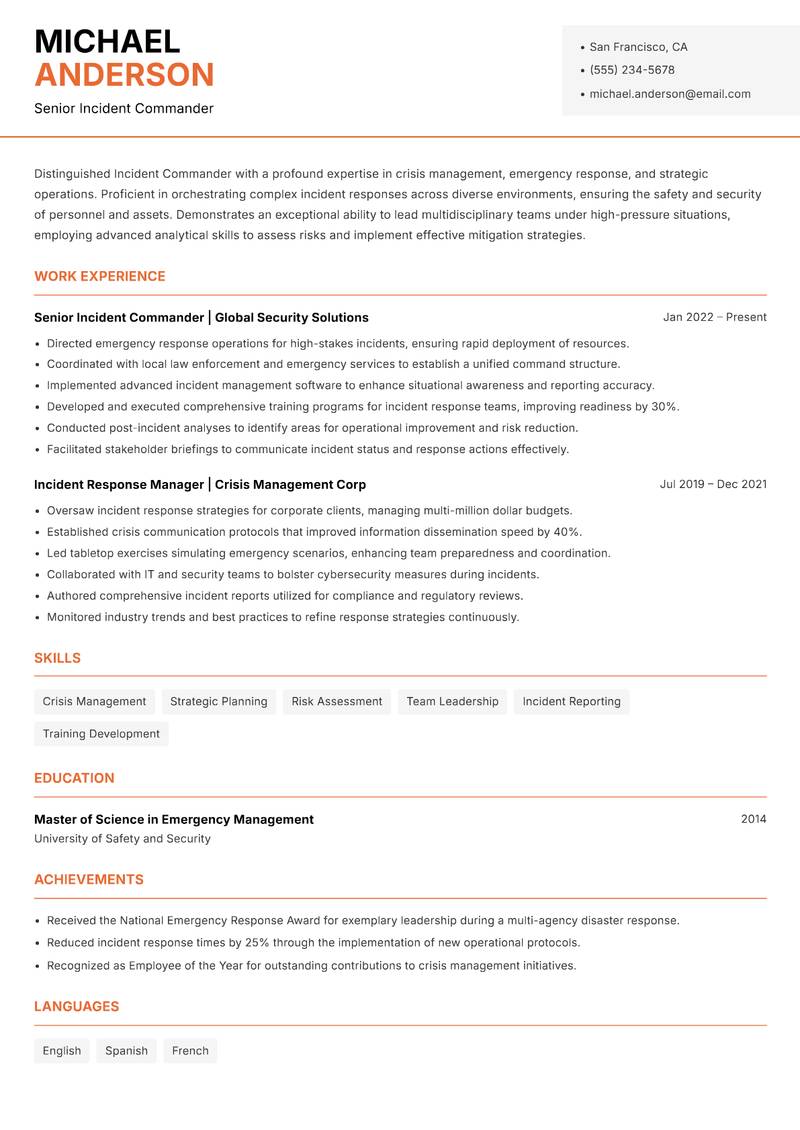
Senior Incident Commander Resume

Distinguished Incident Commander with a profound expertise in crisis management, emergency response, and strategic operations. Proficient in orchestrating complex incident responses across diverse environments, ensuring the safety and security of personnel and assets. Demonstrates an exceptional ability to lead multidisciplinary teams under high-pressure situations, employing advanced analytical skills to assess risks and implement effective mitigation strategies. Adept at liaising with governmental agencies, public safety organizations, and corporate stakeholders to facilitate seamless communication and coordination during critical incidents. Holds a proven track record of enhancing operational protocols and developing comprehensive training programs that bolster organizational resilience. Committed to continuous improvement and innovation within incident management frameworks, leveraging cutting-edge technologies and methodologies to optimize response efficacy and resource allocation.

Crisis Management Strategic Planning Risk Assessment Team Leadership Incident Reporting Training Development
Incident Commander Resume Preview Example
View PDF
  1. Directed emergency response operations for high-stakes incidents, ensuring rapid deployment of resources.
  2. Coordinated with local law enforcement and emergency services to establish a unified command structure.
  3. Implemented advanced incident management software to enhance situational awareness and reporting accuracy.
  4. Developed and executed comprehensive training programs for incident response teams, improving readiness by 30%.
  5. Conducted post-incident analyses to identify areas for operational improvement and risk reduction.
  6. Facilitated stakeholder briefings to communicate incident status and response actions effectively.
  1. Oversaw incident response strategies for corporate clients, managing multi-million dollar budgets.
  2. Established crisis communication protocols that improved information dissemination speed by 40%.
  3. Led tabletop exercises simulating emergency scenarios, enhancing team preparedness and coordination.
  4. Collaborated with IT and security teams to bolster cybersecurity measures during incidents.
  5. Authored comprehensive incident reports utilized for compliance and regulatory reviews.
  6. Monitored industry trends and best practices to refine response strategies continuously.

Achievements

  • Received the National Emergency Response Award for exemplary leadership during a multi-agency disaster response.
  • Reduced incident response times by 25% through the implementation of new operational protocols.
  • Recognized as Employee of the Year for outstanding contributions to crisis management initiatives.
⏱️
Experience
2-5 Years
📅
Level
Mid Level
🎓
Education
Master of Science in Emergency...

Key Skills for Incident Commander Positions

Resume Tips for Incident Commander Applications

Strong Action Verbs for Incident Commander Resumes

Responded · Coordinated · Led · Managed · Trained · Rescued · Communicated · Treated · Deployed · Advised · Executed · Achieved · Administered · Analyzed · Architected · Assessed

Common Mistakes to Avoid

Experience Levels

How to Write a Incident Commander Resume

Browse Incident Commander resume examples built around the overall management of emergency incidents, tailored for Emergency Services roles.

A strong Incident Commander resume leads with a focused professional summary that names the exact role and your standout achievement. In the experience section, open every bullet with a strong action verb and quantify the result with numbers wherever possible. Highlight your most relevant competencies — especially The overall management of emergency incidents, Emergency Medical Response, and Incident Command Systems (ICS) — in a dedicated Skills section positioned early so ATS systems and hiring managers both find it immediately.

For format, most Incident Commander roles suit a reverse-chronological layout: most recent position first, working backwards. Keep to one page for under five years of experience, or two pages for senior candidates with a rich project or leadership history. Use clean, ATS-safe fonts (10–12pt), standard section headings (Summary, Experience, Education, Skills), and avoid tables, text boxes, or multi-column layouts that applicant tracking systems cannot parse reliably.
Frequently Asked Questions

What makes a strong Incident Commander resume stand out to employers?

A standout Incident Commander resume combines role-specific skills with quantified achievements. Name the exact job title in your professional summary, mirror keywords from each job posting, and open every bullet point with a strong action verb followed by a measurable result. Certifications, tools, and domain experience specific to incident commander roles should appear prominently near the top.

What skills are most important to include on a Emergency Services resume?

Recruiters hiring in Emergency Services consistently look for Emergency Medical Response, Incident Command Systems (ICS), Fire & Rescue Operations, Disaster Management Frameworks. List these in a dedicated Skills section near the top so both ATS systems and human reviewers spot them fast. Mirror the exact phrasing from each job posting wherever possible — many applicant tracking systems match literal strings rather than synonyms.

What is the best resume format for Emergency Services professionals?

A reverse-chronological format is the standard choice for most Emergency Services candidates — employers expect to see your most recent role first, working backwards. If you are transitioning into Emergency Services from a related field, a hybrid format (brief skills summary at the top followed by chronological experience) can bridge the gap effectively. Keep the document to one page for under five years of experience, or two pages for senior specialists.

How do I make my Emergency Services resume pass applicant tracking systems (ATS)?

Use standard section headings — Summary, Experience, Education, Skills — rather than creative labels that ATS parsers do not recognise. Embed domain keywords such as "Emergency Medical Response" and "Incident Command Systems (ICS)" naturally inside your experience bullets rather than cramming them into a standalone keyword list. Avoid tables, multi-column layouts, text boxes, headers, footers, and images — these confuse most modern parsers and can cause your resume to be misread or rejected before a human sees it.

What mistakes do Emergency Services professionals most commonly make on their resume?

The most frequent issue is failing to list relevant emergency certifications. Beyond that, generic objective statements, unquantified achievements, and inconsistent date formatting appear across almost every Emergency Services application. Fix these by replacing every vague claim with a measurable outcome — specific numbers and named projects add credibility that adjectives cannot.

How long should a Emergency Services resume be?

One page is appropriate for candidates with under five years of relevant Emergency Services experience. Two pages are acceptable — and sometimes expected — for senior specialists, managers, or professionals with a strong portfolio of projects, publications, or credentials. Avoid padding to reach a page count: every line should directly support your application for the specific role you are targeting.

Should I include a professional summary at the top of my Emergency Services resume?

Yes — a two to three sentence summary is the first section most recruiters read. Open with your title and years of Emergency Services experience, then name your most relevant achievement or specialisation. One proven approach: Lead with your emergency services domain and years of operational experience. List specific certifications (EMT-B, NREMT, ICS 100-400, NEBOSH). Quantify response volume — incidents attended, lives saved, or community programs delivered. Highlight leadership roles in multi-agency coordination — this level of specificity signals genuine expertise before a recruiter reaches your experience section.

Scroll to view samples