Judicial Officer Resume

These Judicial Officer resume samples are designed to help you write a resume that gets noticed by hiring managers and passes applicant tracking systems (ATS) in Judiciary. Each example shows real formatting, section structure, and language you can adapt to your own background. When writing your own Judicial Officer resume, focus on highlighting legal interpretation & judgment writing\, case management\ and evidence analysis\. Recruiters scan for these qualifications first, so they should appear early in your summary and experience sections. Use strong action verbs such as "adjudicated\", "interpreted\", "managed\", "researched\" to describe your achievements, and quantify your impact wherever possible — percentages, dollar amounts, or time saved make your resume more convincing. A common mistake to avoid: writing a generic objective statement instead of a targeted judicial officer professional summary. Tailor your resume to each Judicial Officer position you apply for rather than using one generic version.

Judicial Officer Resume Template
View PDF
0.0 (0 ratings)

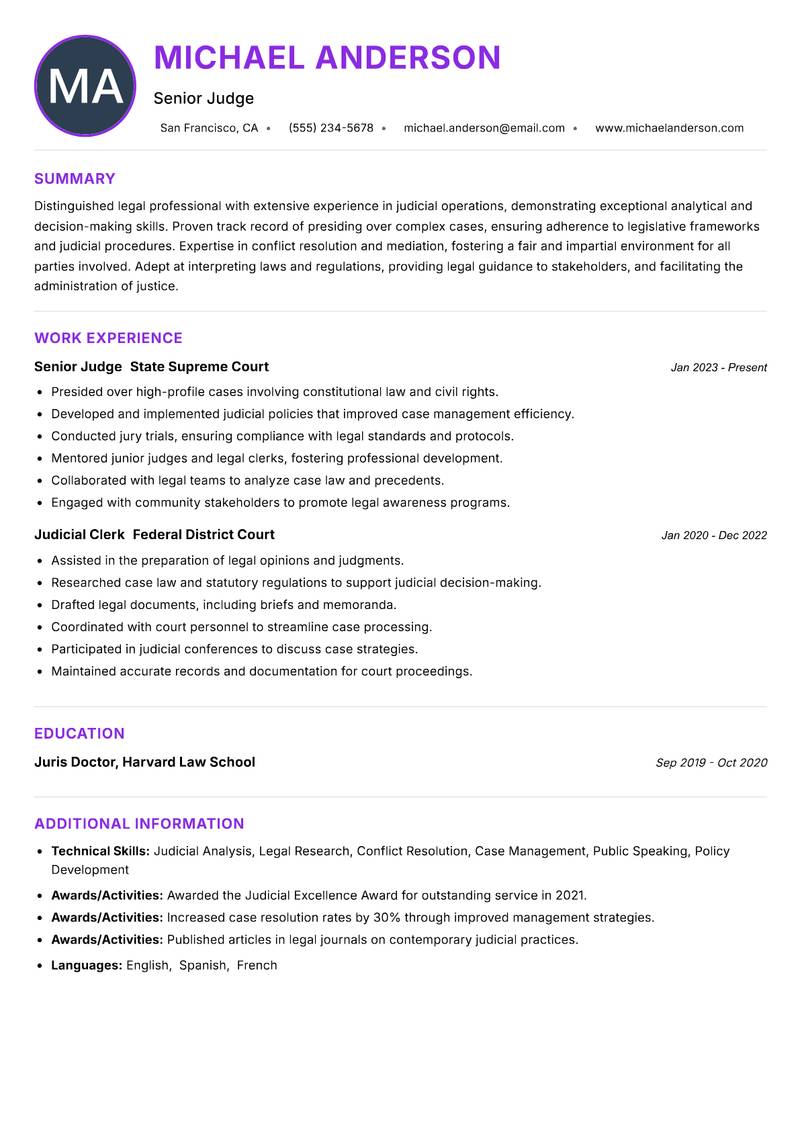
Senior Judge Resume

Distinguished legal professional with extensive experience in judicial operations, demonstrating exceptional analytical and decision-making skills. Proven track record of presiding over complex cases, ensuring adherence to legislative frameworks and judicial procedures. Expertise in conflict resolution and mediation, fostering a fair and impartial environment for all parties involved. Adept at interpreting laws and regulations, providing legal guidance to stakeholders, and facilitating the administration of justice. Committed to upholding the integrity of the judiciary and enhancing public trust through transparency and accountability. Recognized for exemplary leadership in courtroom management and the effective delivery of judicial services.

Judicial Analysis Legal Research Conflict Resolution Case Management Public Speaking Policy Development
Judicial Officer Resume Preview Example
View PDF
  1. Presided over high-profile cases involving constitutional law and civil rights.
  2. Developed and implemented judicial policies that improved case management efficiency.
  3. Conducted jury trials, ensuring compliance with legal standards and protocols.
  4. Mentored junior judges and legal clerks, fostering professional development.
  5. Collaborated with legal teams to analyze case law and precedents.
  6. Engaged with community stakeholders to promote legal awareness programs.
  1. Assisted in the preparation of legal opinions and judgments.
  2. Researched case law and statutory regulations to support judicial decision-making.
  3. Drafted legal documents, including briefs and memoranda.
  4. Coordinated with court personnel to streamline case processing.
  5. Participated in judicial conferences to discuss case strategies.
  6. Maintained accurate records and documentation for court proceedings.

Achievements

  • Awarded the Judicial Excellence Award for outstanding service in 2021.
  • Increased case resolution rates by 30% through improved management strategies.
  • Published articles in legal journals on contemporary judicial practices.
⏱️
Experience
2-5 Years
📅
Level
Mid Level
🎓
Education
Juris Doctor, Harvard Law Scho...

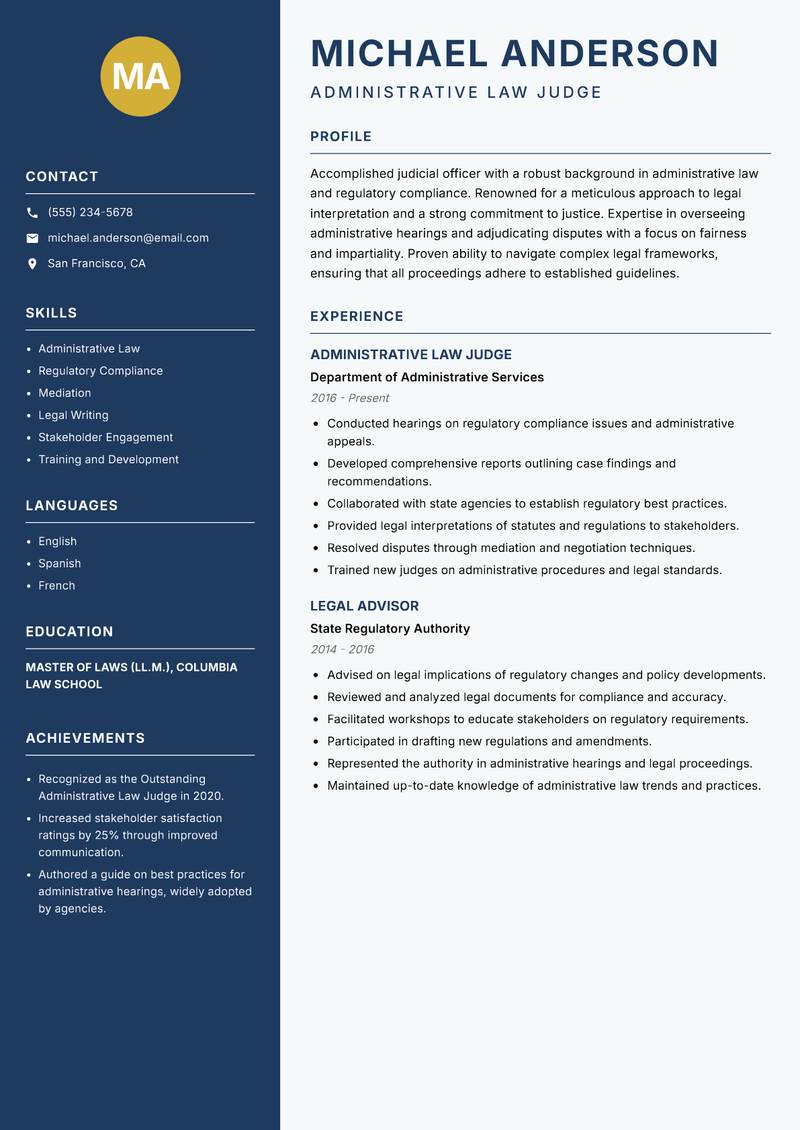
Administrative Law Judge Resume

Accomplished judicial officer with a robust background in administrative law and regulatory compliance. Renowned for a meticulous approach to legal interpretation and a strong commitment to justice. Expertise in overseeing administrative hearings and adjudicating disputes with a focus on fairness and impartiality. Proven ability to navigate complex legal frameworks, ensuring that all proceedings adhere to established guidelines. Adept at facilitating negotiations between parties to reach amicable resolutions. Recognized for contributions to legal scholarship and public service, enhancing the understanding of administrative processes among stakeholders.

Administrative Law Regulatory Compliance Mediation Legal Writing Stakeholder Engagement Training and Development
Judicial Officer Resume Preview Example
View PDF
  1. Conducted hearings on regulatory compliance issues and administrative appeals.
  2. Developed comprehensive reports outlining case findings and recommendations.
  3. Collaborated with state agencies to establish regulatory best practices.
  4. Provided legal interpretations of statutes and regulations to stakeholders.
  5. Resolved disputes through mediation and negotiation techniques.
  6. Trained new judges on administrative procedures and legal standards.
  1. Advised on legal implications of regulatory changes and policy developments.
  2. Reviewed and analyzed legal documents for compliance and accuracy.
  3. Facilitated workshops to educate stakeholders on regulatory requirements.
  4. Participated in drafting new regulations and amendments.
  5. Represented the authority in administrative hearings and legal proceedings.
  6. Maintained up-to-date knowledge of administrative law trends and practices.

Achievements

  • Recognized as the Outstanding Administrative Law Judge in 2020.
  • Increased stakeholder satisfaction ratings by 25% through improved communication.
  • Authored a guide on best practices for administrative hearings, widely adopted by agencies.
⏱️
Experience
2-5 Years
📅
Level
Mid Level
🎓
Education
Master of Laws (LL.M.), Columb...

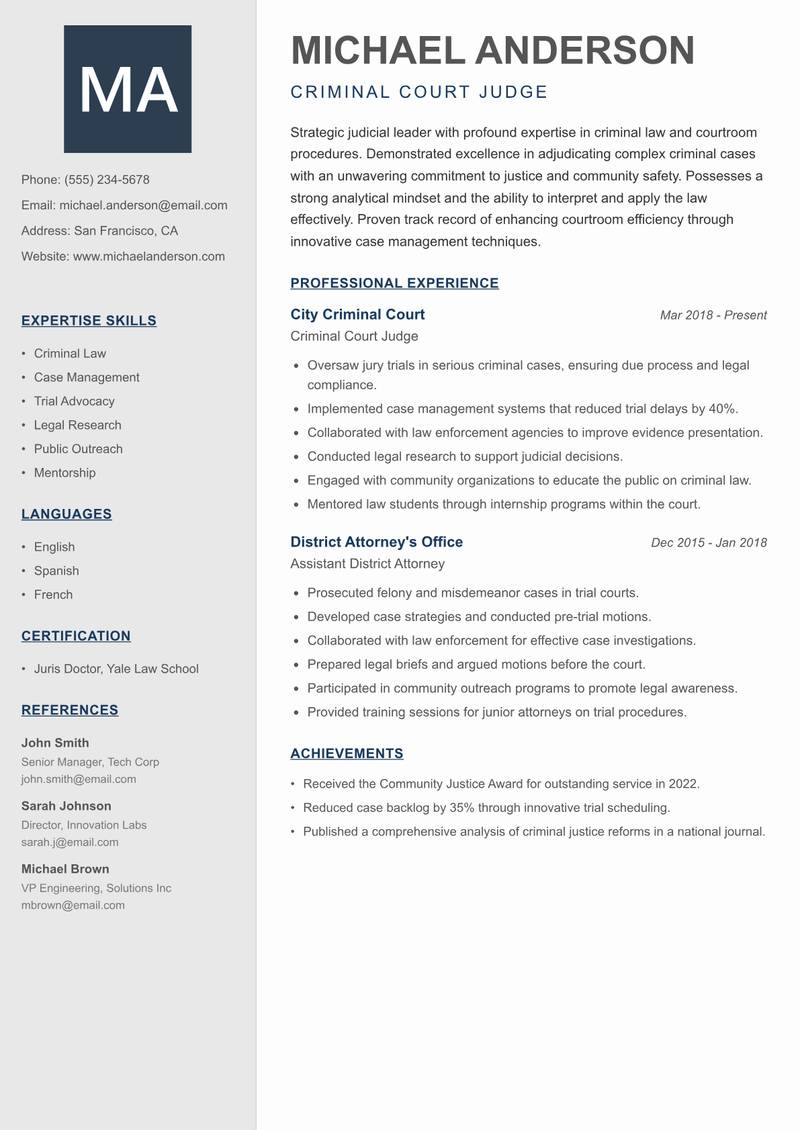
Criminal Court Judge Resume

Strategic judicial leader with profound expertise in criminal law and courtroom procedures. Demonstrated excellence in adjudicating complex criminal cases with an unwavering commitment to justice and community safety. Possesses a strong analytical mindset and the ability to interpret and apply the law effectively. Proven track record of enhancing courtroom efficiency through innovative case management techniques. Experienced in working collaboratively with law enforcement and legal professionals to ensure the fair administration of justice. Recognized for contributions to legal education and community outreach initiatives aimed at promoting public understanding of the criminal justice system.

Criminal Law Case Management Trial Advocacy Legal Research Public Outreach Mentorship
Judicial Officer Resume Preview Example
View PDF
  1. Oversaw jury trials in serious criminal cases, ensuring due process and legal compliance.
  2. Implemented case management systems that reduced trial delays by 40%.
  3. Collaborated with law enforcement agencies to improve evidence presentation.
  4. Conducted legal research to support judicial decisions.
  5. Engaged with community organizations to educate the public on criminal law.
  6. Mentored law students through internship programs within the court.
  1. Prosecuted felony and misdemeanor cases in trial courts.
  2. Developed case strategies and conducted pre-trial motions.
  3. Collaborated with law enforcement for effective case investigations.
  4. Prepared legal briefs and argued motions before the court.
  5. Participated in community outreach programs to promote legal awareness.
  6. Provided training sessions for junior attorneys on trial procedures.

Achievements

  • Received the Community Justice Award for outstanding service in 2022.
  • Reduced case backlog by 35% through innovative trial scheduling.
  • Published a comprehensive analysis of criminal justice reforms in a national journal.
⏱️
Experience
2-5 Years
📅
Level
Mid Level
🎓
Education
Juris Doctor, Yale Law School

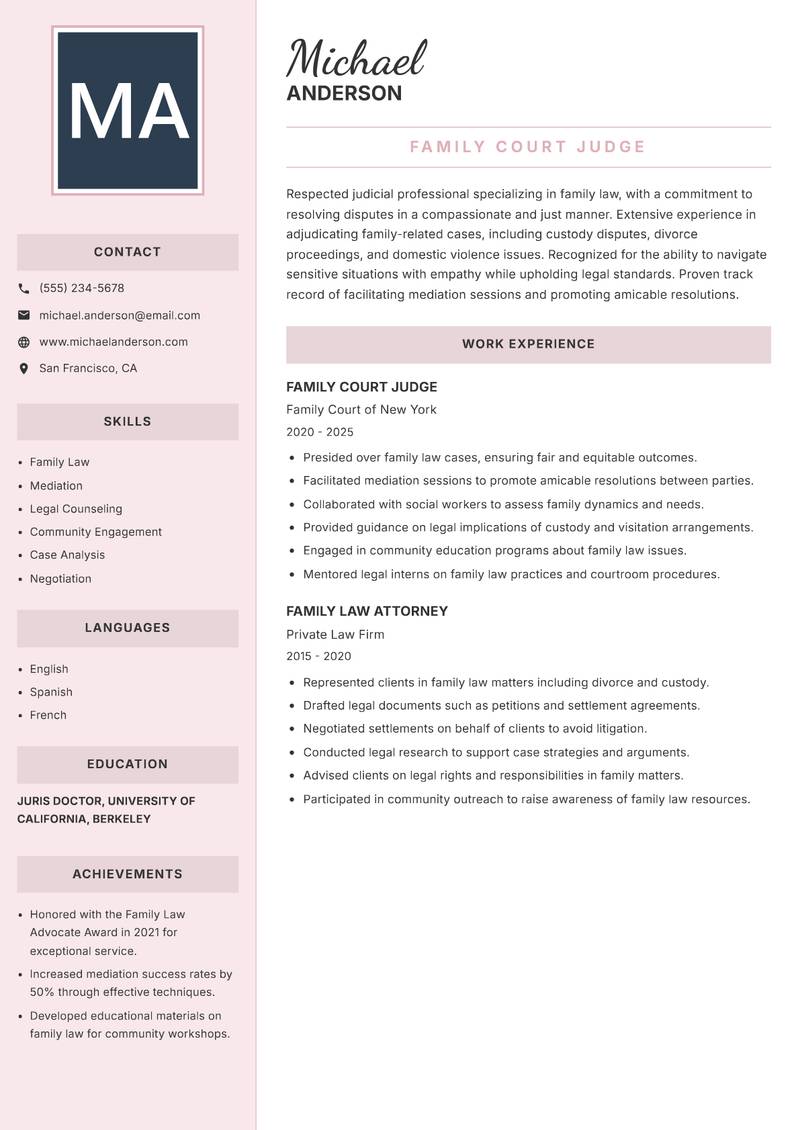
Family Court Judge Resume

Respected judicial professional specializing in family law, with a commitment to resolving disputes in a compassionate and just manner. Extensive experience in adjudicating family-related cases, including custody disputes, divorce proceedings, and domestic violence issues. Recognized for the ability to navigate sensitive situations with empathy while upholding legal standards. Proven track record of facilitating mediation sessions and promoting amicable resolutions. Expertise in collaborating with social services and community organizations to support families in crisis. Committed to public education initiatives that enhance awareness of family law issues.

Family Law Mediation Legal Counseling Community Engagement Case Analysis Negotiation
Judicial Officer Resume Preview Example
View PDF
  1. Presided over family law cases, ensuring fair and equitable outcomes.
  2. Facilitated mediation sessions to promote amicable resolutions between parties.
  3. Collaborated with social workers to assess family dynamics and needs.
  4. Provided guidance on legal implications of custody and visitation arrangements.
  5. Engaged in community education programs about family law issues.
  6. Mentored legal interns on family law practices and courtroom procedures.
  1. Represented clients in family law matters including divorce and custody.
  2. Drafted legal documents such as petitions and settlement agreements.
  3. Negotiated settlements on behalf of clients to avoid litigation.
  4. Conducted legal research to support case strategies and arguments.
  5. Advised clients on legal rights and responsibilities in family matters.
  6. Participated in community outreach to raise awareness of family law resources.

Achievements

  • Honored with the Family Law Advocate Award in 2021 for exceptional service.
  • Increased mediation success rates by 50% through effective techniques.
  • Developed educational materials on family law for community workshops.
⏱️
Experience
2-5 Years
📅
Level
Mid Level
🎓
Education
Juris Doctor, University of Ca...

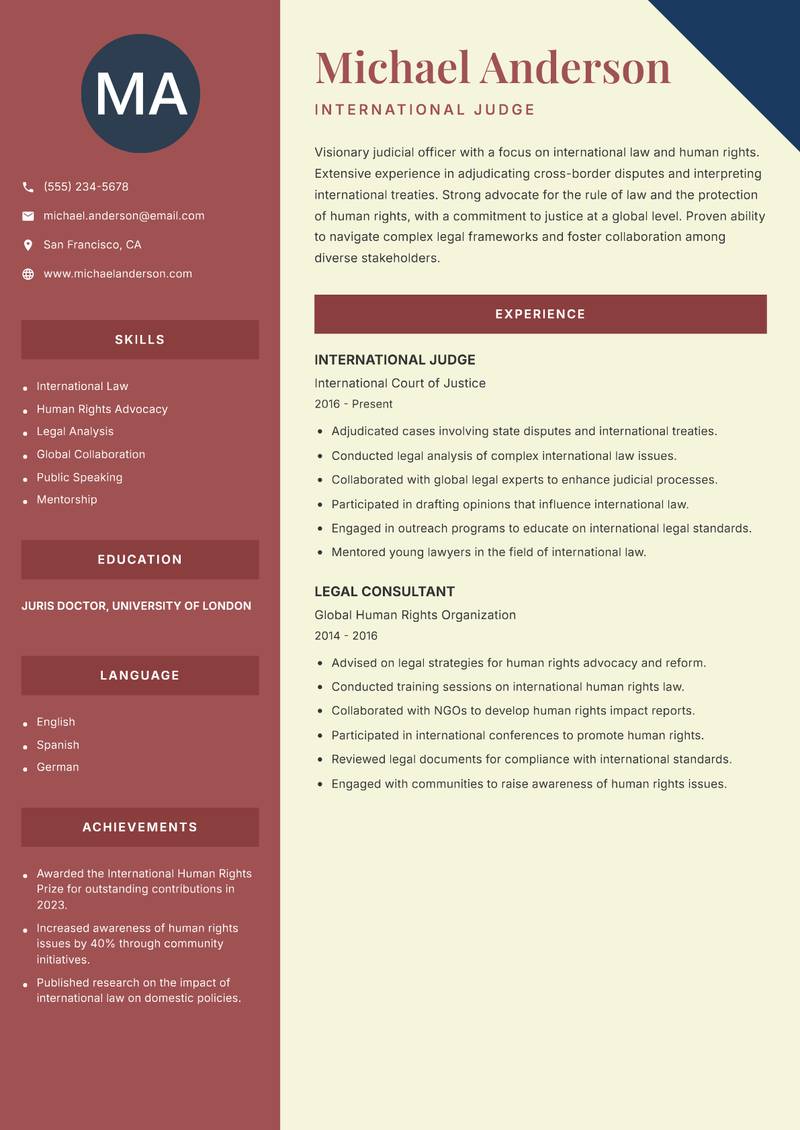
International Judge Resume

Visionary judicial officer with a focus on international law and human rights. Extensive experience in adjudicating cross-border disputes and interpreting international treaties. Strong advocate for the rule of law and the protection of human rights, with a commitment to justice at a global level. Proven ability to navigate complex legal frameworks and foster collaboration among diverse stakeholders. Recognized for contributions to international legal scholarship and participation in global forums. Committed to promoting legal education and awareness of human rights issues within communities.

International Law Human Rights Advocacy Legal Analysis Global Collaboration Public Speaking Mentorship
Judicial Officer Resume Preview Example
View PDF
  1. Adjudicated cases involving state disputes and international treaties.
  2. Conducted legal analysis of complex international law issues.
  3. Collaborated with global legal experts to enhance judicial processes.
  4. Participated in drafting opinions that influence international law.
  5. Engaged in outreach programs to educate on international legal standards.
  6. Mentored young lawyers in the field of international law.
  1. Advised on legal strategies for human rights advocacy and reform.
  2. Conducted training sessions on international human rights law.
  3. Collaborated with NGOs to develop human rights impact reports.
  4. Participated in international conferences to promote human rights.
  5. Reviewed legal documents for compliance with international standards.
  6. Engaged with communities to raise awareness of human rights issues.

Achievements

  • Awarded the International Human Rights Prize for outstanding contributions in 2023.
  • Increased awareness of human rights issues by 40% through community initiatives.
  • Published research on the impact of international law on domestic policies.
⏱️
Experience
2-5 Years
📅
Level
Mid Level
🎓
Education
Juris Doctor, University of Lo...

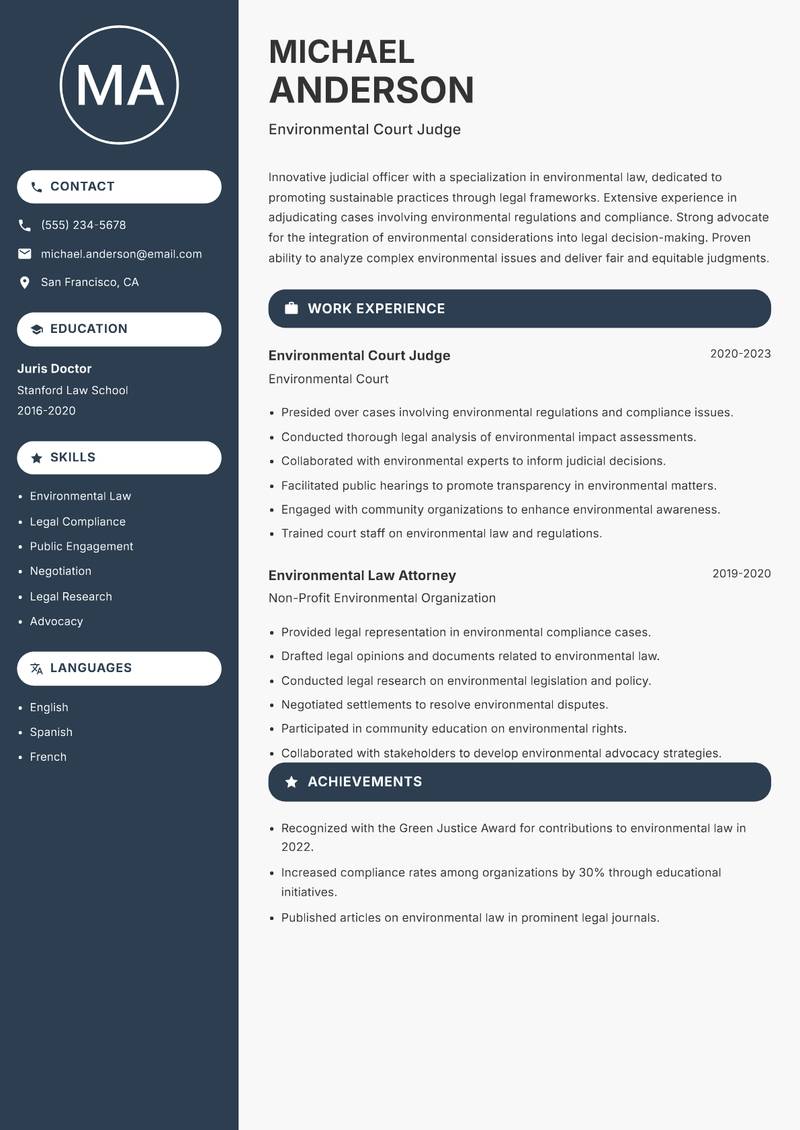
Environmental Court Judge Resume

Innovative judicial officer with a specialization in environmental law, dedicated to promoting sustainable practices through legal frameworks. Extensive experience in adjudicating cases involving environmental regulations and compliance. Strong advocate for the integration of environmental considerations into legal decision-making. Proven ability to analyze complex environmental issues and deliver fair and equitable judgments. Recognized for leadership in fostering collaboration among governmental, non-governmental, and community stakeholders. Committed to advancing public understanding of environmental law and its implications for society.

Environmental Law Legal Compliance Public Engagement Negotiation Legal Research Advocacy
Judicial Officer Resume Preview Example
View PDF
  1. Presided over cases involving environmental regulations and compliance issues.
  2. Conducted thorough legal analysis of environmental impact assessments.
  3. Collaborated with environmental experts to inform judicial decisions.
  4. Facilitated public hearings to promote transparency in environmental matters.
  5. Engaged with community organizations to enhance environmental awareness.
  6. Trained court staff on environmental law and regulations.
  1. Provided legal representation in environmental compliance cases.
  2. Drafted legal opinions and documents related to environmental law.
  3. Conducted legal research on environmental legislation and policy.
  4. Negotiated settlements to resolve environmental disputes.
  5. Participated in community education on environmental rights.
  6. Collaborated with stakeholders to develop environmental advocacy strategies.

Achievements

  • Recognized with the Green Justice Award for contributions to environmental law in 2022.
  • Increased compliance rates among organizations by 30% through educational initiatives.
  • Published articles on environmental law in prominent legal journals.
⏱️
Experience
2-5 Years
📅
Level
Mid Level
🎓
Education
Juris Doctor, Stanford Law Sch...

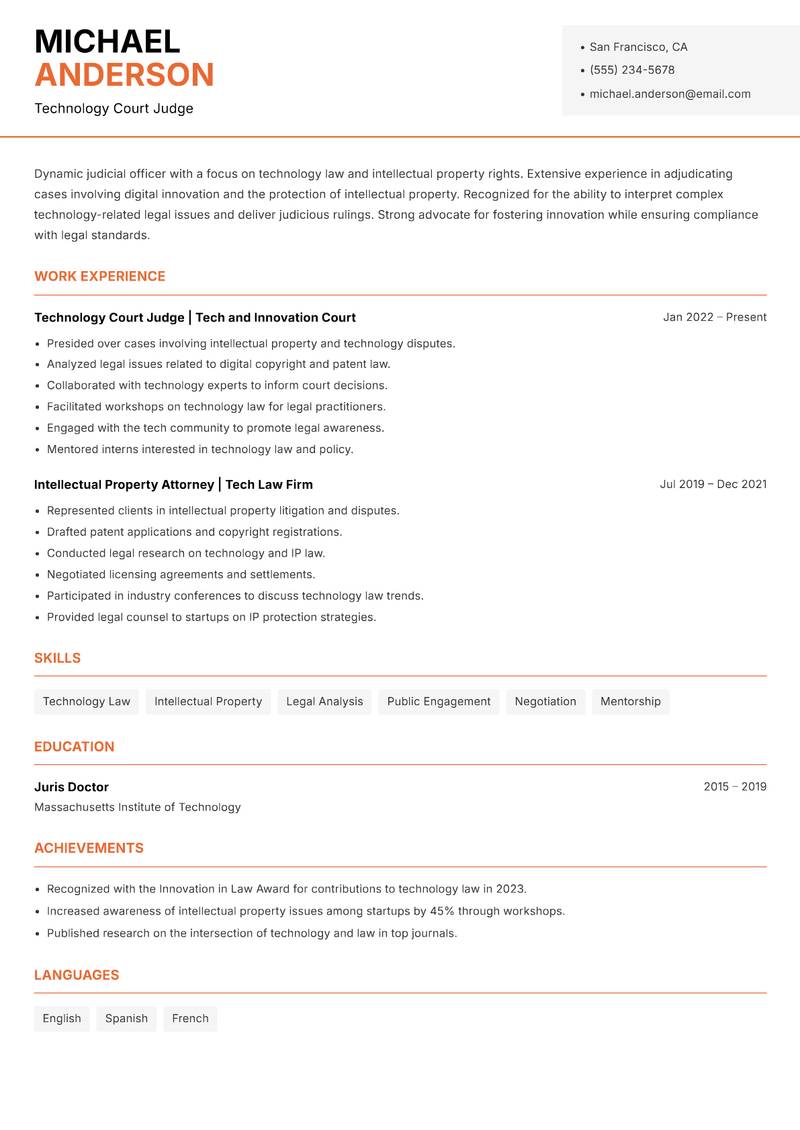
Technology Court Judge Resume

Dynamic judicial officer with a focus on technology law and intellectual property rights. Extensive experience in adjudicating cases involving digital innovation and the protection of intellectual property. Recognized for the ability to interpret complex technology-related legal issues and deliver judicious rulings. Strong advocate for fostering innovation while ensuring compliance with legal standards. Proven track record of engaging with technology stakeholders to promote understanding of legal implications in the tech industry. Committed to educating the public on technology law and its evolving landscape.

Technology Law Intellectual Property Legal Analysis Public Engagement Negotiation Mentorship
Judicial Officer Resume Preview Example
View PDF
  1. Presided over cases involving intellectual property and technology disputes.
  2. Analyzed legal issues related to digital copyright and patent law.
  3. Collaborated with technology experts to inform court decisions.
  4. Facilitated workshops on technology law for legal practitioners.
  5. Engaged with the tech community to promote legal awareness.
  6. Mentored interns interested in technology law and policy.
  1. Represented clients in intellectual property litigation and disputes.
  2. Drafted patent applications and copyright registrations.
  3. Conducted legal research on technology and IP law.
  4. Negotiated licensing agreements and settlements.
  5. Participated in industry conferences to discuss technology law trends.
  6. Provided legal counsel to startups on IP protection strategies.

Achievements

  • Recognized with the Innovation in Law Award for contributions to technology law in 2023.
  • Increased awareness of intellectual property issues among startups by 45% through workshops.
  • Published research on the intersection of technology and law in top journals.
⏱️
Experience
2-5 Years
📅
Level
Mid Level
🎓
Education
Juris Doctor, Massachusetts In...

Key Skills for Judicial Officer Positions

Resume Tips for Judicial Officer Applications

Strong Action Verbs for Judicial Officer Resumes

Adjudicated · Interpreted · Managed · Researched · Wrote · Presided · Coordinated · Reformed · Analysed · Administered · Conducted · Achieved · Administered · Analyzed · Architected · Assessed

Common Mistakes to Avoid

Experience Levels

How to Write a Judicial Officer Resume

Browse Judicial Officer resume examples built around legal interpretation & judgment writing\, tailored for Judiciary roles.

A strong Judicial Officer resume leads with a focused professional summary that names the exact role and your standout achievement. In the experience section, open every bullet with a strong action verb and quantify the result with numbers wherever possible. Highlight your most relevant competencies — especially Legal Interpretation & Judgment Writing, Case Management, and Evidence Analysis — in a dedicated Skills section positioned early so ATS systems and hiring managers both find it immediately.

For format, most Judicial Officer roles suit a reverse-chronological layout: most recent position first, working backwards. Keep to one page for under five years of experience, or two pages for senior candidates with a rich project or leadership history. Use clean, ATS-safe fonts (10–12pt), standard section headings (Summary, Experience, Education, Skills), and avoid tables, text boxes, or multi-column layouts that applicant tracking systems cannot parse reliably.
Frequently Asked Questions

What makes a strong Judicial Officer resume stand out to employers?

A standout Judicial Officer resume combines role-specific skills with quantified achievements. Name the exact job title in your professional summary, mirror keywords from each job posting, and open every bullet point with a strong action verb followed by a measurable result. Certifications, tools, and domain experience specific to judicial officer roles should appear prominently near the top.

What skills are most important to include on a Judiciary resume?

Recruiters hiring in Judiciary consistently look for Legal Interpretation & Judgment Writing, Case Management, Evidence Analysis, Legal Research & Precedent. List these in a dedicated Skills section near the top so both ATS systems and human reviewers spot them fast. Mirror the exact phrasing from each job posting wherever possible — many applicant tracking systems match literal strings rather than synonyms.

What is the best resume format for Judiciary professionals?

A reverse-chronological format is the standard choice for most Judiciary candidates — employers expect to see your most recent role first, working backwards. If you are transitioning into Judiciary from a related field, a hybrid format (brief skills summary at the top followed by chronological experience) can bridge the gap effectively. Keep the document to one page for under five years of experience, or two pages for senior specialists.

How do I make my Judiciary resume pass applicant tracking systems (ATS)?

Use standard section headings — Summary, Experience, Education, Skills — rather than creative labels that ATS parsers do not recognise. Embed domain keywords such as "Legal Interpretation & Judgment Writing" and "Case Management" naturally inside your experience bullets rather than cramming them into a standalone keyword list. Avoid tables, multi-column layouts, text boxes, headers, footers, and images — these confuse most modern parsers and can cause your resume to be misread or rejected before a human sees it.

What mistakes do Judiciary professionals most commonly make on their resume?

The most frequent issue is being vague about jurisdiction and court level. Beyond that, generic objective statements, unquantified achievements, and inconsistent date formatting appear across almost every Judiciary application. Fix these by replacing every vague claim with a measurable outcome — specific numbers and named projects add credibility that adjectives cannot.

How long should a Judiciary resume be?

One page is appropriate for candidates with under five years of relevant Judiciary experience. Two pages are acceptable — and sometimes expected — for senior specialists, managers, or professionals with a strong portfolio of projects, publications, or credentials. Avoid padding to reach a page count: every line should directly support your application for the specific role you are targeting.

Should I include a professional summary at the top of my Judiciary resume?

Yes — a two to three sentence summary is the first section most recruiters read. Open with your title and years of Judiciary experience, then name your most relevant achievement or specialisation. One proven approach: List your jurisdictional appointment, area of legal specialisation, and seniority. For court administrators, quantify the operational scope (cases managed, staff supervised). Include bar admission, silk appointment, or judicial appointment details. Highlight publications, law reform contributions, or academic appointments — this level of specificity signals genuine expertise before a recruiter reaches your experience section.

Scroll to view samples