Nanomaterials Scientist Resume

These Nanomaterials Scientist resume samples are designed to help you write a resume that gets noticed by hiring managers and passes applicant tracking systems (ATS) in Nanotechnology. Each example shows real formatting, section structure, and language you can adapt to your own background. When writing your own Nanomaterials Scientist resume, focus on highlighting publishing research findings, presenting results at and nanofabrication & synthesis\. Recruiters scan for these qualifications first, so they should appear early in your summary and experience sections. Use strong action verbs such as "synthesised\", "fabricated\", "characterised\", "modelled\" to describe your achievements, and quantify your impact wherever possible — percentages, dollar amounts, or time saved make your resume more convincing. A common mistake to avoid: writing a generic objective statement instead of a targeted nanomaterials scientist professional summary. Tailor your resume to each Nanomaterials Scientist position you apply for rather than using one generic version.

Nanomaterials Scientist Resume Template
View PDF
0.0 (0 ratings)

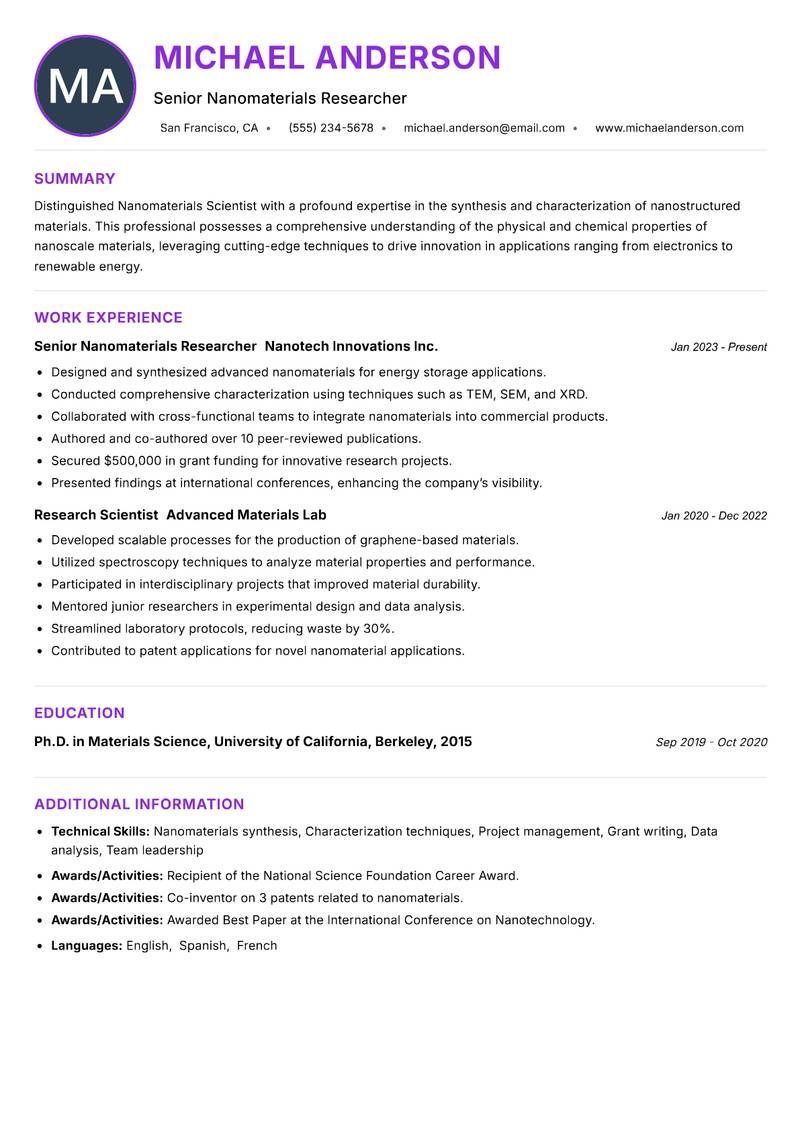
Senior Nanomaterials Researcher Resume

Distinguished Nanomaterials Scientist with a profound expertise in the synthesis and characterization of nanostructured materials. This professional possesses a comprehensive understanding of the physical and chemical properties of nanoscale materials, leveraging cutting-edge techniques to drive innovation in applications ranging from electronics to renewable energy. With a strong commitment to advancing research, this individual has led multidisciplinary teams in the development of novel nanomaterials, resulting in significant contributions to both academic and industrial sectors. A proven track record of securing funding for research initiatives and publishing high-impact papers in peer-reviewed journals underscores a dedication to excellence in scientific inquiry and technological advancement. An adept communicator, this scientist effectively collaborates with stakeholders to translate complex scientific concepts into actionable insights. Passion for mentoring emerging scientists and fostering a culture of inquiry and innovation within research teams is evident throughout a distinguished career.

Nanomaterials synthesis Characterization techniques Project management Grant writing Data analysis Team leadership
Nanomaterials Scientist Resume Preview Example
View PDF
  1. Designed and synthesized advanced nanomaterials for energy storage applications.
  2. Conducted comprehensive characterization using techniques such as TEM, SEM, and XRD.
  3. Collaborated with cross-functional teams to integrate nanomaterials into commercial products.
  4. Authored and co-authored over 10 peer-reviewed publications.
  5. Secured $500,000 in grant funding for innovative research projects.
  6. Presented findings at international conferences, enhancing the company’s visibility.
  1. Developed scalable processes for the production of graphene-based materials.
  2. Utilized spectroscopy techniques to analyze material properties and performance.
  3. Participated in interdisciplinary projects that improved material durability.
  4. Mentored junior researchers in experimental design and data analysis.
  5. Streamlined laboratory protocols, reducing waste by 30%.
  6. Contributed to patent applications for novel nanomaterial applications.

Achievements

  • Recipient of the National Science Foundation Career Award.
  • Co-inventor on 3 patents related to nanomaterials.
  • Awarded Best Paper at the International Conference on Nanotechnology.
⏱️
Experience
2-5 Years
📅
Level
Mid Level
🎓
Education
Ph.D. in Materials Science, Un...

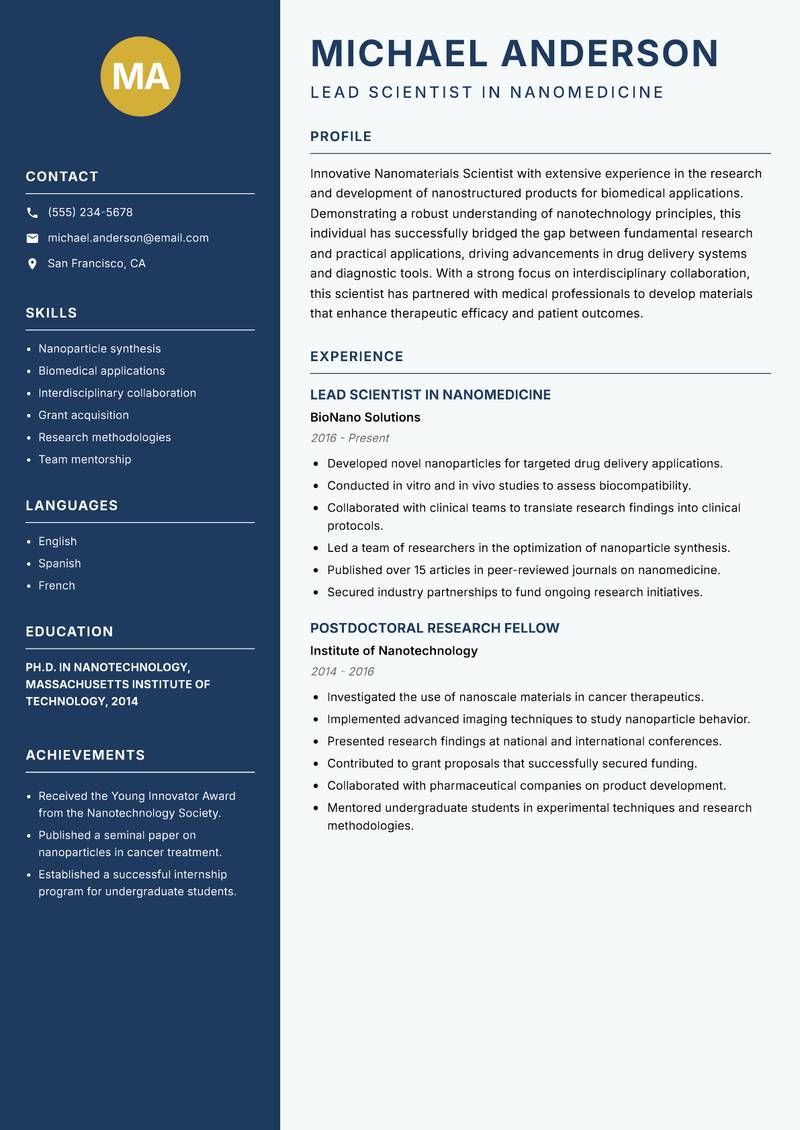
Lead Scientist in Nanomedicine Resume

Innovative Nanomaterials Scientist with extensive experience in the research and development of nanostructured products for biomedical applications. Demonstrating a robust understanding of nanotechnology principles, this individual has successfully bridged the gap between fundamental research and practical applications, driving advancements in drug delivery systems and diagnostic tools. With a strong focus on interdisciplinary collaboration, this scientist has partnered with medical professionals to develop materials that enhance therapeutic efficacy and patient outcomes. A recipient of multiple awards for contributions to the field, this professional is recognized for pioneering research that has been published in high-impact journals. Through effective leadership and mentorship, this scientist fosters an environment conducive to innovation and scientific inquiry, preparing the next generation of researchers in nanomedicine.

Nanoparticle synthesis Biomedical applications Interdisciplinary collaboration Grant acquisition Research methodologies Team mentorship
Nanomaterials Scientist Resume Preview Example
View PDF
  1. Developed novel nanoparticles for targeted drug delivery applications.
  2. Conducted in vitro and in vivo studies to assess biocompatibility.
  3. Collaborated with clinical teams to translate research findings into clinical protocols.
  4. Led a team of researchers in the optimization of nanoparticle synthesis.
  5. Published over 15 articles in peer-reviewed journals on nanomedicine.
  6. Secured industry partnerships to fund ongoing research initiatives.
  1. Investigated the use of nanoscale materials in cancer therapeutics.
  2. Implemented advanced imaging techniques to study nanoparticle behavior.
  3. Presented research findings at national and international conferences.
  4. Contributed to grant proposals that successfully secured funding.
  5. Collaborated with pharmaceutical companies on product development.
  6. Mentored undergraduate students in experimental techniques and research methodologies.

Achievements

  • Received the Young Innovator Award from the Nanotechnology Society.
  • Published a seminal paper on nanoparticles in cancer treatment.
  • Established a successful internship program for undergraduate students.
⏱️
Experience
2-5 Years
📅
Level
Mid Level
🎓
Education
Ph.D. in Nanotechnology, Massa...

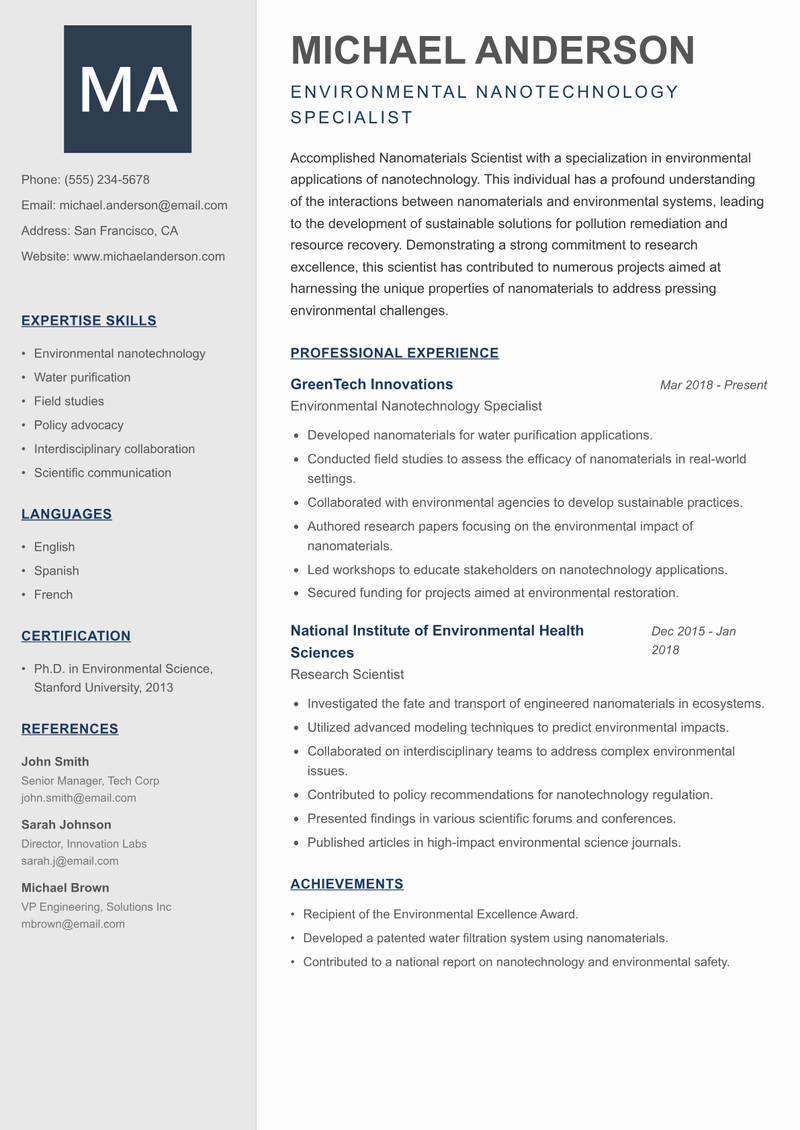
Environmental Nanotechnology Specialist Resume

Accomplished Nanomaterials Scientist with a specialization in environmental applications of nanotechnology. This individual has a profound understanding of the interactions between nanomaterials and environmental systems, leading to the development of sustainable solutions for pollution remediation and resource recovery. Demonstrating a strong commitment to research excellence, this scientist has contributed to numerous projects aimed at harnessing the unique properties of nanomaterials to address pressing environmental challenges. With a history of collaboration with governmental and non-governmental organizations, this expert has effectively translated scientific research into practical applications that yield measurable benefits for communities and ecosystems. A recognized thought leader in the field, this professional has authored influential publications and frequently speaks at international conferences, advocating for the responsible use of nanotechnology in environmental sustainability.

Environmental nanotechnology Water purification Field studies Policy advocacy Interdisciplinary collaboration Scientific communication
Nanomaterials Scientist Resume Preview Example
View PDF
  1. Developed nanomaterials for water purification applications.
  2. Conducted field studies to assess the efficacy of nanomaterials in real-world settings.
  3. Collaborated with environmental agencies to develop sustainable practices.
  4. Authored research papers focusing on the environmental impact of nanomaterials.
  5. Led workshops to educate stakeholders on nanotechnology applications.
  6. Secured funding for projects aimed at environmental restoration.
  1. Investigated the fate and transport of engineered nanomaterials in ecosystems.
  2. Utilized advanced modeling techniques to predict environmental impacts.
  3. Collaborated on interdisciplinary teams to address complex environmental issues.
  4. Contributed to policy recommendations for nanotechnology regulation.
  5. Presented findings in various scientific forums and conferences.
  6. Published articles in high-impact environmental science journals.

Achievements

  • Recipient of the Environmental Excellence Award.
  • Developed a patented water filtration system using nanomaterials.
  • Contributed to a national report on nanotechnology and environmental safety.
⏱️
Experience
2-5 Years
📅
Level
Mid Level
🎓
Education
Ph.D. in Environmental Science...

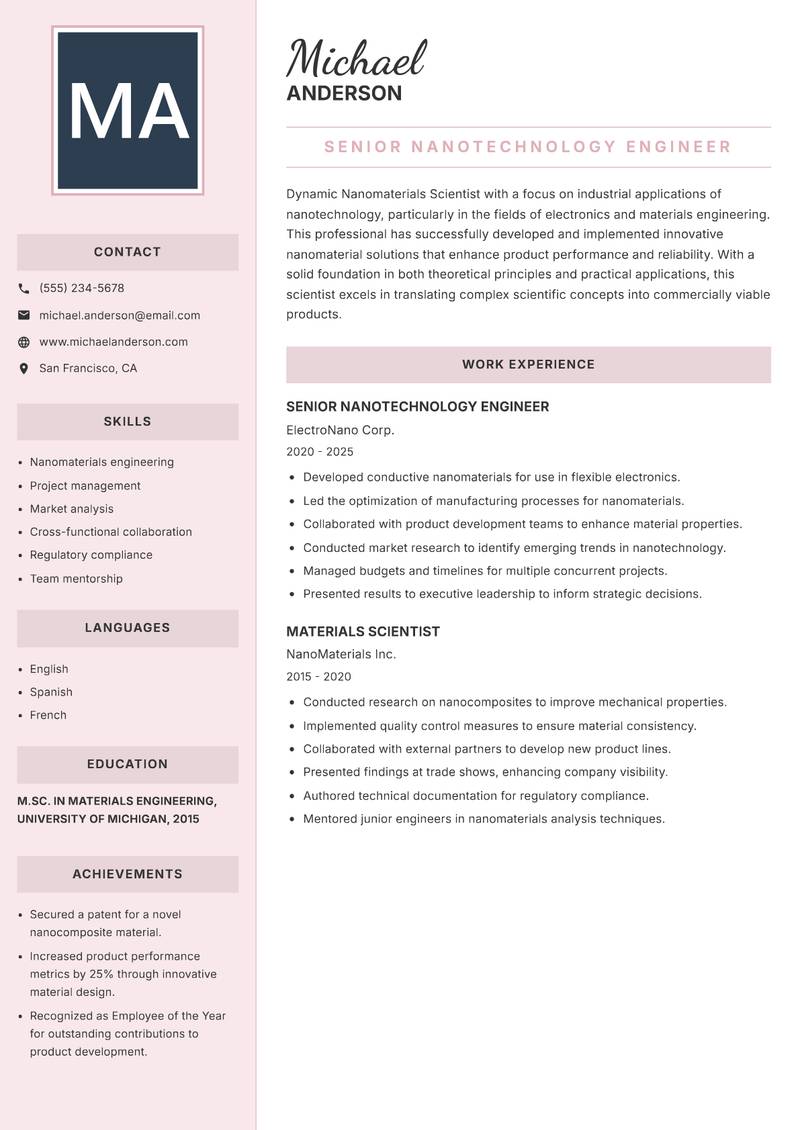
Senior Nanotechnology Engineer Resume

Dynamic Nanomaterials Scientist with a focus on industrial applications of nanotechnology, particularly in the fields of electronics and materials engineering. This professional has successfully developed and implemented innovative nanomaterial solutions that enhance product performance and reliability. With a solid foundation in both theoretical principles and practical applications, this scientist excels in translating complex scientific concepts into commercially viable products. Demonstrating a history of successful project management, this individual has led cross-functional teams in the development of nanomaterial-based technologies that are now integral to various industries. A proactive communicator, this scientist has built strong relationships with clients and stakeholders, ensuring that project goals align with market needs. Recognized for contributions to product innovation, this individual is committed to continuous improvement and staying at the forefront of technological advancements.

Nanomaterials engineering Project management Market analysis Cross-functional collaboration Regulatory compliance Team mentorship
Nanomaterials Scientist Resume Preview Example
View PDF
  1. Developed conductive nanomaterials for use in flexible electronics.
  2. Led the optimization of manufacturing processes for nanomaterials.
  3. Collaborated with product development teams to enhance material properties.
  4. Conducted market research to identify emerging trends in nanotechnology.
  5. Managed budgets and timelines for multiple concurrent projects.
  6. Presented results to executive leadership to inform strategic decisions.
  1. Conducted research on nanocomposites to improve mechanical properties.
  2. Implemented quality control measures to ensure material consistency.
  3. Collaborated with external partners to develop new product lines.
  4. Presented findings at trade shows, enhancing company visibility.
  5. Authored technical documentation for regulatory compliance.
  6. Mentored junior engineers in nanomaterials analysis techniques.

Achievements

  • Secured a patent for a novel nanocomposite material.
  • Increased product performance metrics by 25% through innovative material design.
  • Recognized as Employee of the Year for outstanding contributions to product development.
⏱️
Experience
2-5 Years
📅
Level
Mid Level
🎓
Education
M.Sc. in Materials Engineering...

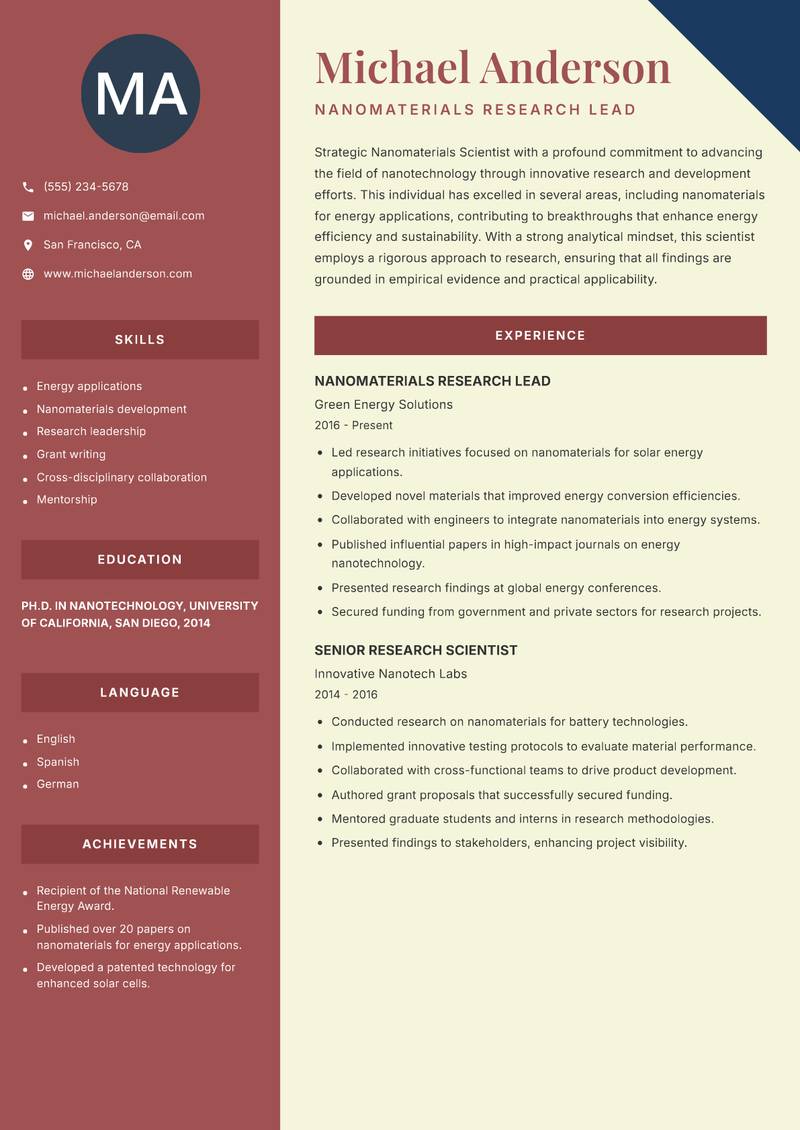
Nanomaterials Research Lead Resume

Strategic Nanomaterials Scientist with a profound commitment to advancing the field of nanotechnology through innovative research and development efforts. This individual has excelled in several areas, including nanomaterials for energy applications, contributing to breakthroughs that enhance energy efficiency and sustainability. With a strong analytical mindset, this scientist employs a rigorous approach to research, ensuring that all findings are grounded in empirical evidence and practical applicability. A history of successful collaborations with academic institutions and industry partners has led to significant advancements in the commercialization of nanomaterials. This professional is also dedicated to fostering an inclusive research environment, mentoring young scientists and promoting diversity within the field. Recognized for excellence in research, this scientist has received multiple awards and honors, further solidifying a reputation as a leader in the nanotechnology domain.

Energy applications Nanomaterials development Research leadership Grant writing Cross-disciplinary collaboration Mentorship
Nanomaterials Scientist Resume Preview Example
View PDF
  1. Led research initiatives focused on nanomaterials for solar energy applications.
  2. Developed novel materials that improved energy conversion efficiencies.
  3. Collaborated with engineers to integrate nanomaterials into energy systems.
  4. Published influential papers in high-impact journals on energy nanotechnology.
  5. Presented research findings at global energy conferences.
  6. Secured funding from government and private sectors for research projects.
  1. Conducted research on nanomaterials for battery technologies.
  2. Implemented innovative testing protocols to evaluate material performance.
  3. Collaborated with cross-functional teams to drive product development.
  4. Authored grant proposals that successfully secured funding.
  5. Mentored graduate students and interns in research methodologies.
  6. Presented findings to stakeholders, enhancing project visibility.

Achievements

  • Recipient of the National Renewable Energy Award.
  • Published over 20 papers on nanomaterials for energy applications.
  • Developed a patented technology for enhanced solar cells.
⏱️
Experience
2-5 Years
📅
Level
Mid Level
🎓
Education
Ph.D. in Nanotechnology, Unive...

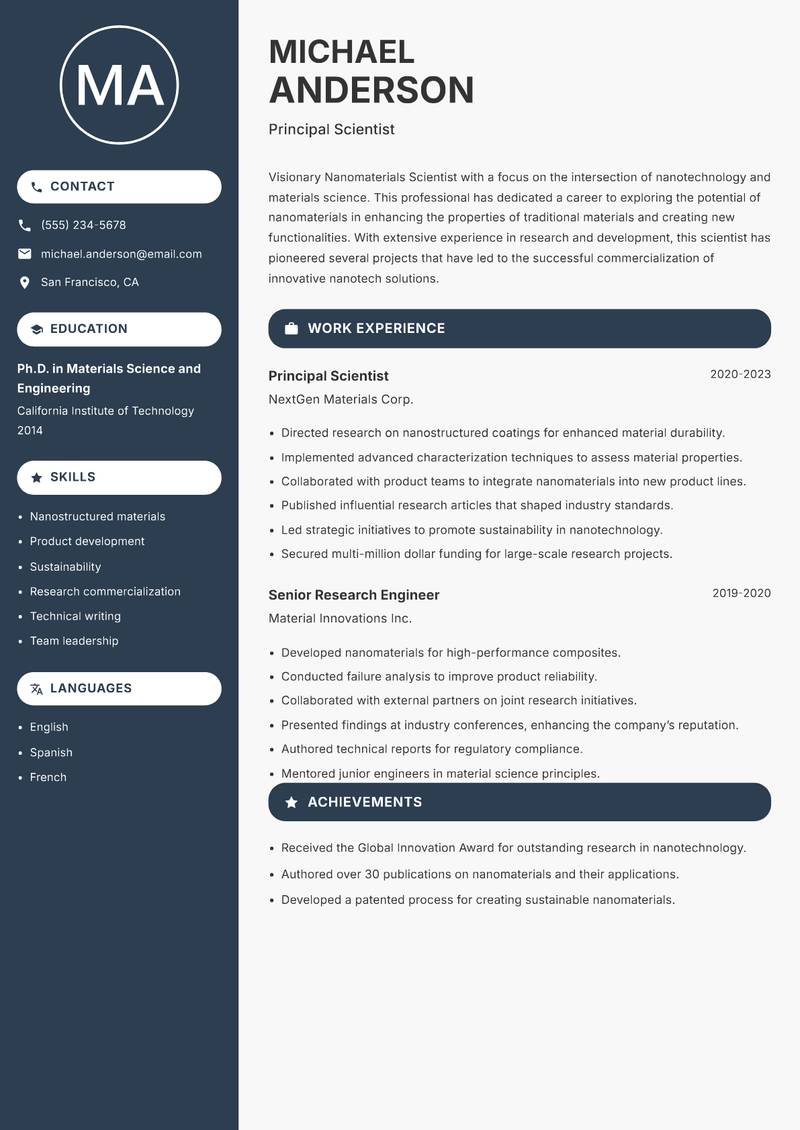
Principal Scientist Resume

Visionary Nanomaterials Scientist with a focus on the intersection of nanotechnology and materials science. This professional has dedicated a career to exploring the potential of nanomaterials in enhancing the properties of traditional materials and creating new functionalities. With extensive experience in research and development, this scientist has pioneered several projects that have led to the successful commercialization of innovative nanotech solutions. A strong advocate for sustainability, this individual emphasizes the responsible use of nanotechnology in product development, aiming to minimize environmental impact while maximizing performance. Through collaboration with industry partners and academic institutions, this scientist has cultivated a robust network that fosters innovation and knowledge exchange. Recognized for exceptional contributions to the field, this professional has received several awards and is frequently invited to speak at conferences worldwide.

Nanostructured materials Product development Sustainability Research commercialization Technical writing Team leadership
Nanomaterials Scientist Resume Preview Example
View PDF
  1. Directed research on nanostructured coatings for enhanced material durability.
  2. Implemented advanced characterization techniques to assess material properties.
  3. Collaborated with product teams to integrate nanomaterials into new product lines.
  4. Published influential research articles that shaped industry standards.
  5. Led strategic initiatives to promote sustainability in nanotechnology.
  6. Secured multi-million dollar funding for large-scale research projects.
  1. Developed nanomaterials for high-performance composites.
  2. Conducted failure analysis to improve product reliability.
  3. Collaborated with external partners on joint research initiatives.
  4. Presented findings at industry conferences, enhancing the company’s reputation.
  5. Authored technical reports for regulatory compliance.
  6. Mentored junior engineers in material science principles.

Achievements

  • Received the Global Innovation Award for outstanding research in nanotechnology.
  • Authored over 30 publications on nanomaterials and their applications.
  • Developed a patented process for creating sustainable nanomaterials.
⏱️
Experience
2-5 Years
📅
Level
Mid Level
🎓
Education
Ph.D. in Materials Science and...

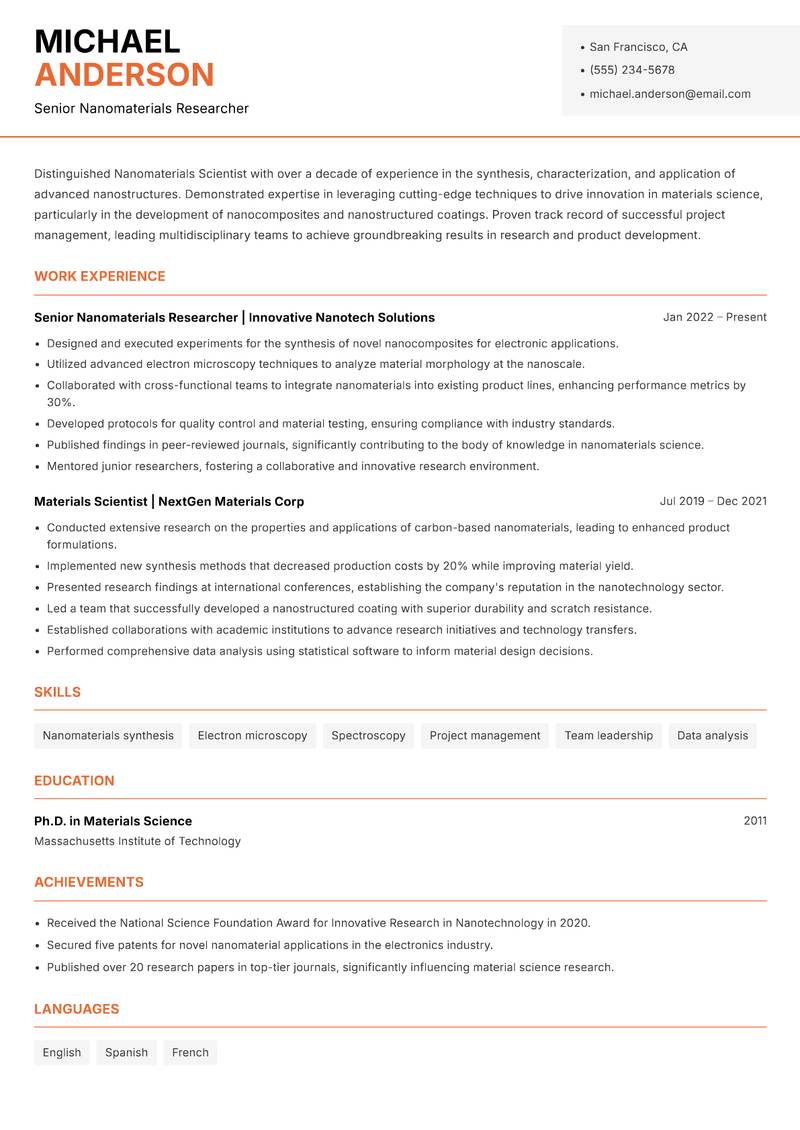
Senior Nanomaterials Researcher Resume

Distinguished Nanomaterials Scientist with over a decade of experience in the synthesis, characterization, and application of advanced nanostructures. Demonstrated expertise in leveraging cutting-edge techniques to drive innovation in materials science, particularly in the development of nanocomposites and nanostructured coatings. Proven track record of successful project management, leading multidisciplinary teams to achieve groundbreaking results in research and product development. Adept at utilizing state-of-the-art characterization methods, including electron microscopy and spectroscopy, to elucidate material properties and enhance performance. Committed to advancing the field through rigorous experimentation and collaboration with industry partners, resulting in numerous patents and publications. A recognized leader in the nanotechnology community, contributing to conferences and workshops to disseminate knowledge and foster collaboration.

Nanomaterials synthesis Electron microscopy Spectroscopy Project management Team leadership Data analysis
Nanomaterials Scientist Resume Preview Example
View PDF
  1. Designed and executed experiments for the synthesis of novel nanocomposites for electronic applications.
  2. Utilized advanced electron microscopy techniques to analyze material morphology at the nanoscale.
  3. Collaborated with cross-functional teams to integrate nanomaterials into existing product lines, enhancing performance metrics by 30%.
  4. Developed protocols for quality control and material testing, ensuring compliance with industry standards.
  5. Published findings in peer-reviewed journals, significantly contributing to the body of knowledge in nanomaterials science.
  6. Mentored junior researchers, fostering a collaborative and innovative research environment.
  1. Conducted extensive research on the properties and applications of carbon-based nanomaterials, leading to enhanced product formulations.
  2. Implemented new synthesis methods that decreased production costs by 20% while improving material yield.
  3. Presented research findings at international conferences, establishing the company's reputation in the nanotechnology sector.
  4. Led a team that successfully developed a nanostructured coating with superior durability and scratch resistance.
  5. Established collaborations with academic institutions to advance research initiatives and technology transfers.
  6. Performed comprehensive data analysis using statistical software to inform material design decisions.

Achievements

  • Received the National Science Foundation Award for Innovative Research in Nanotechnology in 2020.
  • Secured five patents for novel nanomaterial applications in the electronics industry.
  • Published over 20 research papers in top-tier journals, significantly influencing material science research.
⏱️
Experience
2-5 Years
📅
Level
Mid Level
🎓
Education
Ph.D. in Materials Science, Ma...

Key Skills for Nanomaterials Scientist Positions

Resume Tips for Nanomaterials Scientist Applications

Strong Action Verbs for Nanomaterials Scientist Resumes

Synthesised · Fabricated · Characterised · Modelled · Published · Patented · Developed · Analysed · Researched · Designed · Achieved · Administered · Analyzed · Architected · Assessed · Automated

Common Mistakes to Avoid

Experience Levels

How to Write a Nanomaterials Scientist Resume

Browse Nanomaterials Scientist resume examples built around publishing research findings, tailored for Nanotechnology roles.

A strong Nanomaterials Scientist resume leads with a focused professional summary that names the exact role and your standout achievement. In the experience section, open every bullet with a strong action verb and quantify the result with numbers wherever possible. Highlight your most relevant competencies — especially Publishing research findings, Presenting results at, and Nanofabrication & Synthesis — in a dedicated Skills section positioned early so ATS systems and hiring managers both find it immediately.

For format, most Nanomaterials Scientist roles suit a reverse-chronological layout: most recent position first, working backwards. Keep to one page for under five years of experience, or two pages for senior candidates with a rich project or leadership history. Use clean, ATS-safe fonts (10–12pt), standard section headings (Summary, Experience, Education, Skills), and avoid tables, text boxes, or multi-column layouts that applicant tracking systems cannot parse reliably.
Frequently Asked Questions

What makes a strong Nanomaterials Scientist resume stand out to employers?

A standout Nanomaterials Scientist resume combines role-specific skills with quantified achievements. Name the exact job title in your professional summary, mirror keywords from each job posting, and open every bullet point with a strong action verb followed by a measurable result. Certifications, tools, and domain experience specific to nanomaterials scientist roles should appear prominently near the top.

What skills are most important to include on a Nanotechnology resume?

Recruiters hiring in Nanotechnology consistently look for Nanofabrication & Synthesis, Scanning Electron Microscopy (SEM), Transmission Electron Microscopy (TEM), Atomic Force Microscopy (AFM). List these in a dedicated Skills section near the top so both ATS systems and human reviewers spot them fast. Mirror the exact phrasing from each job posting wherever possible — many applicant tracking systems match literal strings rather than synonyms.

What is the best resume format for Nanotechnology professionals?

A reverse-chronological format is the standard choice for most Nanotechnology candidates — employers expect to see your most recent role first, working backwards. If you are transitioning into Nanotechnology from a related field, a hybrid format (brief skills summary at the top followed by chronological experience) can bridge the gap effectively. Keep the document to one page for under five years of experience, or two pages for senior specialists.

How do I make my Nanotechnology resume pass applicant tracking systems (ATS)?

Use standard section headings — Summary, Experience, Education, Skills — rather than creative labels that ATS parsers do not recognise. Embed domain keywords such as "Nanofabrication & Synthesis" and "Scanning Electron Microscopy (SEM)" naturally inside your experience bullets rather than cramming them into a standalone keyword list. Avoid tables, multi-column layouts, text boxes, headers, footers, and images — these confuse most modern parsers and can cause your resume to be misread or rejected before a human sees it.

What mistakes do Nanotechnology professionals most commonly make on their resume?

The most frequent issue is being too academic without showing applied or commercial relevance. Beyond that, generic objective statements, unquantified achievements, and inconsistent date formatting appear across almost every Nanotechnology application. Fix these by replacing every vague claim with a measurable outcome — specific numbers and named projects add credibility that adjectives cannot.

How long should a Nanotechnology resume be?

One page is appropriate for candidates with under five years of relevant Nanotechnology experience. Two pages are acceptable — and sometimes expected — for senior specialists, managers, or professionals with a strong portfolio of projects, publications, or credentials. Avoid padding to reach a page count: every line should directly support your application for the specific role you are targeting.

Should I include a professional summary at the top of my Nanotechnology resume?

Yes — a two to three sentence summary is the first section most recruiters read. Open with your title and years of Nanotechnology experience, then name your most relevant achievement or specialisation. One proven approach: Lead with your nanotechnology specialisation and the characterisation tools you are proficient with. List publications, patents, and research grants. Demonstrate how your nano research has progressed toward applied or commercial outcomes. Include any cleanroom or advanced laboratory certifications — this level of specificity signals genuine expertise before a recruiter reaches your experience section.

Scroll to view samples