Software Reliability Engineer Resume

These Software Reliability Engineer resume samples are designed to help you write a resume that gets noticed by hiring managers and passes applicant tracking systems (ATS) in Software Development. Each example shows real formatting, section structure, and language you can adapt to your own background. When writing your own Software Reliability Engineer resume, focus on highlighting programming languages (Python, java, JavaScript, go, rust, C++), web frameworks (React, node.js, django, spring, FastAPI) and database design (SQL, NoSQL, ORM). Recruiters scan for these qualifications first, so they should appear early in your summary and experience sections. Use strong action verbs such as "engineered", "built", "refactored", "deployed" to describe your achievements, and quantify your impact wherever possible — percentages, dollar amounts, or time saved make your resume more convincing. A common mistake to avoid: writing a generic objective statement instead of a targeted software reliability engineer professional summary. Tailor your resume to each Software Reliability Engineer position you apply for rather than using one generic version.

Software Reliability Engineer Resume Template
View PDF
0.0 (0 ratings)

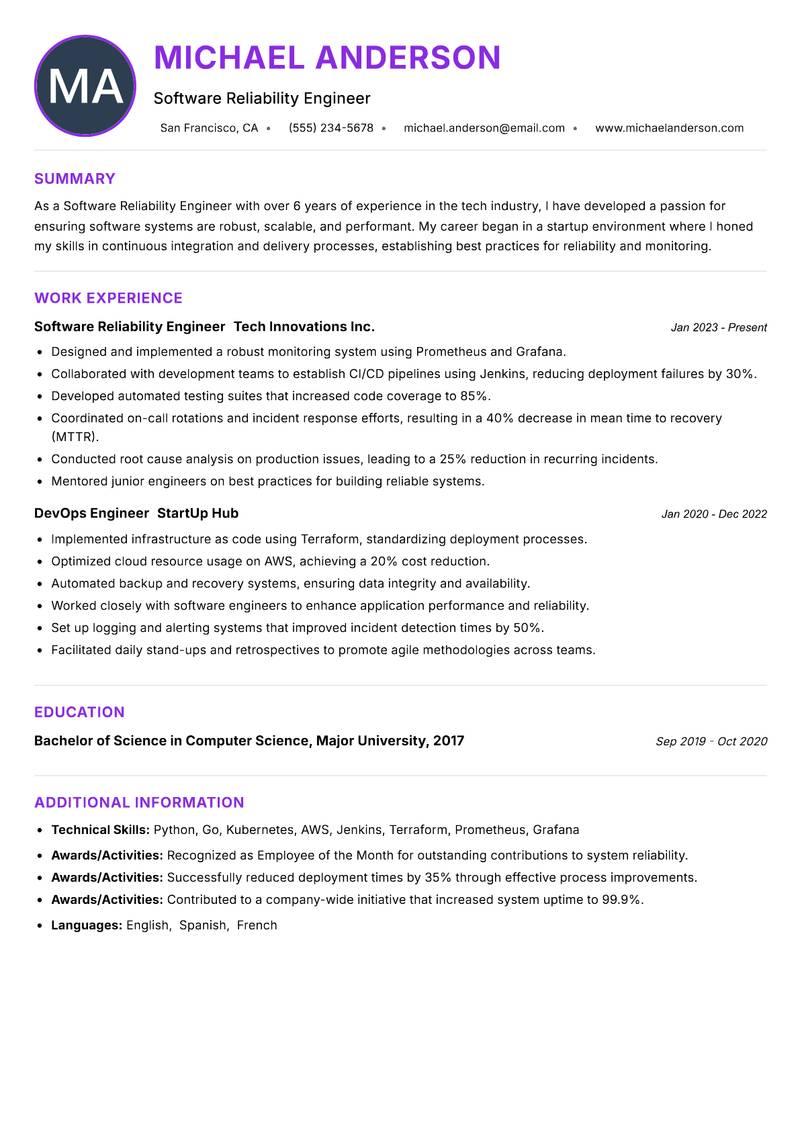
Software Reliability Engineer Resume

As a Software Reliability Engineer with over 6 years of experience in the tech industry, I have developed a passion for ensuring software systems are robust, scalable, and performant. My career began in a startup environment where I honed my skills in continuous integration and delivery processes, establishing best practices for reliability and monitoring. In my previous roles, I have effectively collaborated with cross-functional teams to implement automated testing frameworks, significantly reducing deployment times and improving system uptime. My expertise encompasses both backend and frontend technologies, enabling me to contribute to all layers of an application stack. I am dedicated to fostering a culture of reliability within development teams, advocating for proactive problem-solving and continuous improvement. I have a proven track record of leveraging data analysis to inform decision-making and enhance system performance. My technical toolkit includes a variety of languages and tools, such as Python, Go, Kubernetes, and AWS. Looking ahead, I am eager to take on new challenges that allow me to drive reliability initiatives and mentor upcoming engineers in best practices.

Python Go Kubernetes AWS Jenkins Terraform Prometheus Grafana
Software Reliability Engineer Resume Preview Example
View PDF
  1. Designed and implemented a robust monitoring system using Prometheus and Grafana.
  2. Collaborated with development teams to establish CI/CD pipelines using Jenkins, reducing deployment failures by 30%.
  3. Developed automated testing suites that increased code coverage to 85%.
  4. Coordinated on-call rotations and incident response efforts, resulting in a 40% decrease in mean time to recovery (MTTR).
  5. Conducted root cause analysis on production issues, leading to a 25% reduction in recurring incidents.
  6. Mentored junior engineers on best practices for building reliable systems.
  1. Implemented infrastructure as code using Terraform, standardizing deployment processes.
  2. Optimized cloud resource usage on AWS, achieving a 20% cost reduction.
  3. Automated backup and recovery systems, ensuring data integrity and availability.
  4. Worked closely with software engineers to enhance application performance and reliability.
  5. Set up logging and alerting systems that improved incident detection times by 50%.
  6. Facilitated daily stand-ups and retrospectives to promote agile methodologies across teams.

Achievements

  • Recognized as Employee of the Month for outstanding contributions to system reliability.
  • Successfully reduced deployment times by 35% through effective process improvements.
  • Contributed to a company-wide initiative that increased system uptime to 99.9%.
⏱️
Experience
2-5 Years
📅
Level
Mid Level
🎓
Education
Bachelor of Science in Compute...

Software Reliability Engineer Resume

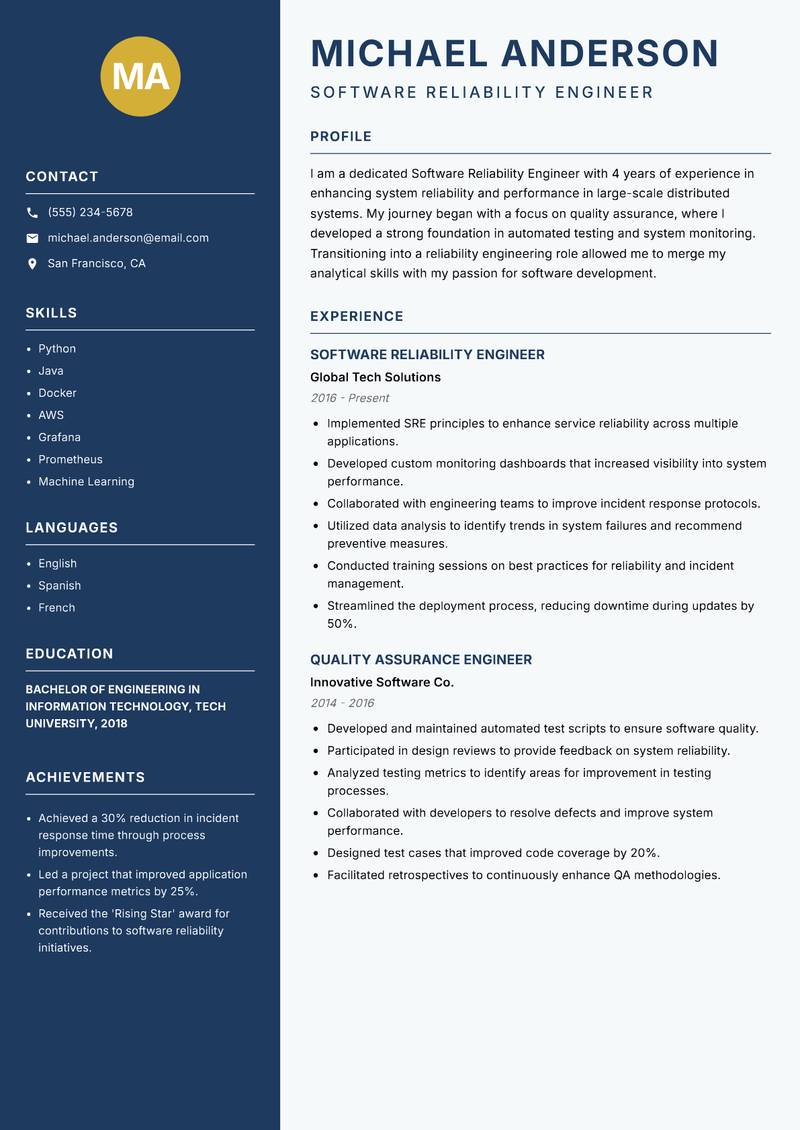
I am a dedicated Software Reliability Engineer with 4 years of experience in enhancing system reliability and performance in large-scale distributed systems. My journey began with a focus on quality assurance, where I developed a strong foundation in automated testing and system monitoring. Transitioning into a reliability engineering role allowed me to merge my analytical skills with my passion for software development. I have successfully implemented SRE practices in various projects, leading to improved application performance and reduced downtime. My expertise includes using advanced monitoring tools and frameworks to proactively identify system bottlenecks and optimize resource allocation. I thrive in fast-paced environments and enjoy collaborating with diverse teams to solve complex challenges. I am particularly interested in leveraging machine learning models to predict system failures before they occur, thereby enhancing user experience and operational efficiency. My technical skills include Python, Java, Docker, and various cloud platforms. I am committed to continuous learning and am currently pursuing additional certifications to advance my knowledge in reliability engineering.

Python Java Docker AWS Grafana Prometheus Machine Learning
Software Reliability Engineer Resume Preview Example
View PDF
  1. Implemented SRE principles to enhance service reliability across multiple applications.
  2. Developed custom monitoring dashboards that increased visibility into system performance.
  3. Collaborated with engineering teams to improve incident response protocols.
  4. Utilized data analysis to identify trends in system failures and recommend preventive measures.
  5. Conducted training sessions on best practices for reliability and incident management.
  6. Streamlined the deployment process, reducing downtime during updates by 50%.
  1. Developed and maintained automated test scripts to ensure software quality.
  2. Participated in design reviews to provide feedback on system reliability.
  3. Analyzed testing metrics to identify areas for improvement in testing processes.
  4. Collaborated with developers to resolve defects and improve system performance.
  5. Designed test cases that improved code coverage by 20%.
  6. Facilitated retrospectives to continuously enhance QA methodologies.

Achievements

  • Achieved a 30% reduction in incident response time through process improvements.
  • Led a project that improved application performance metrics by 25%.
  • Received the 'Rising Star' award for contributions to software reliability initiatives.
⏱️
Experience
2-5 Years
📅
Level
Mid Level
🎓
Education
Bachelor of Engineering in Inf...

Senior Software Reliability Engineer Resume

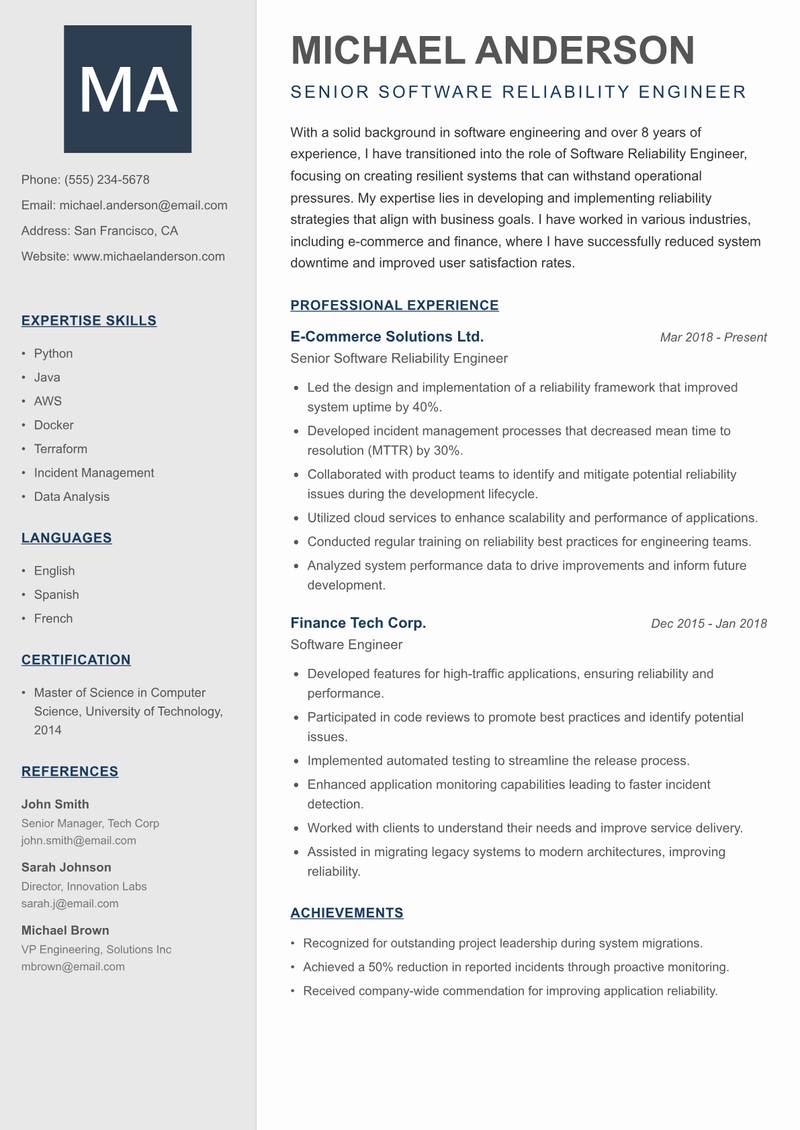
With a solid background in software engineering and over 8 years of experience, I have transitioned into the role of Software Reliability Engineer, focusing on creating resilient systems that can withstand operational pressures. My expertise lies in developing and implementing reliability strategies that align with business goals. I have worked in various industries, including e-commerce and finance, where I have successfully reduced system downtime and improved user satisfaction rates. My technical skills include proficiency in scripting languages, cloud services, and infrastructure management tools. I am passionate about fostering a culture of reliability within teams, advocating for proactive monitoring, and establishing clear incident management protocols. Throughout my career, I have consistently utilized data-driven insights to enhance system performance and inform strategic decisions. I excel in high-stakes environments and am adept at leading cross-functional teams to achieve operational excellence. I am eager to contribute my experience and leadership skills to a forward-thinking company that values innovation and reliability.

Python Java AWS Docker Terraform Incident Management Data Analysis
Software Reliability Engineer Resume Preview Example
View PDF
  1. Led the design and implementation of a reliability framework that improved system uptime by 40%.
  2. Developed incident management processes that decreased mean time to resolution (MTTR) by 30%.
  3. Collaborated with product teams to identify and mitigate potential reliability issues during the development lifecycle.
  4. Utilized cloud services to enhance scalability and performance of applications.
  5. Conducted regular training on reliability best practices for engineering teams.
  6. Analyzed system performance data to drive improvements and inform future development.
  1. Developed features for high-traffic applications, ensuring reliability and performance.
  2. Participated in code reviews to promote best practices and identify potential issues.
  3. Implemented automated testing to streamline the release process.
  4. Enhanced application monitoring capabilities leading to faster incident detection.
  5. Worked with clients to understand their needs and improve service delivery.
  6. Assisted in migrating legacy systems to modern architectures, improving reliability.

Achievements

  • Recognized for outstanding project leadership during system migrations.
  • Achieved a 50% reduction in reported incidents through proactive monitoring.
  • Received company-wide commendation for improving application reliability.
⏱️
Experience
2-5 Years
📅
Level
Mid Level
🎓
Education
Master of Science in Computer ...

Software Reliability Engineer Resume

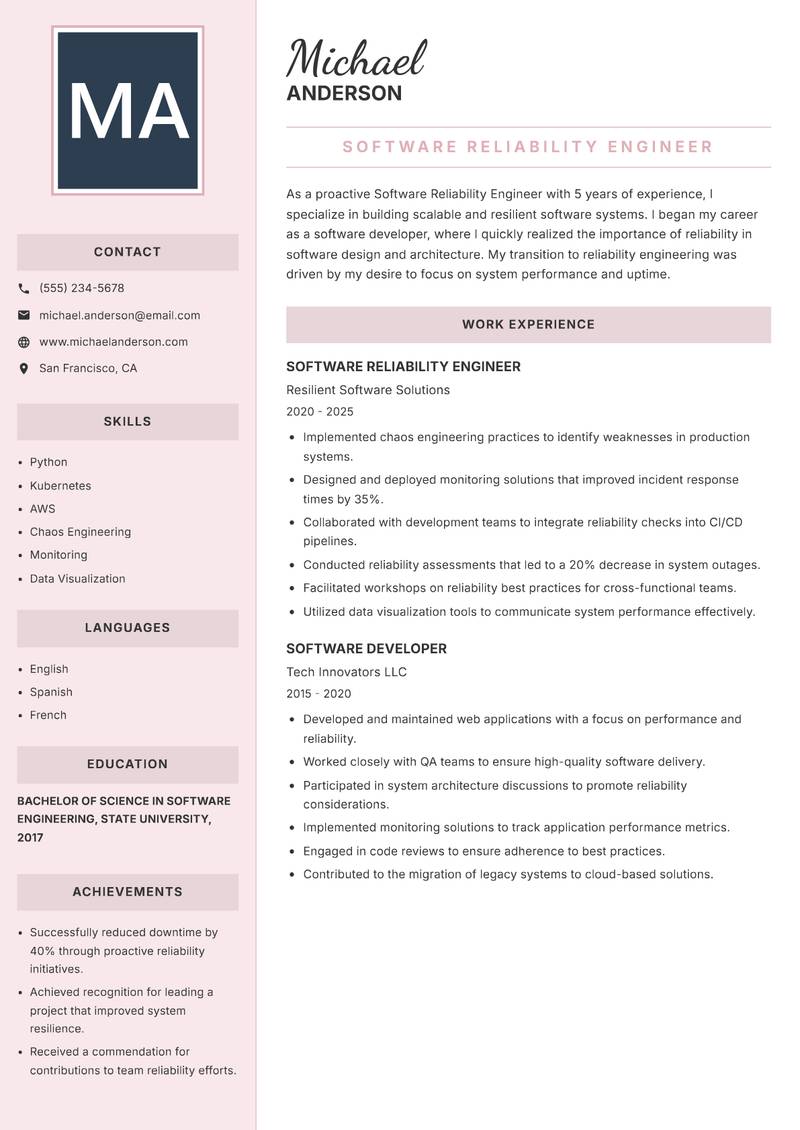
As a proactive Software Reliability Engineer with 5 years of experience, I specialize in building scalable and resilient software systems. I began my career as a software developer, where I quickly realized the importance of reliability in software design and architecture. My transition to reliability engineering was driven by my desire to focus on system performance and uptime. In my current role, I have implemented various reliability strategies, including chaos engineering and automated testing, to ensure our applications remain performant under stress. I have a strong background in monitoring and alerting systems and have successfully integrated these tools into our development processes. I am committed to fostering a culture of reliability and collaboration across teams, ensuring that every member understands the importance of building systems with resilience in mind. My technical skills include proficiency in Python, Kubernetes, and cloud infrastructure. I am enthusiastic about leveraging my expertise to help organizations achieve their reliability goals and enhance user experiences.

Python Kubernetes AWS Chaos Engineering Monitoring Data Visualization
Software Reliability Engineer Resume Preview Example
View PDF
  1. Implemented chaos engineering practices to identify weaknesses in production systems.
  2. Designed and deployed monitoring solutions that improved incident response times by 35%.
  3. Collaborated with development teams to integrate reliability checks into CI/CD pipelines.
  4. Conducted reliability assessments that led to a 20% decrease in system outages.
  5. Facilitated workshops on reliability best practices for cross-functional teams.
  6. Utilized data visualization tools to communicate system performance effectively.
  1. Developed and maintained web applications with a focus on performance and reliability.
  2. Worked closely with QA teams to ensure high-quality software delivery.
  3. Participated in system architecture discussions to promote reliability considerations.
  4. Implemented monitoring solutions to track application performance metrics.
  5. Engaged in code reviews to ensure adherence to best practices.
  6. Contributed to the migration of legacy systems to cloud-based solutions.

Achievements

  • Successfully reduced downtime by 40% through proactive reliability initiatives.
  • Achieved recognition for leading a project that improved system resilience.
  • Received a commendation for contributions to team reliability efforts.
⏱️
Experience
2-5 Years
📅
Level
Mid Level
🎓
Education
Bachelor of Science in Softwar...

Software Reliability Engineer Resume

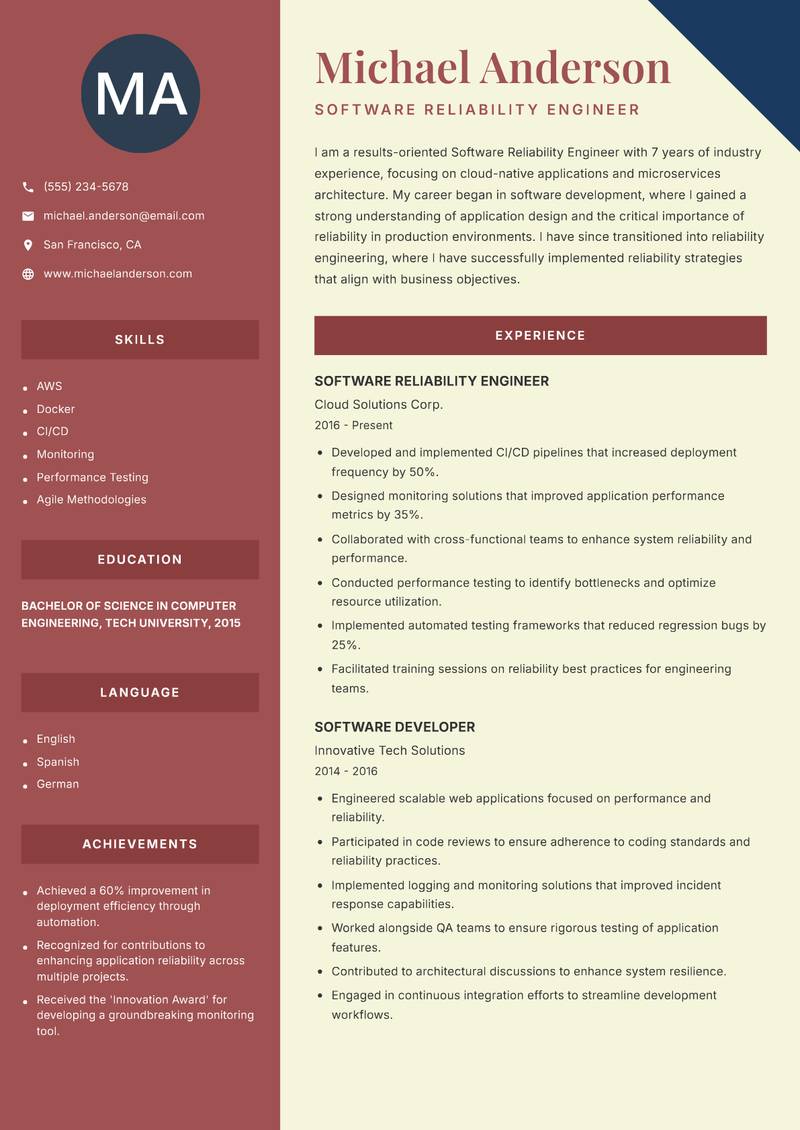
I am a results-oriented Software Reliability Engineer with 7 years of industry experience, focusing on cloud-native applications and microservices architecture. My career began in software development, where I gained a strong understanding of application design and the critical importance of reliability in production environments. I have since transitioned into reliability engineering, where I have successfully implemented reliability strategies that align with business objectives. My experience includes designing and managing CI/CD pipelines, automating testing processes, and monitoring system health. I have a proven track record of improving application performance and reducing downtime across various projects. I am an advocate for DevOps practices and have worked extensively in collaborative environments to promote a culture of reliability. My technical expertise includes AWS, Docker, and various programming languages. I am passionate about leveraging my skills to build resilient systems that meet user needs and enhance operational efficiency.

AWS Docker CI/CD Monitoring Performance Testing Agile Methodologies
Software Reliability Engineer Resume Preview Example
View PDF
  1. Developed and implemented CI/CD pipelines that increased deployment frequency by 50%.
  2. Designed monitoring solutions that improved application performance metrics by 35%.
  3. Collaborated with cross-functional teams to enhance system reliability and performance.
  4. Conducted performance testing to identify bottlenecks and optimize resource utilization.
  5. Implemented automated testing frameworks that reduced regression bugs by 25%.
  6. Facilitated training sessions on reliability best practices for engineering teams.
  1. Engineered scalable web applications focused on performance and reliability.
  2. Participated in code reviews to ensure adherence to coding standards and reliability practices.
  3. Implemented logging and monitoring solutions that improved incident response capabilities.
  4. Worked alongside QA teams to ensure rigorous testing of application features.
  5. Contributed to architectural discussions to enhance system resilience.
  6. Engaged in continuous integration efforts to streamline development workflows.

Achievements

  • Achieved a 60% improvement in deployment efficiency through automation.
  • Recognized for contributions to enhancing application reliability across multiple projects.
  • Received the 'Innovation Award' for developing a groundbreaking monitoring tool.
⏱️
Experience
2-5 Years
📅
Level
Mid Level
🎓
Education
Bachelor of Science in Compute...

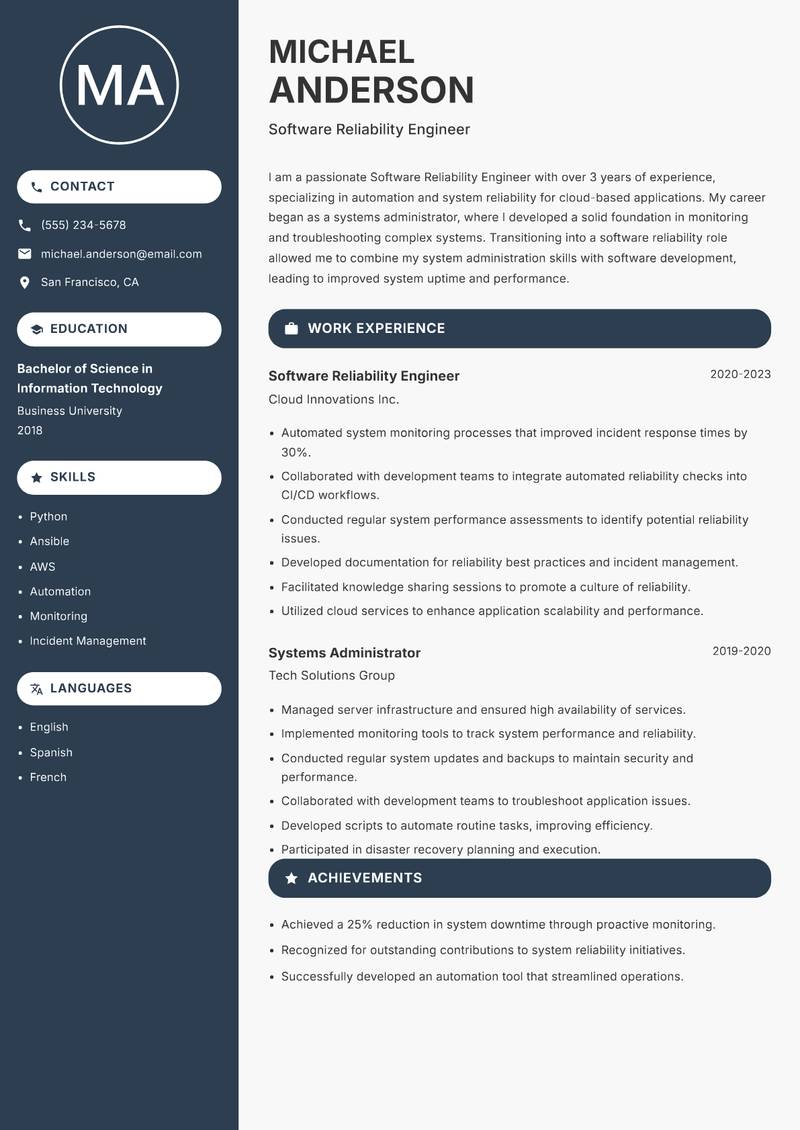
Software Reliability Engineer Resume

I am a passionate Software Reliability Engineer with over 3 years of experience, specializing in automation and system reliability for cloud-based applications. My career began as a systems administrator, where I developed a solid foundation in monitoring and troubleshooting complex systems. Transitioning into a software reliability role allowed me to combine my system administration skills with software development, leading to improved system uptime and performance. I have successfully implemented various automation tools and practices that enhance operational efficiencies and reduce manual interventions. I thrive on solving complex problems and enjoy collaborating with teams to build resilient systems. My technical skills include proficiency in Python, Ansible, and cloud services. I am committed to continuous learning and improvement, always seeking new ways to enhance system reliability and performance.

Python Ansible AWS Automation Monitoring Incident Management
Software Reliability Engineer Resume Preview Example
View PDF
  1. Automated system monitoring processes that improved incident response times by 30%.
  2. Collaborated with development teams to integrate automated reliability checks into CI/CD workflows.
  3. Conducted regular system performance assessments to identify potential reliability issues.
  4. Developed documentation for reliability best practices and incident management.
  5. Facilitated knowledge sharing sessions to promote a culture of reliability.
  6. Utilized cloud services to enhance application scalability and performance.
  1. Managed server infrastructure and ensured high availability of services.
  2. Implemented monitoring tools to track system performance and reliability.
  3. Conducted regular system updates and backups to maintain security and performance.
  4. Collaborated with development teams to troubleshoot application issues.
  5. Developed scripts to automate routine tasks, improving efficiency.
  6. Participated in disaster recovery planning and execution.

Achievements

  • Achieved a 25% reduction in system downtime through proactive monitoring.
  • Recognized for outstanding contributions to system reliability initiatives.
  • Successfully developed an automation tool that streamlined operations.
⏱️
Experience
2-5 Years
📅
Level
Mid Level
🎓
Education
Bachelor of Science in Informa...

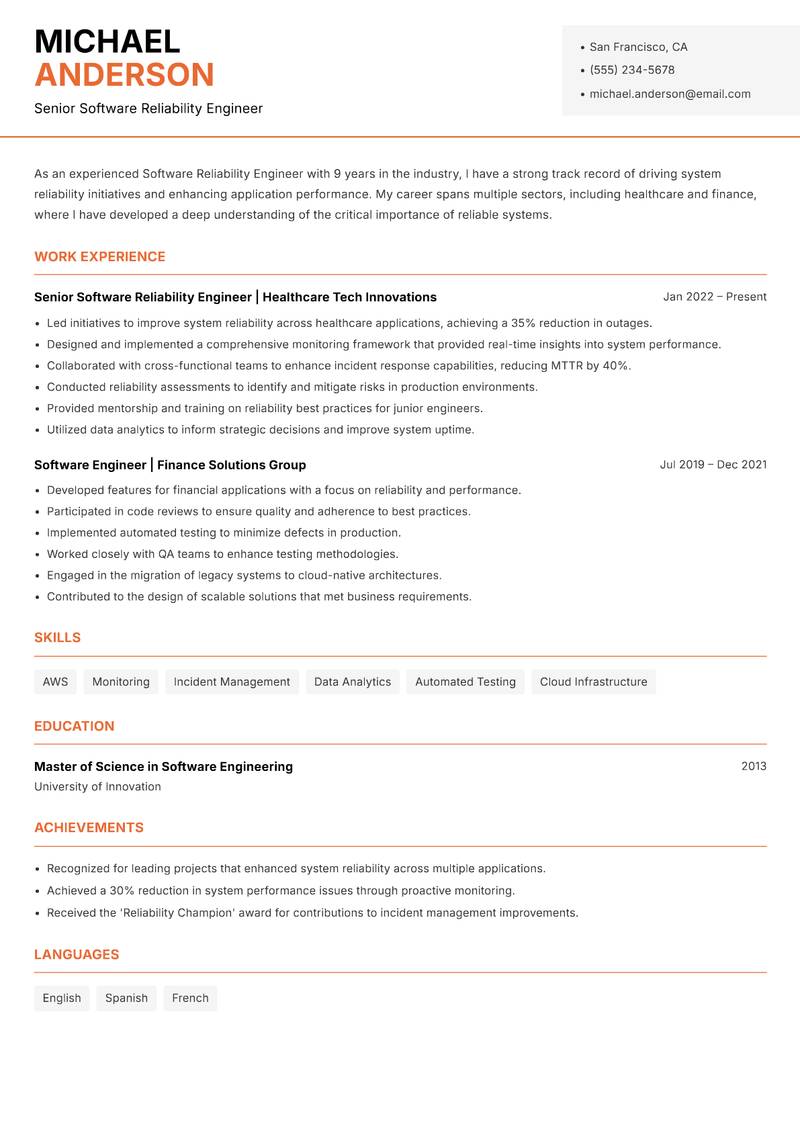
Senior Software Reliability Engineer Resume

As an experienced Software Reliability Engineer with 9 years in the industry, I have a strong track record of driving system reliability initiatives and enhancing application performance. My career spans multiple sectors, including healthcare and finance, where I have developed a deep understanding of the critical importance of reliable systems. I specialize in designing and implementing monitoring solutions that provide real-time insights into system health, allowing teams to respond proactively to potential issues. My technical expertise includes cloud infrastructure management, automated testing, and incident response strategies. I am passionate about mentoring junior engineers and fostering a culture of reliability and collaboration within teams. I thrive in fast-paced environments, where I can leverage my problem-solving skills to ensure the availability and performance of critical systems. I am committed to continuous improvement and am always seeking innovative ways to enhance the reliability of software applications.

AWS Monitoring Incident Management Data Analytics Automated Testing Cloud Infrastructure
Software Reliability Engineer Resume Preview Example
View PDF
  1. Led initiatives to improve system reliability across healthcare applications, achieving a 35% reduction in outages.
  2. Designed and implemented a comprehensive monitoring framework that provided real-time insights into system performance.
  3. Collaborated with cross-functional teams to enhance incident response capabilities, reducing MTTR by 40%.
  4. Conducted reliability assessments to identify and mitigate risks in production environments.
  5. Provided mentorship and training on reliability best practices for junior engineers.
  6. Utilized data analytics to inform strategic decisions and improve system uptime.
  1. Developed features for financial applications with a focus on reliability and performance.
  2. Participated in code reviews to ensure quality and adherence to best practices.
  3. Implemented automated testing to minimize defects in production.
  4. Worked closely with QA teams to enhance testing methodologies.
  5. Engaged in the migration of legacy systems to cloud-native architectures.
  6. Contributed to the design of scalable solutions that met business requirements.

Achievements

  • Recognized for leading projects that enhanced system reliability across multiple applications.
  • Achieved a 30% reduction in system performance issues through proactive monitoring.
  • Received the 'Reliability Champion' award for contributions to incident management improvements.
⏱️
Experience
2-5 Years
📅
Level
Mid Level
🎓
Education
Master of Science in Software ...

Key Skills for Software Reliability Engineer Positions

Resume Tips for Software Reliability Engineer Applications

Strong Action Verbs for Software Reliability Engineer Resumes

Engineered · Built · Refactored · Deployed · Optimized · Architected · Shipped · Debugged · Designed · Implemented · Automated · Achieved · Administered · Analyzed

Common Mistakes to Avoid

Experience Levels

How to Write a Software Reliability Engineer Resume

Browse Software Reliability Engineer resume examples built around programming languages (Python, java, JavaScript, go, rust, C++), tailored for Software…

A strong Software Reliability Engineer resume leads with a focused professional summary that names the exact role and your standout achievement. In the experience section, open every bullet with a strong action verb and quantify the result with numbers wherever possible. Highlight your most relevant competencies — especially Programming Languages (Python, Java, JavaScript, Go, Rust, C++), Web Frameworks (React, Node.js, Django, Spring, FastAPI), and Database Design (SQL, NoSQL, ORM) — in a dedicated Skills section positioned early so ATS systems and hiring managers both find it immediately.

For format, most Software Reliability Engineer roles suit a reverse-chronological layout: most recent position first, working backwards. Keep to one page for under five years of experience, or two pages for senior candidates with a rich project or leadership history. Use clean, ATS-safe fonts (10–12pt), standard section headings (Summary, Experience, Education, Skills), and avoid tables, text boxes, or multi-column layouts that applicant tracking systems cannot parse reliably.
Frequently Asked Questions

What makes a strong Software Reliability Engineer resume stand out to employers?

A standout Software Reliability Engineer resume combines role-specific skills with quantified achievements. Name the exact job title in your professional summary, mirror keywords from each job posting, and open every bullet point with a strong action verb followed by a measurable result. Certifications, tools, and domain experience specific to software reliability engineer roles should appear prominently near the top.

What skills are most important to include on a Software Development resume?

Recruiters hiring in Software Development consistently look for Programming Languages (Python, Java, JavaScript, Go, Rust, C++), Web Frameworks (React, Node.js, Django, Spring, FastAPI), Database Design (SQL, NoSQL, ORM), Version Control (Git, GitHub, GitLab). List these in a dedicated Skills section near the top so both ATS systems and human reviewers spot them fast. Mirror the exact phrasing from each job posting wherever possible — many applicant tracking systems match literal strings rather than synonyms.

What is the best resume format for Software Development professionals?

A reverse-chronological format is the standard choice for most Software Development candidates — employers expect to see your most recent role first, working backwards. If you are transitioning into Software Development from a related field, a hybrid format (brief skills summary at the top followed by chronological experience) can bridge the gap effectively. Keep the document to one page for under five years of experience, or two pages for senior specialists.

How do I make my Software Development resume pass applicant tracking systems (ATS)?

Use standard section headings — Summary, Experience, Education, Skills — rather than creative labels that ATS parsers do not recognise. Embed domain keywords such as "Programming Languages (Python, Java, JavaScript, Go, Rust, C++)" and "Web Frameworks (React, Node.js, Django, Spring, FastAPI)" naturally inside your experience bullets rather than cramming them into a standalone keyword list. Avoid tables, multi-column layouts, text boxes, headers, footers, and images — these confuse most modern parsers and can cause your resume to be misread or rejected before a human sees it.

What mistakes do Software Development professionals most commonly make on their resume?

The most frequent issue is listing every language or framework touched without demonstrating depth. Beyond that, generic objective statements, unquantified achievements, and inconsistent date formatting appear across almost every Software Development application. Fix these by replacing every vague claim with a measurable outcome — specific numbers and named projects add credibility that adjectives cannot.

How long should a Software Development resume be?

One page is appropriate for candidates with under five years of relevant Software Development experience. Two pages are acceptable — and sometimes expected — for senior specialists, managers, or professionals with a strong portfolio of projects, publications, or credentials. Avoid padding to reach a page count: every line should directly support your application for the specific role you are targeting.

Should I include a professional summary at the top of my Software Development resume?

Yes — a two to three sentence summary is the first section most recruiters read. Open with your title and years of Software Development experience, then name your most relevant achievement or specialisation. One proven approach: Link to your GitHub, portfolio, or notable open-source contributions — working code is the best credential — this level of specificity signals genuine expertise before a recruiter reaches your experience section.

Scroll to view samples