Water Resources Scientist Resume

These Water Resources Scientist resume samples are designed to help you write a resume that gets noticed by hiring managers and passes applicant tracking systems (ATS) in Earth Sciences. Each example shows real formatting, section structure, and language you can adapt to your own background. When writing your own Water Resources Scientist resume, focus on highlighting hydrology, environmental science and geological mapping & field survey. Recruiters scan for these qualifications first, so they should appear early in your summary and experience sections. Use strong action verbs such as "mapped", "surveyed", "interpreted", "modeled" to describe your achievements, and quantify your impact wherever possible — percentages, dollar amounts, or time saved make your resume more convincing. A common mistake to avoid: writing a generic objective statement instead of a targeted water resources scientist professional summary. Tailor your resume to each Water Resources Scientist position you apply for rather than using one generic version.

Water Resources Scientist Resume Template
View PDF
0.0 (0 ratings)

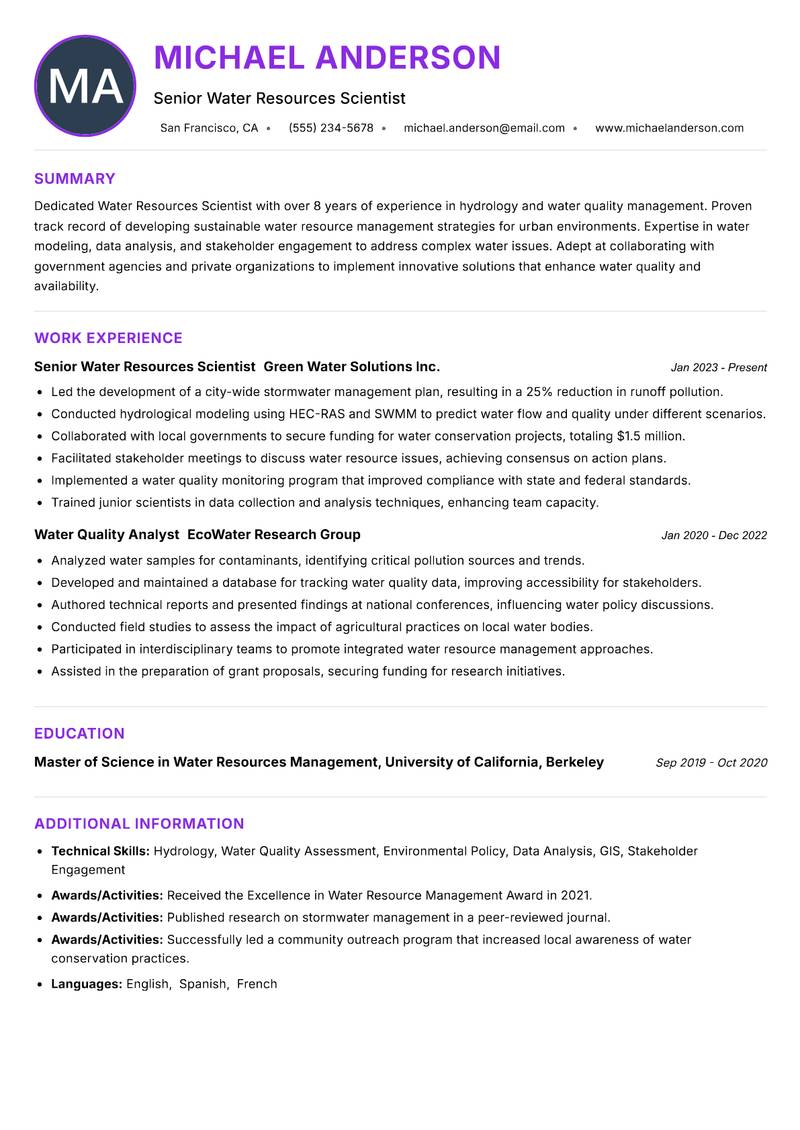
Senior Water Resources Scientist Resume

Dedicated Water Resources Scientist with over 8 years of experience in hydrology and water quality management. Proven track record of developing sustainable water resource management strategies for urban environments. Expertise in water modeling, data analysis, and stakeholder engagement to address complex water issues. Adept at collaborating with government agencies and private organizations to implement innovative solutions that enhance water quality and availability. Passionate about leveraging technology and scientific research to inform policy decisions and improve community access to clean water. Strong communication skills with a history of presenting findings to diverse audiences, including local governments and community groups. Committed to continuous learning and applying the latest scientific advancements in water resource management.

Hydrology Water Quality Assessment Environmental Policy Data Analysis GIS Stakeholder Engagement
Water Resources Scientist Resume Preview Example
View PDF
  1. Led the development of a city-wide stormwater management plan, resulting in a 25% reduction in runoff pollution.
  2. Conducted hydrological modeling using HEC-RAS and SWMM to predict water flow and quality under different scenarios.
  3. Collaborated with local governments to secure funding for water conservation projects, totaling $1.5 million.
  4. Facilitated stakeholder meetings to discuss water resource issues, achieving consensus on action plans.
  5. Implemented a water quality monitoring program that improved compliance with state and federal standards.
  6. Trained junior scientists in data collection and analysis techniques, enhancing team capacity.
  1. Analyzed water samples for contaminants, identifying critical pollution sources and trends.
  2. Developed and maintained a database for tracking water quality data, improving accessibility for stakeholders.
  3. Authored technical reports and presented findings at national conferences, influencing water policy discussions.
  4. Conducted field studies to assess the impact of agricultural practices on local water bodies.
  5. Participated in interdisciplinary teams to promote integrated water resource management approaches.
  6. Assisted in the preparation of grant proposals, securing funding for research initiatives.

Achievements

  • Received the Excellence in Water Resource Management Award in 2021.
  • Published research on stormwater management in a peer-reviewed journal.
  • Successfully led a community outreach program that increased local awareness of water conservation practices.
⏱️
Experience
2-5 Years
📅
Level
Mid Level
🎓
Education
Master of Science in Water Res...

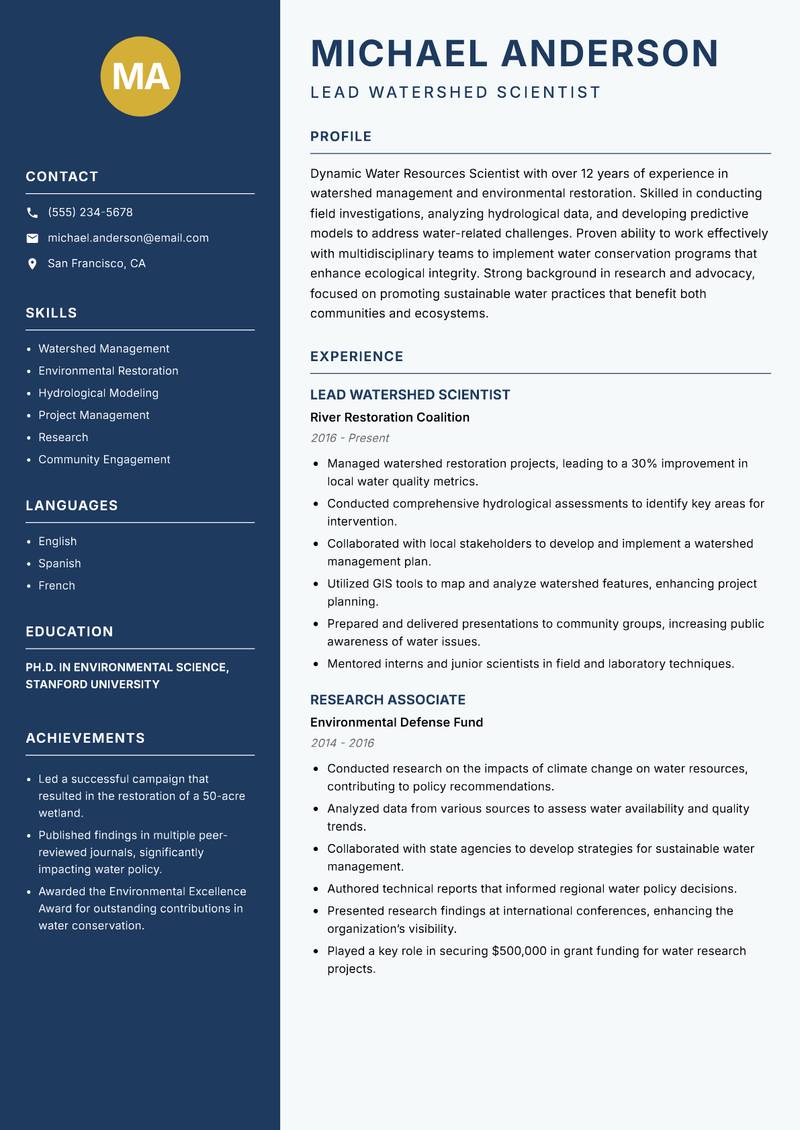
Lead Watershed Scientist Resume

Dynamic Water Resources Scientist with over 12 years of experience in watershed management and environmental restoration. Skilled in conducting field investigations, analyzing hydrological data, and developing predictive models to address water-related challenges. Proven ability to work effectively with multidisciplinary teams to implement water conservation programs that enhance ecological integrity. Strong background in research and advocacy, focused on promoting sustainable water practices that benefit both communities and ecosystems. Experienced in grant writing and project management, securing funding for various initiatives aimed at improving water quality and availability. Committed to advancing the science of water resource management through innovative research and policy initiatives.

Watershed Management Environmental Restoration Hydrological Modeling Project Management Research Community Engagement
Water Resources Scientist Resume Preview Example
View PDF
  1. Managed watershed restoration projects, leading to a 30% improvement in local water quality metrics.
  2. Conducted comprehensive hydrological assessments to identify key areas for intervention.
  3. Collaborated with local stakeholders to develop and implement a watershed management plan.
  4. Utilized GIS tools to map and analyze watershed features, enhancing project planning.
  5. Prepared and delivered presentations to community groups, increasing public awareness of water issues.
  6. Mentored interns and junior scientists in field and laboratory techniques.
  1. Conducted research on the impacts of climate change on water resources, contributing to policy recommendations.
  2. Analyzed data from various sources to assess water availability and quality trends.
  3. Collaborated with state agencies to develop strategies for sustainable water management.
  4. Authored technical reports that informed regional water policy decisions.
  5. Presented research findings at international conferences, enhancing the organization’s visibility.
  6. Played a key role in securing $500,000 in grant funding for water research projects.

Achievements

  • Led a successful campaign that resulted in the restoration of a 50-acre wetland.
  • Published findings in multiple peer-reviewed journals, significantly impacting water policy.
  • Awarded the Environmental Excellence Award for outstanding contributions in water conservation.
⏱️
Experience
2-5 Years
📅
Level
Mid Level
🎓
Education
Ph.D. in Environmental Science...

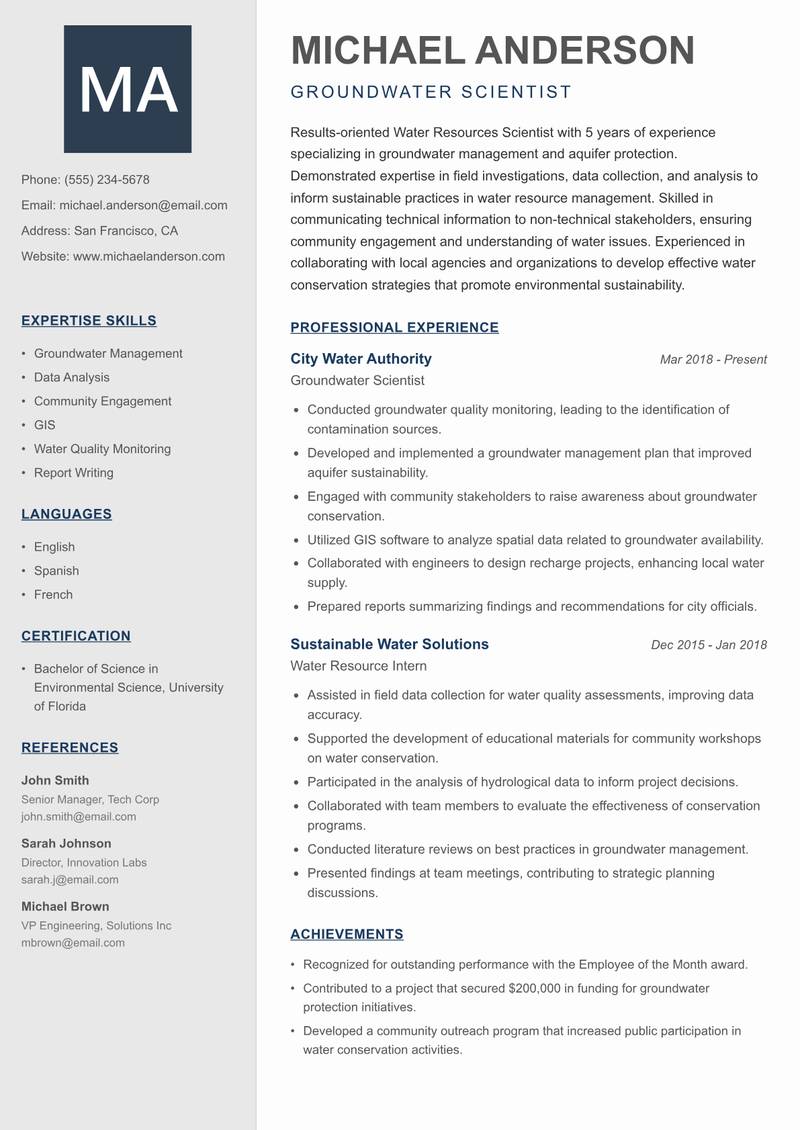
Groundwater Scientist Resume

Accomplished Water Resources Scientist with 5 years of experience specializing in groundwater management and aquifer protection. Demonstrated expertise in field investigations, data collection, and analysis to inform sustainable practices in water resource management. Skilled in communicating technical information to non-technical stakeholders, ensuring community engagement and understanding of water issues. Experienced in collaborating with local agencies and organizations to develop effective water conservation strategies that promote environmental sustainability. Committed to applying scientific research to address pressing water challenges and enhance community resilience. Continually pursuing professional development opportunities to expand knowledge in hydrology and water management.

Groundwater Management Data Analysis Community Engagement GIS Water Quality Monitoring Report Writing
Water Resources Scientist Resume Preview Example
View PDF
  1. Conducted groundwater quality monitoring, leading to the identification of contamination sources.
  2. Developed and implemented a groundwater management plan that improved aquifer sustainability.
  3. Engaged with community stakeholders to raise awareness about groundwater conservation.
  4. Utilized GIS software to analyze spatial data related to groundwater availability.
  5. Collaborated with engineers to design recharge projects, enhancing local water supply.
  6. Prepared reports summarizing findings and recommendations for city officials.
  1. Assisted in field data collection for water quality assessments, improving data accuracy.
  2. Supported the development of educational materials for community workshops on water conservation.
  3. Participated in the analysis of hydrological data to inform project decisions.
  4. Collaborated with team members to evaluate the effectiveness of conservation programs.
  5. Conducted literature reviews on best practices in groundwater management.
  6. Presented findings at team meetings, contributing to strategic planning discussions.

Achievements

  • Recognized for outstanding performance with the Employee of the Month award.
  • Contributed to a project that secured $200,000 in funding for groundwater protection initiatives.
  • Developed a community outreach program that increased public participation in water conservation activities.
⏱️
Experience
2-5 Years
📅
Level
Mid Level
🎓
Education
Bachelor of Science in Environ...

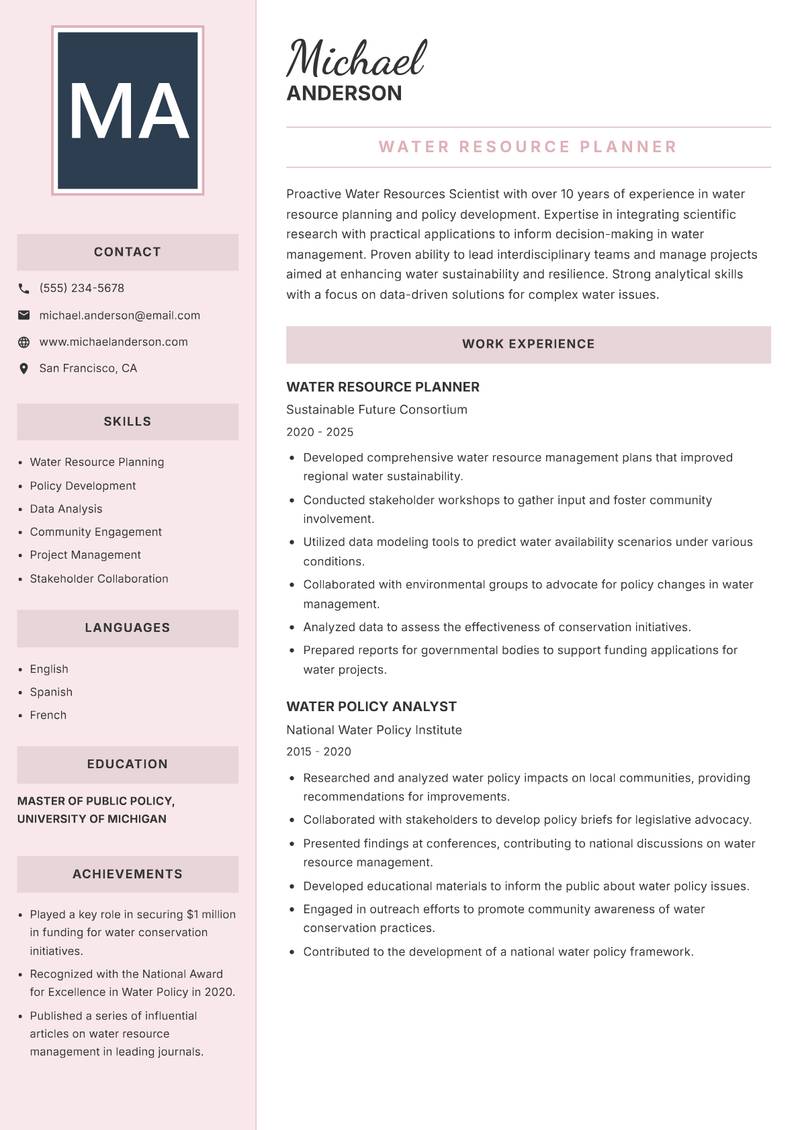
Water Resource Planner Resume

Driven Water Resources Scientist with over 10 years of experience in water resource planning and policy development. Expertise in integrating scientific research with practical applications to inform decision-making in water management. Proven ability to lead interdisciplinary teams and manage projects aimed at enhancing water sustainability and resilience. Strong analytical skills with a focus on data-driven solutions for complex water issues. Committed to promoting sustainable practices through stakeholder engagement and public outreach. Experienced in collaborating with government entities, NGOs, and community organizations to implement effective water conservation strategies. Passionate about fostering innovation in water resource management through research and community collaboration.

Water Resource Planning Policy Development Data Analysis Community Engagement Project Management Stakeholder Collaboration
Water Resources Scientist Resume Preview Example
View PDF
  1. Developed comprehensive water resource management plans that improved regional water sustainability.
  2. Conducted stakeholder workshops to gather input and foster community involvement.
  3. Utilized data modeling tools to predict water availability scenarios under various conditions.
  4. Collaborated with environmental groups to advocate for policy changes in water management.
  5. Analyzed data to assess the effectiveness of conservation initiatives.
  6. Prepared reports for governmental bodies to support funding applications for water projects.
  1. Researched and analyzed water policy impacts on local communities, providing recommendations for improvements.
  2. Collaborated with stakeholders to develop policy briefs for legislative advocacy.
  3. Presented findings at conferences, contributing to national discussions on water resource management.
  4. Developed educational materials to inform the public about water policy issues.
  5. Engaged in outreach efforts to promote community awareness of water conservation practices.
  6. Contributed to the development of a national water policy framework.

Achievements

  • Played a key role in securing $1 million in funding for water conservation initiatives.
  • Recognized with the National Award for Excellence in Water Policy in 2020.
  • Published a series of influential articles on water resource management in leading journals.
⏱️
Experience
2-5 Years
📅
Level
Mid Level
🎓
Education
Master of Public Policy, Unive...

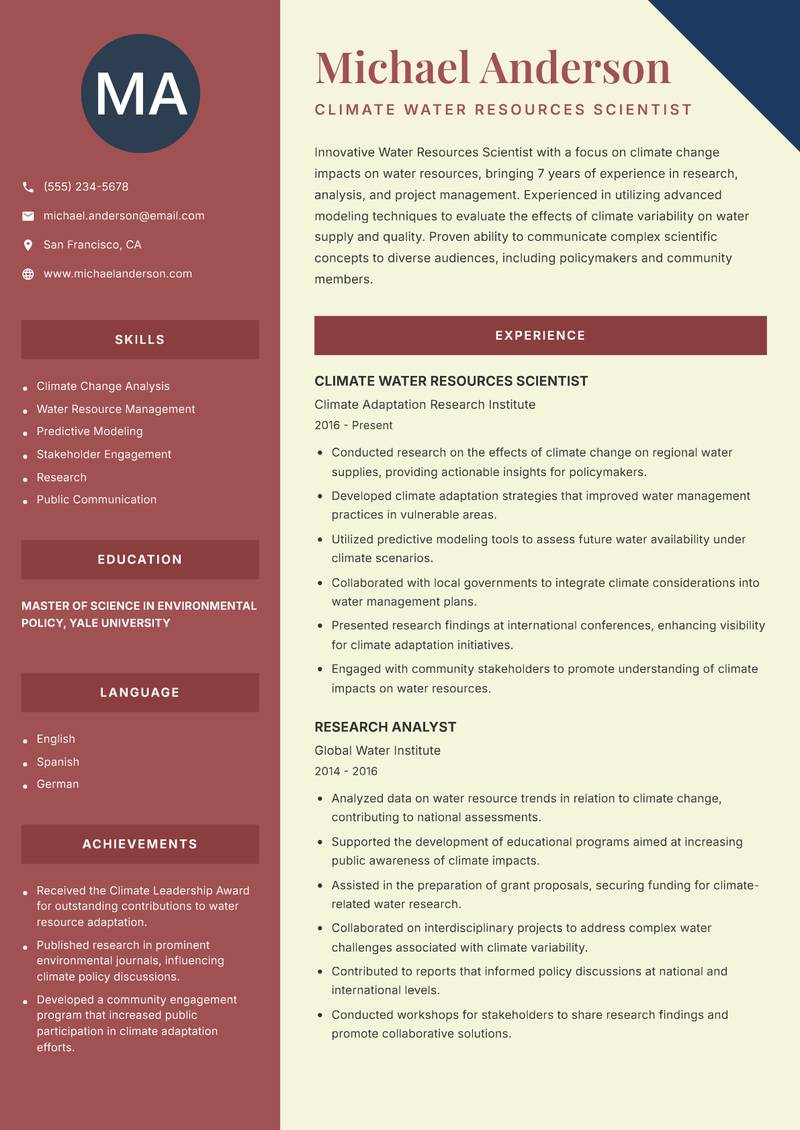
Climate Water Resources Scientist Resume

Innovative Water Resources Scientist with a focus on climate change impacts on water resources, bringing 7 years of experience in research, analysis, and project management. Experienced in utilizing advanced modeling techniques to evaluate the effects of climate variability on water supply and quality. Proven ability to communicate complex scientific concepts to diverse audiences, including policymakers and community members. Skilled in developing and implementing adaptation strategies to enhance resilience to climate-related water challenges. Strong background in interdisciplinary collaboration, working with scientists, engineers, and community leaders to promote sustainable water practices. Committed to advancing the understanding of climate impacts on water resources through research and education.

Climate Change Analysis Water Resource Management Predictive Modeling Stakeholder Engagement Research Public Communication
Water Resources Scientist Resume Preview Example
View PDF
  1. Conducted research on the effects of climate change on regional water supplies, providing actionable insights for policymakers.
  2. Developed climate adaptation strategies that improved water management practices in vulnerable areas.
  3. Utilized predictive modeling tools to assess future water availability under climate scenarios.
  4. Collaborated with local governments to integrate climate considerations into water management plans.
  5. Presented research findings at international conferences, enhancing visibility for climate adaptation initiatives.
  6. Engaged with community stakeholders to promote understanding of climate impacts on water resources.
  1. Analyzed data on water resource trends in relation to climate change, contributing to national assessments.
  2. Supported the development of educational programs aimed at increasing public awareness of climate impacts.
  3. Assisted in the preparation of grant proposals, securing funding for climate-related water research.
  4. Collaborated on interdisciplinary projects to address complex water challenges associated with climate variability.
  5. Contributed to reports that informed policy discussions at national and international levels.
  6. Conducted workshops for stakeholders to share research findings and promote collaborative solutions.

Achievements

  • Received the Climate Leadership Award for outstanding contributions to water resource adaptation.
  • Published research in prominent environmental journals, influencing climate policy discussions.
  • Developed a community engagement program that increased public participation in climate adaptation efforts.
⏱️
Experience
2-5 Years
📅
Level
Mid Level
🎓
Education
Master of Science in Environme...

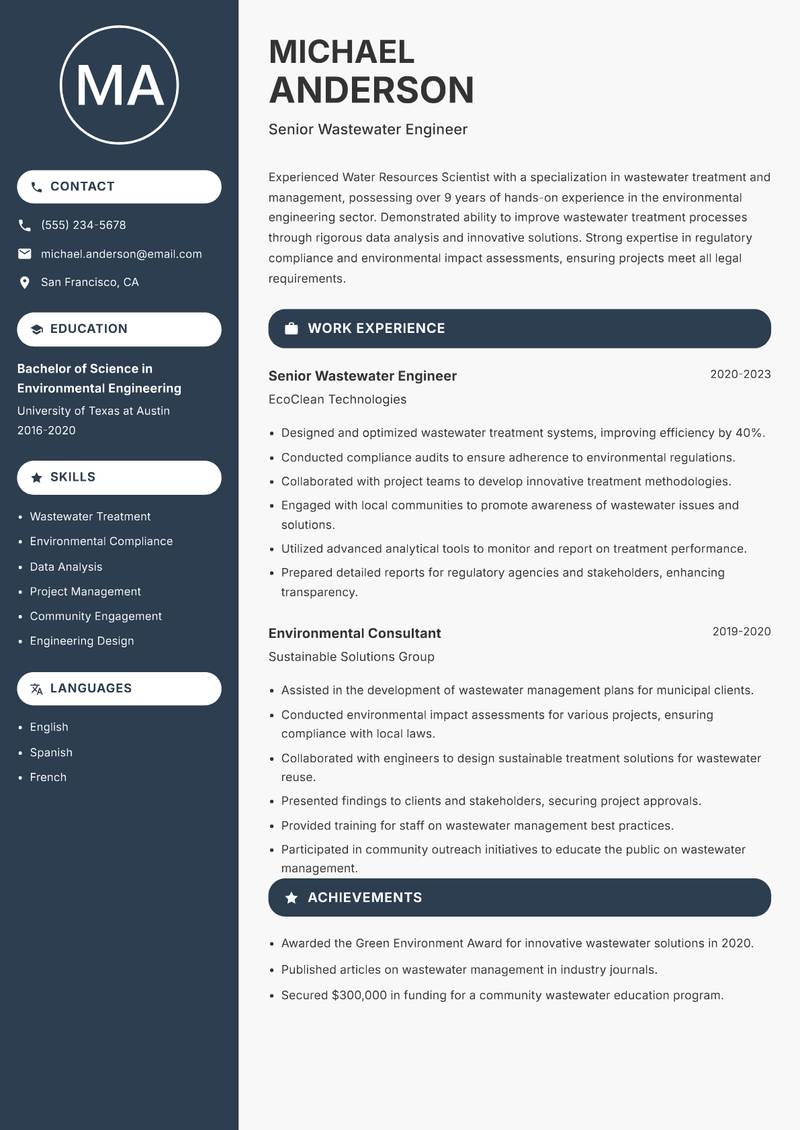
Senior Wastewater Engineer Resume

Experienced Water Resources Scientist with a specialization in wastewater treatment and management, possessing over 9 years of hands-on experience in the environmental engineering sector. Demonstrated ability to improve wastewater treatment processes through rigorous data analysis and innovative solutions. Strong expertise in regulatory compliance and environmental impact assessments, ensuring projects meet all legal requirements. Proven track record of collaborating with multidisciplinary teams to design and implement effective wastewater management strategies that protect public health and the environment. Committed to advancing sustainable practices in wastewater management through research and community education. Passionate about leveraging technology to enhance treatment efficiency and reduce environmental footprints.

Wastewater Treatment Environmental Compliance Data Analysis Project Management Community Engagement Engineering Design
Water Resources Scientist Resume Preview Example
View PDF
  1. Designed and optimized wastewater treatment systems, improving efficiency by 40%.
  2. Conducted compliance audits to ensure adherence to environmental regulations.
  3. Collaborated with project teams to develop innovative treatment methodologies.
  4. Engaged with local communities to promote awareness of wastewater issues and solutions.
  5. Utilized advanced analytical tools to monitor and report on treatment performance.
  6. Prepared detailed reports for regulatory agencies and stakeholders, enhancing transparency.
  1. Assisted in the development of wastewater management plans for municipal clients.
  2. Conducted environmental impact assessments for various projects, ensuring compliance with local laws.
  3. Collaborated with engineers to design sustainable treatment solutions for wastewater reuse.
  4. Presented findings to clients and stakeholders, securing project approvals.
  5. Provided training for staff on wastewater management best practices.
  6. Participated in community outreach initiatives to educate the public on wastewater management.

Achievements

  • Awarded the Green Environment Award for innovative wastewater solutions in 2020.
  • Published articles on wastewater management in industry journals.
  • Secured $300,000 in funding for a community wastewater education program.
⏱️
Experience
2-5 Years
📅
Level
Mid Level
🎓
Education
Bachelor of Science in Environ...

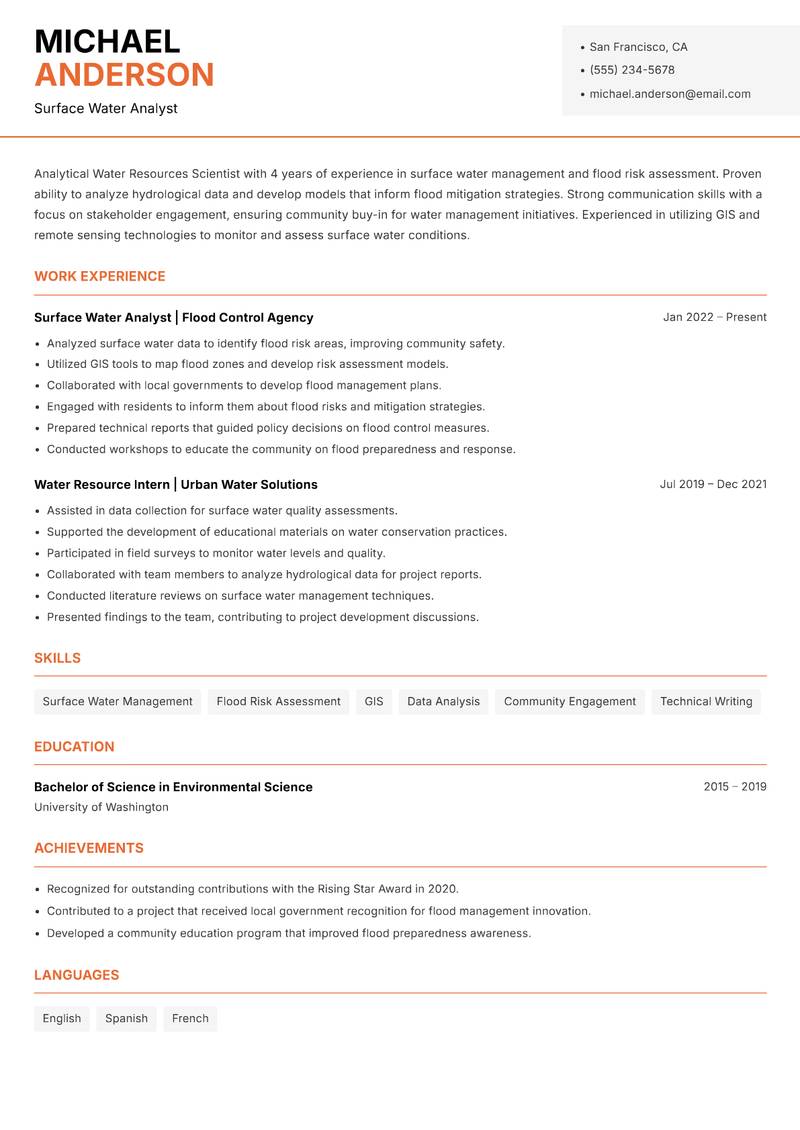
Surface Water Analyst Resume

Analytical Water Resources Scientist with 4 years of experience in surface water management and flood risk assessment. Proven ability to analyze hydrological data and develop models that inform flood mitigation strategies. Strong communication skills with a focus on stakeholder engagement, ensuring community buy-in for water management initiatives. Experienced in utilizing GIS and remote sensing technologies to monitor and assess surface water conditions. Committed to promoting sustainable water practices through research and community education. Passionate about addressing the challenges posed by climate change and urbanization on water resources.

Surface Water Management Flood Risk Assessment GIS Data Analysis Community Engagement Technical Writing
Water Resources Scientist Resume Preview Example
View PDF
  1. Analyzed surface water data to identify flood risk areas, improving community safety.
  2. Utilized GIS tools to map flood zones and develop risk assessment models.
  3. Collaborated with local governments to develop flood management plans.
  4. Engaged with residents to inform them about flood risks and mitigation strategies.
  5. Prepared technical reports that guided policy decisions on flood control measures.
  6. Conducted workshops to educate the community on flood preparedness and response.
  1. Assisted in data collection for surface water quality assessments.
  2. Supported the development of educational materials on water conservation practices.
  3. Participated in field surveys to monitor water levels and quality.
  4. Collaborated with team members to analyze hydrological data for project reports.
  5. Conducted literature reviews on surface water management techniques.
  6. Presented findings to the team, contributing to project development discussions.

Achievements

  • Recognized for outstanding contributions with the Rising Star Award in 2020.
  • Contributed to a project that received local government recognition for flood management innovation.
  • Developed a community education program that improved flood preparedness awareness.
⏱️
Experience
2-5 Years
📅
Level
Mid Level
🎓
Education
Bachelor of Science in Environ...

Key Skills for Water Resources Scientist Positions

Resume Tips for Water Resources Scientist Applications

Strong Action Verbs for Water Resources Scientist Resumes

Mapped · Surveyed · Interpreted · Modeled · Analyzed · Investigated · Drilled · Characterized · Published · Assessed · Achieved · Administered · Architected · Automated

Common Mistakes to Avoid

Experience Levels

How to Write a Water Resources Scientist Resume

Browse Water Resources Scientist resume examples built around hydrology, tailored for Earth Sciences roles.

A strong Water Resources Scientist resume leads with a focused professional summary that names the exact role and your standout achievement. In the experience section, open every bullet with a strong action verb and quantify the result with numbers wherever possible. Highlight your most relevant competencies — especially Hydrology, Environmental science, and Geological Mapping & Field Survey — in a dedicated Skills section positioned early so ATS systems and hiring managers both find it immediately.

For format, most Water Resources Scientist roles suit a reverse-chronological layout: most recent position first, working backwards. Keep to one page for under five years of experience, or two pages for senior candidates with a rich project or leadership history. Use clean, ATS-safe fonts (10–12pt), standard section headings (Summary, Experience, Education, Skills), and avoid tables, text boxes, or multi-column layouts that applicant tracking systems cannot parse reliably.
Frequently Asked Questions

What makes a strong Water Resources Scientist resume stand out to employers?

A standout Water Resources Scientist resume combines role-specific skills with quantified achievements. Name the exact job title in your professional summary, mirror keywords from each job posting, and open every bullet point with a strong action verb followed by a measurable result. Certifications, tools, and domain experience specific to water resources scientist roles should appear prominently near the top.

What skills are most important to include on a Earth Sciences resume?

Recruiters hiring in Earth Sciences consistently look for Geological Mapping & Field Survey, Petrography & Mineralogy, Seismic & Geophysical Data Interpretation, GIS & Remote Sensing (ArcGIS, QGIS). List these in a dedicated Skills section near the top so both ATS systems and human reviewers spot them fast. Mirror the exact phrasing from each job posting wherever possible — many applicant tracking systems match literal strings rather than synonyms.

What is the best resume format for Earth Sciences professionals?

A reverse-chronological format is the standard choice for most Earth Sciences candidates — employers expect to see your most recent role first, working backwards. If you are transitioning into Earth Sciences from a related field, a hybrid format (brief skills summary at the top followed by chronological experience) can bridge the gap effectively. Keep the document to one page for under five years of experience, or two pages for senior specialists.

How do I make my Earth Sciences resume pass applicant tracking systems (ATS)?

Use standard section headings — Summary, Experience, Education, Skills — rather than creative labels that ATS parsers do not recognise. Embed domain keywords such as "Geological Mapping & Field Survey" and "Petrography & Mineralogy" naturally inside your experience bullets rather than cramming them into a standalone keyword list. Avoid tables, multi-column layouts, text boxes, headers, footers, and images — these confuse most modern parsers and can cause your resume to be misread or rejected before a human sees it.

What mistakes do Earth Sciences professionals most commonly make on their resume?

The most frequent issue is not specifying field environments — offshore vs. tropical vs. arctic geology are very different competencies. Beyond that, generic objective statements, unquantified achievements, and inconsistent date formatting appear across almost every Earth Sciences application. Fix these by replacing every vague claim with a measurable outcome — specific numbers and named projects add credibility that adjectives cannot.

How long should a Earth Sciences resume be?

One page is appropriate for candidates with under five years of relevant Earth Sciences experience. Two pages are acceptable — and sometimes expected — for senior specialists, managers, or professionals with a strong portfolio of projects, publications, or credentials. Avoid padding to reach a page count: every line should directly support your application for the specific role you are targeting.

Should I include a professional summary at the top of my Earth Sciences resume?

Yes — a two to three sentence summary is the first section most recruiters read. Open with your title and years of Earth Sciences experience, then name your most relevant achievement or specialisation. One proven approach: Specify field experience including environments worked in (desert, offshore, Arctic) and duration — this level of specificity signals genuine expertise before a recruiter reaches your experience section.

Scroll to view samples