Biomedical Signal Scientist Resume

These Biomedical Signal Scientist resume samples are designed to help you write a resume that gets noticed by hiring managers and passes applicant tracking systems (ATS) in Biomedical Sciences. Each example shows real formatting, section structure, and language you can adapt to your own background. When writing your own Biomedical Signal Scientist resume, focus on highlighting haematology & blood sciences, clinical biochemistry & toxicology and medical microbiology & virology. Recruiters scan for these qualifications first, so they should appear early in your summary and experience sections. Use strong action verbs such as "analyzed", "processed", "diagnosed", "validated" to describe your achievements, and quantify your impact wherever possible — percentages, dollar amounts, or time saved make your resume more convincing. A common mistake to avoid: writing a generic objective statement instead of a targeted biomedical signal scientist professional summary. Tailor your resume to each Biomedical Signal Scientist position you apply for rather than using one generic version.

Biomedical Signal Scientist Resume Template
View PDF
0.0 (0 ratings)

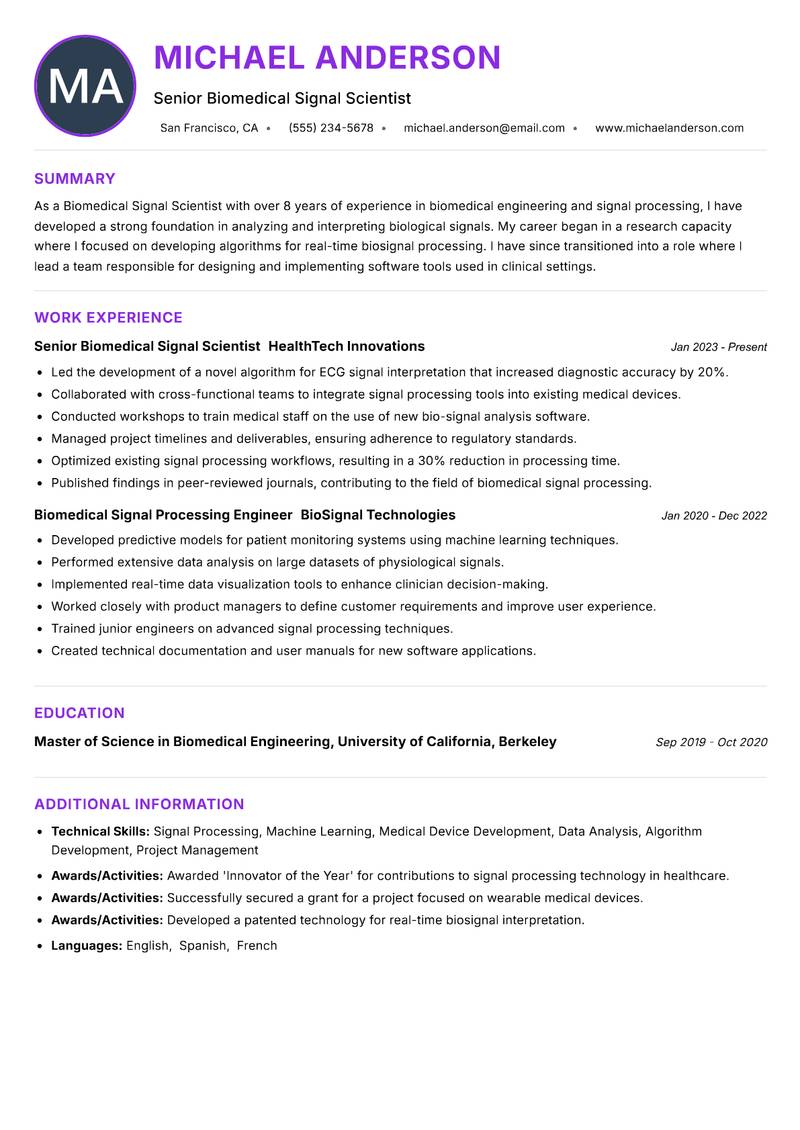
Senior Biomedical Signal Scientist Resume

As a Biomedical Signal Scientist with over 8 years of experience in biomedical engineering and signal processing, I have developed a strong foundation in analyzing and interpreting biological signals. My career began in a research capacity where I focused on developing algorithms for real-time biosignal processing. I have since transitioned into a role where I lead a team responsible for designing and implementing software tools used in clinical settings. My expertise lies in machine learning applications for healthcare, notably in areas such as ECG and EEG signal analysis. I am dedicated to enhancing patient outcomes through innovative technological solutions. My strong analytical skills combined with a passion for healthcare have driven successful projects that improve diagnostic accuracy and efficiency in medical settings. I possess excellent communication skills, allowing me to effectively collaborate with interdisciplinary teams, including physicians and researchers, to translate complex technical concepts into understandable terms. I am now looking to leverage my expertise in a challenging position that allows me to further contribute to advancements in medical technology and patient care.

Signal Processing Machine Learning Medical Device Development Data Analysis Algorithm Development Project Management
Biomedical Signal Scientist Resume Preview Example
View PDF
  1. Led the development of a novel algorithm for ECG signal interpretation that increased diagnostic accuracy by 20%.
  2. Collaborated with cross-functional teams to integrate signal processing tools into existing medical devices.
  3. Conducted workshops to train medical staff on the use of new bio-signal analysis software.
  4. Managed project timelines and deliverables, ensuring adherence to regulatory standards.
  5. Optimized existing signal processing workflows, resulting in a 30% reduction in processing time.
  6. Published findings in peer-reviewed journals, contributing to the field of biomedical signal processing.
  1. Developed predictive models for patient monitoring systems using machine learning techniques.
  2. Performed extensive data analysis on large datasets of physiological signals.
  3. Implemented real-time data visualization tools to enhance clinician decision-making.
  4. Worked closely with product managers to define customer requirements and improve user experience.
  5. Trained junior engineers on advanced signal processing techniques.
  6. Created technical documentation and user manuals for new software applications.

Achievements

  • Awarded 'Innovator of the Year' for contributions to signal processing technology in healthcare.
  • Successfully secured a grant for a project focused on wearable medical devices.
  • Developed a patented technology for real-time biosignal interpretation.
⏱️
Experience
2-5 Years
📅
Level
Mid Level
🎓
Education
Master of Science in Biomedica...

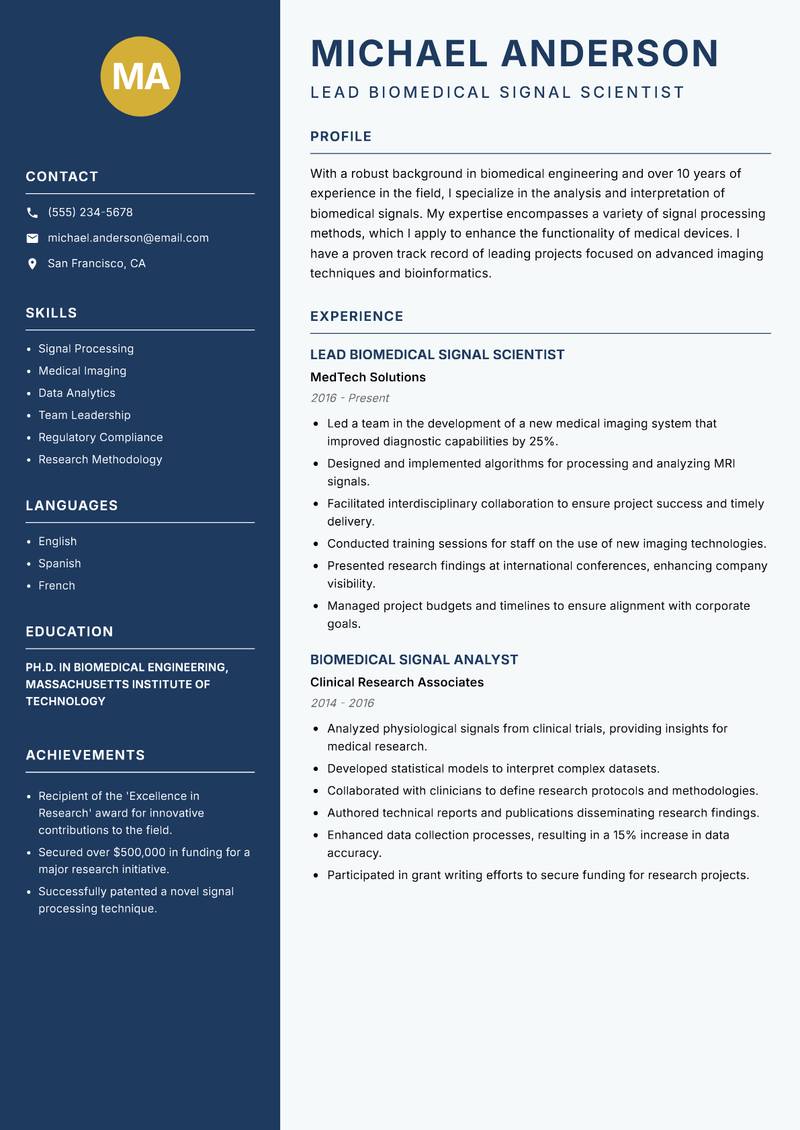
Lead Biomedical Signal Scientist Resume

With a robust background in biomedical engineering and over 10 years of experience in the field, I specialize in the analysis and interpretation of biomedical signals. My expertise encompasses a variety of signal processing methods, which I apply to enhance the functionality of medical devices. I have a proven track record of leading projects focused on advanced imaging techniques and bioinformatics. My role at a leading medical technology firm involved spearheading initiatives that significantly improved patient monitoring systems. I am passionate about using data-driven insights to drive innovations in healthcare technology. I thrive in fast-paced environments and excel at problem-solving and critical thinking, which allows me to navigate complex challenges effectively. I have worked extensively with regulatory bodies to ensure compliance with medical standards and have a deep understanding of the clinical needs that drive healthcare technology advancements. As I look to further my career, I am eager to take on new challenges that allow me to utilize my analytical skills and leadership experience to contribute to transformative healthcare solutions.

Signal Processing Medical Imaging Data Analytics Team Leadership Regulatory Compliance Research Methodology
Biomedical Signal Scientist Resume Preview Example
View PDF
  1. Led a team in the development of a new medical imaging system that improved diagnostic capabilities by 25%.
  2. Designed and implemented algorithms for processing and analyzing MRI signals.
  3. Facilitated interdisciplinary collaboration to ensure project success and timely delivery.
  4. Conducted training sessions for staff on the use of new imaging technologies.
  5. Presented research findings at international conferences, enhancing company visibility.
  6. Managed project budgets and timelines to ensure alignment with corporate goals.
  1. Analyzed physiological signals from clinical trials, providing insights for medical research.
  2. Developed statistical models to interpret complex datasets.
  3. Collaborated with clinicians to define research protocols and methodologies.
  4. Authored technical reports and publications disseminating research findings.
  5. Enhanced data collection processes, resulting in a 15% increase in data accuracy.
  6. Participated in grant writing efforts to secure funding for research projects.

Achievements

  • Recipient of the 'Excellence in Research' award for innovative contributions to the field.
  • Secured over $500,000 in funding for a major research initiative.
  • Successfully patented a novel signal processing technique.
⏱️
Experience
2-5 Years
📅
Level
Mid Level
🎓
Education
Ph.D. in Biomedical Engineerin...

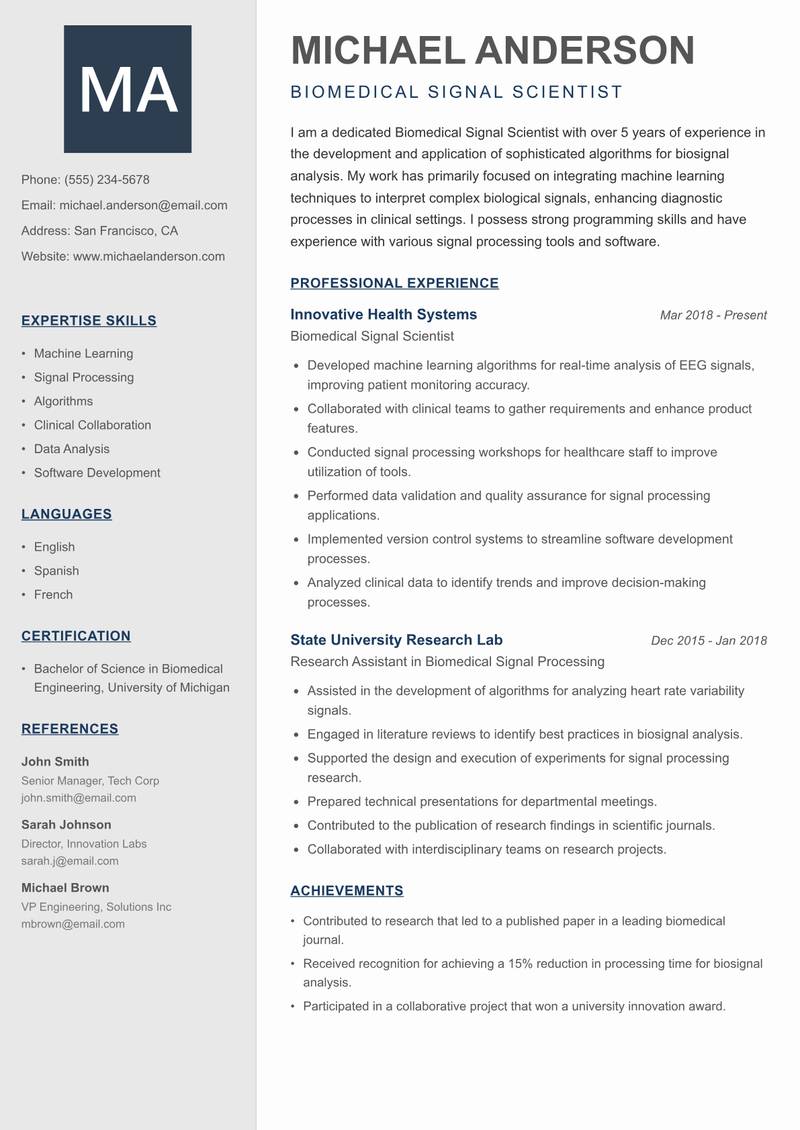
Biomedical Signal Scientist Resume

I am a dedicated Biomedical Signal Scientist with over 5 years of experience in the development and application of sophisticated algorithms for biosignal analysis. My work has primarily focused on integrating machine learning techniques to interpret complex biological signals, enhancing diagnostic processes in clinical settings. I possess strong programming skills and have experience with various signal processing tools and software. My background in both engineering and biology allows me to bridge the gap between technology and healthcare, ensuring that solutions are both innovative and clinically relevant. Throughout my career, I have collaborated with healthcare professionals to understand their needs and to translate those into functional technical solutions. I am particularly passionate about advancing technologies that improve patient care and streamline medical practices. I am now seeking to expand my horizons within a dynamic organization that values creativity and scientific rigor in its approach to healthcare solutions.

Machine Learning Signal Processing Algorithms Clinical Collaboration Data Analysis Software Development
Biomedical Signal Scientist Resume Preview Example
View PDF
  1. Developed machine learning algorithms for real-time analysis of EEG signals, improving patient monitoring accuracy.
  2. Collaborated with clinical teams to gather requirements and enhance product features.
  3. Conducted signal processing workshops for healthcare staff to improve utilization of tools.
  4. Performed data validation and quality assurance for signal processing applications.
  5. Implemented version control systems to streamline software development processes.
  6. Analyzed clinical data to identify trends and improve decision-making processes.
  1. Assisted in the development of algorithms for analyzing heart rate variability signals.
  2. Engaged in literature reviews to identify best practices in biosignal analysis.
  3. Supported the design and execution of experiments for signal processing research.
  4. Prepared technical presentations for departmental meetings.
  5. Contributed to the publication of research findings in scientific journals.
  6. Collaborated with interdisciplinary teams on research projects.

Achievements

  • Contributed to research that led to a published paper in a leading biomedical journal.
  • Received recognition for achieving a 15% reduction in processing time for biosignal analysis.
  • Participated in a collaborative project that won a university innovation award.
⏱️
Experience
2-5 Years
📅
Level
Mid Level
🎓
Education
Bachelor of Science in Biomedi...

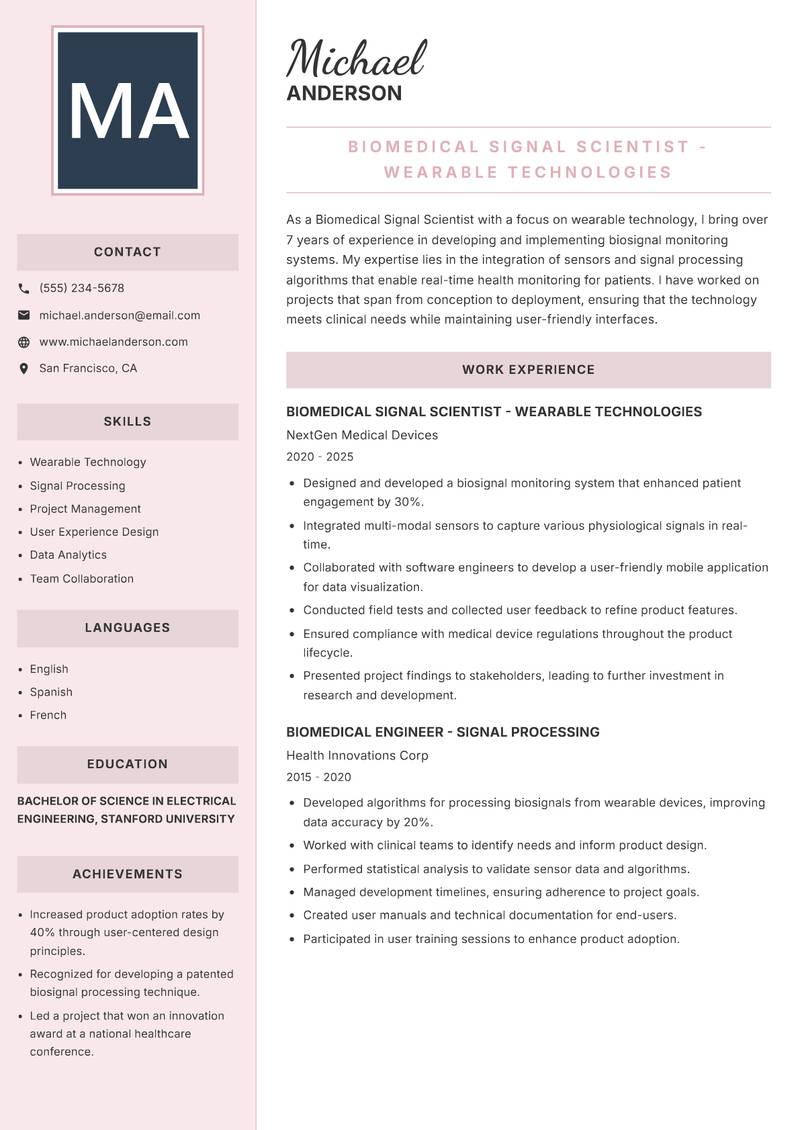
Biomedical Signal Scientist - Wearable Technologies Resume

As a Biomedical Signal Scientist with a focus on wearable technology, I bring over 7 years of experience in developing and implementing biosignal monitoring systems. My expertise lies in the integration of sensors and signal processing algorithms that enable real-time health monitoring for patients. I have worked on projects that span from conception to deployment, ensuring that the technology meets clinical needs while maintaining user-friendly interfaces. My background in electrical engineering, combined with my knowledge of biological systems, allows me to create innovative solutions that improve patient engagement and health outcomes. I am adept at collaborating with multidisciplinary teams to bring projects to fruition and have a track record of successfully managing timelines and resources. I am seeking to leverage my technical skills and project management experience in a challenging role that focuses on the intersection of technology and healthcare.

Wearable Technology Signal Processing Project Management User Experience Design Data Analytics Team Collaboration
Biomedical Signal Scientist Resume Preview Example
View PDF
  1. Designed and developed a biosignal monitoring system that enhanced patient engagement by 30%.
  2. Integrated multi-modal sensors to capture various physiological signals in real-time.
  3. Collaborated with software engineers to develop a user-friendly mobile application for data visualization.
  4. Conducted field tests and collected user feedback to refine product features.
  5. Ensured compliance with medical device regulations throughout the product lifecycle.
  6. Presented project findings to stakeholders, leading to further investment in research and development.
  1. Developed algorithms for processing biosignals from wearable devices, improving data accuracy by 20%.
  2. Worked with clinical teams to identify needs and inform product design.
  3. Performed statistical analysis to validate sensor data and algorithms.
  4. Managed development timelines, ensuring adherence to project goals.
  5. Created user manuals and technical documentation for end-users.
  6. Participated in user training sessions to enhance product adoption.

Achievements

  • Increased product adoption rates by 40% through user-centered design principles.
  • Recognized for developing a patented biosignal processing technique.
  • Led a project that won an innovation award at a national healthcare conference.
⏱️
Experience
2-5 Years
📅
Level
Mid Level
🎓
Education
Bachelor of Science in Electri...

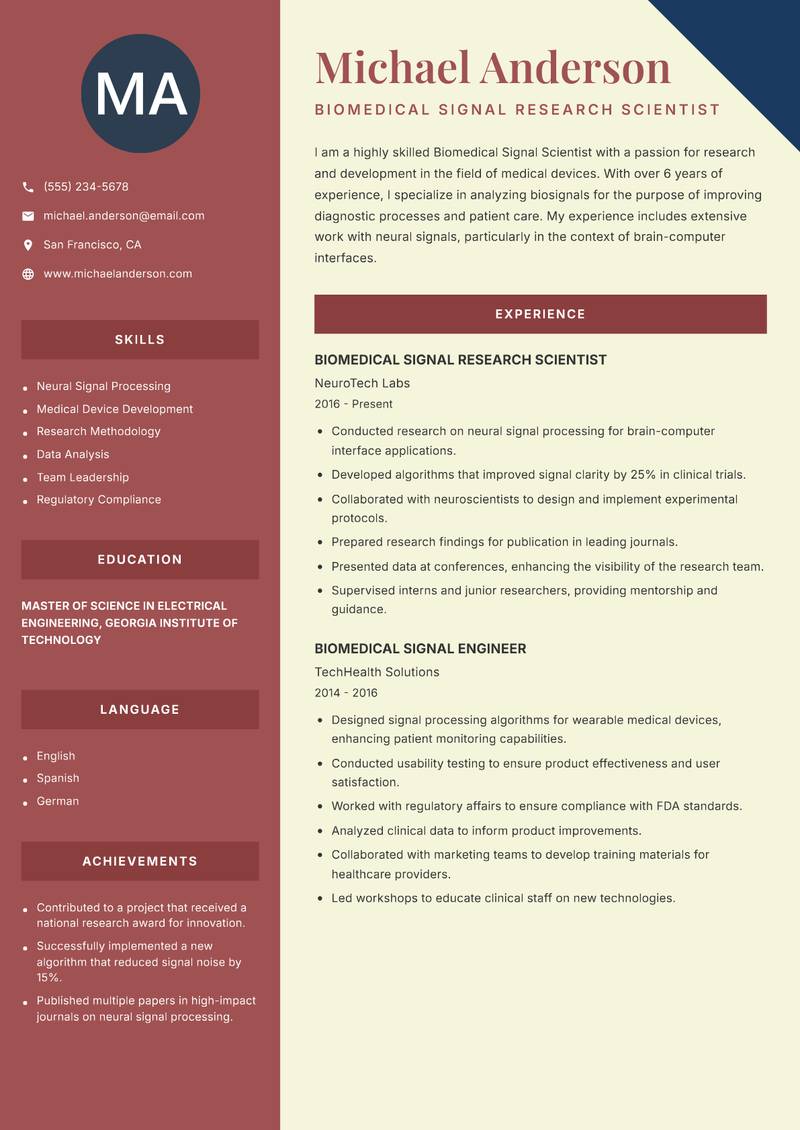
Biomedical Signal Research Scientist Resume

I am a highly skilled Biomedical Signal Scientist with a passion for research and development in the field of medical devices. With over 6 years of experience, I specialize in analyzing biosignals for the purpose of improving diagnostic processes and patient care. My experience includes extensive work with neural signals, particularly in the context of brain-computer interfaces. I am adept at utilizing advanced signal processing techniques and have a solid understanding of the regulatory landscape governing medical device development. Throughout my career, I have contributed to projects from the ground up, actively participating in research, algorithm development, and testing. I excel in collaborative environments and am committed to fostering effective communication among team members to achieve common goals. I am now seeking to further advance my career within a forward-thinking organization that prioritizes innovation and excellence in healthcare technology.

Neural Signal Processing Medical Device Development Research Methodology Data Analysis Team Leadership Regulatory Compliance
Biomedical Signal Scientist Resume Preview Example
View PDF
  1. Conducted research on neural signal processing for brain-computer interface applications.
  2. Developed algorithms that improved signal clarity by 25% in clinical trials.
  3. Collaborated with neuroscientists to design and implement experimental protocols.
  4. Prepared research findings for publication in leading journals.
  5. Presented data at conferences, enhancing the visibility of the research team.
  6. Supervised interns and junior researchers, providing mentorship and guidance.
  1. Designed signal processing algorithms for wearable medical devices, enhancing patient monitoring capabilities.
  2. Conducted usability testing to ensure product effectiveness and user satisfaction.
  3. Worked with regulatory affairs to ensure compliance with FDA standards.
  4. Analyzed clinical data to inform product improvements.
  5. Collaborated with marketing teams to develop training materials for healthcare providers.
  6. Led workshops to educate clinical staff on new technologies.

Achievements

  • Contributed to a project that received a national research award for innovation.
  • Successfully implemented a new algorithm that reduced signal noise by 15%.
  • Published multiple papers in high-impact journals on neural signal processing.
⏱️
Experience
2-5 Years
📅
Level
Mid Level
🎓
Education
Master of Science in Electrica...

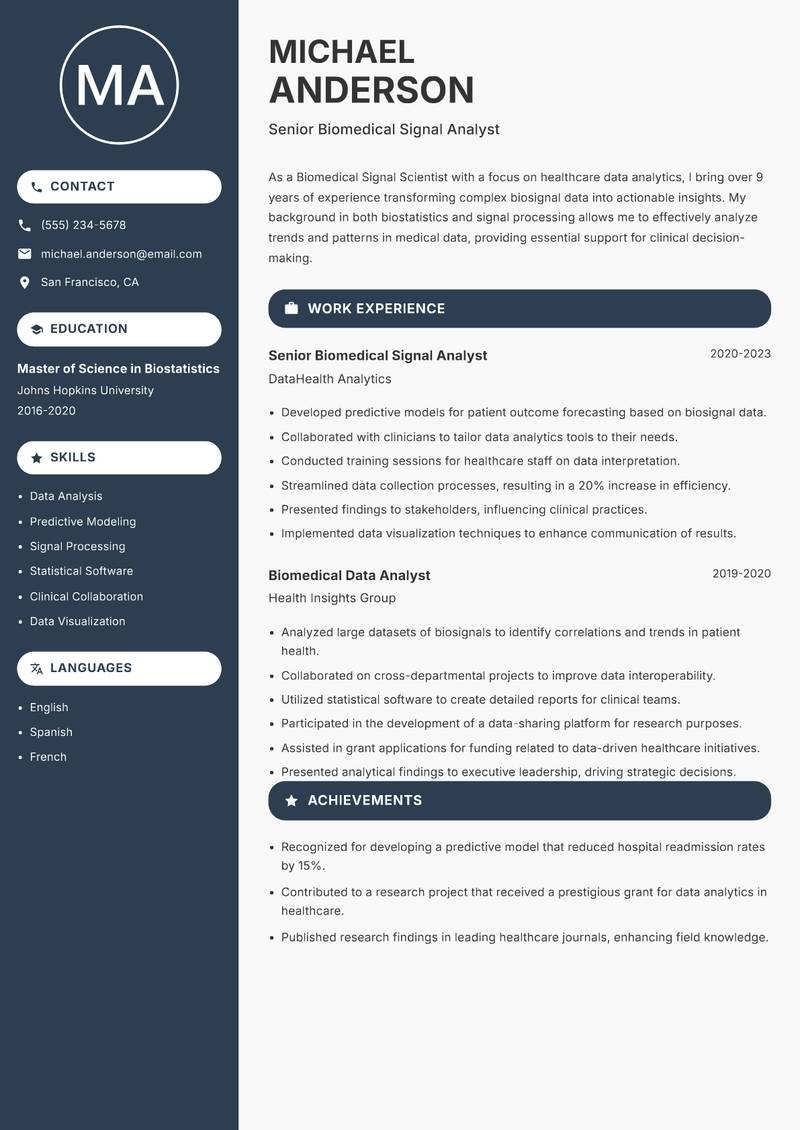
Senior Biomedical Signal Analyst Resume

As a Biomedical Signal Scientist with a focus on healthcare data analytics, I bring over 9 years of experience transforming complex biosignal data into actionable insights. My background in both biostatistics and signal processing allows me to effectively analyze trends and patterns in medical data, providing essential support for clinical decision-making. I have developed predictive algorithms that assist healthcare providers in identifying at-risk patients before critical health events occur. My experience spans various healthcare settings, including hospitals and research institutions, where I have collaborated with cross-functional teams to improve patient outcomes through data-driven strategies. I am passionate about leveraging technology to enhance healthcare delivery and am dedicated to continuous professional growth in this rapidly evolving field. I am looking for an opportunity to leverage my analytical skills and technical expertise to contribute to innovative healthcare solutions.

Data Analysis Predictive Modeling Signal Processing Statistical Software Clinical Collaboration Data Visualization
Biomedical Signal Scientist Resume Preview Example
View PDF
  1. Developed predictive models for patient outcome forecasting based on biosignal data.
  2. Collaborated with clinicians to tailor data analytics tools to their needs.
  3. Conducted training sessions for healthcare staff on data interpretation.
  4. Streamlined data collection processes, resulting in a 20% increase in efficiency.
  5. Presented findings to stakeholders, influencing clinical practices.
  6. Implemented data visualization techniques to enhance communication of results.
  1. Analyzed large datasets of biosignals to identify correlations and trends in patient health.
  2. Collaborated on cross-departmental projects to improve data interoperability.
  3. Utilized statistical software to create detailed reports for clinical teams.
  4. Participated in the development of a data-sharing platform for research purposes.
  5. Assisted in grant applications for funding related to data-driven healthcare initiatives.
  6. Presented analytical findings to executive leadership, driving strategic decisions.

Achievements

  • Recognized for developing a predictive model that reduced hospital readmission rates by 15%.
  • Contributed to a research project that received a prestigious grant for data analytics in healthcare.
  • Published research findings in leading healthcare journals, enhancing field knowledge.
⏱️
Experience
2-5 Years
📅
Level
Mid Level
🎓
Education
Master of Science in Biostatis...

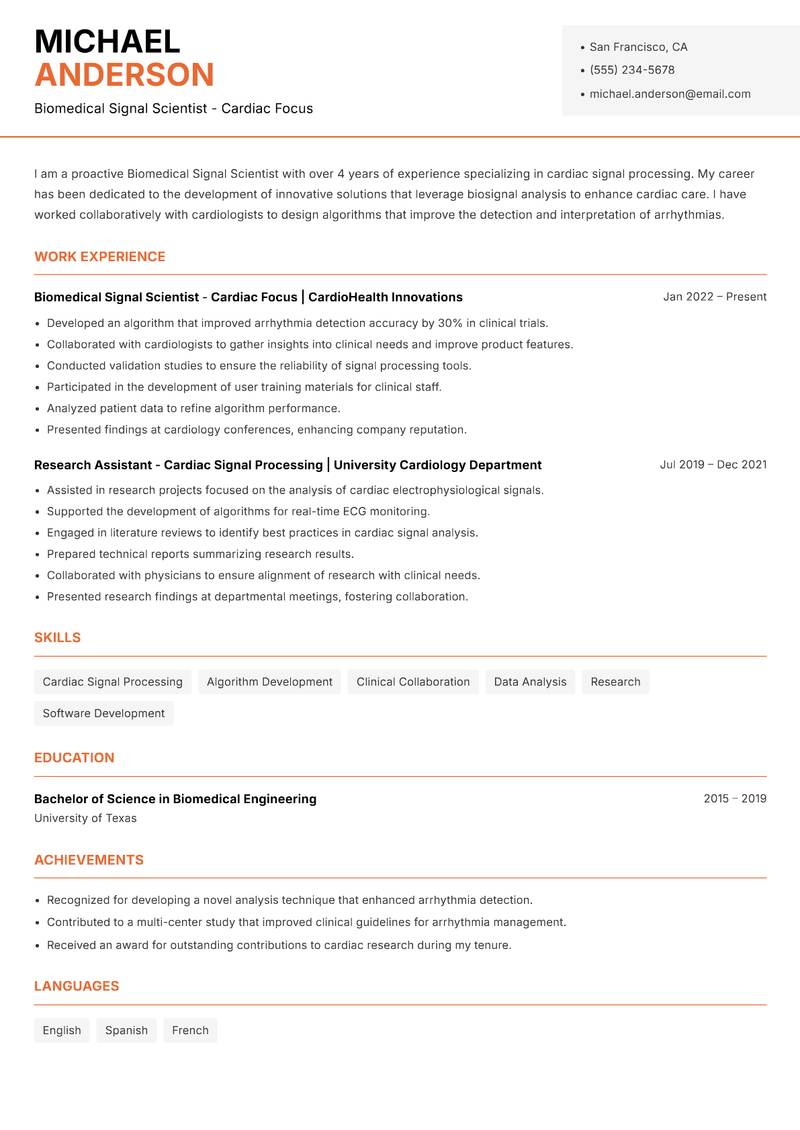
Biomedical Signal Scientist - Cardiac Focus Resume

I am a proactive Biomedical Signal Scientist with over 4 years of experience specializing in cardiac signal processing. My career has been dedicated to the development of innovative solutions that leverage biosignal analysis to enhance cardiac care. I have worked collaboratively with cardiologists to design algorithms that improve the detection and interpretation of arrhythmias. My hands-on experience in both software development and clinical application of signal processing has equipped me with a unique perspective on the needs of healthcare providers. I am passionate about advancing technologies that not only improve patient outcomes but also streamline clinical workflows. I am eager to bring my technical skills and clinical insights to a dynamic team focused on improving cardiac health through innovative biomedical signal solutions.

Cardiac Signal Processing Algorithm Development Clinical Collaboration Data Analysis Research Software Development
Biomedical Signal Scientist Resume Preview Example
View PDF
  1. Developed an algorithm that improved arrhythmia detection accuracy by 30% in clinical trials.
  2. Collaborated with cardiologists to gather insights into clinical needs and improve product features.
  3. Conducted validation studies to ensure the reliability of signal processing tools.
  4. Participated in the development of user training materials for clinical staff.
  5. Analyzed patient data to refine algorithm performance.
  6. Presented findings at cardiology conferences, enhancing company reputation.
  1. Assisted in research projects focused on the analysis of cardiac electrophysiological signals.
  2. Supported the development of algorithms for real-time ECG monitoring.
  3. Engaged in literature reviews to identify best practices in cardiac signal analysis.
  4. Prepared technical reports summarizing research results.
  5. Collaborated with physicians to ensure alignment of research with clinical needs.
  6. Presented research findings at departmental meetings, fostering collaboration.

Achievements

  • Recognized for developing a novel analysis technique that enhanced arrhythmia detection.
  • Contributed to a multi-center study that improved clinical guidelines for arrhythmia management.
  • Received an award for outstanding contributions to cardiac research during my tenure.
⏱️
Experience
2-5 Years
📅
Level
Mid Level
🎓
Education
Bachelor of Science in Biomedi...

Key Skills for Biomedical Signal Scientist Positions

Resume Tips for Biomedical Signal Scientist Applications

Strong Action Verbs for Biomedical Signal Scientist Resumes

Analyzed · Processed · Diagnosed · Validated · Calibrated · Implemented · Reported · Researched · Accredited · Documented · Reviewed · Achieved · Administered · Architected

Common Mistakes to Avoid

Experience Levels

How to Write a Biomedical Signal Scientist Resume

Browse Biomedical Signal Scientist resume examples built around haematology & blood sciences, tailored for Biomedical Sciences roles.

A strong Biomedical Signal Scientist resume leads with a focused professional summary that names the exact role and your standout achievement. In the experience section, open every bullet with a strong action verb and quantify the result with numbers wherever possible. Highlight your most relevant competencies — especially Haematology & Blood Sciences, Clinical Biochemistry & Toxicology, and Medical Microbiology & Virology — in a dedicated Skills section positioned early so ATS systems and hiring managers both find it immediately.

For format, most Biomedical Signal Scientist roles suit a reverse-chronological layout: most recent position first, working backwards. Keep to one page for under five years of experience, or two pages for senior candidates with a rich project or leadership history. Use clean, ATS-safe fonts (10–12pt), standard section headings (Summary, Experience, Education, Skills), and avoid tables, text boxes, or multi-column layouts that applicant tracking systems cannot parse reliably.
Frequently Asked Questions

What makes a strong Biomedical Signal Scientist resume stand out to employers?

A standout Biomedical Signal Scientist resume combines role-specific skills with quantified achievements. Name the exact job title in your professional summary, mirror keywords from each job posting, and open every bullet point with a strong action verb followed by a measurable result. Certifications, tools, and domain experience specific to biomedical signal scientist roles should appear prominently near the top.

What skills are most important to include on a Biomedical Sciences resume?

Recruiters hiring in Biomedical Sciences consistently look for Haematology & Blood Sciences, Clinical Biochemistry & Toxicology, Medical Microbiology & Virology, Histopathology & Cytology. List these in a dedicated Skills section near the top so both ATS systems and human reviewers spot them fast. Mirror the exact phrasing from each job posting wherever possible — many applicant tracking systems match literal strings rather than synonyms.

What is the best resume format for Biomedical Sciences professionals?

A reverse-chronological format is the standard choice for most Biomedical Sciences candidates — employers expect to see your most recent role first, working backwards. If you are transitioning into Biomedical Sciences from a related field, a hybrid format (brief skills summary at the top followed by chronological experience) can bridge the gap effectively. Keep the document to one page for under five years of experience, or two pages for senior specialists.

How do I make my Biomedical Sciences resume pass applicant tracking systems (ATS)?

Use standard section headings — Summary, Experience, Education, Skills — rather than creative labels that ATS parsers do not recognise. Embed domain keywords such as "Haematology & Blood Sciences" and "Clinical Biochemistry & Toxicology" naturally inside your experience bullets rather than cramming them into a standalone keyword list. Avoid tables, multi-column layouts, text boxes, headers, footers, and images — these confuse most modern parsers and can cause your resume to be misread or rejected before a human sees it.

What mistakes do Biomedical Sciences professionals most commonly make on their resume?

The most frequent issue is omitting professional registration for clinical roles — it is a legal requirement. Beyond that, generic objective statements, unquantified achievements, and inconsistent date formatting appear across almost every Biomedical Sciences application. Fix these by replacing every vague claim with a measurable outcome — specific numbers and named projects add credibility that adjectives cannot.

How long should a Biomedical Sciences resume be?

One page is appropriate for candidates with under five years of relevant Biomedical Sciences experience. Two pages are acceptable — and sometimes expected — for senior specialists, managers, or professionals with a strong portfolio of projects, publications, or credentials. Avoid padding to reach a page count: every line should directly support your application for the specific role you are targeting.

Should I include a professional summary at the top of my Biomedical Sciences resume?

Yes — a two to three sentence summary is the first section most recruiters read. Open with your title and years of Biomedical Sciences experience, then name your most relevant achievement or specialisation. One proven approach: List HCPC or equivalent professional registration — it is required for clinical diagnostic roles — this level of specificity signals genuine expertise before a recruiter reaches your experience section.

Scroll to view samples