DevSecOps Engineer Resume

These DevSecOps Engineer resume samples are designed to help you write a resume that gets noticed by hiring managers and passes applicant tracking systems (ATS) in Cybersecurity. Each example shows real formatting, section structure, and language you can adapt to your own background. When writing your own DevSecOps Engineer resume, focus on highlighting threat detection & incident response, penetration testing & vulnerability assessment and security information & event management (SIEM). Recruiters scan for these qualifications first, so they should appear early in your summary and experience sections. Use strong action verbs such as "secured", "detected", "responded", "penetrated" to describe your achievements, and quantify your impact wherever possible — percentages, dollar amounts, or time saved make your resume more convincing. A common mistake to avoid: writing a generic objective statement instead of a targeted devsecops engineer professional summary. Tailor your resume to each DevSecOps Engineer position you apply for rather than using one generic version.

DevSecOps Engineer Resume Template
View PDF
0.0 (0 ratings)

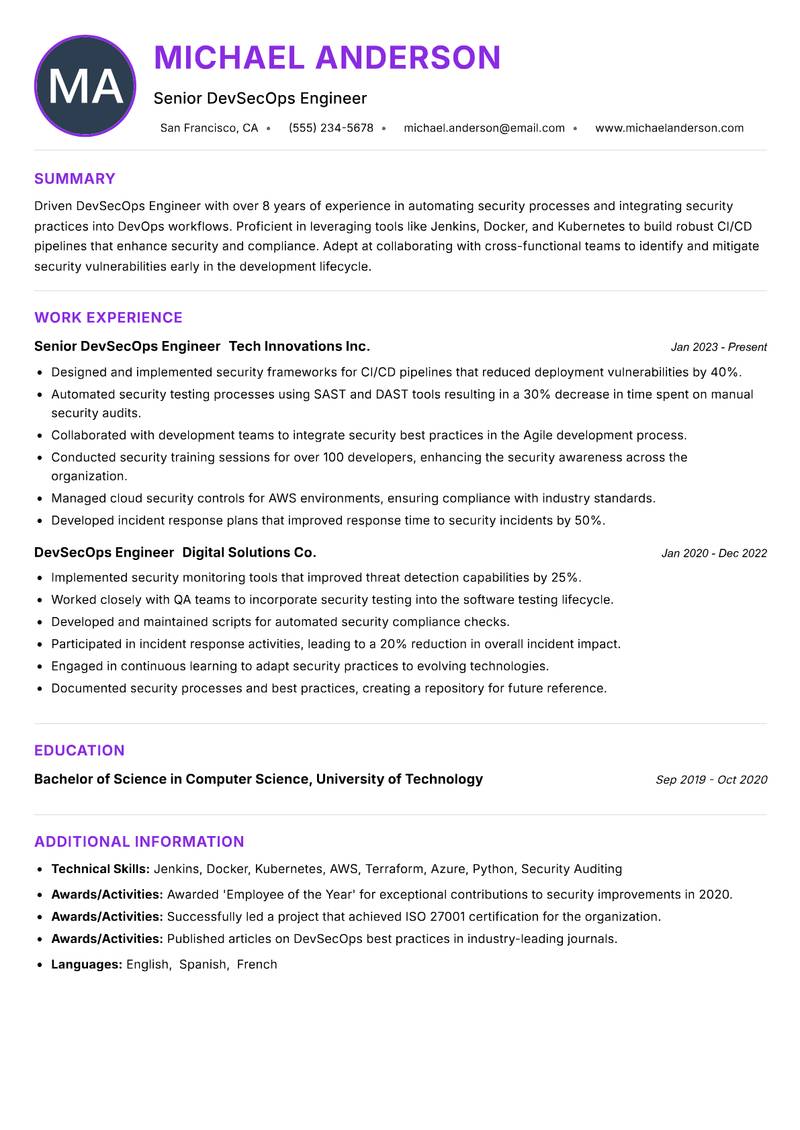
Senior DevSecOps Engineer Resume

Driven DevSecOps Engineer with over 8 years of experience in automating security processes and integrating security practices into DevOps workflows. Proficient in leveraging tools like Jenkins, Docker, and Kubernetes to build robust CI/CD pipelines that enhance security and compliance. Adept at collaborating with cross-functional teams to identify and mitigate security vulnerabilities early in the development lifecycle. Experienced in cloud security practices and implementing Infrastructure as Code (IaC) using Terraform and AWS CloudFormation. Passionate about staying updated with the latest security trends and technologies to ensure organizational resilience against evolving threats. Excellent problem-solving skills with a commitment to delivering secure, scalable solutions that meet business objectives.

Jenkins Docker Kubernetes AWS Terraform Azure Python Security Auditing
DevSecOps Engineer Resume Preview Example
View PDF
  1. Designed and implemented security frameworks for CI/CD pipelines that reduced deployment vulnerabilities by 40%.
  2. Automated security testing processes using SAST and DAST tools resulting in a 30% decrease in time spent on manual security audits.
  3. Collaborated with development teams to integrate security best practices in the Agile development process.
  4. Conducted security training sessions for over 100 developers, enhancing the security awareness across the organization.
  5. Managed cloud security controls for AWS environments, ensuring compliance with industry standards.
  6. Developed incident response plans that improved response time to security incidents by 50%.
  1. Implemented security monitoring tools that improved threat detection capabilities by 25%.
  2. Worked closely with QA teams to incorporate security testing into the software testing lifecycle.
  3. Developed and maintained scripts for automated security compliance checks.
  4. Participated in incident response activities, leading to a 20% reduction in overall incident impact.
  5. Engaged in continuous learning to adapt security practices to evolving technologies.
  6. Documented security processes and best practices, creating a repository for future reference.

Achievements

  • Awarded 'Employee of the Year' for exceptional contributions to security improvements in 2020.
  • Successfully led a project that achieved ISO 27001 certification for the organization.
  • Published articles on DevSecOps best practices in industry-leading journals.
⏱️
Experience
2-5 Years
📅
Level
Mid Level
🎓
Education
Bachelor of Science in Compute...

DevSecOps Engineer Resume

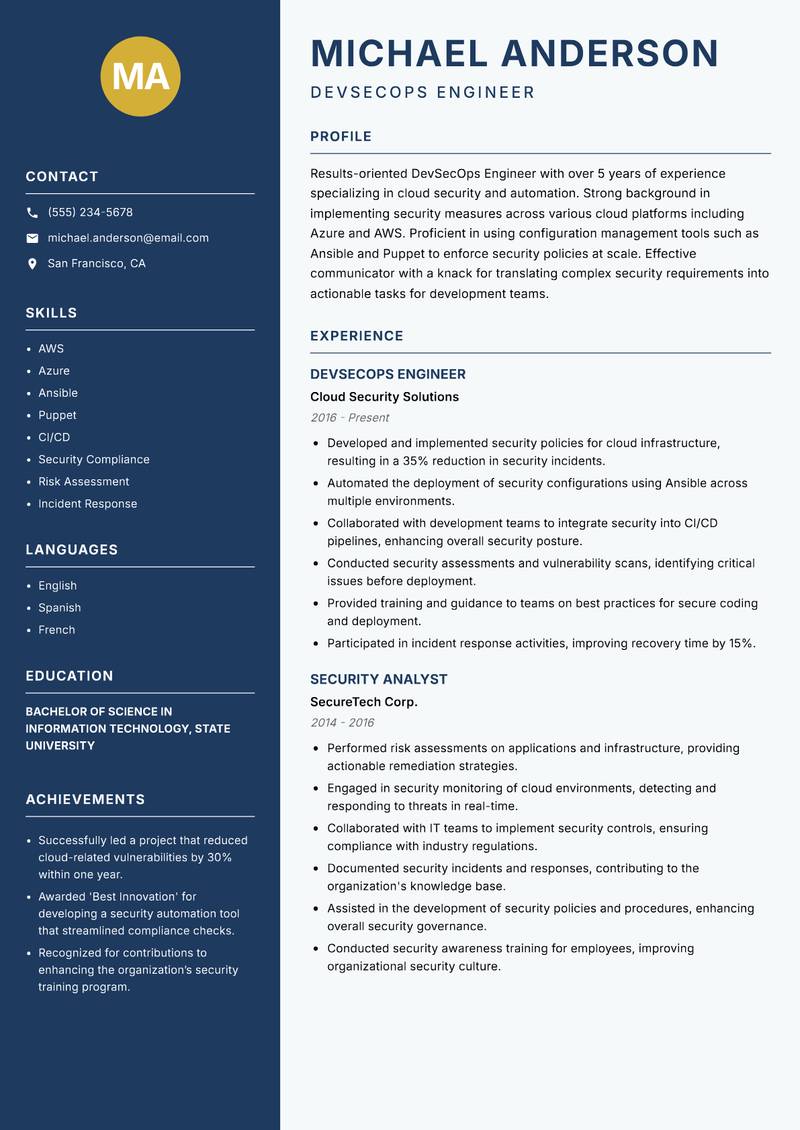
Accomplished DevSecOps Engineer with over 5 years of experience specializing in cloud security and automation. Strong background in implementing security measures across various cloud platforms including Azure and AWS. Proficient in using configuration management tools such as Ansible and Puppet to enforce security policies at scale. Effective communicator with a knack for translating complex security requirements into actionable tasks for development teams. Recognized for improving deployment processes through automation, significantly reducing the time to market for secure applications. Committed to fostering a culture of security within organizations by providing training and support to development teams.

AWS Azure Ansible Puppet CI/CD Security Compliance Risk Assessment Incident Response
DevSecOps Engineer Resume Preview Example
View PDF
  1. Developed and implemented security policies for cloud infrastructure, resulting in a 35% reduction in security incidents.
  2. Automated the deployment of security configurations using Ansible across multiple environments.
  3. Collaborated with development teams to integrate security into CI/CD pipelines, enhancing overall security posture.
  4. Conducted security assessments and vulnerability scans, identifying critical issues before deployment.
  5. Provided training and guidance to teams on best practices for secure coding and deployment.
  6. Participated in incident response activities, improving recovery time by 15%.
  1. Performed risk assessments on applications and infrastructure, providing actionable remediation strategies.
  2. Engaged in security monitoring of cloud environments, detecting and responding to threats in real-time.
  3. Collaborated with IT teams to implement security controls, ensuring compliance with industry regulations.
  4. Documented security incidents and responses, contributing to the organization's knowledge base.
  5. Assisted in the development of security policies and procedures, enhancing overall security governance.
  6. Conducted security awareness training for employees, improving organizational security culture.

Achievements

  • Successfully led a project that reduced cloud-related vulnerabilities by 30% within one year.
  • Awarded 'Best Innovation' for developing a security automation tool that streamlined compliance checks.
  • Recognized for contributions to enhancing the organization’s security training program.
⏱️
Experience
2-5 Years
📅
Level
Mid Level
🎓
Education
Bachelor of Science in Informa...

DevSecOps Engineer Resume

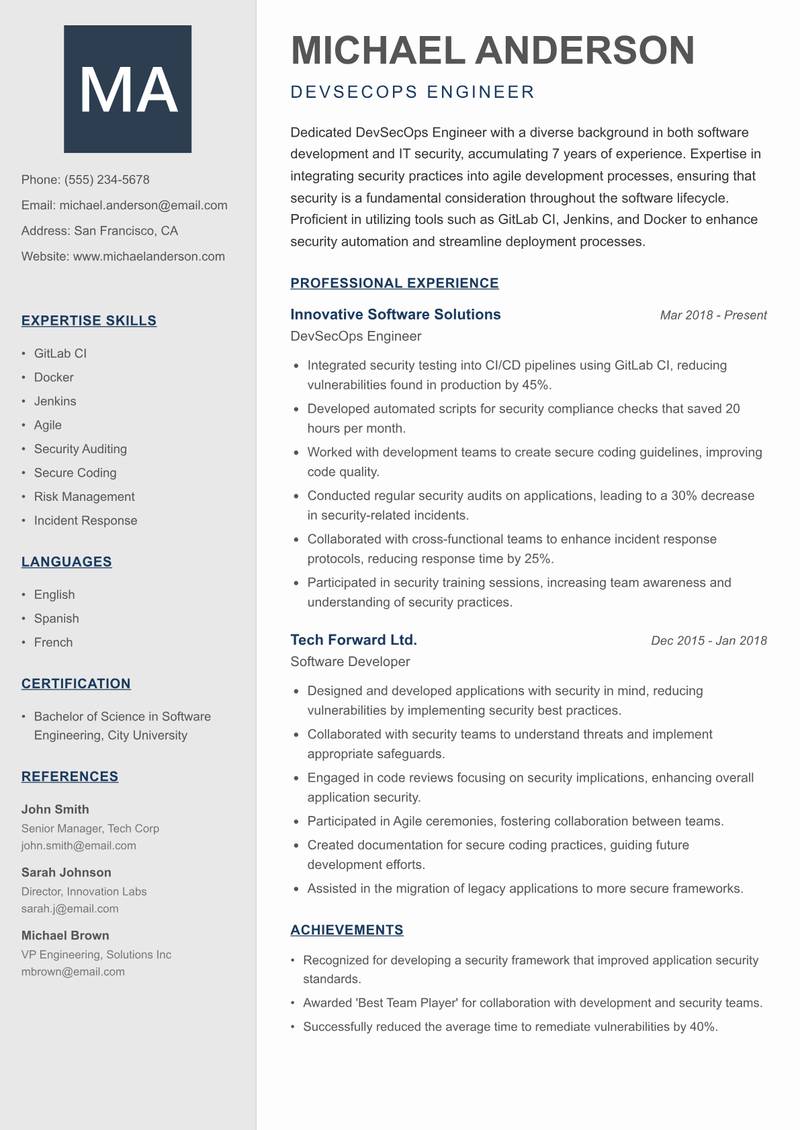
Dedicated DevSecOps Engineer with a diverse background in both software development and IT security, accumulating 7 years of experience. Expertise in integrating security practices into agile development processes, ensuring that security is a fundamental consideration throughout the software lifecycle. Proficient in utilizing tools such as GitLab CI, Jenkins, and Docker to enhance security automation and streamline deployment processes. Passionate about fostering collaboration between development and security teams to identify and address security weaknesses early. Known for implementing innovative solutions that enhance security while maintaining efficiency and speed in application delivery. Strong analytical and troubleshooting skills with a focus on continuous improvement.

GitLab CI Docker Jenkins Agile Security Auditing Secure Coding Risk Management Incident Response
DevSecOps Engineer Resume Preview Example
View PDF
  1. Integrated security testing into CI/CD pipelines using GitLab CI, reducing vulnerabilities found in production by 45%.
  2. Developed automated scripts for security compliance checks that saved 20 hours per month.
  3. Worked with development teams to create secure coding guidelines, improving code quality.
  4. Conducted regular security audits on applications, leading to a 30% decrease in security-related incidents.
  5. Collaborated with cross-functional teams to enhance incident response protocols, reducing response time by 25%.
  6. Participated in security training sessions, increasing team awareness and understanding of security practices.
  1. Designed and developed applications with security in mind, reducing vulnerabilities by implementing security best practices.
  2. Collaborated with security teams to understand threats and implement appropriate safeguards.
  3. Engaged in code reviews focusing on security implications, enhancing overall application security.
  4. Participated in Agile ceremonies, fostering collaboration between teams.
  5. Created documentation for secure coding practices, guiding future development efforts.
  6. Assisted in the migration of legacy applications to more secure frameworks.

Achievements

  • Recognized for developing a security framework that improved application security standards.
  • Awarded 'Best Team Player' for collaboration with development and security teams.
  • Successfully reduced the average time to remediate vulnerabilities by 40%.
⏱️
Experience
2-5 Years
📅
Level
Mid Level
🎓
Education
Bachelor of Science in Softwar...

DevSecOps Engineer Resume

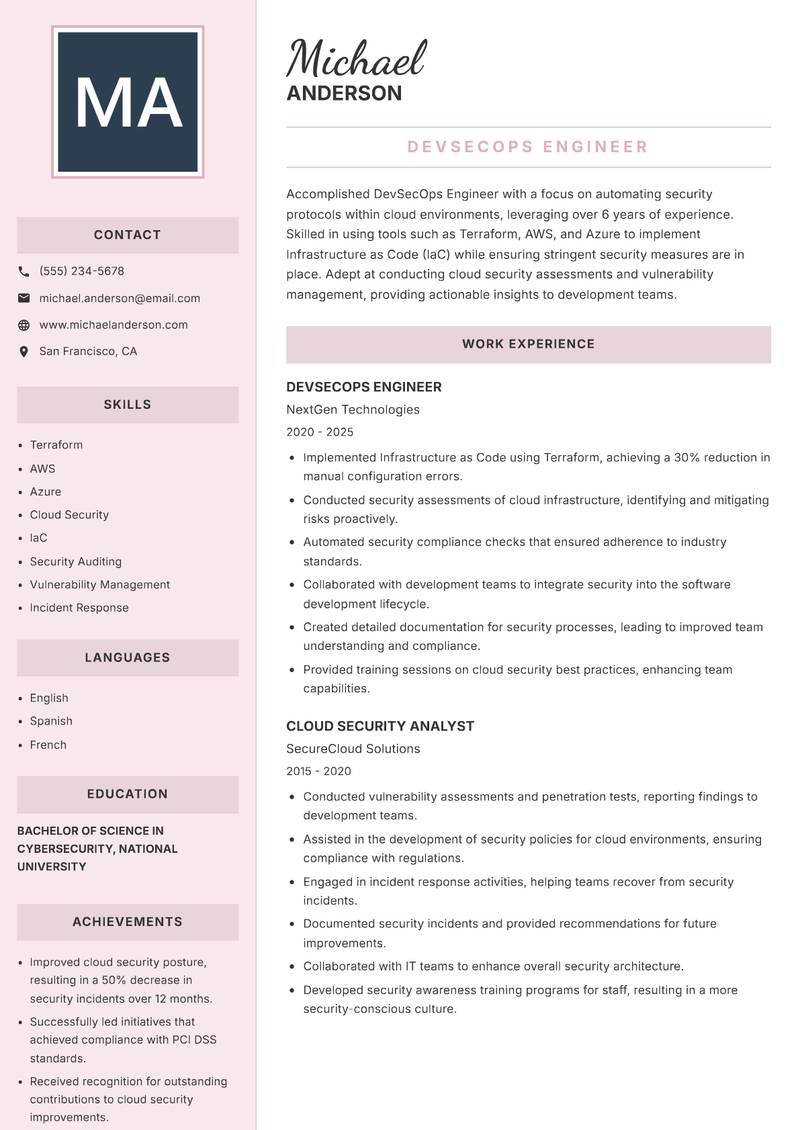
Accomplished DevSecOps Engineer with a focus on automating security protocols within cloud environments, leveraging over 6 years of experience. Skilled in using tools such as Terraform, AWS, and Azure to implement Infrastructure as Code (IaC) while ensuring stringent security measures are in place. Adept at conducting cloud security assessments and vulnerability management, providing actionable insights to development teams. Recognized for driving initiatives that enhance compliance with security standards and regulations. Excellent communicator with a strong ability to articulate complex security concepts to non-technical stakeholders. Passionate about continuous learning and staying ahead of the curve in the fast-evolving security landscape.

Terraform AWS Azure Cloud Security IaC Security Auditing Vulnerability Management Incident Response
DevSecOps Engineer Resume Preview Example
View PDF
  1. Implemented Infrastructure as Code using Terraform, achieving a 30% reduction in manual configuration errors.
  2. Conducted security assessments of cloud infrastructure, identifying and mitigating risks proactively.
  3. Automated security compliance checks that ensured adherence to industry standards.
  4. Collaborated with development teams to integrate security into the software development lifecycle.
  5. Created detailed documentation for security processes, leading to improved team understanding and compliance.
  6. Provided training sessions on cloud security best practices, enhancing team capabilities.
  1. Conducted vulnerability assessments and penetration tests, reporting findings to development teams.
  2. Assisted in the development of security policies for cloud environments, ensuring compliance with regulations.
  3. Engaged in incident response activities, helping teams recover from security incidents.
  4. Documented security incidents and provided recommendations for future improvements.
  5. Collaborated with IT teams to enhance overall security architecture.
  6. Developed security awareness training programs for staff, resulting in a more security-conscious culture.

Achievements

  • Improved cloud security posture, resulting in a 50% decrease in security incidents over 12 months.
  • Successfully led initiatives that achieved compliance with PCI DSS standards.
  • Received recognition for outstanding contributions to cloud security improvements.
⏱️
Experience
2-5 Years
📅
Level
Mid Level
🎓
Education
Bachelor of Science in Cyberse...

DevSecOps Engineer Resume

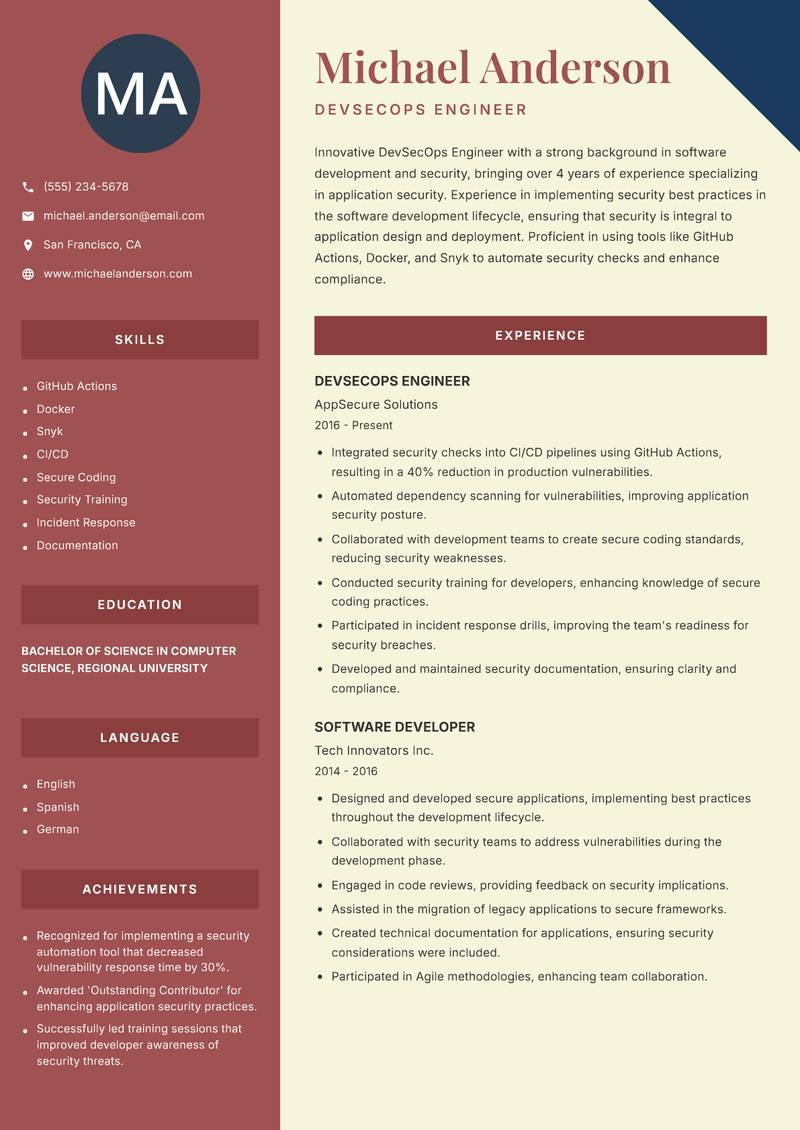
Innovative DevSecOps Engineer with a strong background in software development and security, bringing over 4 years of experience specializing in application security. Experience in implementing security best practices in the software development lifecycle, ensuring that security is integral to application design and deployment. Proficient in using tools like GitHub Actions, Docker, and Snyk to automate security checks and enhance compliance. Strong advocate for DevSecOps culture, fostering collaboration between development and security teams. Highly skilled in identifying vulnerabilities and providing effective solutions to mitigate risks. Committed to continuous learning and adapting to new security challenges in the ever-evolving tech landscape.

GitHub Actions Docker Snyk CI/CD Secure Coding Security Training Incident Response Documentation
DevSecOps Engineer Resume Preview Example
View PDF
  1. Integrated security checks into CI/CD pipelines using GitHub Actions, resulting in a 40% reduction in production vulnerabilities.
  2. Automated dependency scanning for vulnerabilities, improving application security posture.
  3. Collaborated with development teams to create secure coding standards, reducing security weaknesses.
  4. Conducted security training for developers, enhancing knowledge of secure coding practices.
  5. Participated in incident response drills, improving the team's readiness for security breaches.
  6. Developed and maintained security documentation, ensuring clarity and compliance.
  1. Designed and developed secure applications, implementing best practices throughout the development lifecycle.
  2. Collaborated with security teams to address vulnerabilities during the development phase.
  3. Engaged in code reviews, providing feedback on security implications.
  4. Assisted in the migration of legacy applications to secure frameworks.
  5. Created technical documentation for applications, ensuring security considerations were included.
  6. Participated in Agile methodologies, enhancing team collaboration.

Achievements

  • Recognized for implementing a security automation tool that decreased vulnerability response time by 30%.
  • Awarded 'Outstanding Contributor' for enhancing application security practices.
  • Successfully led training sessions that improved developer awareness of security threats.
⏱️
Experience
2-5 Years
📅
Level
Mid Level
🎓
Education
Bachelor of Science in Compute...

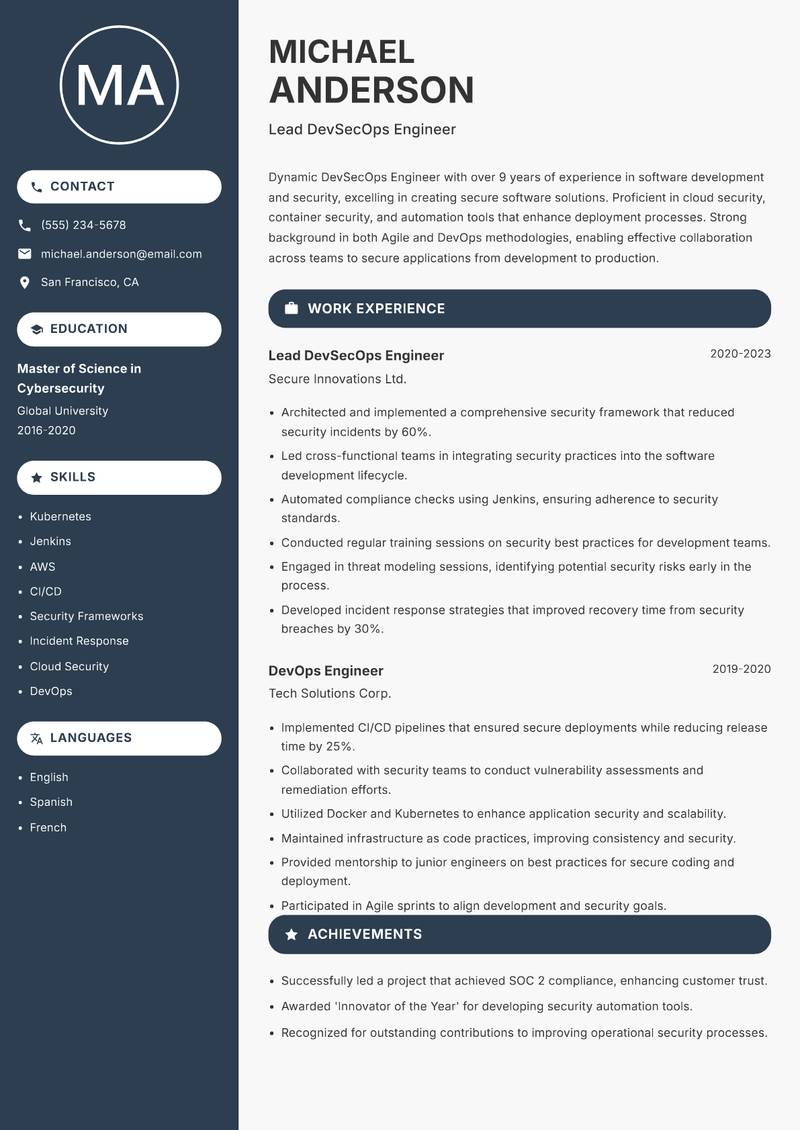
Lead DevSecOps Engineer Resume

Dynamic DevSecOps Engineer with over 9 years of experience in software development and security, excelling in creating secure software solutions. Proficient in cloud security, container security, and automation tools that enhance deployment processes. Strong background in both Agile and DevOps methodologies, enabling effective collaboration across teams to secure applications from development to production. Skilled in using tools such as Kubernetes, Jenkins, and AWS to implement security measures that protect sensitive data. Known for driving initiatives that improve organizational security posture and compliance with industry standards. A proactive problem-solver with a focus on continuous improvement and innovation.

Kubernetes Jenkins AWS CI/CD Security Frameworks Incident Response Cloud Security DevOps
DevSecOps Engineer Resume Preview Example
View PDF
  1. Architected and implemented a comprehensive security framework that reduced security incidents by 60%.
  2. Led cross-functional teams in integrating security practices into the software development lifecycle.
  3. Automated compliance checks using Jenkins, ensuring adherence to security standards.
  4. Conducted regular training sessions on security best practices for development teams.
  5. Engaged in threat modeling sessions, identifying potential security risks early in the process.
  6. Developed incident response strategies that improved recovery time from security breaches by 30%.
  1. Implemented CI/CD pipelines that ensured secure deployments while reducing release time by 25%.
  2. Collaborated with security teams to conduct vulnerability assessments and remediation efforts.
  3. Utilized Docker and Kubernetes to enhance application security and scalability.
  4. Maintained infrastructure as code practices, improving consistency and security.
  5. Provided mentorship to junior engineers on best practices for secure coding and deployment.
  6. Participated in Agile sprints to align development and security goals.

Achievements

  • Successfully led a project that achieved SOC 2 compliance, enhancing customer trust.
  • Awarded 'Innovator of the Year' for developing security automation tools.
  • Recognized for outstanding contributions to improving operational security processes.
⏱️
Experience
2-5 Years
📅
Level
Mid Level
🎓
Education
Master of Science in Cybersecu...

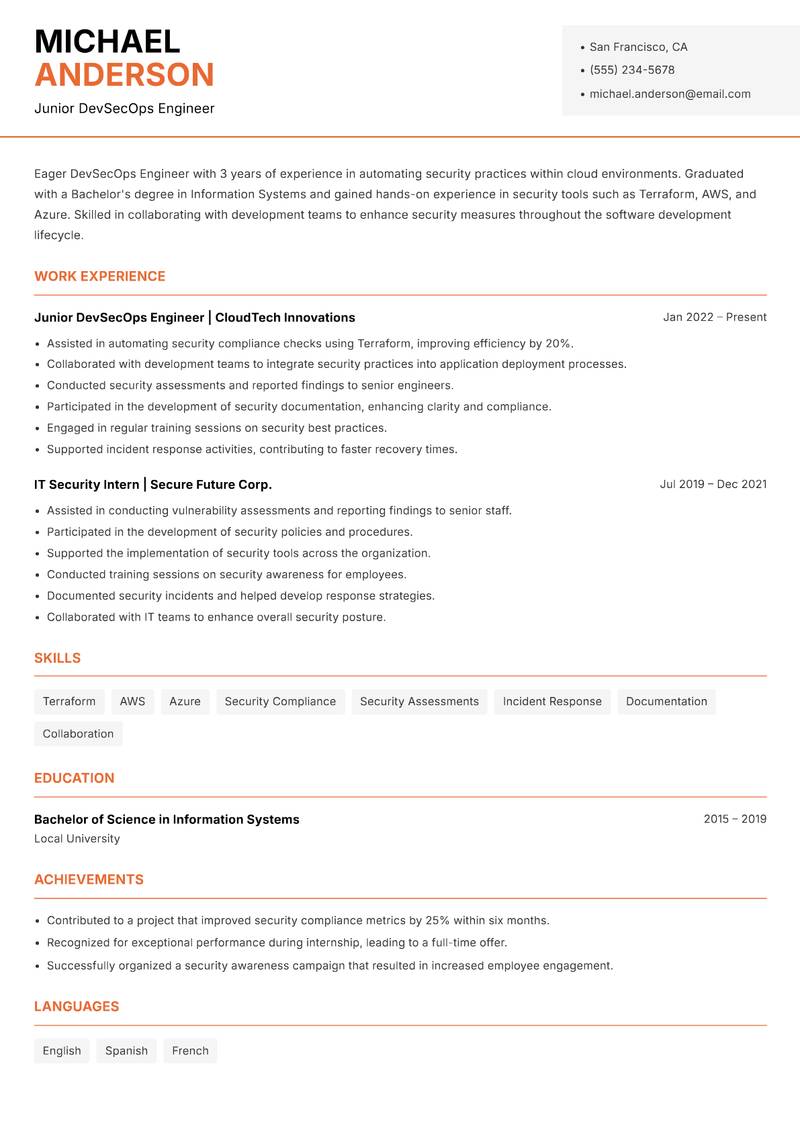
Junior DevSecOps Engineer Resume

Eager DevSecOps Engineer with 3 years of experience in automating security practices within cloud environments. Graduated with a Bachelor's degree in Information Systems and gained hands-on experience in security tools such as Terraform, AWS, and Azure. Skilled in collaborating with development teams to enhance security measures throughout the software development lifecycle. Passionate about learning new technologies and applying them to improve security processes. Recognized for contributing to security compliance initiatives and promoting a security-first culture within development teams. Committed to continuous professional development and eager to tackle new challenges in the field.

Terraform AWS Azure Security Compliance Security Assessments Incident Response Documentation Collaboration
DevSecOps Engineer Resume Preview Example
View PDF
  1. Assisted in automating security compliance checks using Terraform, improving efficiency by 20%.
  2. Collaborated with development teams to integrate security practices into application deployment processes.
  3. Conducted security assessments and reported findings to senior engineers.
  4. Participated in the development of security documentation, enhancing clarity and compliance.
  5. Engaged in regular training sessions on security best practices.
  6. Supported incident response activities, contributing to faster recovery times.
  1. Assisted in conducting vulnerability assessments and reporting findings to senior staff.
  2. Participated in the development of security policies and procedures.
  3. Supported the implementation of security tools across the organization.
  4. Conducted training sessions on security awareness for employees.
  5. Documented security incidents and helped develop response strategies.
  6. Collaborated with IT teams to enhance overall security posture.

Achievements

  • Contributed to a project that improved security compliance metrics by 25% within six months.
  • Recognized for exceptional performance during internship, leading to a full-time offer.
  • Successfully organized a security awareness campaign that resulted in increased employee engagement.
⏱️
Experience
2-5 Years
📅
Level
Mid Level
🎓
Education
Bachelor of Science in Informa...

Key Skills for DevSecOps Engineer Positions

Resume Tips for DevSecOps Engineer Applications

Strong Action Verbs for DevSecOps Engineer Resumes

Secured · Detected · Responded · Penetrated · Analyzed · Mitigated · Forensicated · Audited · Implemented · Monitored · Achieved · Administered · Architected · Assessed

Common Mistakes to Avoid

Experience Levels

How to Write a DevSecOps Engineer Resume

Browse DevSecOps Engineer resume examples built around threat detection & incident response, tailored for Cybersecurity roles.

A strong DevSecOps Engineer resume leads with a focused professional summary that names the exact role and your standout achievement. In the experience section, open every bullet with a strong action verb and quantify the result with numbers wherever possible. Highlight your most relevant competencies — especially Threat Detection & Incident Response, Penetration Testing & Vulnerability Assessment, and Security Information & Event Management (SIEM) — in a dedicated Skills section positioned early so ATS systems and hiring managers both find it immediately.

For format, most DevSecOps Engineer roles suit a reverse-chronological layout: most recent position first, working backwards. Keep to one page for under five years of experience, or two pages for senior candidates with a rich project or leadership history. Use clean, ATS-safe fonts (10–12pt), standard section headings (Summary, Experience, Education, Skills), and avoid tables, text boxes, or multi-column layouts that applicant tracking systems cannot parse reliably.
Frequently Asked Questions

What makes a strong DevSecOps Engineer resume stand out to employers?

A standout DevSecOps Engineer resume combines role-specific skills with quantified achievements. Name the exact job title in your professional summary, mirror keywords from each job posting, and open every bullet point with a strong action verb followed by a measurable result. Certifications, tools, and domain experience specific to devsecops engineer roles should appear prominently near the top.

What skills are most important to include on a Cybersecurity resume?

Recruiters hiring in Cybersecurity consistently look for Threat Detection & Incident Response, Penetration Testing & Vulnerability Assessment, Security Information & Event Management (SIEM), Network Security & Firewall Management. List these in a dedicated Skills section near the top so both ATS systems and human reviewers spot them fast. Mirror the exact phrasing from each job posting wherever possible — many applicant tracking systems match literal strings rather than synonyms.

What is the best resume format for Cybersecurity professionals?

A reverse-chronological format is the standard choice for most Cybersecurity candidates — employers expect to see your most recent role first, working backwards. If you are transitioning into Cybersecurity from a related field, a hybrid format (brief skills summary at the top followed by chronological experience) can bridge the gap effectively. Keep the document to one page for under five years of experience, or two pages for senior specialists.

How do I make my Cybersecurity resume pass applicant tracking systems (ATS)?

Use standard section headings — Summary, Experience, Education, Skills — rather than creative labels that ATS parsers do not recognise. Embed domain keywords such as "Threat Detection & Incident Response" and "Penetration Testing & Vulnerability Assessment" naturally inside your experience bullets rather than cramming them into a standalone keyword list. Avoid tables, multi-column layouts, text boxes, headers, footers, and images — these confuse most modern parsers and can cause your resume to be misread or rejected before a human sees it.

What mistakes do Cybersecurity professionals most commonly make on their resume?

The most frequent issue is omitting specific certifications — hiring managers frequently filter by CISSP, OSCP, or equivalent. Beyond that, generic objective statements, unquantified achievements, and inconsistent date formatting appear across almost every Cybersecurity application. Fix these by replacing every vague claim with a measurable outcome — specific numbers and named projects add credibility that adjectives cannot.

How long should a Cybersecurity resume be?

One page is appropriate for candidates with under five years of relevant Cybersecurity experience. Two pages are acceptable — and sometimes expected — for senior specialists, managers, or professionals with a strong portfolio of projects, publications, or credentials. Avoid padding to reach a page count: every line should directly support your application for the specific role you are targeting.

Should I include a professional summary at the top of my Cybersecurity resume?

Yes — a two to three sentence summary is the first section most recruiters read. Open with your title and years of Cybersecurity experience, then name your most relevant achievement or specialisation. One proven approach: Lead with certifications: CISSP, CEH, OSCP, CompTIA Security+, CISM — they are gatekeepers — this level of specificity signals genuine expertise before a recruiter reaches your experience section.

Scroll to view samples