Ionospheric Scientist Resume

These Ionospheric Scientist resume samples are designed to help you write a resume that gets noticed by hiring managers and passes applicant tracking systems (ATS) in Space Sciences. Each example shows real formatting, section structure, and language you can adapt to your own background. When writing your own Ionospheric Scientist resume, focus on highlighting orbital mechanics & mission design, astrophysics & cosmological analysis and satellite design & systems engineering. Recruiters scan for these qualifications first, so they should appear early in your summary and experience sections. Use strong action verbs such as "launched", "modeled", "analyzed", "designed" to describe your achievements, and quantify your impact wherever possible — percentages, dollar amounts, or time saved make your resume more convincing. A common mistake to avoid: writing a generic objective statement instead of a targeted ionospheric scientist professional summary. Tailor your resume to each Ionospheric Scientist position you apply for rather than using one generic version.

Ionospheric Scientist Resume Template
View PDF
0.0 (0 ratings)

Senior Ionospheric Research Scientist Resume

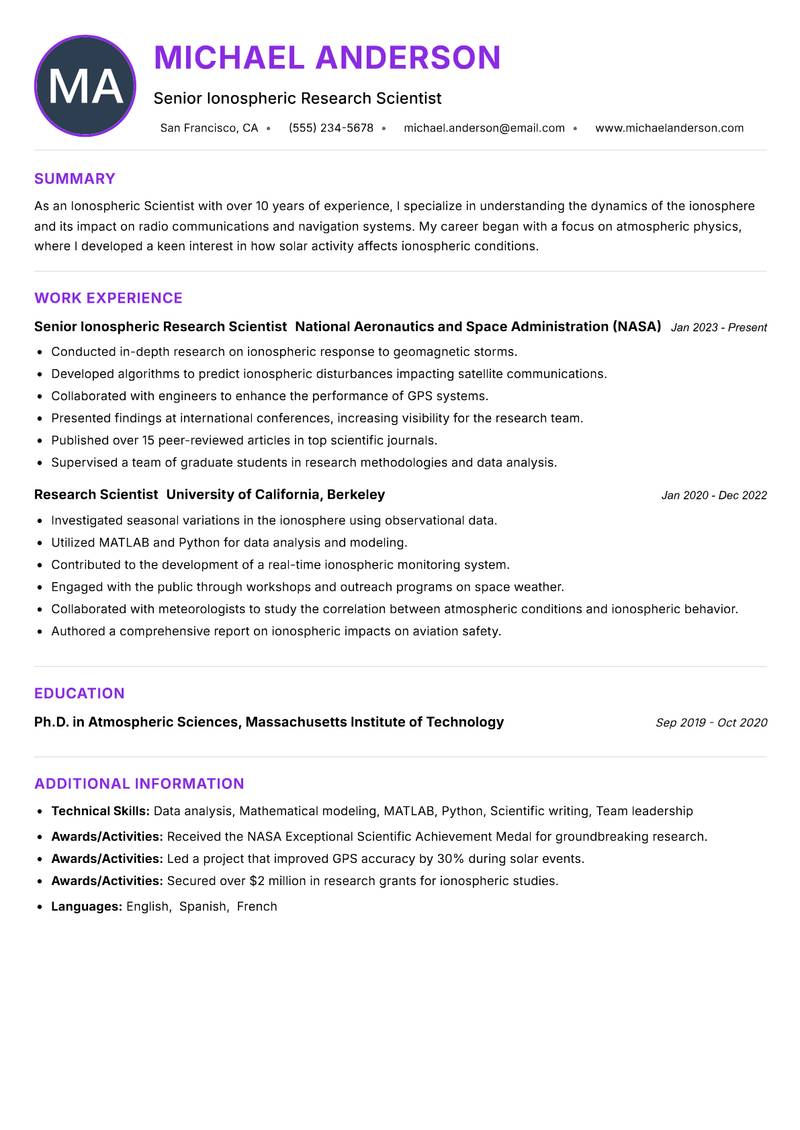
As an Ionospheric Scientist with over 10 years of experience, I specialize in understanding the dynamics of the ionosphere and its impact on radio communications and navigation systems. My career began with a focus on atmospheric physics, where I developed a keen interest in how solar activity affects ionospheric conditions. I have worked on various research projects funded by national agencies, contributing to our understanding of ionospheric irregularities and their implications for satellite operations. My expertise spans data analysis, modeling, and experimental design, which I have applied in both academic and applied research settings. I thrive in collaborative environments and have led interdisciplinary teams to successfully address complex scientific challenges. My goal is to continue advancing our knowledge of the ionosphere while developing innovative solutions that enhance communication technologies.

Data analysis Mathematical modeling MATLAB Python Scientific writing Team leadership
Ionospheric Scientist Resume Preview Example
View PDF
  1. Conducted in-depth research on ionospheric response to geomagnetic storms.
  2. Developed algorithms to predict ionospheric disturbances impacting satellite communications.
  3. Collaborated with engineers to enhance the performance of GPS systems.
  4. Presented findings at international conferences, increasing visibility for the research team.
  5. Published over 15 peer-reviewed articles in top scientific journals.
  6. Supervised a team of graduate students in research methodologies and data analysis.
  1. Investigated seasonal variations in the ionosphere using observational data.
  2. Utilized MATLAB and Python for data analysis and modeling.
  3. Contributed to the development of a real-time ionospheric monitoring system.
  4. Engaged with the public through workshops and outreach programs on space weather.
  5. Collaborated with meteorologists to study the correlation between atmospheric conditions and ionospheric behavior.
  6. Authored a comprehensive report on ionospheric impacts on aviation safety.

Achievements

  • Received the NASA Exceptional Scientific Achievement Medal for groundbreaking research.
  • Led a project that improved GPS accuracy by 30% during solar events.
  • Secured over $2 million in research grants for ionospheric studies.
⏱️
Experience
2-5 Years
📅
Level
Mid Level
🎓
Education
Ph.D. in Atmospheric Sciences,...

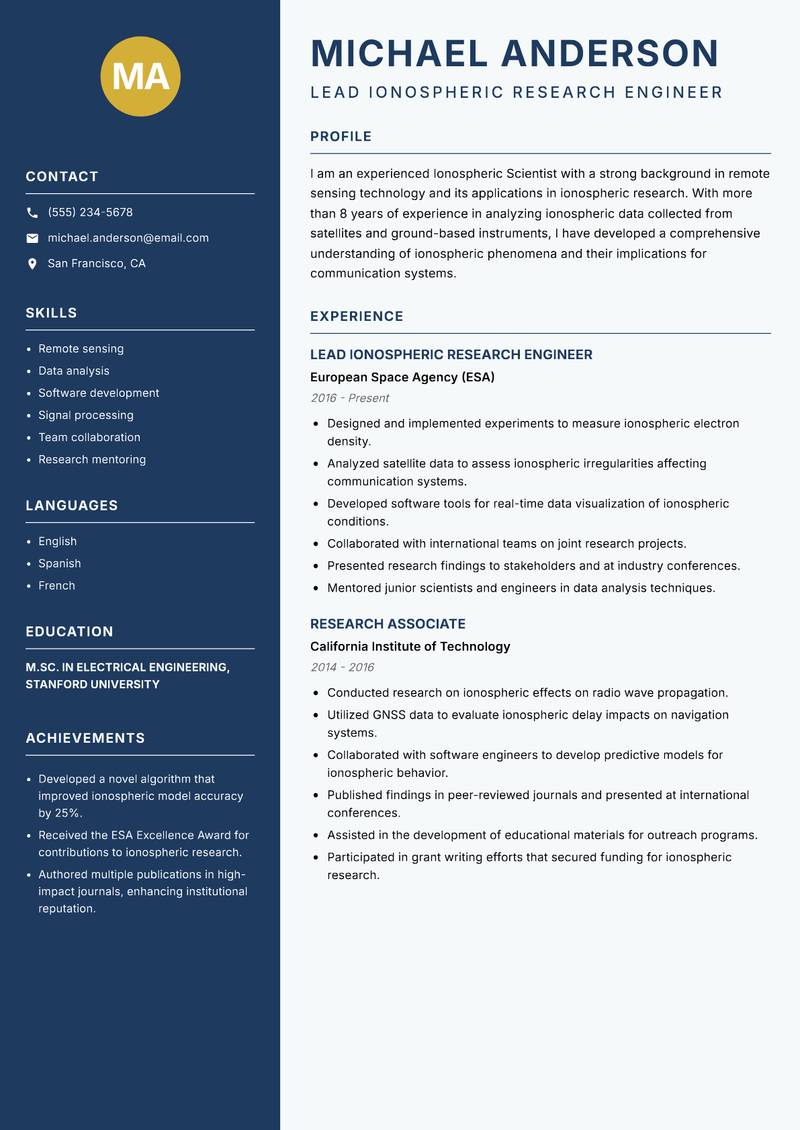
Lead Ionospheric Research Engineer Resume

I am an experienced Ionospheric Scientist with a strong background in remote sensing technology and its applications in ionospheric research. With more than 8 years of experience in analyzing ionospheric data collected from satellites and ground-based instruments, I have developed a comprehensive understanding of ionospheric phenomena and their implications for communication systems. My background in electrical engineering allows me to effectively bridge the gap between theoretical research and practical applications. I have a proven track record in developing innovative solutions that enhance signal reliability and reduce disruption in communication networks. My goal is to leverage my technical expertise and research experience to contribute to advancements in ionospheric science and improve global navigation systems.

Remote sensing Data analysis Software development Signal processing Team collaboration Research mentoring
Ionospheric Scientist Resume Preview Example
View PDF
  1. Designed and implemented experiments to measure ionospheric electron density.
  2. Analyzed satellite data to assess ionospheric irregularities affecting communication systems.
  3. Developed software tools for real-time data visualization of ionospheric conditions.
  4. Collaborated with international teams on joint research projects.
  5. Presented research findings to stakeholders and at industry conferences.
  6. Mentored junior scientists and engineers in data analysis techniques.
  1. Conducted research on ionospheric effects on radio wave propagation.
  2. Utilized GNSS data to evaluate ionospheric delay impacts on navigation systems.
  3. Collaborated with software engineers to develop predictive models for ionospheric behavior.
  4. Published findings in peer-reviewed journals and presented at international conferences.
  5. Assisted in the development of educational materials for outreach programs.
  6. Participated in grant writing efforts that secured funding for ionospheric research.

Achievements

  • Developed a novel algorithm that improved ionospheric model accuracy by 25%.
  • Received the ESA Excellence Award for contributions to ionospheric research.
  • Authored multiple publications in high-impact journals, enhancing institutional reputation.
⏱️
Experience
2-5 Years
📅
Level
Mid Level
🎓
Education
M.Sc. in Electrical Engineerin...

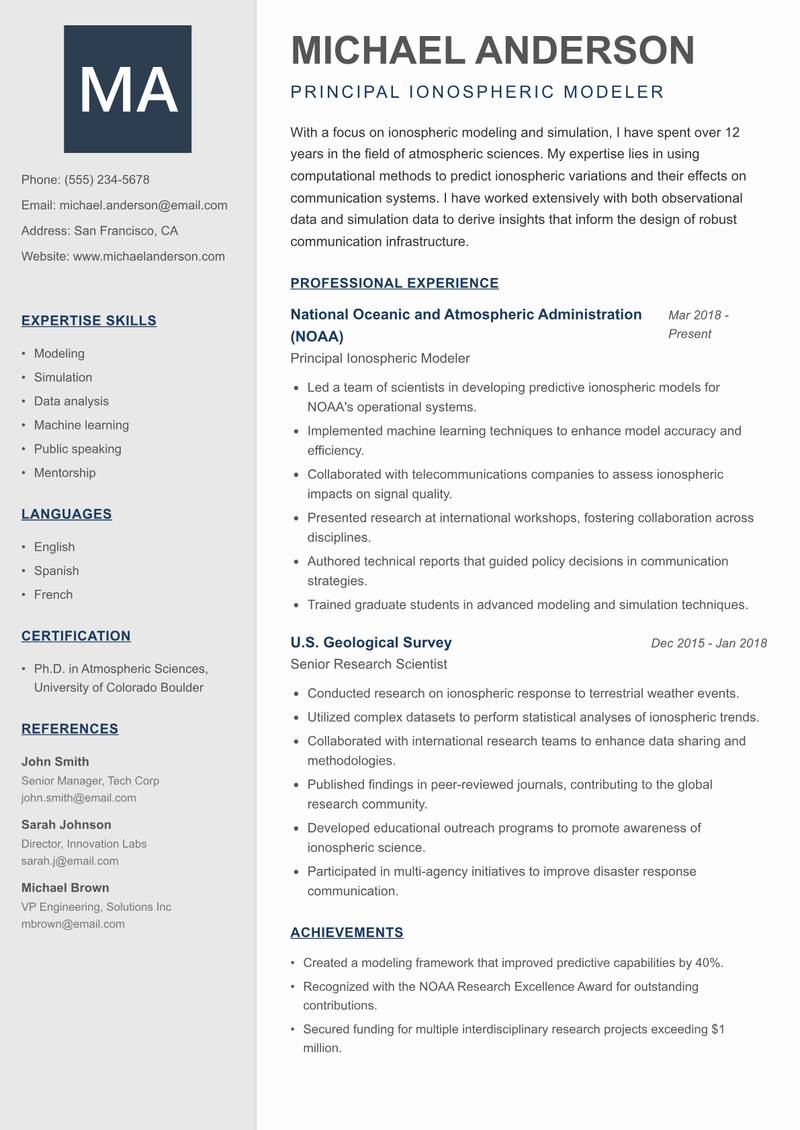
Principal Ionospheric Modeler Resume

With a focus on ionospheric modeling and simulation, I have spent over 12 years in the field of atmospheric sciences. My expertise lies in using computational methods to predict ionospheric variations and their effects on communication systems. I have worked extensively with both observational data and simulation data to derive insights that inform the design of robust communication infrastructure. My career has been marked by a commitment to innovation, demonstrated through the development of advanced modeling techniques that have been adopted by agencies around the world. I am passionate about mentoring the next generation of scientists and sharing knowledge through teaching and public outreach. I aim to further explore the intersection of technology and atmospheric research to enhance global communications.

Modeling Simulation Data analysis Machine learning Public speaking Mentorship
Ionospheric Scientist Resume Preview Example
View PDF
  1. Led a team of scientists in developing predictive ionospheric models for NOAA's operational systems.
  2. Implemented machine learning techniques to enhance model accuracy and efficiency.
  3. Collaborated with telecommunications companies to assess ionospheric impacts on signal quality.
  4. Presented research at international workshops, fostering collaboration across disciplines.
  5. Authored technical reports that guided policy decisions in communication strategies.
  6. Trained graduate students in advanced modeling and simulation techniques.
  1. Conducted research on ionospheric response to terrestrial weather events.
  2. Utilized complex datasets to perform statistical analyses of ionospheric trends.
  3. Collaborated with international research teams to enhance data sharing and methodologies.
  4. Published findings in peer-reviewed journals, contributing to the global research community.
  5. Developed educational outreach programs to promote awareness of ionospheric science.
  6. Participated in multi-agency initiatives to improve disaster response communication.

Achievements

  • Created a modeling framework that improved predictive capabilities by 40%.
  • Recognized with the NOAA Research Excellence Award for outstanding contributions.
  • Secured funding for multiple interdisciplinary research projects exceeding $1 million.
⏱️
Experience
2-5 Years
📅
Level
Mid Level
🎓
Education
Ph.D. in Atmospheric Sciences,...

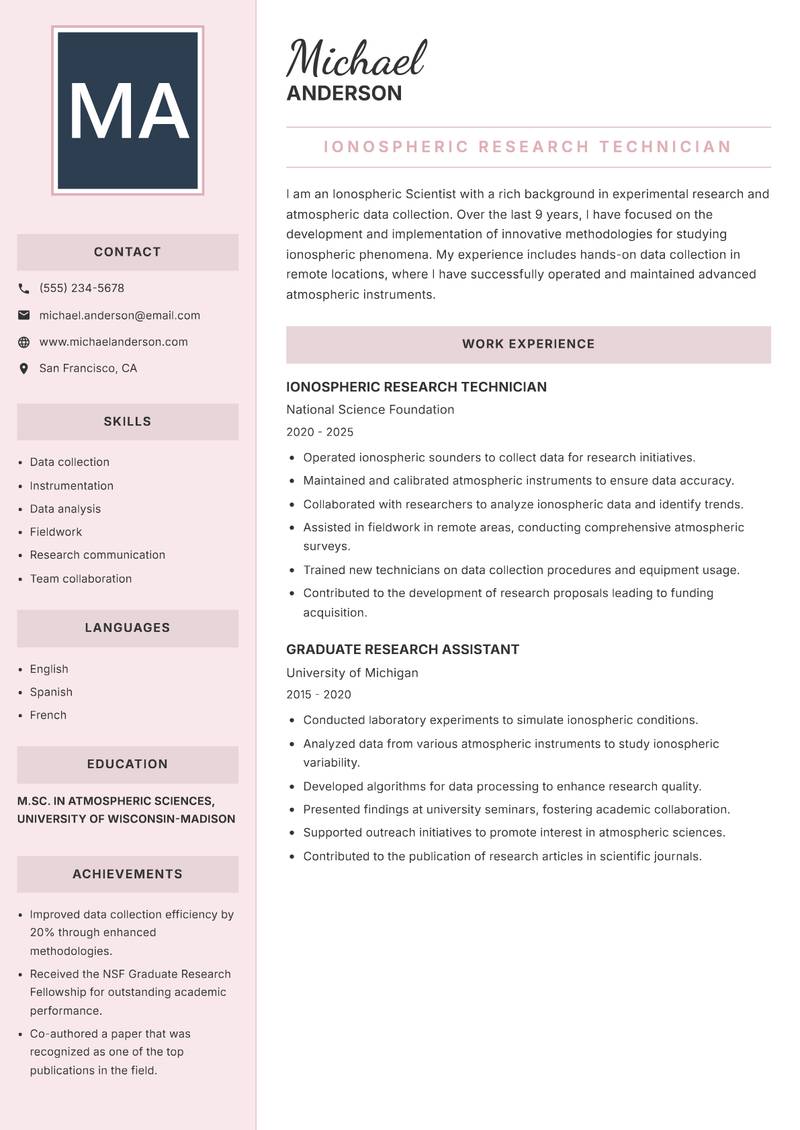
Ionospheric Research Technician Resume

I am an Ionospheric Scientist with a rich background in experimental research and atmospheric data collection. Over the last 9 years, I have focused on the development and implementation of innovative methodologies for studying ionospheric phenomena. My experience includes hands-on data collection in remote locations, where I have successfully operated and maintained advanced atmospheric instruments. I have a strong foundation in analyzing complex datasets and translating findings into actionable insights for both academic and commercial applications. My passion for science communication drives me to engage with diverse audiences, fostering a greater understanding of ionospheric science and its importance in our daily lives. I am eager to continue my work in advancing ionospheric research while contributing to practical solutions for communication challenges.

Data collection Instrumentation Data analysis Fieldwork Research communication Team collaboration
Ionospheric Scientist Resume Preview Example
View PDF
  1. Operated ionospheric sounders to collect data for research initiatives.
  2. Maintained and calibrated atmospheric instruments to ensure data accuracy.
  3. Collaborated with researchers to analyze ionospheric data and identify trends.
  4. Assisted in fieldwork in remote areas, conducting comprehensive atmospheric surveys.
  5. Trained new technicians on data collection procedures and equipment usage.
  6. Contributed to the development of research proposals leading to funding acquisition.
  1. Conducted laboratory experiments to simulate ionospheric conditions.
  2. Analyzed data from various atmospheric instruments to study ionospheric variability.
  3. Developed algorithms for data processing to enhance research quality.
  4. Presented findings at university seminars, fostering academic collaboration.
  5. Supported outreach initiatives to promote interest in atmospheric sciences.
  6. Contributed to the publication of research articles in scientific journals.

Achievements

  • Improved data collection efficiency by 20% through enhanced methodologies.
  • Received the NSF Graduate Research Fellowship for outstanding academic performance.
  • Co-authored a paper that was recognized as one of the top publications in the field.
⏱️
Experience
2-5 Years
📅
Level
Mid Level
🎓
Education
M.Sc. in Atmospheric Sciences,...

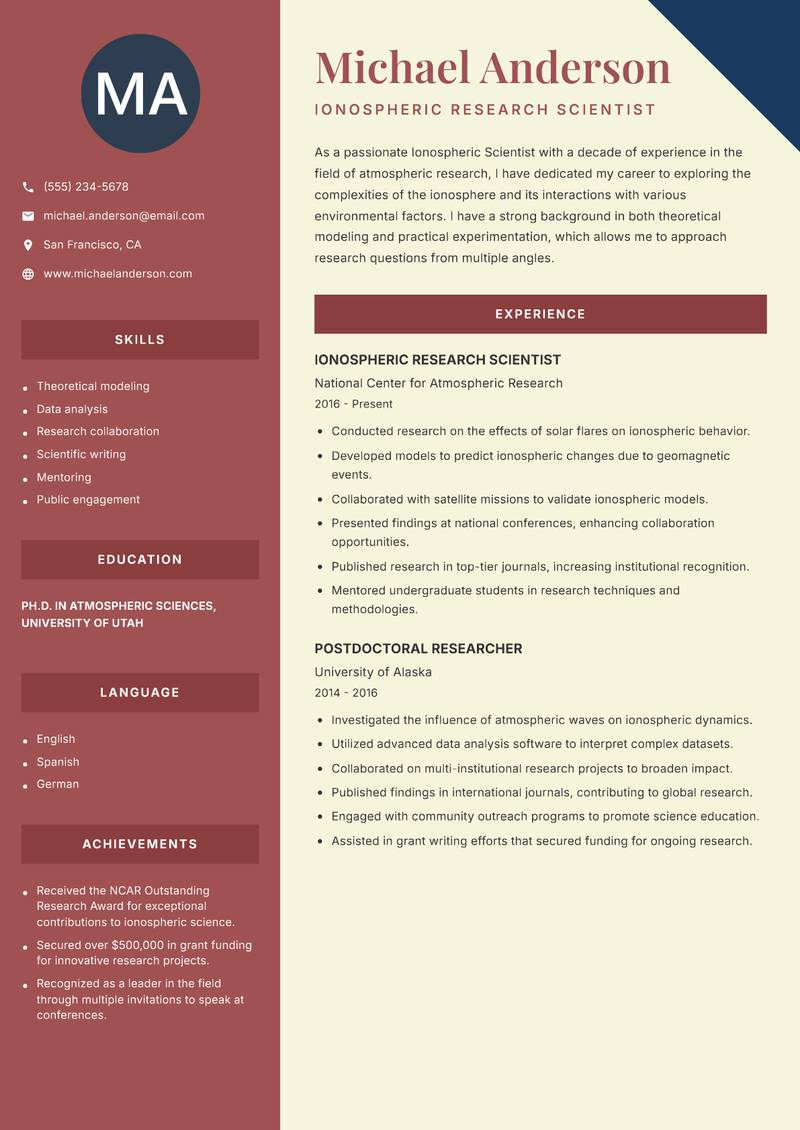
Ionospheric Research Scientist Resume

As a passionate Ionospheric Scientist with a decade of experience in the field of atmospheric research, I have dedicated my career to exploring the complexities of the ionosphere and its interactions with various environmental factors. I have a strong background in both theoretical modeling and practical experimentation, which allows me to approach research questions from multiple angles. My work has primarily focused on the impact of solar activity on the ionosphere, and I have been involved in numerous projects that aim to improve our understanding of these phenomena. I am adept at collaborating with cross-disciplinary teams and have published extensively in peer-reviewed journals. My goal is to contribute to the advancement of ionospheric science while mentoring the next generation of scientists.

Theoretical modeling Data analysis Research collaboration Scientific writing Mentoring Public engagement
Ionospheric Scientist Resume Preview Example
View PDF
  1. Conducted research on the effects of solar flares on ionospheric behavior.
  2. Developed models to predict ionospheric changes due to geomagnetic events.
  3. Collaborated with satellite missions to validate ionospheric models.
  4. Presented findings at national conferences, enhancing collaboration opportunities.
  5. Published research in top-tier journals, increasing institutional recognition.
  6. Mentored undergraduate students in research techniques and methodologies.
  1. Investigated the influence of atmospheric waves on ionospheric dynamics.
  2. Utilized advanced data analysis software to interpret complex datasets.
  3. Collaborated on multi-institutional research projects to broaden impact.
  4. Published findings in international journals, contributing to global research.
  5. Engaged with community outreach programs to promote science education.
  6. Assisted in grant writing efforts that secured funding for ongoing research.

Achievements

  • Received the NCAR Outstanding Research Award for exceptional contributions to ionospheric science.
  • Secured over $500,000 in grant funding for innovative research projects.
  • Recognized as a leader in the field through multiple invitations to speak at conferences.
⏱️
Experience
2-5 Years
📅
Level
Mid Level
🎓
Education
Ph.D. in Atmospheric Sciences,...

Ionospheric Impact Analyst Resume

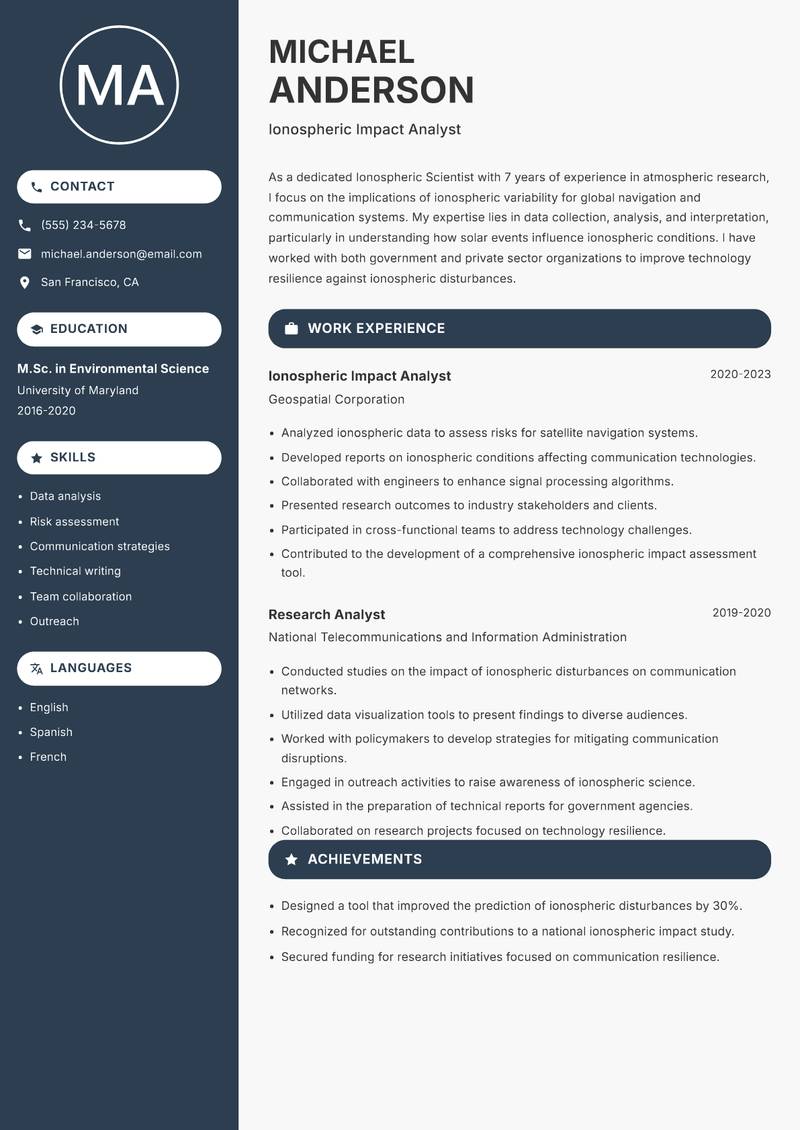
As a dedicated Ionospheric Scientist with 7 years of experience in atmospheric research, I focus on the implications of ionospheric variability for global navigation and communication systems. My expertise lies in data collection, analysis, and interpretation, particularly in understanding how solar events influence ionospheric conditions. I have worked with both government and private sector organizations to improve technology resilience against ionospheric disturbances. My goal is to continue advancing the field through innovative research and practical applications that enhance the reliability of communication systems. I am passionate about disseminating scientific knowledge and engaging with various stakeholders to promote the importance of ionospheric science in modern technology.

Data analysis Risk assessment Communication strategies Technical writing Team collaboration Outreach
Ionospheric Scientist Resume Preview Example
View PDF
  1. Analyzed ionospheric data to assess risks for satellite navigation systems.
  2. Developed reports on ionospheric conditions affecting communication technologies.
  3. Collaborated with engineers to enhance signal processing algorithms.
  4. Presented research outcomes to industry stakeholders and clients.
  5. Participated in cross-functional teams to address technology challenges.
  6. Contributed to the development of a comprehensive ionospheric impact assessment tool.
  1. Conducted studies on the impact of ionospheric disturbances on communication networks.
  2. Utilized data visualization tools to present findings to diverse audiences.
  3. Worked with policymakers to develop strategies for mitigating communication disruptions.
  4. Engaged in outreach activities to raise awareness of ionospheric science.
  5. Assisted in the preparation of technical reports for government agencies.
  6. Collaborated on research projects focused on technology resilience.

Achievements

  • Designed a tool that improved the prediction of ionospheric disturbances by 30%.
  • Recognized for outstanding contributions to a national ionospheric impact study.
  • Secured funding for research initiatives focused on communication resilience.
⏱️
Experience
2-5 Years
📅
Level
Mid Level
🎓
Education
M.Sc. in Environmental Science...

Ionospheric Research Specialist Resume

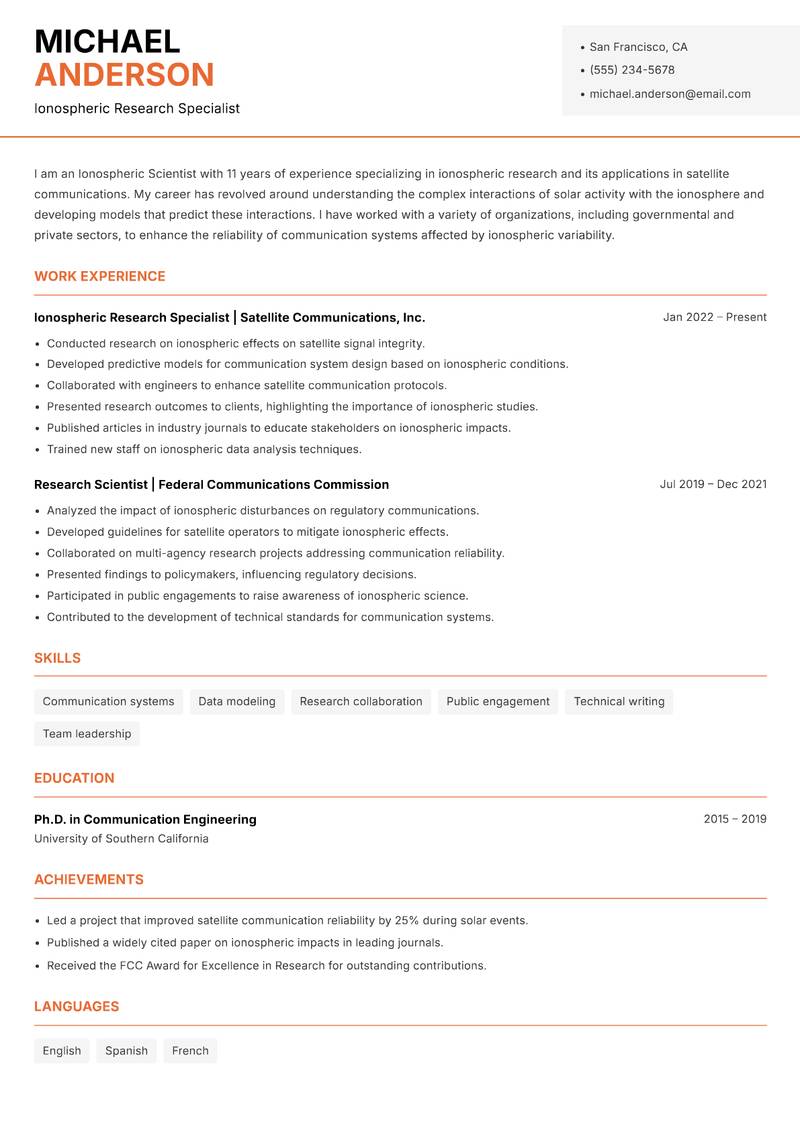
I am an Ionospheric Scientist with 11 years of experience specializing in ionospheric research and its applications in satellite communications. My career has revolved around understanding the complex interactions of solar activity with the ionosphere and developing models that predict these interactions. I have worked with a variety of organizations, including governmental and private sectors, to enhance the reliability of communication systems affected by ionospheric variability. My ability to communicate complex scientific concepts to non-experts has enabled me to effectively engage stakeholders in the importance of ionospheric science. I aim to continue my work at the intersection of science and technology to drive innovations that improve our communication infrastructure.

Communication systems Data modeling Research collaboration Public engagement Technical writing Team leadership
Ionospheric Scientist Resume Preview Example
View PDF
  1. Conducted research on ionospheric effects on satellite signal integrity.
  2. Developed predictive models for communication system design based on ionospheric conditions.
  3. Collaborated with engineers to enhance satellite communication protocols.
  4. Presented research outcomes to clients, highlighting the importance of ionospheric studies.
  5. Published articles in industry journals to educate stakeholders on ionospheric impacts.
  6. Trained new staff on ionospheric data analysis techniques.
  1. Analyzed the impact of ionospheric disturbances on regulatory communications.
  2. Developed guidelines for satellite operators to mitigate ionospheric effects.
  3. Collaborated on multi-agency research projects addressing communication reliability.
  4. Presented findings to policymakers, influencing regulatory decisions.
  5. Participated in public engagements to raise awareness of ionospheric science.
  6. Contributed to the development of technical standards for communication systems.

Achievements

  • Led a project that improved satellite communication reliability by 25% during solar events.
  • Published a widely cited paper on ionospheric impacts in leading journals.
  • Received the FCC Award for Excellence in Research for outstanding contributions.
⏱️
Experience
2-5 Years
📅
Level
Mid Level
🎓
Education
Ph.D. in Communication Enginee...

Key Skills for Ionospheric Scientist Positions

Resume Tips for Ionospheric Scientist Applications

Strong Action Verbs for Ionospheric Scientist Resumes

Launched · Modeled · Analyzed · Designed · Operated · Published · Tracked · Calibrated · Simulated · Investigated · Improved · Achieved · Administered · Architected

Common Mistakes to Avoid

Experience Levels

How to Write a Ionospheric Scientist Resume

Browse Ionospheric Scientist resume examples built around orbital mechanics & mission design, tailored for Space Sciences roles.

A strong Ionospheric Scientist resume leads with a focused professional summary that names the exact role and your standout achievement. In the experience section, open every bullet with a strong action verb and quantify the result with numbers wherever possible. Highlight your most relevant competencies — especially Orbital Mechanics & Mission Design, Astrophysics & Cosmological Analysis, and Satellite Design & Systems Engineering — in a dedicated Skills section positioned early so ATS systems and hiring managers both find it immediately.

For format, most Ionospheric Scientist roles suit a reverse-chronological layout: most recent position first, working backwards. Keep to one page for under five years of experience, or two pages for senior candidates with a rich project or leadership history. Use clean, ATS-safe fonts (10–12pt), standard section headings (Summary, Experience, Education, Skills), and avoid tables, text boxes, or multi-column layouts that applicant tracking systems cannot parse reliably.
Frequently Asked Questions

What makes a strong Ionospheric Scientist resume stand out to employers?

A standout Ionospheric Scientist resume combines role-specific skills with quantified achievements. Name the exact job title in your professional summary, mirror keywords from each job posting, and open every bullet point with a strong action verb followed by a measurable result. Certifications, tools, and domain experience specific to ionospheric scientist roles should appear prominently near the top.

What skills are most important to include on a Space Sciences resume?

Recruiters hiring in Space Sciences consistently look for Orbital Mechanics & Mission Design, Astrophysics & Cosmological Analysis, Satellite Design & Systems Engineering, Remote Sensing & Earth Observation. List these in a dedicated Skills section near the top so both ATS systems and human reviewers spot them fast. Mirror the exact phrasing from each job posting wherever possible — many applicant tracking systems match literal strings rather than synonyms.

What is the best resume format for Space Sciences professionals?

A reverse-chronological format is the standard choice for most Space Sciences candidates — employers expect to see your most recent role first, working backwards. If you are transitioning into Space Sciences from a related field, a hybrid format (brief skills summary at the top followed by chronological experience) can bridge the gap effectively. Keep the document to one page for under five years of experience, or two pages for senior specialists.

How do I make my Space Sciences resume pass applicant tracking systems (ATS)?

Use standard section headings — Summary, Experience, Education, Skills — rather than creative labels that ATS parsers do not recognise. Embed domain keywords such as "Orbital Mechanics & Mission Design" and "Astrophysics & Cosmological Analysis" naturally inside your experience bullets rather than cramming them into a standalone keyword list. Avoid tables, multi-column layouts, text boxes, headers, footers, and images — these confuse most modern parsers and can cause your resume to be misread or rejected before a human sees it.

What mistakes do Space Sciences professionals most commonly make on their resume?

The most frequent issue is not naming specific missions or programs — generic space science experience is far less compelling. Beyond that, generic objective statements, unquantified achievements, and inconsistent date formatting appear across almost every Space Sciences application. Fix these by replacing every vague claim with a measurable outcome — specific numbers and named projects add credibility that adjectives cannot.

How long should a Space Sciences resume be?

One page is appropriate for candidates with under five years of relevant Space Sciences experience. Two pages are acceptable — and sometimes expected — for senior specialists, managers, or professionals with a strong portfolio of projects, publications, or credentials. Avoid padding to reach a page count: every line should directly support your application for the specific role you are targeting.

Should I include a professional summary at the top of my Space Sciences resume?

Yes — a two to three sentence summary is the first section most recruiters read. Open with your title and years of Space Sciences experience, then name your most relevant achievement or specialisation. One proven approach: Named mission involvement (e.g., Hubble, James Webb, Sentinel) is the gold standard credential — lead with it — this level of specificity signals genuine expertise before a recruiter reaches your experience section.

Scroll to view samples