Neuropsychologist Resume

These Neuropsychologist resume samples are designed to help you write a resume that gets noticed by hiring managers and passes applicant tracking systems (ATS) in Mental Health. Each example shows real formatting, section structure, and language you can adapt to your own background. When writing your own Neuropsychologist resume, focus on highlighting Evidence-Based psychotherapy (CBT, DBT, ACT, EMDR), psychiatric assessment & diagnosis (DSM-5, ICD-11) and crisis intervention & risk assessment. Recruiters scan for these qualifications first, so they should appear early in your summary and experience sections. Use strong action verbs such as "assessed", "treated", "facilitated", "coordinated" to describe your achievements, and quantify your impact wherever possible — percentages, dollar amounts, or time saved make your resume more convincing. A common mistake to avoid: writing a generic objective statement instead of a targeted neuropsychologist professional summary. Tailor your resume to each Neuropsychologist position you apply for rather than using one generic version.

Neuropsychologist Resume Template
View PDF
0.0 (0 ratings)

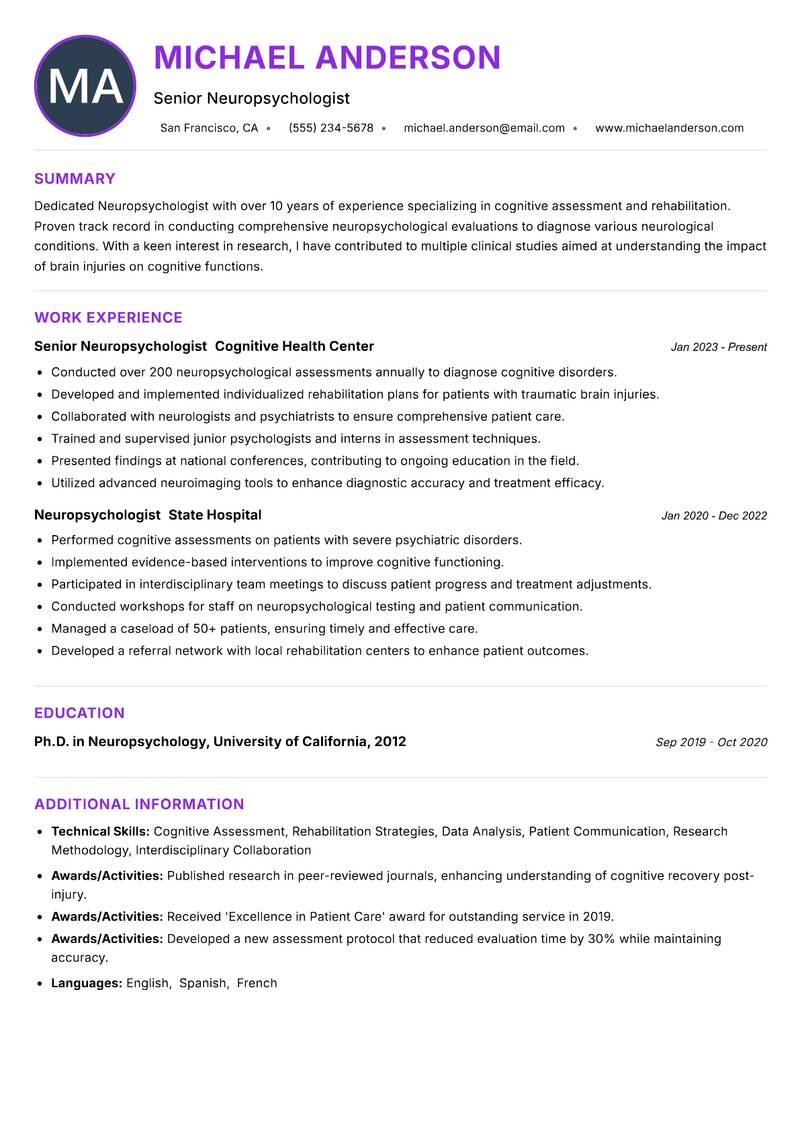
Senior Neuropsychologist Resume

Dedicated Neuropsychologist with over 10 years of experience specializing in cognitive assessment and rehabilitation. Proven track record in conducting comprehensive neuropsychological evaluations to diagnose various neurological conditions. With a keen interest in research, I have contributed to multiple clinical studies aimed at understanding the impact of brain injuries on cognitive functions. My compassionate approach allows me to effectively engage with patients, ensuring their comfort during assessments and treatments. I am skilled in developing individualized treatment plans based on detailed evaluations, collaborating closely with a multidisciplinary team to enhance patient outcomes. Through my work in both clinical and research settings, I have honed my ability to analyze complex data and apply findings to improve therapeutic strategies. I am committed to advancing the field of neuropsychology through continuous learning and collaboration with peers. My goal is to empower patients and their families by providing them with the knowledge and resources needed to navigate their recovery journeys.

Cognitive Assessment Rehabilitation Strategies Data Analysis Patient Communication Research Methodology Interdisciplinary Collaboration
Neuropsychologist Resume Preview Example
View PDF
  1. Conducted over 200 neuropsychological assessments annually to diagnose cognitive disorders.
  2. Developed and implemented individualized rehabilitation plans for patients with traumatic brain injuries.
  3. Collaborated with neurologists and psychiatrists to ensure comprehensive patient care.
  4. Trained and supervised junior psychologists and interns in assessment techniques.
  5. Presented findings at national conferences, contributing to ongoing education in the field.
  6. Utilized advanced neuroimaging tools to enhance diagnostic accuracy and treatment efficacy.
  1. Performed cognitive assessments on patients with severe psychiatric disorders.
  2. Implemented evidence-based interventions to improve cognitive functioning.
  3. Participated in interdisciplinary team meetings to discuss patient progress and treatment adjustments.
  4. Conducted workshops for staff on neuropsychological testing and patient communication.
  5. Managed a caseload of 50+ patients, ensuring timely and effective care.
  6. Developed a referral network with local rehabilitation centers to enhance patient outcomes.

Achievements

  • Published research in peer-reviewed journals, enhancing understanding of cognitive recovery post-injury.
  • Received 'Excellence in Patient Care' award for outstanding service in 2019.
  • Developed a new assessment protocol that reduced evaluation time by 30% while maintaining accuracy.
⏱️
Experience
2-5 Years
📅
Level
Mid Level
🎓
Education
Ph.D. in Neuropsychology, Univ...

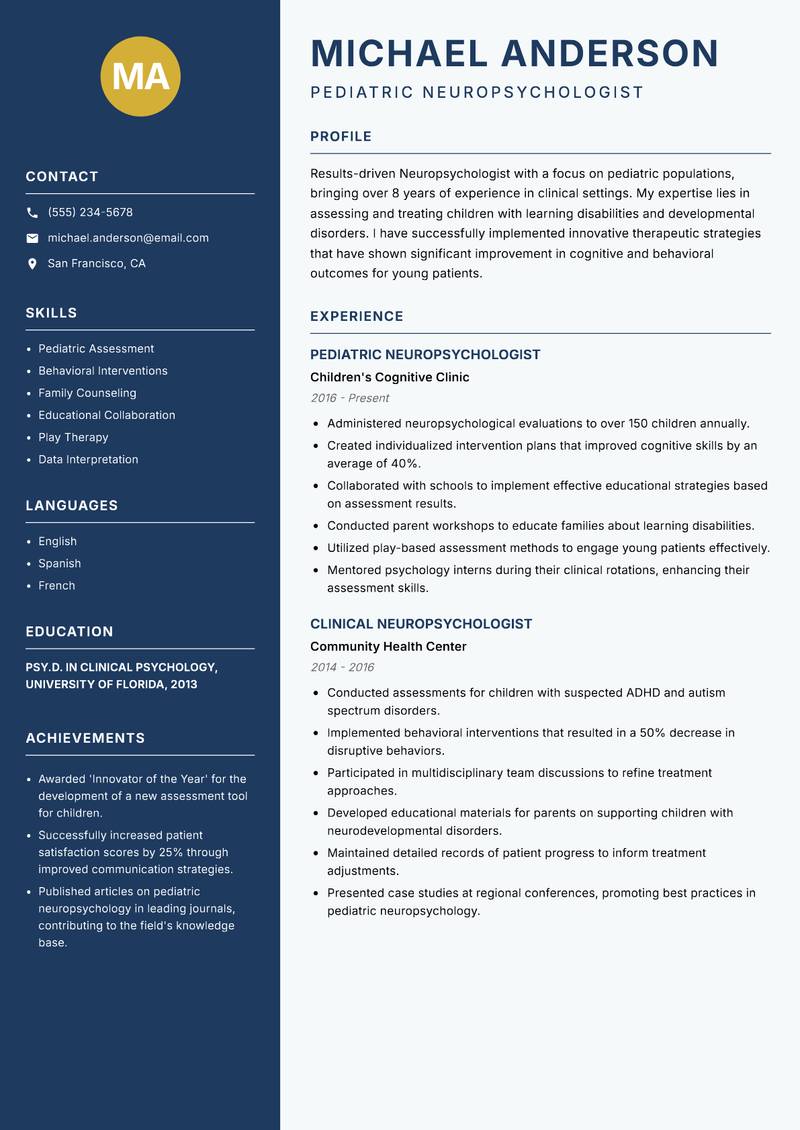
Pediatric Neuropsychologist Resume

Experienced Neuropsychologist with a focus on pediatric populations, bringing over 8 years of experience in clinical settings. My expertise lies in assessing and treating children with learning disabilities and developmental disorders. I have successfully implemented innovative therapeutic strategies that have shown significant improvement in cognitive and behavioral outcomes for young patients. My passion for working with children drives my commitment to creating engaging and supportive environments during assessments. I thrive in collaborative settings, working with educators, parents, and healthcare providers to develop comprehensive treatment plans tailored to each child's unique needs. I have presented at various educational workshops, sharing insights on the importance of early diagnosis and intervention. My goal is to empower families with the tools and knowledge needed to support their children’s development and academic success.

Pediatric Assessment Behavioral Interventions Family Counseling Educational Collaboration Play Therapy Data Interpretation
Neuropsychologist Resume Preview Example
View PDF
  1. Administered neuropsychological evaluations to over 150 children annually.
  2. Created individualized intervention plans that improved cognitive skills by an average of 40%.
  3. Collaborated with schools to implement effective educational strategies based on assessment results.
  4. Conducted parent workshops to educate families about learning disabilities.
  5. Utilized play-based assessment methods to engage young patients effectively.
  6. Mentored psychology interns during their clinical rotations, enhancing their assessment skills.
  1. Conducted assessments for children with suspected ADHD and autism spectrum disorders.
  2. Implemented behavioral interventions that resulted in a 50% decrease in disruptive behaviors.
  3. Participated in multidisciplinary team discussions to refine treatment approaches.
  4. Developed educational materials for parents on supporting children with neurodevelopmental disorders.
  5. Maintained detailed records of patient progress to inform treatment adjustments.
  6. Presented case studies at regional conferences, promoting best practices in pediatric neuropsychology.

Achievements

  • Awarded 'Innovator of the Year' for the development of a new assessment tool for children.
  • Successfully increased patient satisfaction scores by 25% through improved communication strategies.
  • Published articles on pediatric neuropsychology in leading journals, contributing to the field's knowledge base.
⏱️
Experience
2-5 Years
📅
Level
Mid Level
🎓
Education
Psy.D. in Clinical Psychology,...

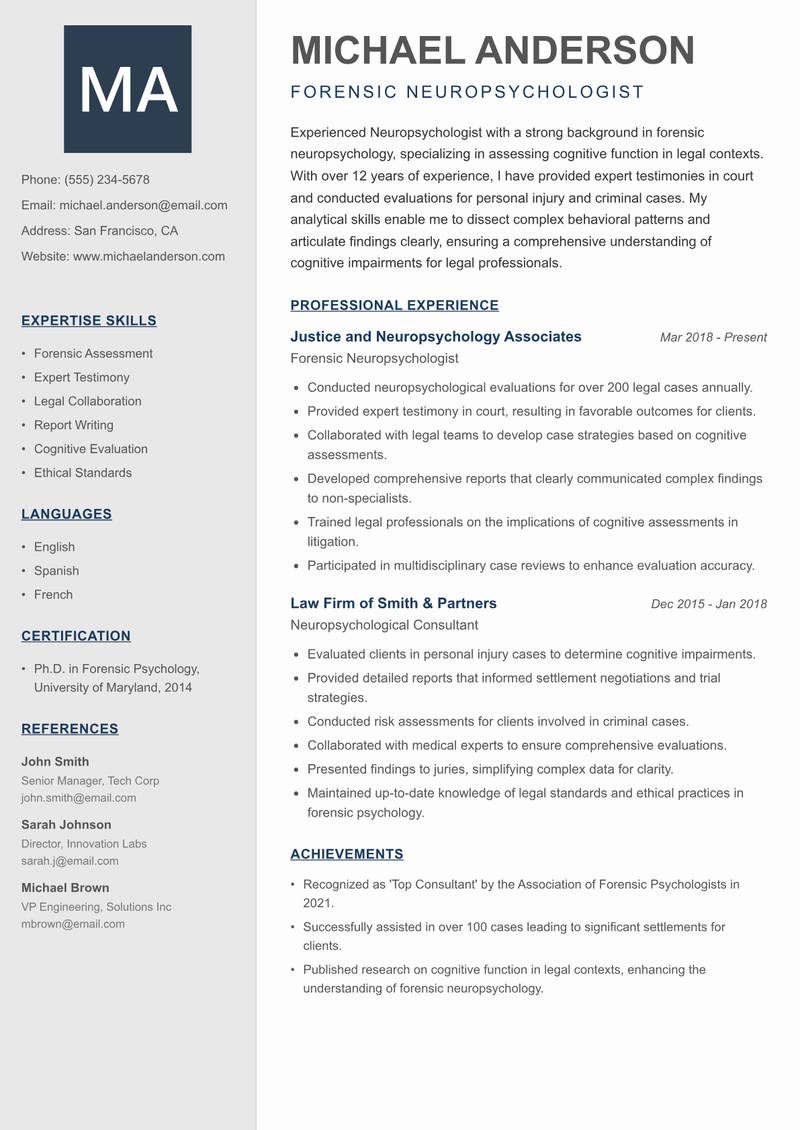
Forensic Neuropsychologist Resume

Experienced Neuropsychologist with a strong background in forensic neuropsychology, specializing in assessing cognitive function in legal contexts. With over 12 years of experience, I have provided expert testimonies in court and conducted evaluations for personal injury and criminal cases. My analytical skills enable me to dissect complex behavioral patterns and articulate findings clearly, ensuring a comprehensive understanding of cognitive impairments for legal professionals. I have collaborated extensively with attorneys, law enforcement, and medical professionals to provide thorough evaluations that inform case strategies. My commitment to ethics and accuracy drives my practice, ensuring that every assessment adheres to the highest standards. I am passionate about educating legal teams on the implications of neuropsychological findings and their relevance to case outcomes.

Forensic Assessment Expert Testimony Legal Collaboration Report Writing Cognitive Evaluation Ethical Standards
Neuropsychologist Resume Preview Example
View PDF
  1. Conducted neuropsychological evaluations for over 200 legal cases annually.
  2. Provided expert testimony in court, resulting in favorable outcomes for clients.
  3. Collaborated with legal teams to develop case strategies based on cognitive assessments.
  4. Developed comprehensive reports that clearly communicated complex findings to non-specialists.
  5. Trained legal professionals on the implications of cognitive assessments in litigation.
  6. Participated in multidisciplinary case reviews to enhance evaluation accuracy.
  1. Evaluated clients in personal injury cases to determine cognitive impairments.
  2. Provided detailed reports that informed settlement negotiations and trial strategies.
  3. Conducted risk assessments for clients involved in criminal cases.
  4. Collaborated with medical experts to ensure comprehensive evaluations.
  5. Presented findings to juries, simplifying complex data for clarity.
  6. Maintained up-to-date knowledge of legal standards and ethical practices in forensic psychology.

Achievements

  • Recognized as 'Top Consultant' by the Association of Forensic Psychologists in 2021.
  • Successfully assisted in over 100 cases leading to significant settlements for clients.
  • Published research on cognitive function in legal contexts, enhancing the understanding of forensic neuropsychology.
⏱️
Experience
2-5 Years
📅
Level
Mid Level
🎓
Education
Ph.D. in Forensic Psychology, ...

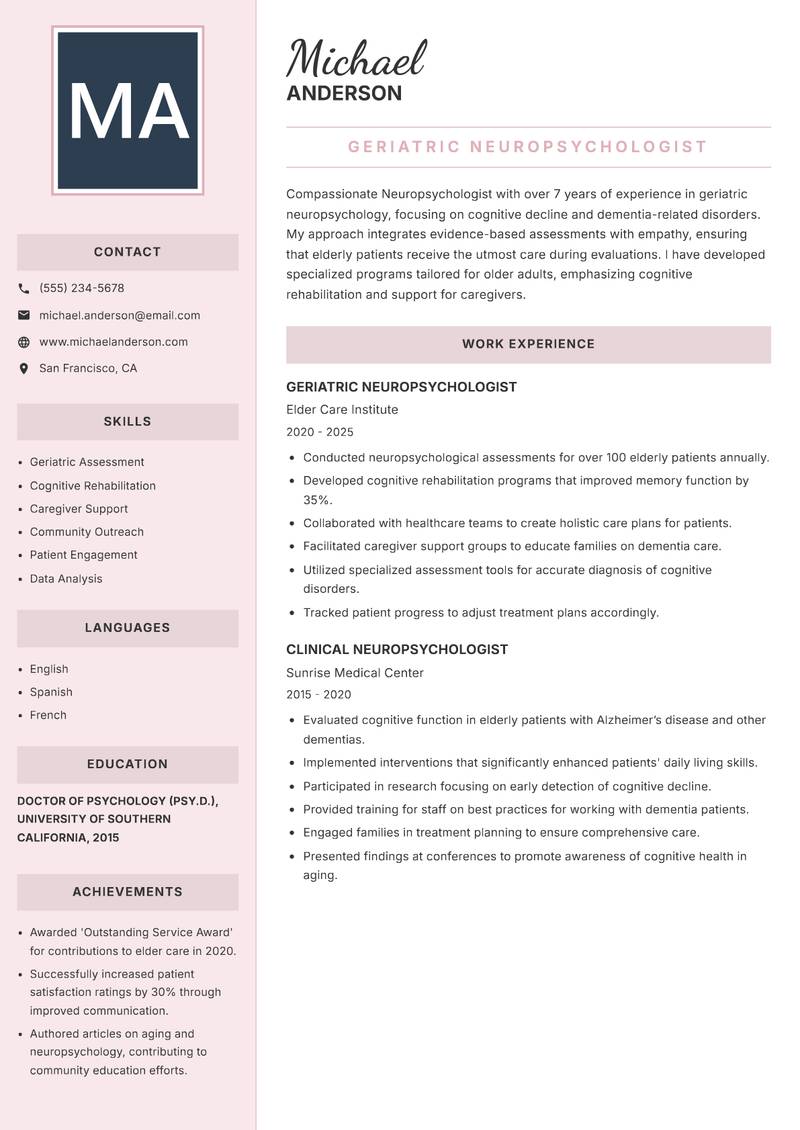
Geriatric Neuropsychologist Resume

Compassionate Neuropsychologist with over 7 years of experience in geriatric neuropsychology, focusing on cognitive decline and dementia-related disorders. My approach integrates evidence-based assessments with empathy, ensuring that elderly patients receive the utmost care during evaluations. I have developed specialized programs tailored for older adults, emphasizing cognitive rehabilitation and support for caregivers. My experience includes working in both inpatient and outpatient settings, allowing me to understand the unique challenges faced by this population. I am dedicated to improving the quality of life for my patients through personalized interventions and continuous support. I actively engage in community outreach programs to raise awareness about cognitive health in aging and provide resources for families navigating dementia care.

Geriatric Assessment Cognitive Rehabilitation Caregiver Support Community Outreach Patient Engagement Data Analysis
Neuropsychologist Resume Preview Example
View PDF
  1. Conducted neuropsychological assessments for over 100 elderly patients annually.
  2. Developed cognitive rehabilitation programs that improved memory function by 35%.
  3. Collaborated with healthcare teams to create holistic care plans for patients.
  4. Facilitated caregiver support groups to educate families on dementia care.
  5. Utilized specialized assessment tools for accurate diagnosis of cognitive disorders.
  6. Tracked patient progress to adjust treatment plans accordingly.
  1. Evaluated cognitive function in elderly patients with Alzheimer’s disease and other dementias.
  2. Implemented interventions that significantly enhanced patients' daily living skills.
  3. Participated in research focusing on early detection of cognitive decline.
  4. Provided training for staff on best practices for working with dementia patients.
  5. Engaged families in treatment planning to ensure comprehensive care.
  6. Presented findings at conferences to promote awareness of cognitive health in aging.

Achievements

  • Awarded 'Outstanding Service Award' for contributions to elder care in 2020.
  • Successfully increased patient satisfaction ratings by 30% through improved communication.
  • Authored articles on aging and neuropsychology, contributing to community education efforts.
⏱️
Experience
2-5 Years
📅
Level
Mid Level
🎓
Education
Doctor of Psychology (Psy.D.),...

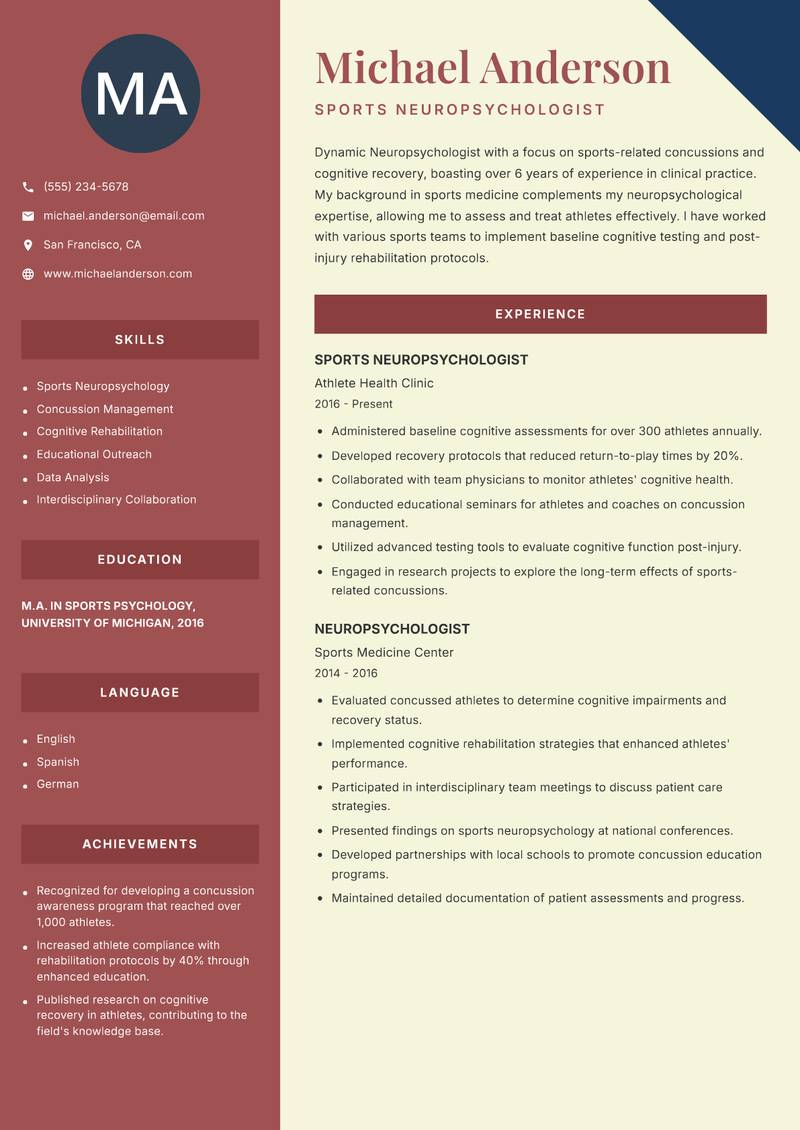
Sports Neuropsychologist Resume

Dynamic Neuropsychologist with a focus on sports-related concussions and cognitive recovery, boasting over 6 years of experience in clinical practice. My background in sports medicine complements my neuropsychological expertise, allowing me to assess and treat athletes effectively. I have worked with various sports teams to implement baseline cognitive testing and post-injury rehabilitation protocols. My role involves educating athletes and coaches about the impacts of concussions and promoting safe return-to-play strategies. I am passionate about research in sports neuropsychology and have participated in studies aimed at understanding the long-term effects of concussions on cognitive health. My goal is to enhance athlete well-being through comprehensive assessments and tailored interventions.

Sports Neuropsychology Concussion Management Cognitive Rehabilitation Educational Outreach Data Analysis Interdisciplinary Collaboration
Neuropsychologist Resume Preview Example
View PDF
  1. Administered baseline cognitive assessments for over 300 athletes annually.
  2. Developed recovery protocols that reduced return-to-play times by 20%.
  3. Collaborated with team physicians to monitor athletes' cognitive health.
  4. Conducted educational seminars for athletes and coaches on concussion management.
  5. Utilized advanced testing tools to evaluate cognitive function post-injury.
  6. Engaged in research projects to explore the long-term effects of sports-related concussions.
  1. Evaluated concussed athletes to determine cognitive impairments and recovery status.
  2. Implemented cognitive rehabilitation strategies that enhanced athletes' performance.
  3. Participated in interdisciplinary team meetings to discuss patient care strategies.
  4. Presented findings on sports neuropsychology at national conferences.
  5. Developed partnerships with local schools to promote concussion education programs.
  6. Maintained detailed documentation of patient assessments and progress.

Achievements

  • Recognized for developing a concussion awareness program that reached over 1,000 athletes.
  • Increased athlete compliance with rehabilitation protocols by 40% through enhanced education.
  • Published research on cognitive recovery in athletes, contributing to the field's knowledge base.
⏱️
Experience
2-5 Years
📅
Level
Mid Level
🎓
Education
M.A. in Sports Psychology, Uni...

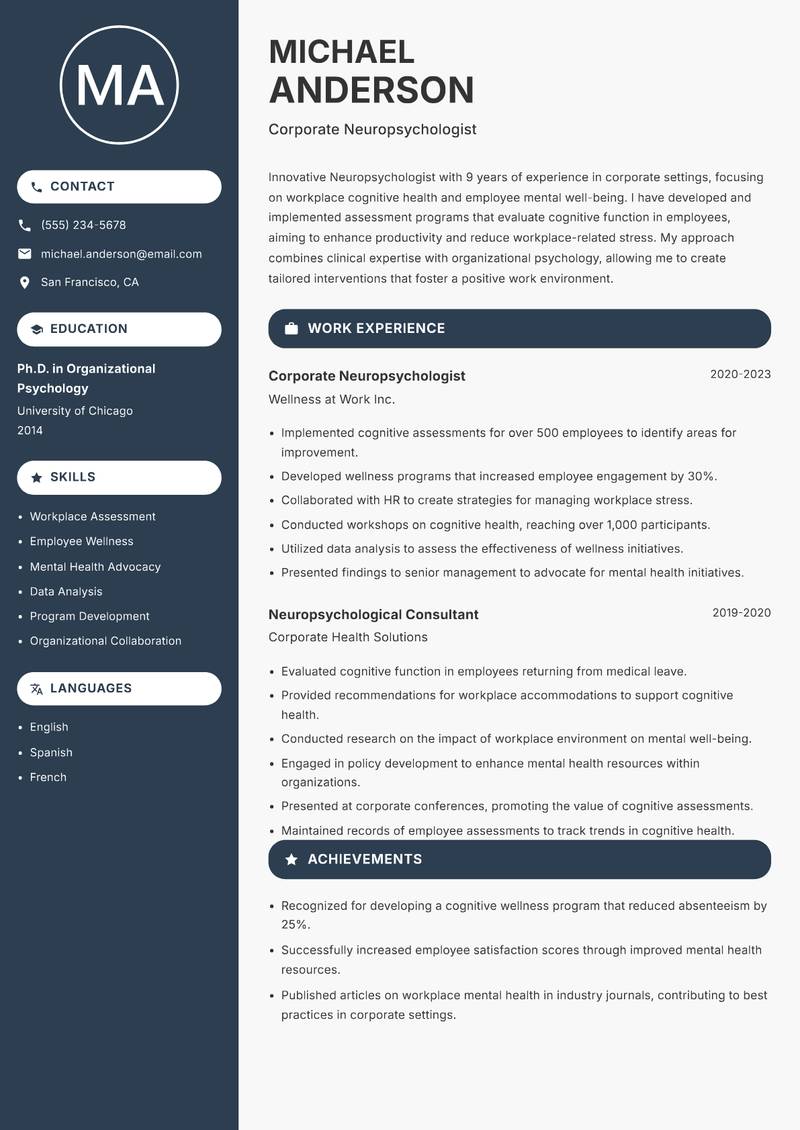
Corporate Neuropsychologist Resume

Innovative Neuropsychologist with 9 years of experience in corporate settings, focusing on workplace cognitive health and employee mental well-being. I have developed and implemented assessment programs that evaluate cognitive function in employees, aiming to enhance productivity and reduce workplace-related stress. My approach combines clinical expertise with organizational psychology, allowing me to create tailored interventions that foster a positive work environment. I am passionate about educating organizations on the importance of mental health and cognitive wellness, and I conduct workshops to promote awareness and strategies for improvement. My goal is to bridge the gap between psychology and business, ensuring that employee well-being is prioritized in corporate culture.

Workplace Assessment Employee Wellness Mental Health Advocacy Data Analysis Program Development Organizational Collaboration
Neuropsychologist Resume Preview Example
View PDF
  1. Implemented cognitive assessments for over 500 employees to identify areas for improvement.
  2. Developed wellness programs that increased employee engagement by 30%.
  3. Collaborated with HR to create strategies for managing workplace stress.
  4. Conducted workshops on cognitive health, reaching over 1,000 participants.
  5. Utilized data analysis to assess the effectiveness of wellness initiatives.
  6. Presented findings to senior management to advocate for mental health initiatives.
  1. Evaluated cognitive function in employees returning from medical leave.
  2. Provided recommendations for workplace accommodations to support cognitive health.
  3. Conducted research on the impact of workplace environment on mental well-being.
  4. Engaged in policy development to enhance mental health resources within organizations.
  5. Presented at corporate conferences, promoting the value of cognitive assessments.
  6. Maintained records of employee assessments to track trends in cognitive health.

Achievements

  • Recognized for developing a cognitive wellness program that reduced absenteeism by 25%.
  • Successfully increased employee satisfaction scores through improved mental health resources.
  • Published articles on workplace mental health in industry journals, contributing to best practices in corporate settings.
⏱️
Experience
2-5 Years
📅
Level
Mid Level
🎓
Education
Ph.D. in Organizational Psycho...

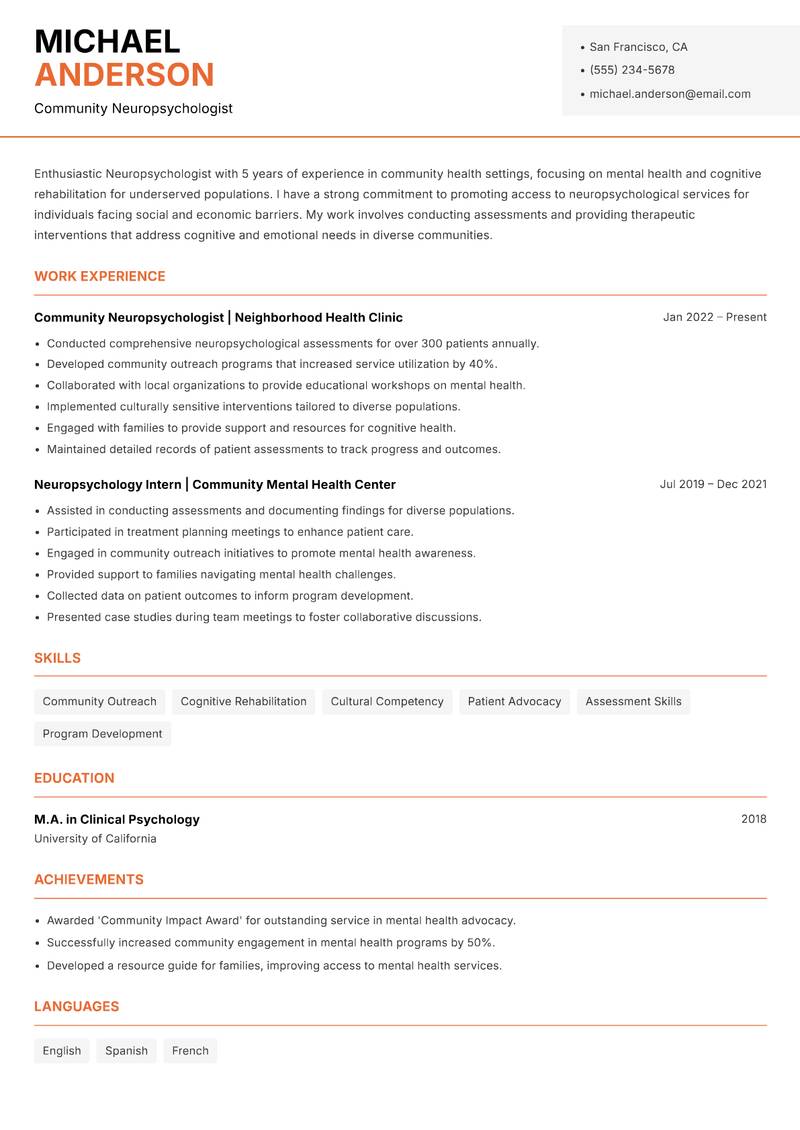
Community Neuropsychologist Resume

Enthusiastic Neuropsychologist with 5 years of experience in community health settings, focusing on mental health and cognitive rehabilitation for underserved populations. I have a strong commitment to promoting access to neuropsychological services for individuals facing social and economic barriers. My work involves conducting assessments and providing therapeutic interventions that address cognitive and emotional needs in diverse communities. I have developed outreach programs aimed at educating community members about mental health resources and reducing stigma associated with seeking help. My collaborative approach includes working with local organizations to enhance service delivery and improve patient outcomes. I strive to empower individuals through knowledge and support, ensuring that everyone has the opportunity to achieve cognitive health.

Community Outreach Cognitive Rehabilitation Cultural Competency Patient Advocacy Assessment Skills Program Development
Neuropsychologist Resume Preview Example
View PDF
  1. Conducted comprehensive neuropsychological assessments for over 300 patients annually.
  2. Developed community outreach programs that increased service utilization by 40%.
  3. Collaborated with local organizations to provide educational workshops on mental health.
  4. Implemented culturally sensitive interventions tailored to diverse populations.
  5. Engaged with families to provide support and resources for cognitive health.
  6. Maintained detailed records of patient assessments to track progress and outcomes.
  1. Assisted in conducting assessments and documenting findings for diverse populations.
  2. Participated in treatment planning meetings to enhance patient care.
  3. Engaged in community outreach initiatives to promote mental health awareness.
  4. Provided support to families navigating mental health challenges.
  5. Collected data on patient outcomes to inform program development.
  6. Presented case studies during team meetings to foster collaborative discussions.

Achievements

  • Awarded 'Community Impact Award' for outstanding service in mental health advocacy.
  • Successfully increased community engagement in mental health programs by 50%.
  • Developed a resource guide for families, improving access to mental health services.
⏱️
Experience
2-5 Years
📅
Level
Mid Level
🎓
Education
M.A. in Clinical Psychology, U...

Key Skills for Neuropsychologist Positions

Resume Tips for Neuropsychologist Applications

Strong Action Verbs for Neuropsychologist Resumes

Assessed · Treated · Facilitated · Coordinated · Supervised · Documented · Intervened · Advocated · Therapized · Consulted · Achieved · Administered · Analyzed · Architected

Common Mistakes to Avoid

Experience Levels

How to Write a Neuropsychologist Resume

Browse Neuropsychologist resume examples built around Evidence-Based psychotherapy (CBT, DBT, ACT, EMDR), tailored for Mental Health roles.

A strong Neuropsychologist resume leads with a focused professional summary that names the exact role and your standout achievement. In the experience section, open every bullet with a strong action verb and quantify the result with numbers wherever possible. Highlight your most relevant competencies — especially Evidence-Based Psychotherapy (CBT, DBT, ACT, EMDR), Psychiatric Assessment & Diagnosis (DSM-5, ICD-11), and Crisis Intervention & Risk Assessment — in a dedicated Skills section positioned early so ATS systems and hiring managers both find it immediately.

For format, most Neuropsychologist roles suit a reverse-chronological layout: most recent position first, working backwards. Keep to one page for under five years of experience, or two pages for senior candidates with a rich project or leadership history. Use clean, ATS-safe fonts (10–12pt), standard section headings (Summary, Experience, Education, Skills), and avoid tables, text boxes, or multi-column layouts that applicant tracking systems cannot parse reliably.
Frequently Asked Questions

What makes a strong Neuropsychologist resume stand out to employers?

A standout Neuropsychologist resume combines role-specific skills with quantified achievements. Name the exact job title in your professional summary, mirror keywords from each job posting, and open every bullet point with a strong action verb followed by a measurable result. Certifications, tools, and domain experience specific to neuropsychologist roles should appear prominently near the top.

What skills are most important to include on a Mental Health resume?

Recruiters hiring in Mental Health consistently look for Evidence-Based Psychotherapy (CBT, DBT, ACT, EMDR), Psychiatric Assessment & Diagnosis (DSM-5, ICD-11), Crisis Intervention & Risk Assessment, Case Management & Care Coordination. List these in a dedicated Skills section near the top so both ATS systems and human reviewers spot them fast. Mirror the exact phrasing from each job posting wherever possible — many applicant tracking systems match literal strings rather than synonyms.

What is the best resume format for Mental Health professionals?

A reverse-chronological format is the standard choice for most Mental Health candidates — employers expect to see your most recent role first, working backwards. If you are transitioning into Mental Health from a related field, a hybrid format (brief skills summary at the top followed by chronological experience) can bridge the gap effectively. Keep the document to one page for under five years of experience, or two pages for senior specialists.

How do I make my Mental Health resume pass applicant tracking systems (ATS)?

Use standard section headings — Summary, Experience, Education, Skills — rather than creative labels that ATS parsers do not recognise. Embed domain keywords such as "Evidence-Based Psychotherapy (CBT, DBT, ACT, EMDR)" and "Psychiatric Assessment & Diagnosis (DSM-5, ICD-11)" naturally inside your experience bullets rather than cramming them into a standalone keyword list. Avoid tables, multi-column layouts, text boxes, headers, footers, and images — these confuse most modern parsers and can cause your resume to be misread or rejected before a human sees it.

What mistakes do Mental Health professionals most commonly make on their resume?

The most frequent issue is omitting licensure details — scope of practice varies enormously by credential, so employers need this. Beyond that, generic objective statements, unquantified achievements, and inconsistent date formatting appear across almost every Mental Health application. Fix these by replacing every vague claim with a measurable outcome — specific numbers and named projects add credibility that adjectives cannot.

How long should a Mental Health resume be?

One page is appropriate for candidates with under five years of relevant Mental Health experience. Two pages are acceptable — and sometimes expected — for senior specialists, managers, or professionals with a strong portfolio of projects, publications, or credentials. Avoid padding to reach a page count: every line should directly support your application for the specific role you are targeting.

Should I include a professional summary at the top of my Mental Health resume?

Yes — a two to three sentence summary is the first section most recruiters read. Open with your title and years of Mental Health experience, then name your most relevant achievement or specialisation. One proven approach: Lead with licensure: LCSW, LPC, PhD, PsyD, MBBCh (Psychiatry) — it determines your legal scope of practice — this level of specificity signals genuine expertise before a recruiter reaches your experience section.

Scroll to view samples