Soil Microbiologist Resume

These Soil Microbiologist resume samples are designed to help you write a resume that gets noticed by hiring managers and passes applicant tracking systems (ATS) in Agricultural Sciences. Each example shows real formatting, section structure, and language you can adapt to your own background. When writing your own Soil Microbiologist resume, focus on highlighting crop physiology and agronomy, soil science and nutrient management and plant genetics and breeding. Recruiters scan for these qualifications first, so they should appear early in your summary and experience sections. Use strong action verbs such as "researched", "analyzed", "developed", "experimented" to describe your achievements, and quantify your impact wherever possible — percentages, dollar amounts, or time saved make your resume more convincing. A common mistake to avoid: writing a generic objective statement instead of a targeted soil microbiologist professional summary. Tailor your resume to each Soil Microbiologist position you apply for rather than using one generic version.

Soil Microbiologist Resume Template
View PDF
0.0 (0 ratings)

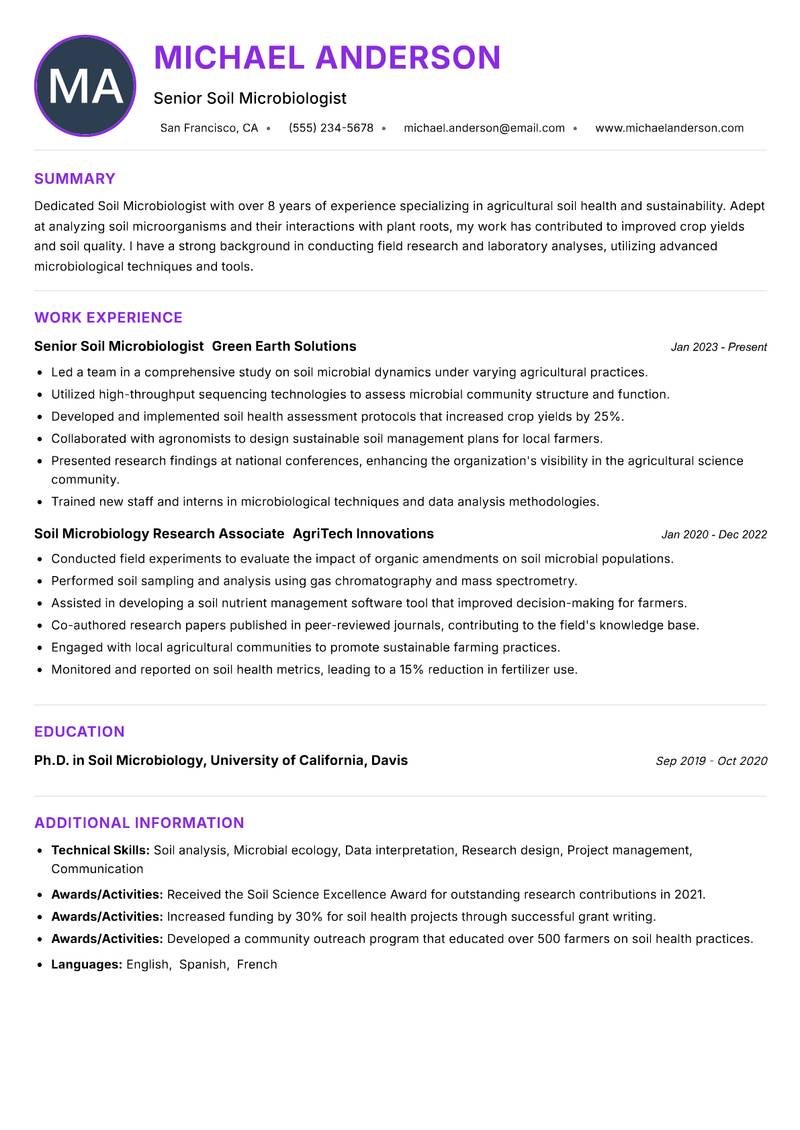
Senior Soil Microbiologist Resume

Dedicated Soil Microbiologist with over 8 years of experience specializing in agricultural soil health and sustainability. Adept at analyzing soil microorganisms and their interactions with plant roots, my work has contributed to improved crop yields and soil quality. I have a strong background in conducting field research and laboratory analyses, utilizing advanced microbiological techniques and tools. My expertise extends to developing innovative solutions for soil remediation and nutrient management to promote sustainable farming practices. I have successfully collaborated with interdisciplinary teams to implement research findings into practical applications, ensuring that agricultural practices are both productive and environmentally responsible. My passion for environmental science drives my commitment to advancing soil microbiology, and I am eager to contribute to projects that seek to enhance soil ecosystems and support food security.

Soil analysis Microbial ecology Data interpretation Research design Project management Communication
Soil Microbiologist Resume Preview Example
View PDF
  1. Led a team in a comprehensive study on soil microbial dynamics under varying agricultural practices.
  2. Utilized high-throughput sequencing technologies to assess microbial community structure and function.
  3. Developed and implemented soil health assessment protocols that increased crop yields by 25%.
  4. Collaborated with agronomists to design sustainable soil management plans for local farmers.
  5. Presented research findings at national conferences, enhancing the organization's visibility in the agricultural science community.
  6. Trained new staff and interns in microbiological techniques and data analysis methodologies.
  1. Conducted field experiments to evaluate the impact of organic amendments on soil microbial populations.
  2. Performed soil sampling and analysis using gas chromatography and mass spectrometry.
  3. Assisted in developing a soil nutrient management software tool that improved decision-making for farmers.
  4. Co-authored research papers published in peer-reviewed journals, contributing to the field's knowledge base.
  5. Engaged with local agricultural communities to promote sustainable farming practices.
  6. Monitored and reported on soil health metrics, leading to a 15% reduction in fertilizer use.

Achievements

  • Received the Soil Science Excellence Award for outstanding research contributions in 2021.
  • Increased funding by 30% for soil health projects through successful grant writing.
  • Developed a community outreach program that educated over 500 farmers on soil health practices.
⏱️
Experience
2-5 Years
📅
Level
Mid Level
🎓
Education
Ph.D. in Soil Microbiology, Un...

Soil Microbiologist Resume

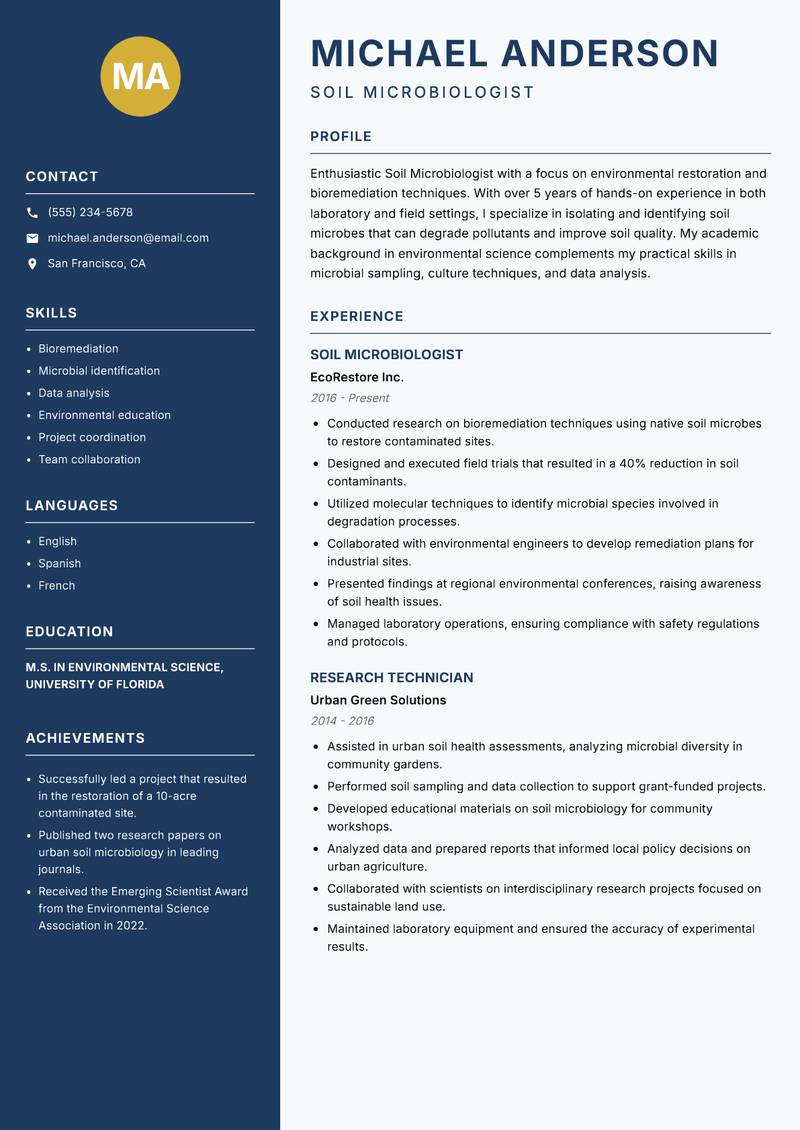
Enthusiastic Soil Microbiologist with a focus on environmental restoration and bioremediation techniques. With over 5 years of hands-on experience in both laboratory and field settings, I specialize in isolating and identifying soil microbes that can degrade pollutants and improve soil quality. My academic background in environmental science complements my practical skills in microbial sampling, culture techniques, and data analysis. I have a strong commitment to contributing to sustainability initiatives, particularly in urban agriculture and contaminated land rehabilitation. Through my work, I have developed a keen understanding of the essential role that soil microorganisms play in ecosystem health. I thrive in collaborative environments and am passionate about educating stakeholders on the importance of soil microbiology in environmental conservation.

Bioremediation Microbial identification Data analysis Environmental education Project coordination Team collaboration
Soil Microbiologist Resume Preview Example
View PDF
  1. Conducted research on bioremediation techniques using native soil microbes to restore contaminated sites.
  2. Designed and executed field trials that resulted in a 40% reduction in soil contaminants.
  3. Utilized molecular techniques to identify microbial species involved in degradation processes.
  4. Collaborated with environmental engineers to develop remediation plans for industrial sites.
  5. Presented findings at regional environmental conferences, raising awareness of soil health issues.
  6. Managed laboratory operations, ensuring compliance with safety regulations and protocols.
  1. Assisted in urban soil health assessments, analyzing microbial diversity in community gardens.
  2. Performed soil sampling and data collection to support grant-funded projects.
  3. Developed educational materials on soil microbiology for community workshops.
  4. Analyzed data and prepared reports that informed local policy decisions on urban agriculture.
  5. Collaborated with scientists on interdisciplinary research projects focused on sustainable land use.
  6. Maintained laboratory equipment and ensured the accuracy of experimental results.

Achievements

  • Successfully led a project that resulted in the restoration of a 10-acre contaminated site.
  • Published two research papers on urban soil microbiology in leading journals.
  • Received the Emerging Scientist Award from the Environmental Science Association in 2022.
⏱️
Experience
2-5 Years
📅
Level
Mid Level
🎓
Education
M.S. in Environmental Science,...

Lead Soil Microbiologist Resume

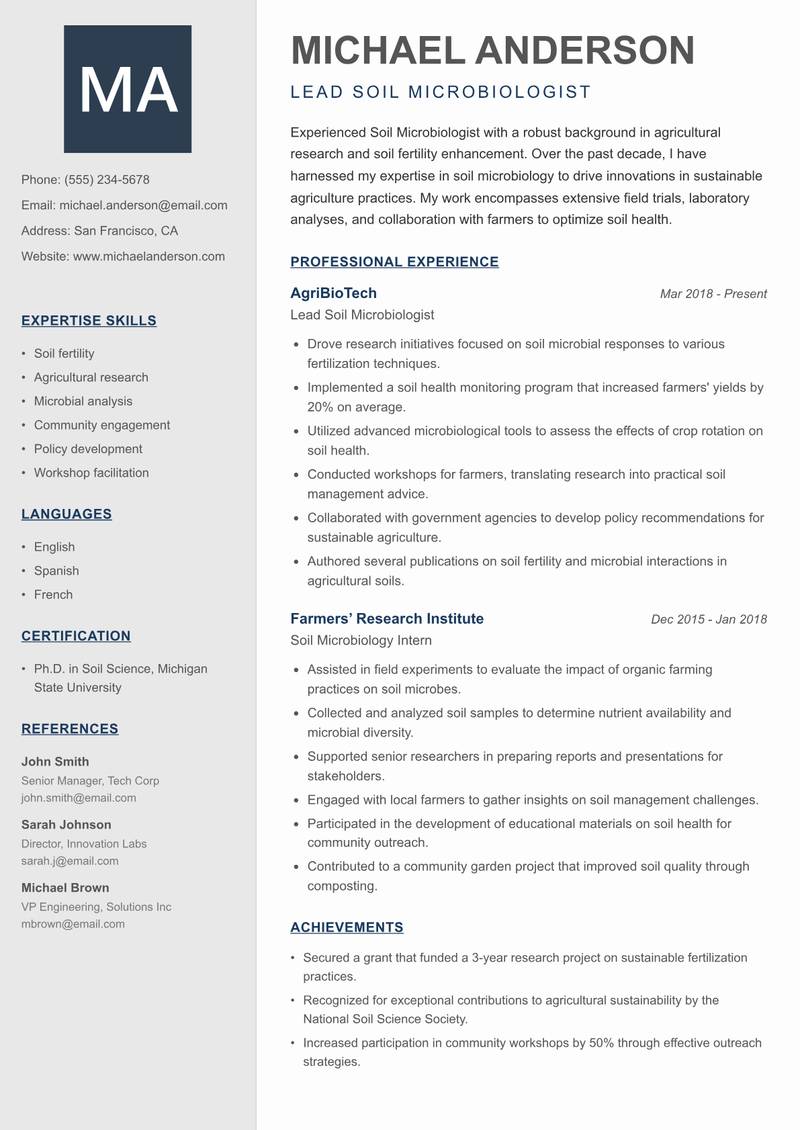
Experienced Soil Microbiologist with a robust background in agricultural research and soil fertility enhancement. Over the past decade, I have harnessed my expertise in soil microbiology to drive innovations in sustainable agriculture practices. My work encompasses extensive field trials, laboratory analyses, and collaboration with farmers to optimize soil health. I specialize in studying the interactions between soil microorganisms and nutrients, which has led to the development of improved fertilizer application strategies that maximize crop productivity while minimizing environmental impact. I am passionate about translating complex scientific concepts into actionable strategies for farmers, fostering stronger connections between science and agricultural practices. I am committed to advancing the field of soil microbiology through research, education, and community engagement.

Soil fertility Agricultural research Microbial analysis Community engagement Policy development Workshop facilitation
Soil Microbiologist Resume Preview Example
View PDF
  1. Drove research initiatives focused on soil microbial responses to various fertilization techniques.
  2. Implemented a soil health monitoring program that increased farmers' yields by 20% on average.
  3. Utilized advanced microbiological tools to assess the effects of crop rotation on soil health.
  4. Conducted workshops for farmers, translating research into practical soil management advice.
  5. Collaborated with government agencies to develop policy recommendations for sustainable agriculture.
  6. Authored several publications on soil fertility and microbial interactions in agricultural soils.
  1. Assisted in field experiments to evaluate the impact of organic farming practices on soil microbes.
  2. Collected and analyzed soil samples to determine nutrient availability and microbial diversity.
  3. Supported senior researchers in preparing reports and presentations for stakeholders.
  4. Engaged with local farmers to gather insights on soil management challenges.
  5. Participated in the development of educational materials on soil health for community outreach.
  6. Contributed to a community garden project that improved soil quality through composting.

Achievements

  • Secured a grant that funded a 3-year research project on sustainable fertilization practices.
  • Recognized for exceptional contributions to agricultural sustainability by the National Soil Science Society.
  • Increased participation in community workshops by 50% through effective outreach strategies.
⏱️
Experience
2-5 Years
📅
Level
Mid Level
🎓
Education
Ph.D. in Soil Science, Michiga...

Climate Soil Microbiologist Resume

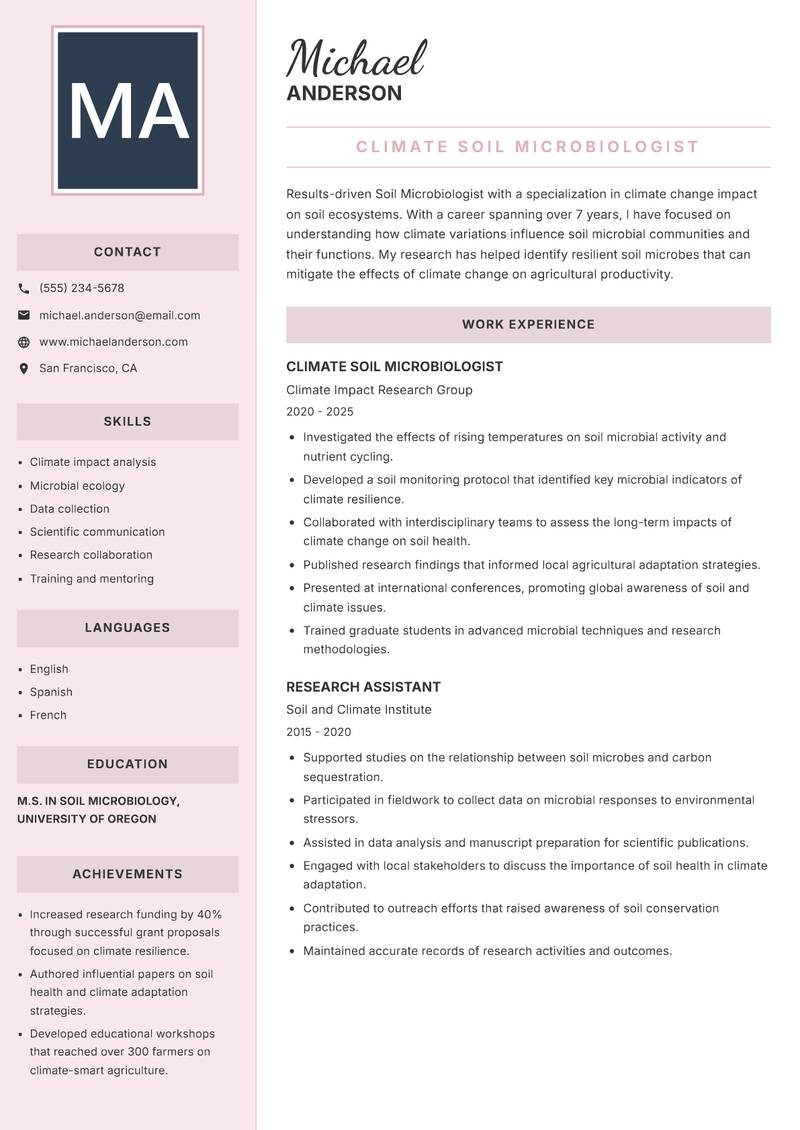
Experienced Soil Microbiologist with a specialization in climate change impact on soil ecosystems. With a career spanning over 7 years, I have focused on understanding how climate variations influence soil microbial communities and their functions. My research has helped identify resilient soil microbes that can mitigate the effects of climate change on agricultural productivity. I leverage advanced molecular techniques to conduct detailed microbial community analyses and work closely with climate scientists to develop integrated solutions for sustainable land use. My ability to communicate scientific findings to diverse audiences has enhanced collaboration between researchers, policymakers, and farmers. I am dedicated to fostering practices that protect soil health and contribute to climate resilience in agriculture.

Climate impact analysis Microbial ecology Data collection Scientific communication Research collaboration Training and mentoring
Soil Microbiologist Resume Preview Example
View PDF
  1. Investigated the effects of rising temperatures on soil microbial activity and nutrient cycling.
  2. Developed a soil monitoring protocol that identified key microbial indicators of climate resilience.
  3. Collaborated with interdisciplinary teams to assess the long-term impacts of climate change on soil health.
  4. Published research findings that informed local agricultural adaptation strategies.
  5. Presented at international conferences, promoting global awareness of soil and climate issues.
  6. Trained graduate students in advanced microbial techniques and research methodologies.
  1. Supported studies on the relationship between soil microbes and carbon sequestration.
  2. Participated in fieldwork to collect data on microbial responses to environmental stressors.
  3. Assisted in data analysis and manuscript preparation for scientific publications.
  4. Engaged with local stakeholders to discuss the importance of soil health in climate adaptation.
  5. Contributed to outreach efforts that raised awareness of soil conservation practices.
  6. Maintained accurate records of research activities and outcomes.

Achievements

  • Increased research funding by 40% through successful grant proposals focused on climate resilience.
  • Authored influential papers on soil health and climate adaptation strategies.
  • Developed educational workshops that reached over 300 farmers on climate-smart agriculture.
⏱️
Experience
2-5 Years
📅
Level
Mid Level
🎓
Education
M.S. in Soil Microbiology, Uni...

Soil Microbiologist Resume

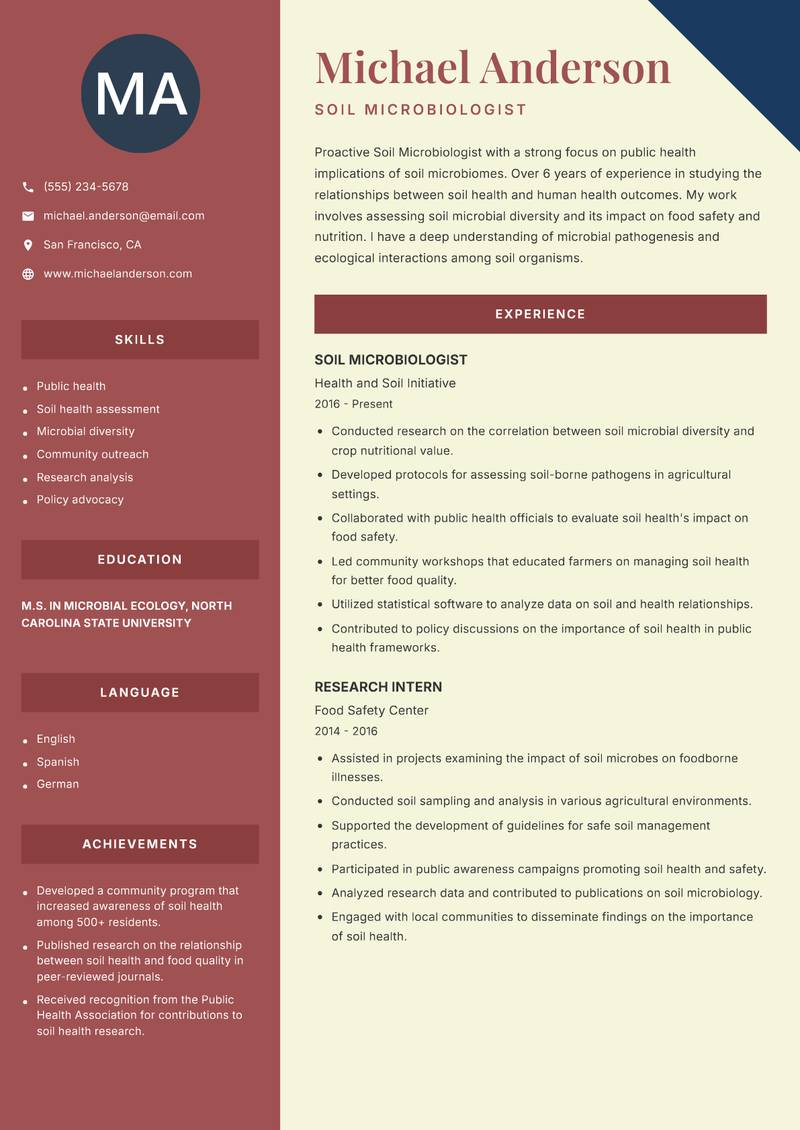
Driven Soil Microbiologist with a strong focus on public health implications of soil microbiomes. Over 6 years of experience in studying the relationships between soil health and human health outcomes. My work involves assessing soil microbial diversity and its impact on food safety and nutrition. I have a deep understanding of microbial pathogenesis and ecological interactions among soil organisms. By collaborating with health professionals and agricultural experts, I aim to bridge the gap between soil science and public health. I am passionate about educating communities about the importance of healthy soils for overall well-being and have developed outreach programs to promote sustainable practices that benefit both soil and human health. My goal is to contribute to integrated health approaches that recognize the vital role of soil microbiomes in food systems.

Public health Soil health assessment Microbial diversity Community outreach Research analysis Policy advocacy
Soil Microbiologist Resume Preview Example
View PDF
  1. Conducted research on the correlation between soil microbial diversity and crop nutritional value.
  2. Developed protocols for assessing soil-borne pathogens in agricultural settings.
  3. Collaborated with public health officials to evaluate soil health's impact on food safety.
  4. Led community workshops that educated farmers on managing soil health for better food quality.
  5. Utilized statistical software to analyze data on soil and health relationships.
  6. Contributed to policy discussions on the importance of soil health in public health frameworks.
  1. Assisted in projects examining the impact of soil microbes on foodborne illnesses.
  2. Conducted soil sampling and analysis in various agricultural environments.
  3. Supported the development of guidelines for safe soil management practices.
  4. Participated in public awareness campaigns promoting soil health and safety.
  5. Analyzed research data and contributed to publications on soil microbiology.
  6. Engaged with local communities to disseminate findings on the importance of soil health.

Achievements

  • Developed a community program that increased awareness of soil health among 500+ residents.
  • Published research on the relationship between soil health and food quality in peer-reviewed journals.
  • Received recognition from the Public Health Association for contributions to soil health research.
⏱️
Experience
2-5 Years
📅
Level
Mid Level
🎓
Education
M.S. in Microbial Ecology, Nor...

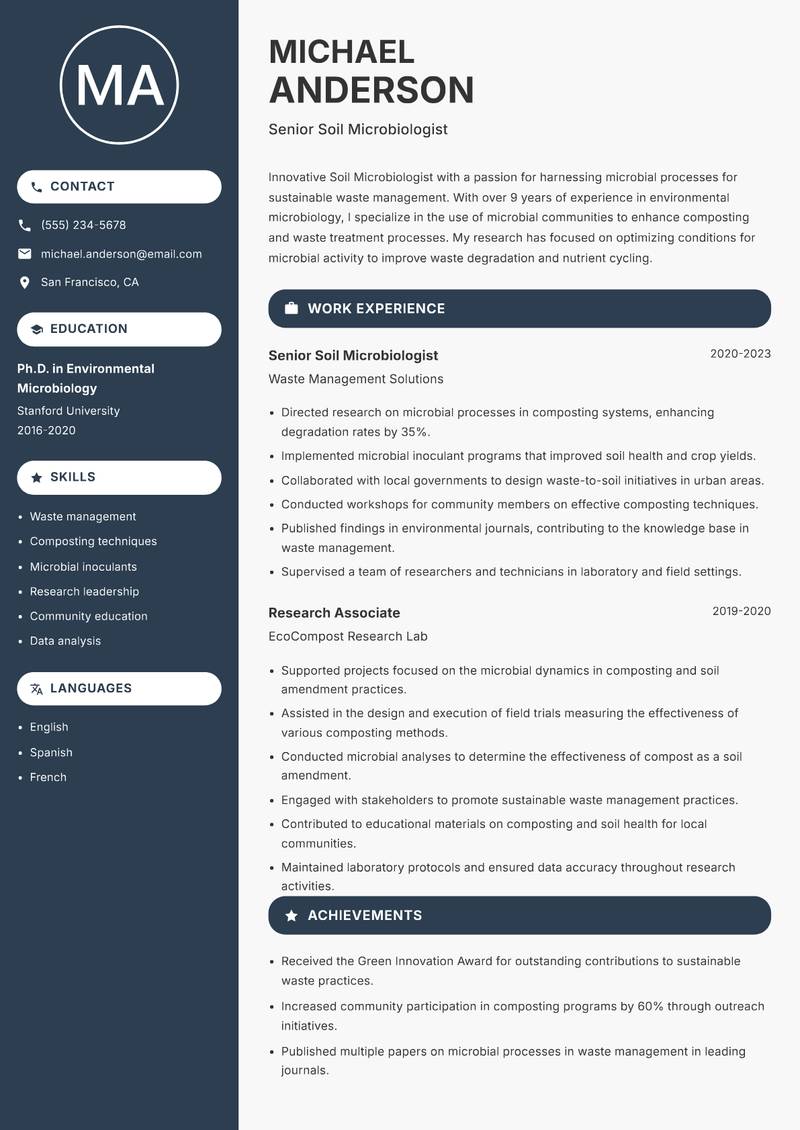
Senior Soil Microbiologist Resume

Innovative Soil Microbiologist with a passion for harnessing microbial processes for sustainable waste management. With over 9 years of experience in environmental microbiology, I specialize in the use of microbial communities to enhance composting and waste treatment processes. My research has focused on optimizing conditions for microbial activity to improve waste degradation and nutrient cycling. I have successfully implemented large-scale composting projects that not only reduce waste but also enrich soil quality. My expertise in microbial inoculants has led to the development of effective products that promote healthy soil ecosystems. I believe in the power of education and have conducted numerous workshops to teach sustainable waste management practices to diverse audiences. My goal is to contribute to a circular economy through innovative soil microbiology applications.

Waste management Composting techniques Microbial inoculants Research leadership Community education Data analysis
Soil Microbiologist Resume Preview Example
View PDF
  1. Directed research on microbial processes in composting systems, enhancing degradation rates by 35%.
  2. Implemented microbial inoculant programs that improved soil health and crop yields.
  3. Collaborated with local governments to design waste-to-soil initiatives in urban areas.
  4. Conducted workshops for community members on effective composting techniques.
  5. Published findings in environmental journals, contributing to the knowledge base in waste management.
  6. Supervised a team of researchers and technicians in laboratory and field settings.
  1. Supported projects focused on the microbial dynamics in composting and soil amendment practices.
  2. Assisted in the design and execution of field trials measuring the effectiveness of various composting methods.
  3. Conducted microbial analyses to determine the effectiveness of compost as a soil amendment.
  4. Engaged with stakeholders to promote sustainable waste management practices.
  5. Contributed to educational materials on composting and soil health for local communities.
  6. Maintained laboratory protocols and ensured data accuracy throughout research activities.

Achievements

  • Received the Green Innovation Award for outstanding contributions to sustainable waste practices.
  • Increased community participation in composting programs by 60% through outreach initiatives.
  • Published multiple papers on microbial processes in waste management in leading journals.
⏱️
Experience
2-5 Years
📅
Level
Mid Level
🎓
Education
Ph.D. in Environmental Microbi...

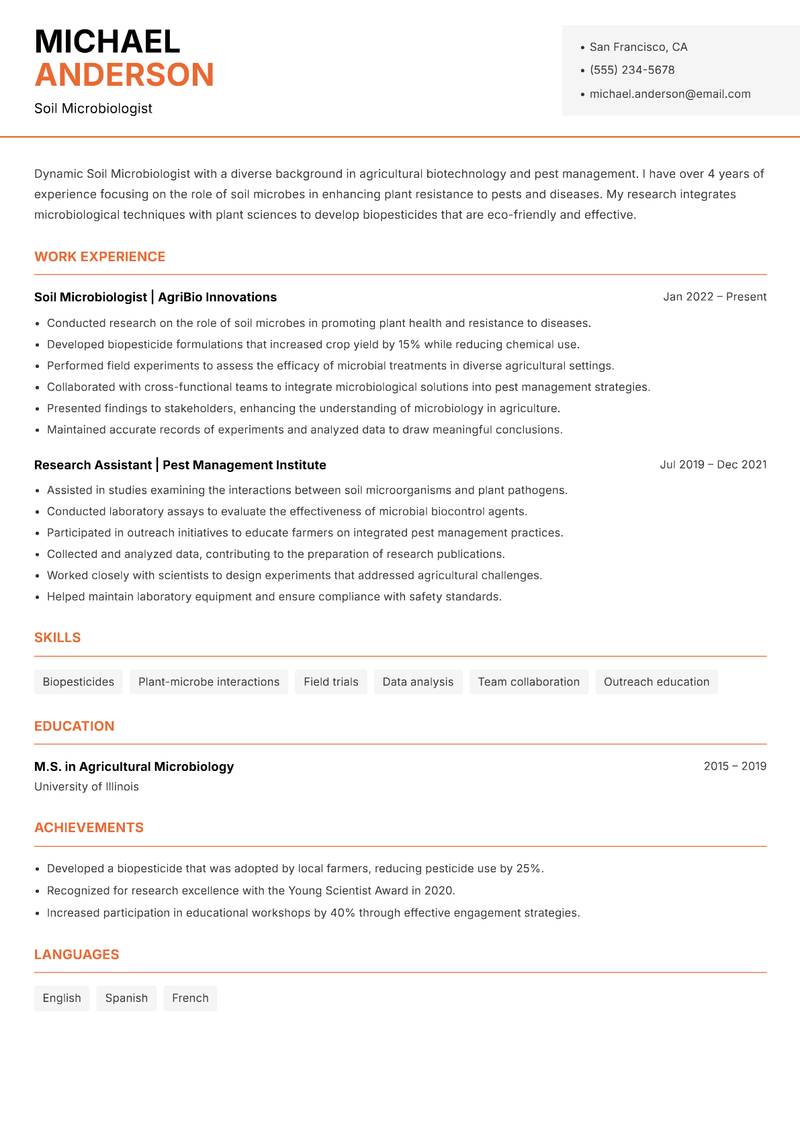
Soil Microbiologist Resume

Dynamic Soil Microbiologist with a diverse background in agricultural biotechnology and pest management. I have over 4 years of experience focusing on the role of soil microbes in enhancing plant resistance to pests and diseases. My research integrates microbiological techniques with plant sciences to develop biopesticides that are eco-friendly and effective. I am skilled in conducting field trials, analyzing microbial interactions with plants, and collaborating with agronomists to create innovative pest management solutions. My passion for sustainable agriculture drives my commitment to finding solutions that benefit both farmers and the environment. I thrive in fast-paced environments where creativity and scientific rigor are essential, and I am eager to contribute to cutting-edge agricultural research initiatives.

Biopesticides Plant-microbe interactions Field trials Data analysis Team collaboration Outreach education
Soil Microbiologist Resume Preview Example
View PDF
  1. Conducted research on the role of soil microbes in promoting plant health and resistance to diseases.
  2. Developed biopesticide formulations that increased crop yield by 15% while reducing chemical use.
  3. Performed field experiments to assess the efficacy of microbial treatments in diverse agricultural settings.
  4. Collaborated with cross-functional teams to integrate microbiological solutions into pest management strategies.
  5. Presented findings to stakeholders, enhancing the understanding of microbiology in agriculture.
  6. Maintained accurate records of experiments and analyzed data to draw meaningful conclusions.
  1. Assisted in studies examining the interactions between soil microorganisms and plant pathogens.
  2. Conducted laboratory assays to evaluate the effectiveness of microbial biocontrol agents.
  3. Participated in outreach initiatives to educate farmers on integrated pest management practices.
  4. Collected and analyzed data, contributing to the preparation of research publications.
  5. Worked closely with scientists to design experiments that addressed agricultural challenges.
  6. Helped maintain laboratory equipment and ensure compliance with safety standards.

Achievements

  • Developed a biopesticide that was adopted by local farmers, reducing pesticide use by 25%.
  • Recognized for research excellence with the Young Scientist Award in 2020.
  • Increased participation in educational workshops by 40% through effective engagement strategies.
⏱️
Experience
2-5 Years
📅
Level
Mid Level
🎓
Education
M.S. in Agricultural Microbiol...

Key Skills for Soil Microbiologist Positions

Resume Tips for Soil Microbiologist Applications

Strong Action Verbs for Soil Microbiologist Resumes

Researched · Analyzed · Developed · Experimented · Evaluated · Validated · Published · Optimized · Investigated · Innovated · Achieved · Administered · Architected · Assessed

Common Mistakes to Avoid

Experience Levels

How to Write a Soil Microbiologist Resume

Browse Soil Microbiologist resume examples built around crop physiology and agronomy, tailored for Agricultural Sciences roles.

A strong Soil Microbiologist resume leads with a focused professional summary that names the exact role and your standout achievement. In the experience section, open every bullet with a strong action verb and quantify the result with numbers wherever possible. Highlight your most relevant competencies — especially Crop physiology and agronomy, Soil science and nutrient management, and Plant genetics and breeding — in a dedicated Skills section positioned early so ATS systems and hiring managers both find it immediately.

For format, most Soil Microbiologist roles suit a reverse-chronological layout: most recent position first, working backwards. Keep to one page for under five years of experience, or two pages for senior candidates with a rich project or leadership history. Use clean, ATS-safe fonts (10–12pt), standard section headings (Summary, Experience, Education, Skills), and avoid tables, text boxes, or multi-column layouts that applicant tracking systems cannot parse reliably.
Frequently Asked Questions

What makes a strong Soil Microbiologist resume stand out to employers?

A standout Soil Microbiologist resume combines role-specific skills with quantified achievements. Name the exact job title in your professional summary, mirror keywords from each job posting, and open every bullet point with a strong action verb followed by a measurable result. Certifications, tools, and domain experience specific to soil microbiologist roles should appear prominently near the top.

What skills are most important to include on a Agricultural Sciences resume?

Recruiters hiring in Agricultural Sciences consistently look for Crop physiology and agronomy, Soil science and nutrient management, Plant genetics and breeding, Agricultural biotechnology techniques. List these in a dedicated Skills section near the top so both ATS systems and human reviewers spot them fast. Mirror the exact phrasing from each job posting wherever possible — many applicant tracking systems match literal strings rather than synonyms.

What is the best resume format for Agricultural Sciences professionals?

A reverse-chronological format is the standard choice for most Agricultural Sciences candidates — employers expect to see your most recent role first, working backwards. If you are transitioning into Agricultural Sciences from a related field, a hybrid format (brief skills summary at the top followed by chronological experience) can bridge the gap effectively. Keep the document to one page for under five years of experience, or two pages for senior specialists.

How do I make my Agricultural Sciences resume pass applicant tracking systems (ATS)?

Use standard section headings — Summary, Experience, Education, Skills — rather than creative labels that ATS parsers do not recognise. Embed domain keywords such as "Crop physiology and agronomy" and "Soil science and nutrient management" naturally inside your experience bullets rather than cramming them into a standalone keyword list. Avoid tables, multi-column layouts, text boxes, headers, footers, and images — these confuse most modern parsers and can cause your resume to be misread or rejected before a human sees it.

What mistakes do Agricultural Sciences professionals most commonly make on their resume?

The most frequent issue is listing academic qualifications without practical research impact. Beyond that, generic objective statements, unquantified achievements, and inconsistent date formatting appear across almost every Agricultural Sciences application. Fix these by replacing every vague claim with a measurable outcome — specific numbers and named projects add credibility that adjectives cannot.

How long should a Agricultural Sciences resume be?

One page is appropriate for candidates with under five years of relevant Agricultural Sciences experience. Two pages are acceptable — and sometimes expected — for senior specialists, managers, or professionals with a strong portfolio of projects, publications, or credentials. Avoid padding to reach a page count: every line should directly support your application for the specific role you are targeting.

Should I include a professional summary at the top of my Agricultural Sciences resume?

Yes — a two to three sentence summary is the first section most recruiters read. Open with your title and years of Agricultural Sciences experience, then name your most relevant achievement or specialisation. One proven approach: Highlight research outcomes such as yield improvement or disease resistance — this level of specificity signals genuine expertise before a recruiter reaches your experience section.

Scroll to view samples