Space Telescope Scientist Resume

These Space Telescope Scientist resume samples are designed to help you write a resume that gets noticed by hiring managers and passes applicant tracking systems (ATS) in Space Sciences. Each example shows real formatting, section structure, and language you can adapt to your own background. When writing your own Space Telescope Scientist resume, focus on highlighting orbital mechanics & mission design, astrophysics & cosmological analysis and satellite design & systems engineering. Recruiters scan for these qualifications first, so they should appear early in your summary and experience sections. Use strong action verbs such as "launched", "modeled", "analyzed", "designed" to describe your achievements, and quantify your impact wherever possible — percentages, dollar amounts, or time saved make your resume more convincing. A common mistake to avoid: writing a generic objective statement instead of a targeted space telescope scientist professional summary. Tailor your resume to each Space Telescope Scientist position you apply for rather than using one generic version.

Space Telescope Scientist Resume Template
View PDF
0.0 (0 ratings)

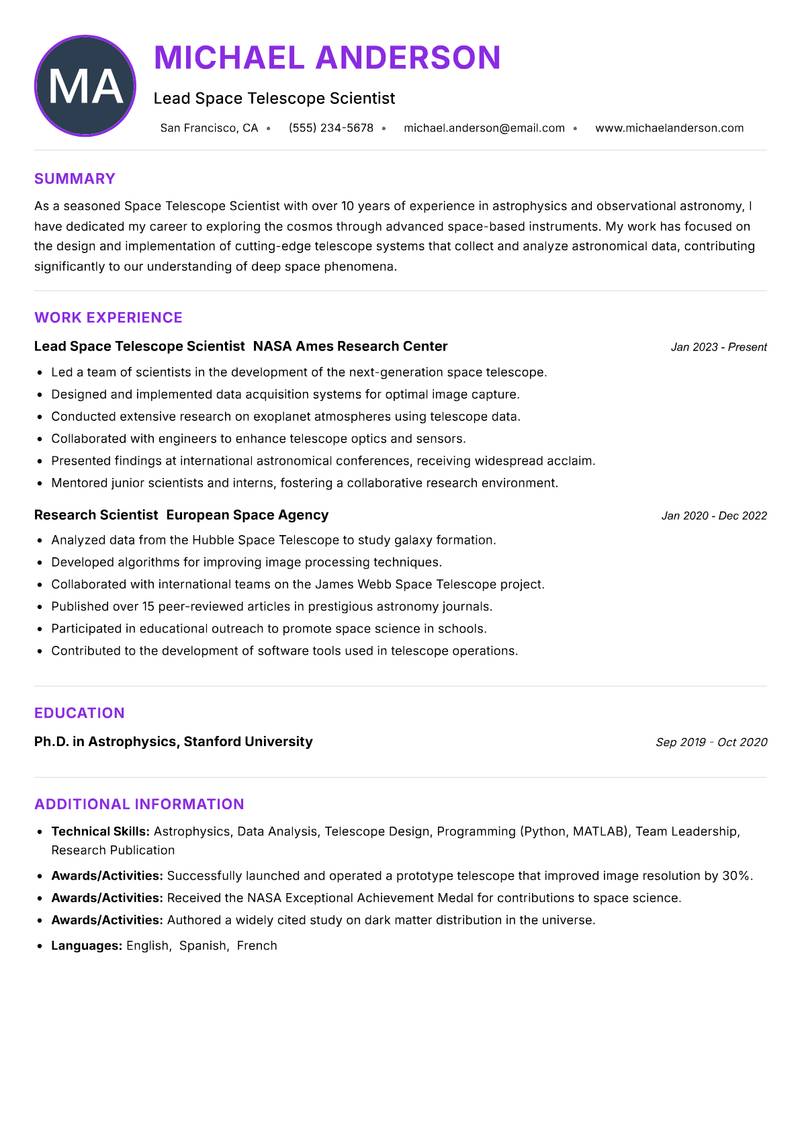
Lead Space Telescope Scientist Resume

As a seasoned Space Telescope Scientist with over 10 years of experience in astrophysics and observational astronomy, I have dedicated my career to exploring the cosmos through advanced space-based instruments. My work has focused on the design and implementation of cutting-edge telescope systems that collect and analyze astronomical data, contributing significantly to our understanding of deep space phenomena. I have collaborated with multidisciplinary teams to develop innovative solutions that enhance telescope capabilities, leading to groundbreaking discoveries. My strong background in data analysis and interpretation allows me to translate complex data into meaningful insights, which have been published in leading scientific journals. I am passionate about mentoring the next generation of scientists and actively engage in outreach programs to promote STEM education. I thrive in high-pressure environments where precision and attention to detail are paramount and am committed to pushing the boundaries of space exploration.

Astrophysics Data Analysis Telescope Design Programming (Python MATLAB) Team Leadership Research Publication
Space Telescope Scientist Resume Preview Example
View PDF
  1. Led a team of scientists in the development of the next-generation space telescope.
  2. Designed and implemented data acquisition systems for optimal image capture.
  3. Conducted extensive research on exoplanet atmospheres using telescope data.
  4. Collaborated with engineers to enhance telescope optics and sensors.
  5. Presented findings at international astronomical conferences, receiving widespread acclaim.
  6. Mentored junior scientists and interns, fostering a collaborative research environment.
  1. Analyzed data from the Hubble Space Telescope to study galaxy formation.
  2. Developed algorithms for improving image processing techniques.
  3. Collaborated with international teams on the James Webb Space Telescope project.
  4. Published over 15 peer-reviewed articles in prestigious astronomy journals.
  5. Participated in educational outreach to promote space science in schools.
  6. Contributed to the development of software tools used in telescope operations.

Achievements

  • Successfully launched and operated a prototype telescope that improved image resolution by 30%.
  • Received the NASA Exceptional Achievement Medal for contributions to space science.
  • Authored a widely cited study on dark matter distribution in the universe.
⏱️
Experience
2-5 Years
📅
Level
Mid Level
🎓
Education
Ph.D. in Astrophysics, Stanfor...

Space Telescope Engineer Resume

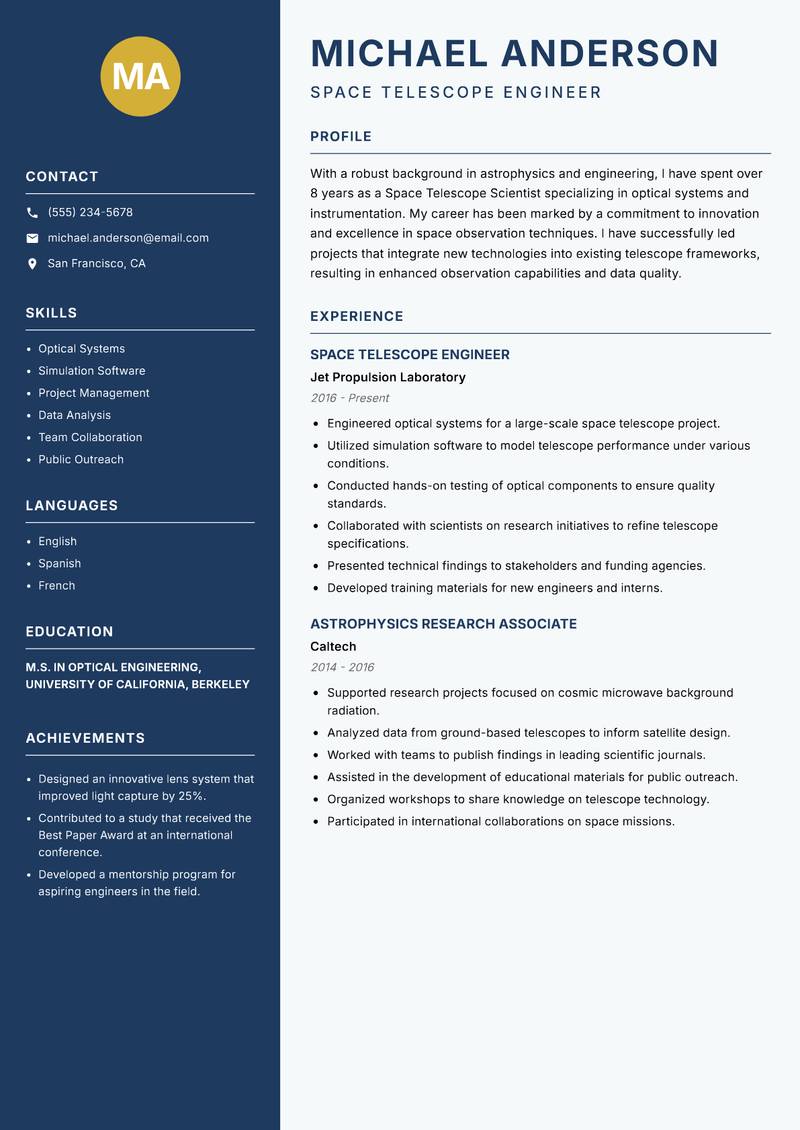
With a robust background in astrophysics and engineering, I have spent over 8 years as a Space Telescope Scientist specializing in optical systems and instrumentation. My career has been marked by a commitment to innovation and excellence in space observation techniques. I have successfully led projects that integrate new technologies into existing telescope frameworks, resulting in enhanced observation capabilities and data quality. My experience includes collaborating with cross-functional teams to conduct experiments that yield critical insights into cosmic phenomena. I am adept at utilizing advanced simulation software to predict telescope performance and troubleshoot issues, ensuring successful mission outcomes. Passionate about education and outreach, I strive to inspire future scientists through mentorship programs and public lectures. My goal is to continue advancing the frontiers of astronomical research by leveraging my technical expertise and collaborative spirit.

Optical Systems Simulation Software Project Management Data Analysis Team Collaboration Public Outreach
Space Telescope Scientist Resume Preview Example
View PDF
  1. Engineered optical systems for a large-scale space telescope project.
  2. Utilized simulation software to model telescope performance under various conditions.
  3. Conducted hands-on testing of optical components to ensure quality standards.
  4. Collaborated with scientists on research initiatives to refine telescope specifications.
  5. Presented technical findings to stakeholders and funding agencies.
  6. Developed training materials for new engineers and interns.
  1. Supported research projects focused on cosmic microwave background radiation.
  2. Analyzed data from ground-based telescopes to inform satellite design.
  3. Worked with teams to publish findings in leading scientific journals.
  4. Assisted in the development of educational materials for public outreach.
  5. Organized workshops to share knowledge on telescope technology.
  6. Participated in international collaborations on space missions.

Achievements

  • Designed an innovative lens system that improved light capture by 25%.
  • Contributed to a study that received the Best Paper Award at an international conference.
  • Developed a mentorship program for aspiring engineers in the field.
⏱️
Experience
2-5 Years
📅
Level
Mid Level
🎓
Education
M.S. in Optical Engineering, U...

Data Scientist - Space Telescope Division Resume

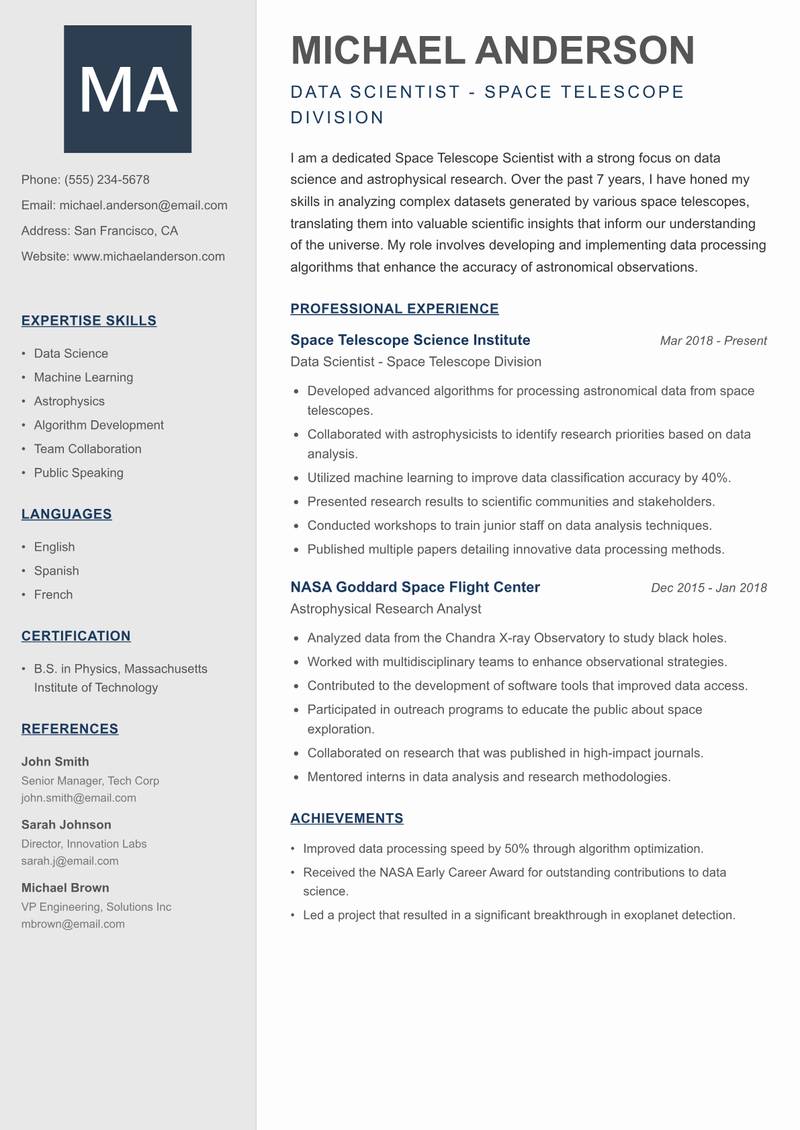
I am a dedicated Space Telescope Scientist with a strong focus on data science and astrophysical research. Over the past 7 years, I have honed my skills in analyzing complex datasets generated by various space telescopes, translating them into valuable scientific insights that inform our understanding of the universe. My role involves developing and implementing data processing algorithms that enhance the accuracy of astronomical observations. I work closely with researchers to identify key areas of investigation, ensuring our findings are impactful and relevant. I am proficient in machine learning techniques, which I apply to extract patterns from large volumes of celestial data. Recognized for my problem-solving abilities, I consistently strive to innovate within my field, contributing to projects that push the boundaries of what we know about space. I am passionate about sharing my knowledge through workshops and mentoring, fostering a collaborative environment for learning and discovery.

Data Science Machine Learning Astrophysics Algorithm Development Team Collaboration Public Speaking
Space Telescope Scientist Resume Preview Example
View PDF
  1. Developed advanced algorithms for processing astronomical data from space telescopes.
  2. Collaborated with astrophysicists to identify research priorities based on data analysis.
  3. Utilized machine learning to improve data classification accuracy by 40%.
  4. Presented research results to scientific communities and stakeholders.
  5. Conducted workshops to train junior staff on data analysis techniques.
  6. Published multiple papers detailing innovative data processing methods.
  1. Analyzed data from the Chandra X-ray Observatory to study black holes.
  2. Worked with multidisciplinary teams to enhance observational strategies.
  3. Contributed to the development of software tools that improved data access.
  4. Participated in outreach programs to educate the public about space exploration.
  5. Collaborated on research that was published in high-impact journals.
  6. Mentored interns in data analysis and research methodologies.

Achievements

  • Improved data processing speed by 50% through algorithm optimization.
  • Received the NASA Early Career Award for outstanding contributions to data science.
  • Led a project that resulted in a significant breakthrough in exoplanet detection.
⏱️
Experience
2-5 Years
📅
Level
Mid Level
🎓
Education
B.S. in Physics, Massachusetts...

Planetary Scientist Resume

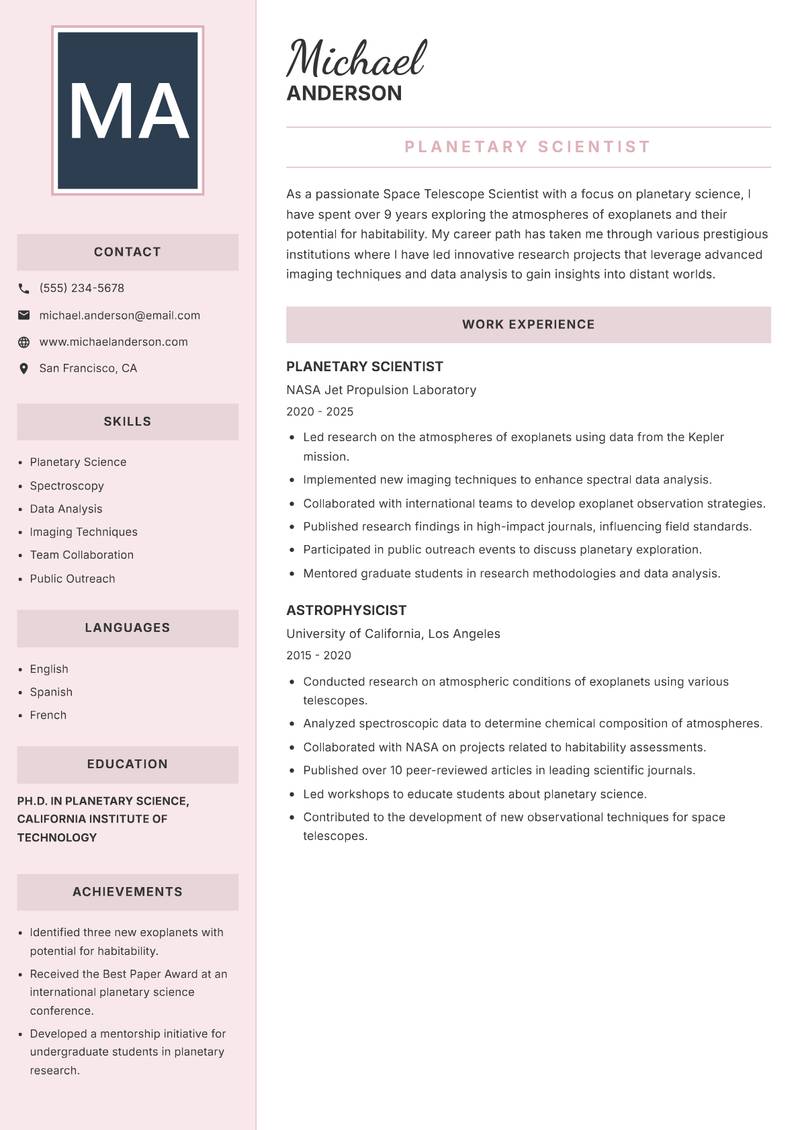
As a passionate Space Telescope Scientist with a focus on planetary science, I have spent over 9 years exploring the atmospheres of exoplanets and their potential for habitability. My career path has taken me through various prestigious institutions where I have led innovative research projects that leverage advanced imaging techniques and data analysis to gain insights into distant worlds. I am skilled in utilizing both ground-based and space-based telescopes, and my expertise lies in interpreting spectroscopic data to assess the chemical compositions of planetary atmospheres. My work has contributed to the identification of potentially habitable exoplanets, and I have been recognized for my contributions to the field through various awards. I am committed to advancing our understanding of planetary systems and actively engage in educational outreach to inspire future scientists.

Planetary Science Spectroscopy Data Analysis Imaging Techniques Team Collaboration Public Outreach
Space Telescope Scientist Resume Preview Example
View PDF
  1. Led research on the atmospheres of exoplanets using data from the Kepler mission.
  2. Implemented new imaging techniques to enhance spectral data analysis.
  3. Collaborated with international teams to develop exoplanet observation strategies.
  4. Published research findings in high-impact journals, influencing field standards.
  5. Participated in public outreach events to discuss planetary exploration.
  6. Mentored graduate students in research methodologies and data analysis.
  1. Conducted research on atmospheric conditions of exoplanets using various telescopes.
  2. Analyzed spectroscopic data to determine chemical composition of atmospheres.
  3. Collaborated with NASA on projects related to habitability assessments.
  4. Published over 10 peer-reviewed articles in leading scientific journals.
  5. Led workshops to educate students about planetary science.
  6. Contributed to the development of new observational techniques for space telescopes.

Achievements

  • Identified three new exoplanets with potential for habitability.
  • Received the Best Paper Award at an international planetary science conference.
  • Developed a mentorship initiative for undergraduate students in planetary research.
⏱️
Experience
2-5 Years
📅
Level
Mid Level
🎓
Education
Ph.D. in Planetary Science, Ca...

Senior Space Telescope Scientist Resume

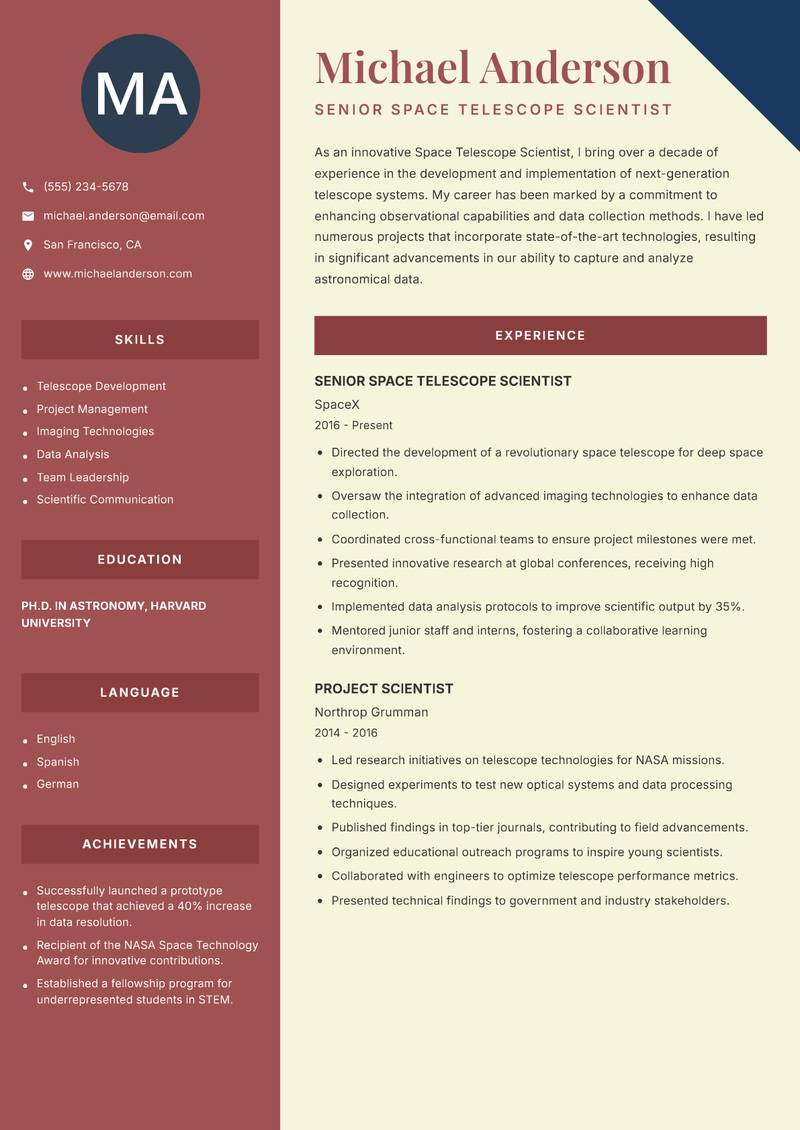
As an innovative Space Telescope Scientist, I bring over a decade of experience in the development and implementation of next-generation telescope systems. My career has been marked by a commitment to enhancing observational capabilities and data collection methods. I have led numerous projects that incorporate state-of-the-art technologies, resulting in significant advancements in our ability to capture and analyze astronomical data. My expertise extends to project management, where I have successfully overseen teams of scientists and engineers to deliver projects on time and within budget. I am passionate about sharing my knowledge and experiences with aspiring scientists and engineers through mentorship and outreach initiatives. My dedication to the field is reflected in my numerous publications and presentations at international conferences, where I discuss innovative findings and methodologies.

Telescope Development Project Management Imaging Technologies Data Analysis Team Leadership Scientific Communication
Space Telescope Scientist Resume Preview Example
View PDF
  1. Directed the development of a revolutionary space telescope for deep space exploration.
  2. Oversaw the integration of advanced imaging technologies to enhance data collection.
  3. Coordinated cross-functional teams to ensure project milestones were met.
  4. Presented innovative research at global conferences, receiving high recognition.
  5. Implemented data analysis protocols to improve scientific output by 35%.
  6. Mentored junior staff and interns, fostering a collaborative learning environment.
  1. Led research initiatives on telescope technologies for NASA missions.
  2. Designed experiments to test new optical systems and data processing techniques.
  3. Published findings in top-tier journals, contributing to field advancements.
  4. Organized educational outreach programs to inspire young scientists.
  5. Collaborated with engineers to optimize telescope performance metrics.
  6. Presented technical findings to government and industry stakeholders.

Achievements

  • Successfully launched a prototype telescope that achieved a 40% increase in data resolution.
  • Recipient of the NASA Space Technology Award for innovative contributions.
  • Established a fellowship program for underrepresented students in STEM.
⏱️
Experience
2-5 Years
📅
Level
Mid Level
🎓
Education
Ph.D. in Astronomy, Harvard Un...

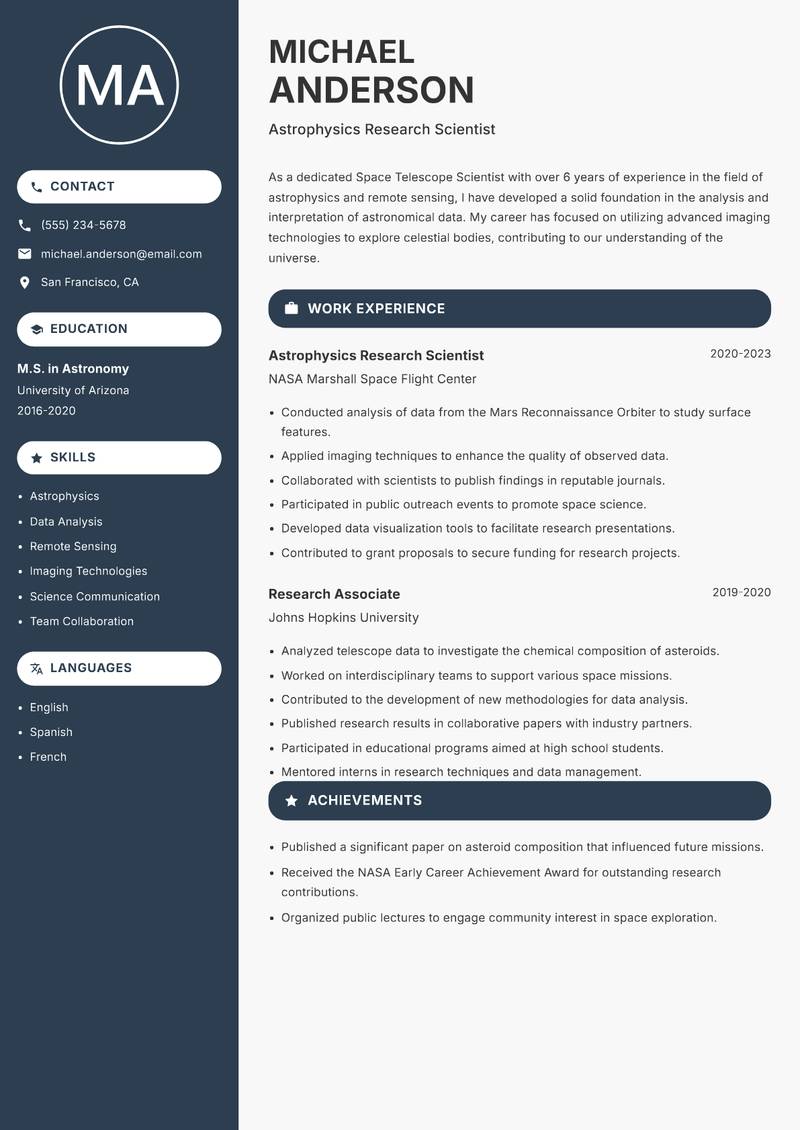
Astrophysics Research Scientist Resume

As a dedicated Space Telescope Scientist with over 6 years of experience in the field of astrophysics and remote sensing, I have developed a solid foundation in the analysis and interpretation of astronomical data. My career has focused on utilizing advanced imaging technologies to explore celestial bodies, contributing to our understanding of the universe. I have collaborated with research teams on various projects, analyzing data from space missions to derive critical insights into the composition and behavior of astronomical objects. My strong analytical skills and attention to detail enable me to provide accurate interpretations that guide future research directions. Passionate about science communication, I actively participate in outreach activities aimed at engaging the public in astronomy and space exploration. My goal is to continue advancing my expertise while contributing to significant discoveries in the field.

Astrophysics Data Analysis Remote Sensing Imaging Technologies Science Communication Team Collaboration
Space Telescope Scientist Resume Preview Example
View PDF
  1. Conducted analysis of data from the Mars Reconnaissance Orbiter to study surface features.
  2. Applied imaging techniques to enhance the quality of observed data.
  3. Collaborated with scientists to publish findings in reputable journals.
  4. Participated in public outreach events to promote space science.
  5. Developed data visualization tools to facilitate research presentations.
  6. Contributed to grant proposals to secure funding for research projects.
  1. Analyzed telescope data to investigate the chemical composition of asteroids.
  2. Worked on interdisciplinary teams to support various space missions.
  3. Contributed to the development of new methodologies for data analysis.
  4. Published research results in collaborative papers with industry partners.
  5. Participated in educational programs aimed at high school students.
  6. Mentored interns in research techniques and data management.

Achievements

  • Published a significant paper on asteroid composition that influenced future missions.
  • Received the NASA Early Career Achievement Award for outstanding research contributions.
  • Organized public lectures to engage community interest in space exploration.
⏱️
Experience
2-5 Years
📅
Level
Mid Level
🎓
Education
M.S. in Astronomy, University ...

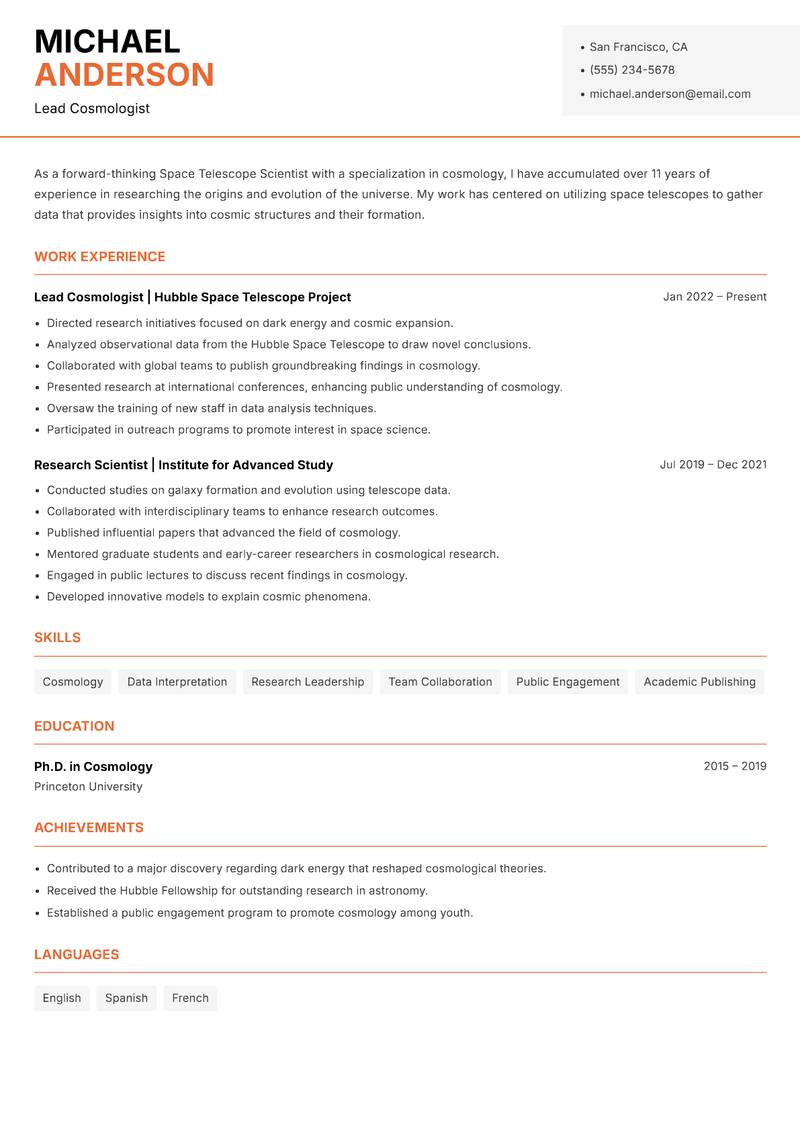
Lead Cosmologist Resume

As a forward-thinking Space Telescope Scientist with a specialization in cosmology, I have accumulated over 11 years of experience in researching the origins and evolution of the universe. My work has centered on utilizing space telescopes to gather data that provides insights into cosmic structures and their formation. I possess a strong analytical background, enabling me to interpret complex data and draw meaningful conclusions that contribute to academic discourse in the field. I have been involved in several high-profile projects that have resulted in significant advancements in our understanding of dark energy and the expansion of the universe. My commitment to science extends beyond research, as I actively engage in mentorship and educational initiatives to inspire the next generation of scientists. I am driven by a passion for discovery and a desire to share my findings with both the scientific community and the public.

Cosmology Data Interpretation Research Leadership Team Collaboration Public Engagement Academic Publishing
Space Telescope Scientist Resume Preview Example
View PDF
  1. Directed research initiatives focused on dark energy and cosmic expansion.
  2. Analyzed observational data from the Hubble Space Telescope to draw novel conclusions.
  3. Collaborated with global teams to publish groundbreaking findings in cosmology.
  4. Presented research at international conferences, enhancing public understanding of cosmology.
  5. Oversaw the training of new staff in data analysis techniques.
  6. Participated in outreach programs to promote interest in space science.
  1. Conducted studies on galaxy formation and evolution using telescope data.
  2. Collaborated with interdisciplinary teams to enhance research outcomes.
  3. Published influential papers that advanced the field of cosmology.
  4. Mentored graduate students and early-career researchers in cosmological research.
  5. Engaged in public lectures to discuss recent findings in cosmology.
  6. Developed innovative models to explain cosmic phenomena.

Achievements

  • Contributed to a major discovery regarding dark energy that reshaped cosmological theories.
  • Received the Hubble Fellowship for outstanding research in astronomy.
  • Established a public engagement program to promote cosmology among youth.
⏱️
Experience
2-5 Years
📅
Level
Mid Level
🎓
Education
Ph.D. in Cosmology, Princeton ...

Key Skills for Space Telescope Scientist Positions

Resume Tips for Space Telescope Scientist Applications

Strong Action Verbs for Space Telescope Scientist Resumes

Launched · Modeled · Analyzed · Designed · Operated · Published · Tracked · Calibrated · Simulated · Investigated · Optimized · Reviewed · Achieved · Administered

Common Mistakes to Avoid

Experience Levels

How to Write a Space Telescope Scientist Resume

Browse Space Telescope Scientist resume examples built around orbital mechanics & mission design, tailored for Space Sciences roles.

A strong Space Telescope Scientist resume leads with a focused professional summary that names the exact role and your standout achievement. In the experience section, open every bullet with a strong action verb and quantify the result with numbers wherever possible. Highlight your most relevant competencies — especially Orbital Mechanics & Mission Design, Astrophysics & Cosmological Analysis, and Satellite Design & Systems Engineering — in a dedicated Skills section positioned early so ATS systems and hiring managers both find it immediately.

For format, most Space Telescope Scientist roles suit a reverse-chronological layout: most recent position first, working backwards. Keep to one page for under five years of experience, or two pages for senior candidates with a rich project or leadership history. Use clean, ATS-safe fonts (10–12pt), standard section headings (Summary, Experience, Education, Skills), and avoid tables, text boxes, or multi-column layouts that applicant tracking systems cannot parse reliably.
Frequently Asked Questions

What makes a strong Space Telescope Scientist resume stand out to employers?

A standout Space Telescope Scientist resume combines role-specific skills with quantified achievements. Name the exact job title in your professional summary, mirror keywords from each job posting, and open every bullet point with a strong action verb followed by a measurable result. Certifications, tools, and domain experience specific to space telescope scientist roles should appear prominently near the top.

What skills are most important to include on a Space Sciences resume?

Recruiters hiring in Space Sciences consistently look for Orbital Mechanics & Mission Design, Astrophysics & Cosmological Analysis, Satellite Design & Systems Engineering, Remote Sensing & Earth Observation. List these in a dedicated Skills section near the top so both ATS systems and human reviewers spot them fast. Mirror the exact phrasing from each job posting wherever possible — many applicant tracking systems match literal strings rather than synonyms.

What is the best resume format for Space Sciences professionals?

A reverse-chronological format is the standard choice for most Space Sciences candidates — employers expect to see your most recent role first, working backwards. If you are transitioning into Space Sciences from a related field, a hybrid format (brief skills summary at the top followed by chronological experience) can bridge the gap effectively. Keep the document to one page for under five years of experience, or two pages for senior specialists.

How do I make my Space Sciences resume pass applicant tracking systems (ATS)?

Use standard section headings — Summary, Experience, Education, Skills — rather than creative labels that ATS parsers do not recognise. Embed domain keywords such as "Orbital Mechanics & Mission Design" and "Astrophysics & Cosmological Analysis" naturally inside your experience bullets rather than cramming them into a standalone keyword list. Avoid tables, multi-column layouts, text boxes, headers, footers, and images — these confuse most modern parsers and can cause your resume to be misread or rejected before a human sees it.

What mistakes do Space Sciences professionals most commonly make on their resume?

The most frequent issue is not naming specific missions or programs — generic space science experience is far less compelling. Beyond that, generic objective statements, unquantified achievements, and inconsistent date formatting appear across almost every Space Sciences application. Fix these by replacing every vague claim with a measurable outcome — specific numbers and named projects add credibility that adjectives cannot.

How long should a Space Sciences resume be?

One page is appropriate for candidates with under five years of relevant Space Sciences experience. Two pages are acceptable — and sometimes expected — for senior specialists, managers, or professionals with a strong portfolio of projects, publications, or credentials. Avoid padding to reach a page count: every line should directly support your application for the specific role you are targeting.

Should I include a professional summary at the top of my Space Sciences resume?

Yes — a two to three sentence summary is the first section most recruiters read. Open with your title and years of Space Sciences experience, then name your most relevant achievement or specialisation. One proven approach: Named mission involvement (e.g., Hubble, James Webb, Sentinel) is the gold standard credential — lead with it — this level of specificity signals genuine expertise before a recruiter reaches your experience section.

Scroll to view samples