Botanist Resume

These Botanist resume samples are designed to help you write a resume that gets noticed by hiring managers and passes applicant tracking systems (ATS) in Life Sciences. Each example shows real formatting, section structure, and language you can adapt to your own background. When writing your own Botanist resume, focus on highlighting molecular biology techniques (PCR, CRISPR, western blot), cell culture & in vitro models and genomics & sequencing (NGS, sanger). Recruiters scan for these qualifications first, so they should appear early in your summary and experience sections. Use strong action verbs such as "discovered", "synthesized", "sequenced", "expressed" to describe your achievements, and quantify your impact wherever possible — percentages, dollar amounts, or time saved make your resume more convincing. A common mistake to avoid: writing a generic objective statement instead of a targeted botanist professional summary. Tailor your resume to each Botanist position you apply for rather than using one generic version.

Botanist Resume Template
View PDF
0.0 (0 ratings)

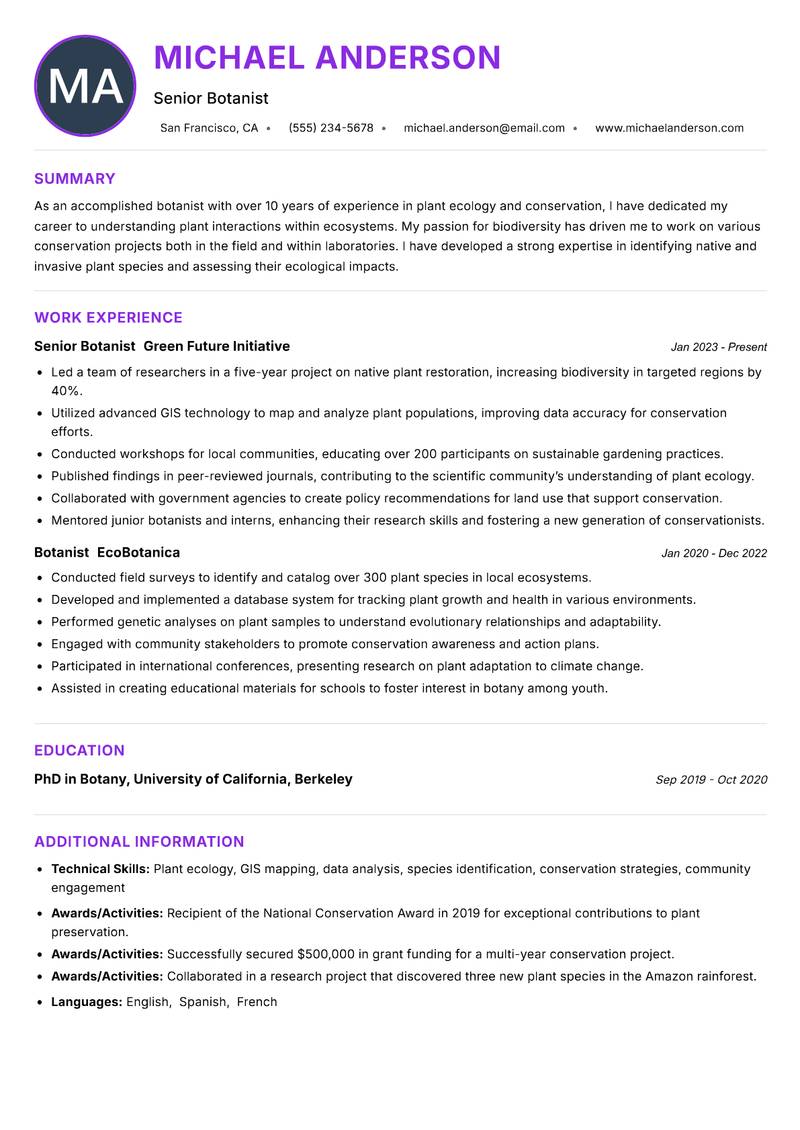
Senior Botanist Resume

As an accomplished botanist with over 10 years of experience in plant ecology and conservation, I have dedicated my career to understanding plant interactions within ecosystems. My passion for biodiversity has driven me to work on various conservation projects both in the field and within laboratories. I have developed a strong expertise in identifying native and invasive plant species and assessing their ecological impacts. My role has often involved collaborating with interdisciplinary teams to achieve project goals, including habitat restoration and sustainable land management. I possess extensive knowledge of plant physiology and genetics, which I have applied in research settings to help develop strategies for preserving endangered species. With a solid background in data analysis and GIS mapping, I excel in translating complex ecological data into actionable insights. I aim to contribute to global efforts to combat climate change through innovative botanical research and education. Continuous learning and adaptation to new methodologies have been key in my career, and I am eager to bring my skills to new challenges in the field of botany.

Plant ecology GIS mapping data analysis species identification conservation strategies community engagement
Botanist Resume Preview Example
View PDF
  1. Led a team of researchers in a five-year project on native plant restoration, increasing biodiversity in targeted regions by 40%.
  2. Utilized advanced GIS technology to map and analyze plant populations, improving data accuracy for conservation efforts.
  3. Conducted workshops for local communities, educating over 200 participants on sustainable gardening practices.
  4. Published findings in peer-reviewed journals, contributing to the scientific community’s understanding of plant ecology.
  5. Collaborated with government agencies to create policy recommendations for land use that support conservation.
  6. Mentored junior botanists and interns, enhancing their research skills and fostering a new generation of conservationists.
  1. Conducted field surveys to identify and catalog over 300 plant species in local ecosystems.
  2. Developed and implemented a database system for tracking plant growth and health in various environments.
  3. Performed genetic analyses on plant samples to understand evolutionary relationships and adaptability.
  4. Engaged with community stakeholders to promote conservation awareness and action plans.
  5. Participated in international conferences, presenting research on plant adaptation to climate change.
  6. Assisted in creating educational materials for schools to foster interest in botany among youth.

Achievements

  • Recipient of the National Conservation Award in 2019 for exceptional contributions to plant preservation.
  • Successfully secured $500,000 in grant funding for a multi-year conservation project.
  • Collaborated in a research project that discovered three new plant species in the Amazon rainforest.
⏱️
Experience
2-5 Years
📅
Level
Mid Level
🎓
Education
PhD in Botany, University of C...

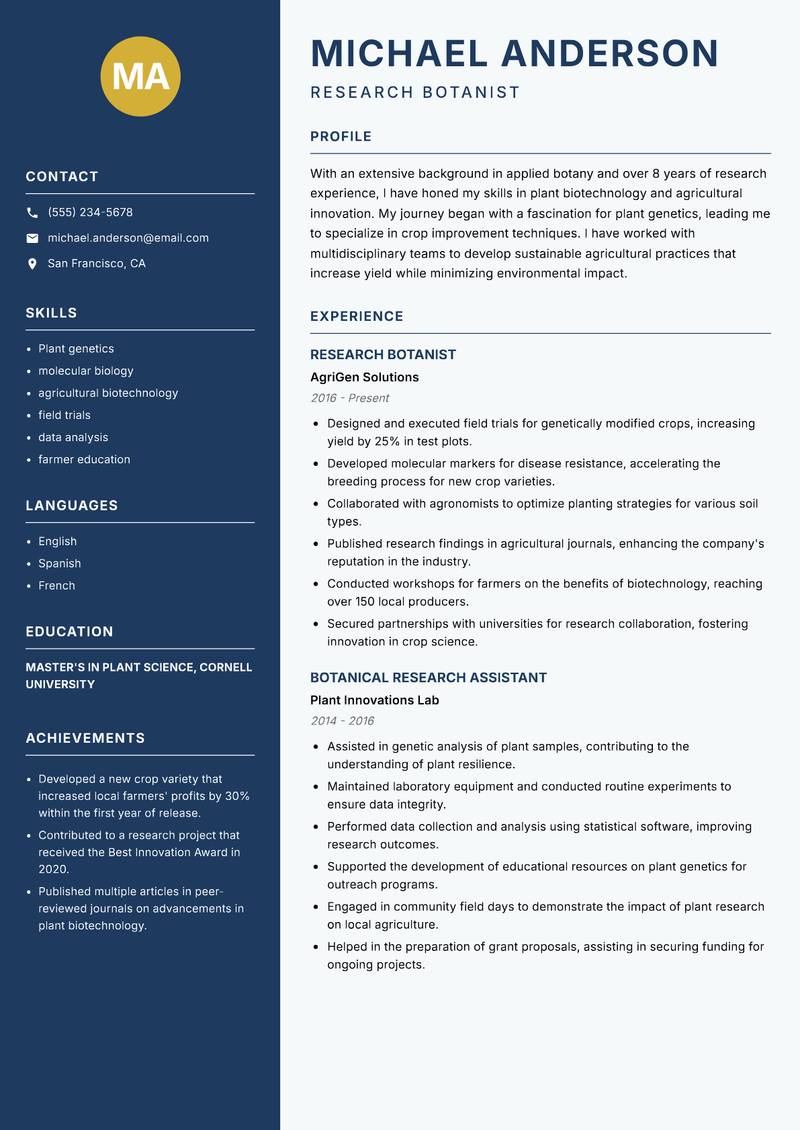
Research Botanist Resume

With an extensive background in applied botany and over 8 years of research experience, I have honed my skills in plant biotechnology and agricultural innovation. My journey began with a fascination for plant genetics, leading me to specialize in crop improvement techniques. I have worked with multidisciplinary teams to develop sustainable agricultural practices that increase yield while minimizing environmental impact. Proficient in molecular biology techniques, I have successfully engineered plant varieties that are resistant to pests and diseases, benefiting farmers and contributing to food security. My work often involves field trials and laboratory experiments, where I analyze plant responses to various environmental stresses. I believe in the importance of bridging the gap between scientific research and practical applications, ensuring that advancements in botany translate into real-world benefits. I am committed to continuous learning and professional development, and I am excited about the potential to innovate in the field of sustainable agriculture.

Plant genetics molecular biology agricultural biotechnology field trials data analysis farmer education
Botanist Resume Preview Example
View PDF
  1. Designed and executed field trials for genetically modified crops, increasing yield by 25% in test plots.
  2. Developed molecular markers for disease resistance, accelerating the breeding process for new crop varieties.
  3. Collaborated with agronomists to optimize planting strategies for various soil types.
  4. Published research findings in agricultural journals, enhancing the company's reputation in the industry.
  5. Conducted workshops for farmers on the benefits of biotechnology, reaching over 150 local producers.
  6. Secured partnerships with universities for research collaboration, fostering innovation in crop science.
  1. Assisted in genetic analysis of plant samples, contributing to the understanding of plant resilience.
  2. Maintained laboratory equipment and conducted routine experiments to ensure data integrity.
  3. Performed data collection and analysis using statistical software, improving research outcomes.
  4. Supported the development of educational resources on plant genetics for outreach programs.
  5. Engaged in community field days to demonstrate the impact of plant research on local agriculture.
  6. Helped in the preparation of grant proposals, assisting in securing funding for ongoing projects.

Achievements

  • Developed a new crop variety that increased local farmers' profits by 30% within the first year of release.
  • Contributed to a research project that received the Best Innovation Award in 2020.
  • Published multiple articles in peer-reviewed journals on advancements in plant biotechnology.
⏱️
Experience
2-5 Years
📅
Level
Mid Level
🎓
Education
Master's in Plant Science, Cor...

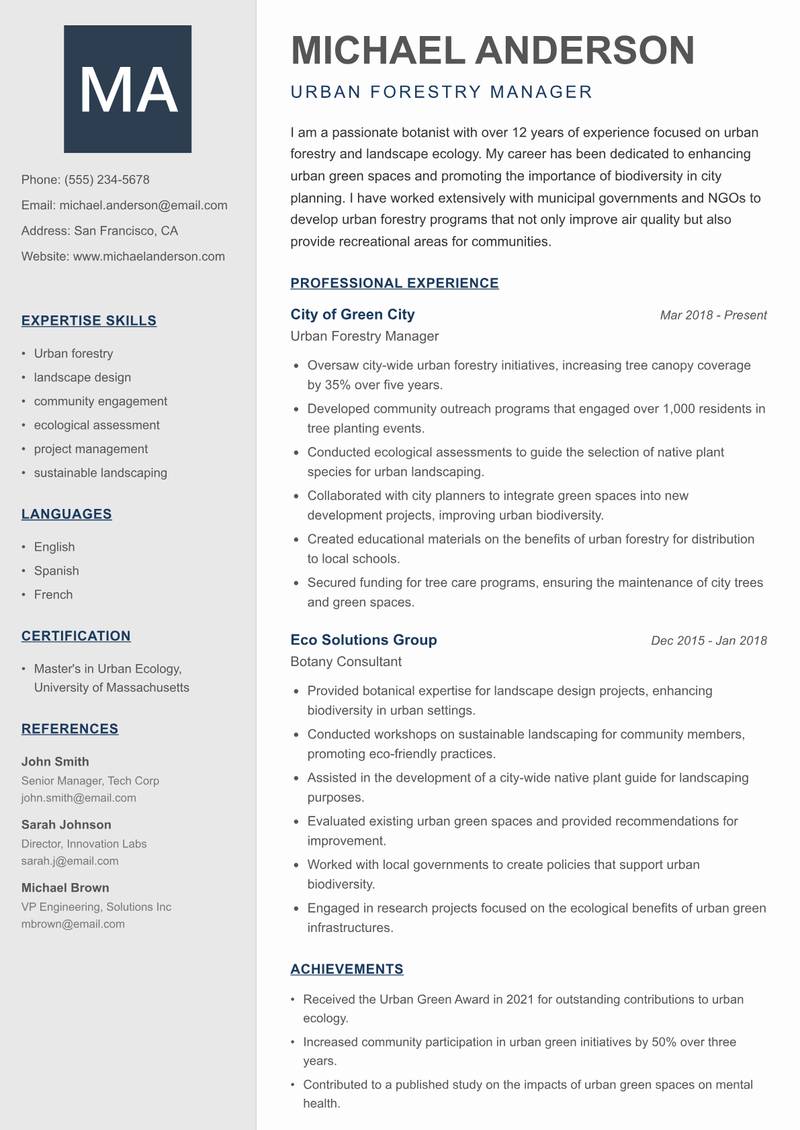
Urban Forestry Manager Resume

I am a passionate botanist with over 12 years of experience focused on urban forestry and landscape ecology. My career has been dedicated to enhancing urban green spaces and promoting the importance of biodiversity in city planning. I have worked extensively with municipal governments and NGOs to develop urban forestry programs that not only improve air quality but also provide recreational areas for communities. My expertise lies in selecting appropriate plant species that thrive in urban environments, conducting ecological assessments, and implementing sustainable landscaping practices. I have a strong background in community engagement, often leading workshops and educational programs to raise awareness about the benefits of urban green spaces. My goal is to create livable cities that prioritize ecological health while enhancing the quality of life for residents. I believe in the power of collaboration and have successfully partnered with architects and city planners to integrate green solutions into urban development projects.

Urban forestry landscape design community engagement ecological assessment project management sustainable landscaping
Botanist Resume Preview Example
View PDF
  1. Oversaw city-wide urban forestry initiatives, increasing tree canopy coverage by 35% over five years.
  2. Developed community outreach programs that engaged over 1,000 residents in tree planting events.
  3. Conducted ecological assessments to guide the selection of native plant species for urban landscaping.
  4. Collaborated with city planners to integrate green spaces into new development projects, improving urban biodiversity.
  5. Created educational materials on the benefits of urban forestry for distribution to local schools.
  6. Secured funding for tree care programs, ensuring the maintenance of city trees and green spaces.
  1. Provided botanical expertise for landscape design projects, enhancing biodiversity in urban settings.
  2. Conducted workshops on sustainable landscaping for community members, promoting eco-friendly practices.
  3. Assisted in the development of a city-wide native plant guide for landscaping purposes.
  4. Evaluated existing urban green spaces and provided recommendations for improvement.
  5. Worked with local governments to create policies that support urban biodiversity.
  6. Engaged in research projects focused on the ecological benefits of urban green infrastructures.

Achievements

  • Received the Urban Green Award in 2021 for outstanding contributions to urban ecology.
  • Increased community participation in urban green initiatives by 50% over three years.
  • Contributed to a published study on the impacts of urban green spaces on mental health.
⏱️
Experience
2-5 Years
📅
Level
Mid Level
🎓
Education
Master's in Urban Ecology, Uni...

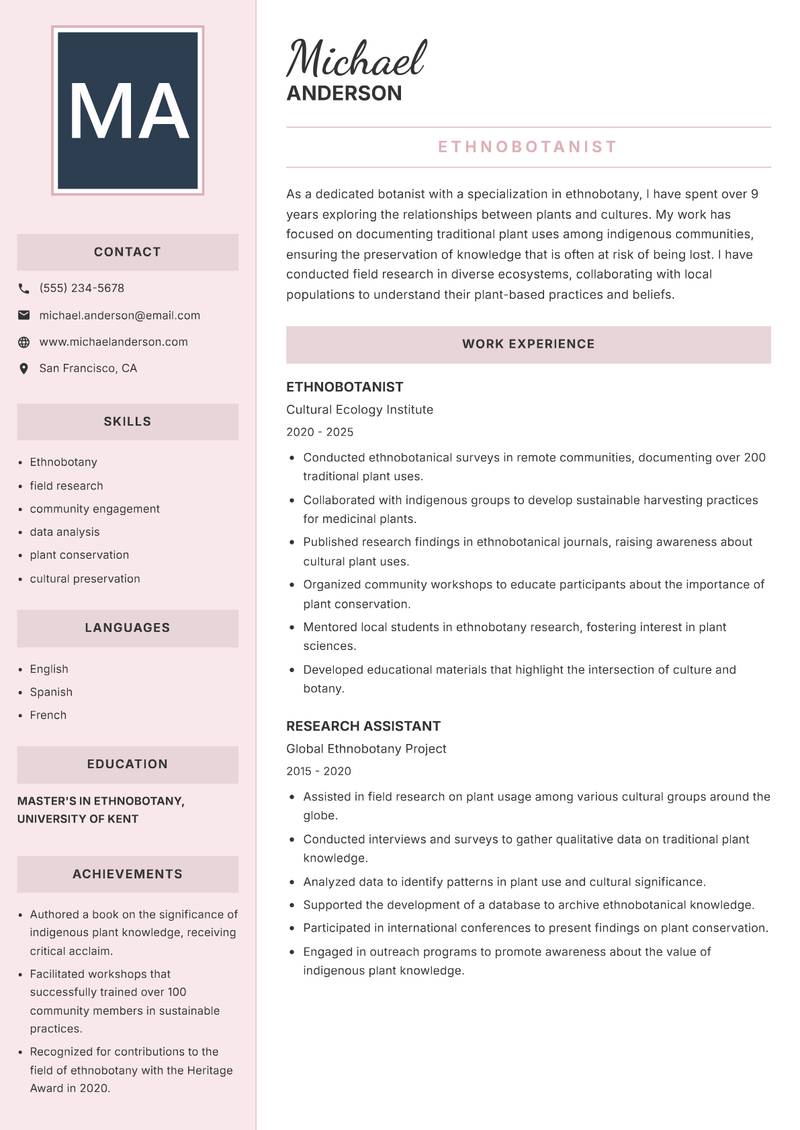
Ethnobotanist Resume

As a dedicated botanist with a specialization in ethnobotany, I have spent over 9 years exploring the relationships between plants and cultures. My work has focused on documenting traditional plant uses among indigenous communities, ensuring the preservation of knowledge that is often at risk of being lost. I have conducted field research in diverse ecosystems, collaborating with local populations to understand their plant-based practices and beliefs. My aim is to bridge the gap between scientific research and traditional knowledge, promoting sustainable practices that honor cultural heritage. I have published several articles on the importance of plant conservation and the role of indigenous knowledge in modern science. My passion for education has led me to create programs that teach about the benefits of biodiversity and the significance of plants in cultural practices. I believe in empowering communities through knowledge and fostering respect for their traditional ecological wisdom.

Ethnobotany field research community engagement data analysis plant conservation cultural preservation
Botanist Resume Preview Example
View PDF
  1. Conducted ethnobotanical surveys in remote communities, documenting over 200 traditional plant uses.
  2. Collaborated with indigenous groups to develop sustainable harvesting practices for medicinal plants.
  3. Published research findings in ethnobotanical journals, raising awareness about cultural plant uses.
  4. Organized community workshops to educate participants about the importance of plant conservation.
  5. Mentored local students in ethnobotany research, fostering interest in plant sciences.
  6. Developed educational materials that highlight the intersection of culture and botany.
  1. Assisted in field research on plant usage among various cultural groups around the globe.
  2. Conducted interviews and surveys to gather qualitative data on traditional plant knowledge.
  3. Analyzed data to identify patterns in plant use and cultural significance.
  4. Supported the development of a database to archive ethnobotanical knowledge.
  5. Participated in international conferences to present findings on plant conservation.
  6. Engaged in outreach programs to promote awareness about the value of indigenous plant knowledge.

Achievements

  • Authored a book on the significance of indigenous plant knowledge, receiving critical acclaim.
  • Facilitated workshops that successfully trained over 100 community members in sustainable practices.
  • Recognized for contributions to the field of ethnobotany with the Heritage Award in 2020.
⏱️
Experience
2-5 Years
📅
Level
Mid Level
🎓
Education
Master's in Ethnobotany, Unive...

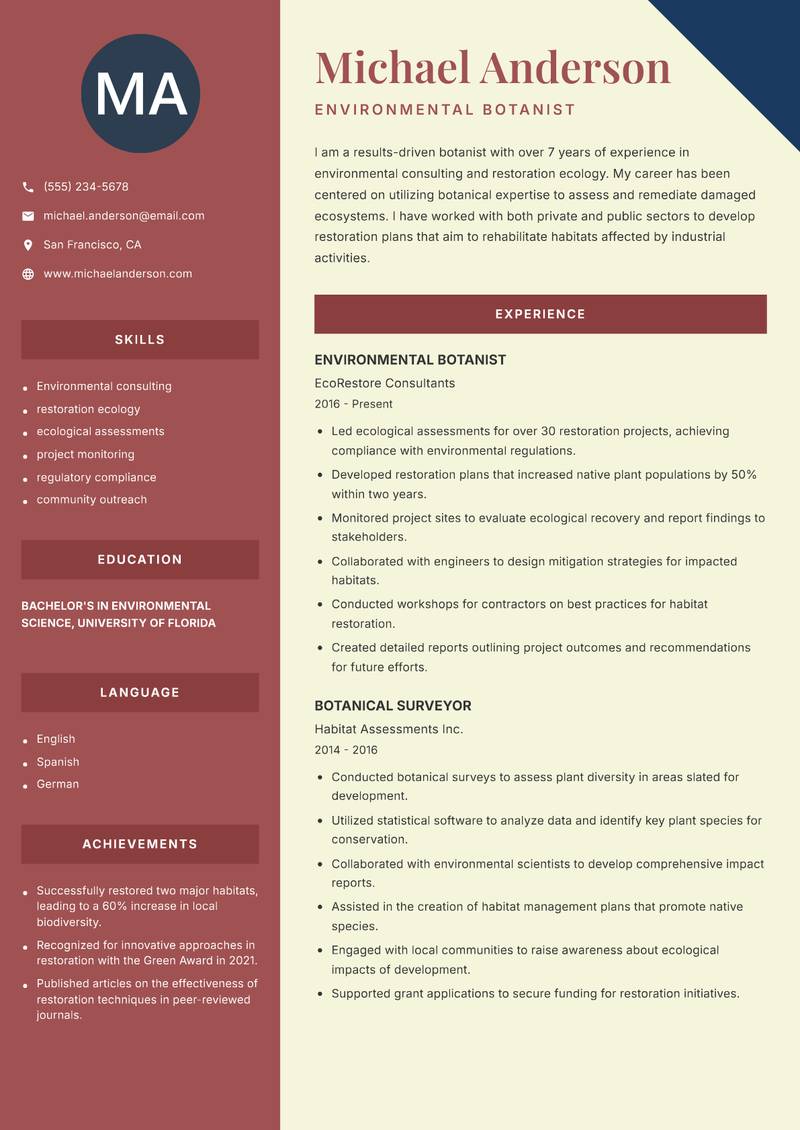
Environmental Botanist Resume

I am a results-driven botanist with over 7 years of experience in environmental consulting and restoration ecology. My career has been centered on utilizing botanical expertise to assess and remediate damaged ecosystems. I have worked with both private and public sectors to develop restoration plans that aim to rehabilitate habitats affected by industrial activities. My work involves conducting ecological assessments, developing site-specific restoration strategies, and monitoring the success of implemented projects. I have a solid understanding of regulatory requirements and have collaborated with stakeholders to ensure compliance throughout the restoration process. My analytical skills allow me to identify ecological impacts and propose effective solutions that enhance biodiversity. I am dedicated to fostering healthy ecosystems and educating communities about the importance of environmental stewardship. I believe that effective communication and collaboration are key to achieving successful restoration outcomes.

Environmental consulting restoration ecology ecological assessments project monitoring regulatory compliance community outreach
Botanist Resume Preview Example
View PDF
  1. Led ecological assessments for over 30 restoration projects, achieving compliance with environmental regulations.
  2. Developed restoration plans that increased native plant populations by 50% within two years.
  3. Monitored project sites to evaluate ecological recovery and report findings to stakeholders.
  4. Collaborated with engineers to design mitigation strategies for impacted habitats.
  5. Conducted workshops for contractors on best practices for habitat restoration.
  6. Created detailed reports outlining project outcomes and recommendations for future efforts.
  1. Conducted botanical surveys to assess plant diversity in areas slated for development.
  2. Utilized statistical software to analyze data and identify key plant species for conservation.
  3. Collaborated with environmental scientists to develop comprehensive impact reports.
  4. Assisted in the creation of habitat management plans that promote native species.
  5. Engaged with local communities to raise awareness about ecological impacts of development.
  6. Supported grant applications to secure funding for restoration initiatives.

Achievements

  • Successfully restored two major habitats, leading to a 60% increase in local biodiversity.
  • Recognized for innovative approaches in restoration with the Green Award in 2021.
  • Published articles on the effectiveness of restoration techniques in peer-reviewed journals.
⏱️
Experience
2-5 Years
📅
Level
Mid Level
🎓
Education
Bachelor's in Environmental Sc...

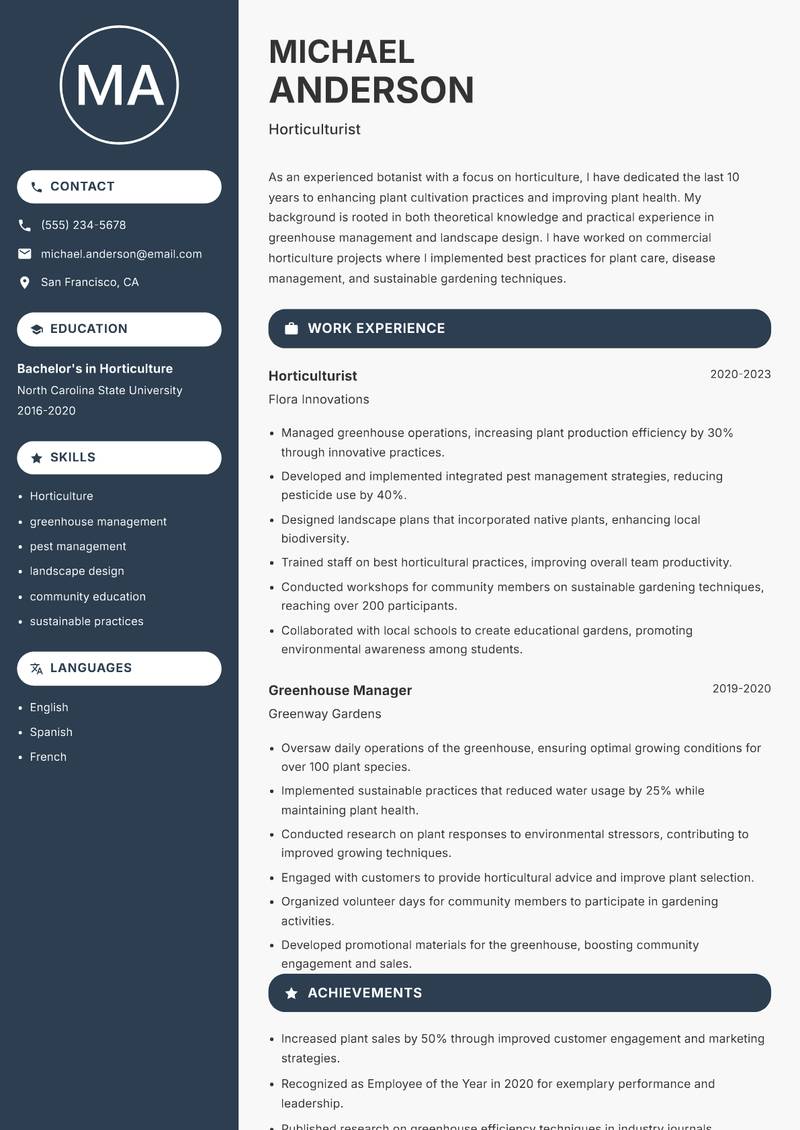
Horticulturist Resume

As an experienced botanist with a focus on horticulture, I have dedicated the last 10 years to enhancing plant cultivation practices and improving plant health. My background is rooted in both theoretical knowledge and practical experience in greenhouse management and landscape design. I have worked on commercial horticulture projects where I implemented best practices for plant care, disease management, and sustainable gardening techniques. My strengths include developing innovative growing systems that maximize yield while minimizing resource use. I thrive in team environments, collaborating with other horticulturists and landscape architects to create sustainable green spaces that are both functional and aesthetically pleasing. I am passionate about educating others about horticultural practices and have led numerous workshops aimed at sharing knowledge with aspiring gardeners and horticulturists. My goal is to continue advancing horticultural practices through research and hands-on experience, promoting environmental sustainability.

Horticulture greenhouse management pest management landscape design community education sustainable practices
Botanist Resume Preview Example
View PDF
  1. Managed greenhouse operations, increasing plant production efficiency by 30% through innovative practices.
  2. Developed and implemented integrated pest management strategies, reducing pesticide use by 40%.
  3. Designed landscape plans that incorporated native plants, enhancing local biodiversity.
  4. Trained staff on best horticultural practices, improving overall team productivity.
  5. Conducted workshops for community members on sustainable gardening techniques, reaching over 200 participants.
  6. Collaborated with local schools to create educational gardens, promoting environmental awareness among students.
  1. Oversaw daily operations of the greenhouse, ensuring optimal growing conditions for over 100 plant species.
  2. Implemented sustainable practices that reduced water usage by 25% while maintaining plant health.
  3. Conducted research on plant responses to environmental stressors, contributing to improved growing techniques.
  4. Engaged with customers to provide horticultural advice and improve plant selection.
  5. Organized volunteer days for community members to participate in gardening activities.
  6. Developed promotional materials for the greenhouse, boosting community engagement and sales.

Achievements

  • Increased plant sales by 50% through improved customer engagement and marketing strategies.
  • Recognized as Employee of the Year in 2020 for exemplary performance and leadership.
  • Published research on greenhouse efficiency techniques in industry journals.
⏱️
Experience
2-5 Years
📅
Level
Mid Level
🎓
Education
Bachelor's in Horticulture, No...

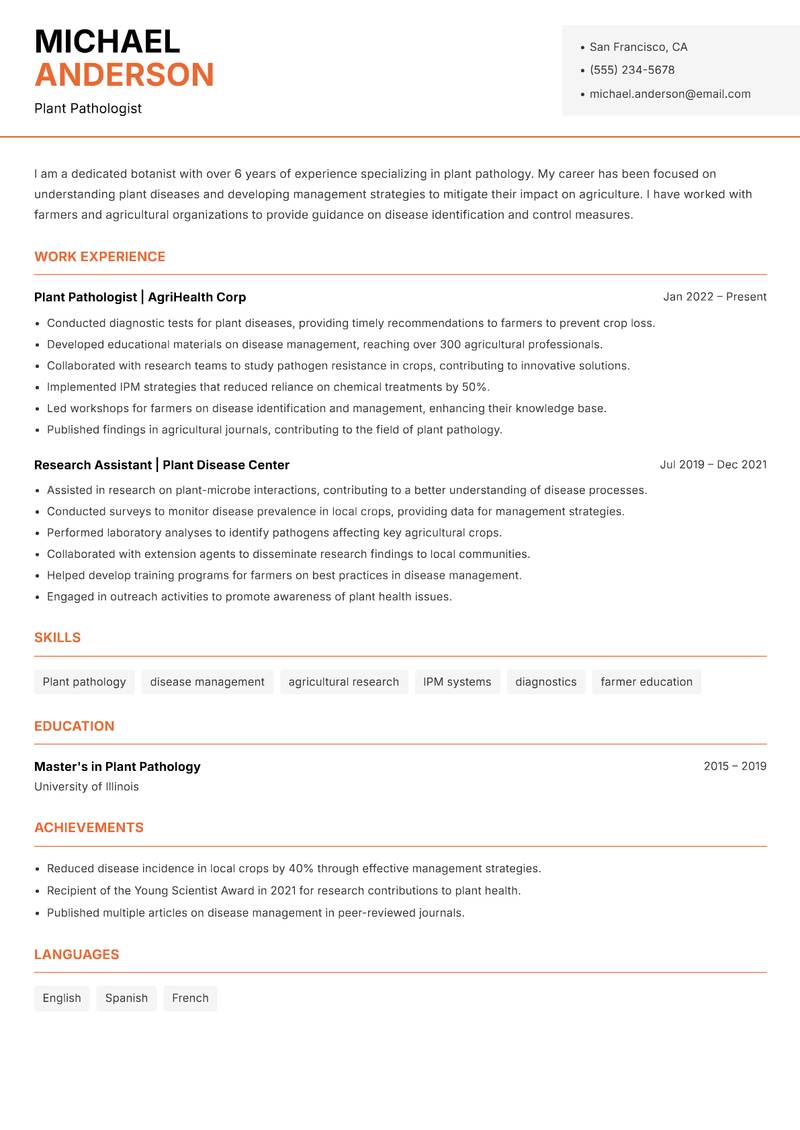
Plant Pathologist Resume

I am a dedicated botanist with over 6 years of experience specializing in plant pathology. My career has been focused on understanding plant diseases and developing management strategies to mitigate their impact on agriculture. I have worked with farmers and agricultural organizations to provide guidance on disease identification and control measures. My expertise includes conducting research on pathogen-host interactions and implementing integrated pest management (IPM) systems that effectively reduce crop losses. I have a strong background in laboratory techniques and field diagnostics, allowing me to provide accurate assessments and recommendations. I am committed to advancing plant health through education and research, believing that informed practices can lead to sustainable agricultural systems. I strive to communicate complex scientific concepts in an accessible manner, empowering farmers with the knowledge they need to protect their crops.

Plant pathology disease management agricultural research IPM systems diagnostics farmer education
Botanist Resume Preview Example
View PDF
  1. Conducted diagnostic tests for plant diseases, providing timely recommendations to farmers to prevent crop loss.
  2. Developed educational materials on disease management, reaching over 300 agricultural professionals.
  3. Collaborated with research teams to study pathogen resistance in crops, contributing to innovative solutions.
  4. Implemented IPM strategies that reduced reliance on chemical treatments by 50%.
  5. Led workshops for farmers on disease identification and management, enhancing their knowledge base.
  6. Published findings in agricultural journals, contributing to the field of plant pathology.
  1. Assisted in research on plant-microbe interactions, contributing to a better understanding of disease processes.
  2. Conducted surveys to monitor disease prevalence in local crops, providing data for management strategies.
  3. Performed laboratory analyses to identify pathogens affecting key agricultural crops.
  4. Collaborated with extension agents to disseminate research findings to local communities.
  5. Helped develop training programs for farmers on best practices in disease management.
  6. Engaged in outreach activities to promote awareness of plant health issues.

Achievements

  • Reduced disease incidence in local crops by 40% through effective management strategies.
  • Recipient of the Young Scientist Award in 2021 for research contributions to plant health.
  • Published multiple articles on disease management in peer-reviewed journals.
⏱️
Experience
2-5 Years
📅
Level
Mid Level
🎓
Education
Master's in Plant Pathology, U...

Key Skills for Botanist Positions

Resume Tips for Botanist Applications

Strong Action Verbs for Botanist Resumes

Discovered · Synthesized · Sequenced · Expressed · Analyzed · Published · Optimized · Developed · Patented · Validated · Achieved · Administered · Architected · Assessed

Common Mistakes to Avoid

Experience Levels

How to Write a Botanist Resume

Browse Botanist resume examples built around molecular biology techniques (PCR, CRISPR, western blot), tailored for Life Sciences roles.

A strong Botanist resume leads with a focused professional summary that names the exact role and your standout achievement. In the experience section, open every bullet with a strong action verb and quantify the result with numbers wherever possible. Highlight your most relevant competencies — especially Molecular Biology Techniques (PCR, CRISPR, Western Blot), Cell Culture & In Vitro Models, and Genomics & Sequencing (NGS, Sanger) — in a dedicated Skills section positioned early so ATS systems and hiring managers both find it immediately.

For format, most Botanist roles suit a reverse-chronological layout: most recent position first, working backwards. Keep to one page for under five years of experience, or two pages for senior candidates with a rich project or leadership history. Use clean, ATS-safe fonts (10–12pt), standard section headings (Summary, Experience, Education, Skills), and avoid tables, text boxes, or multi-column layouts that applicant tracking systems cannot parse reliably.
Frequently Asked Questions

What makes a strong Botanist resume stand out to employers?

A standout Botanist resume combines role-specific skills with quantified achievements. Name the exact job title in your professional summary, mirror keywords from each job posting, and open every bullet point with a strong action verb followed by a measurable result. Certifications, tools, and domain experience specific to botanist roles should appear prominently near the top.

What skills are most important to include on a Life Sciences resume?

Recruiters hiring in Life Sciences consistently look for Molecular Biology Techniques (PCR, CRISPR, Western Blot), Cell Culture & In Vitro Models, Genomics & Sequencing (NGS, Sanger), Bioinformatics & Computational Biology. List these in a dedicated Skills section near the top so both ATS systems and human reviewers spot them fast. Mirror the exact phrasing from each job posting wherever possible — many applicant tracking systems match literal strings rather than synonyms.

What is the best resume format for Life Sciences professionals?

A reverse-chronological format is the standard choice for most Life Sciences candidates — employers expect to see your most recent role first, working backwards. If you are transitioning into Life Sciences from a related field, a hybrid format (brief skills summary at the top followed by chronological experience) can bridge the gap effectively. Keep the document to one page for under five years of experience, or two pages for senior specialists.

How do I make my Life Sciences resume pass applicant tracking systems (ATS)?

Use standard section headings — Summary, Experience, Education, Skills — rather than creative labels that ATS parsers do not recognise. Embed domain keywords such as "Molecular Biology Techniques (PCR, CRISPR, Western Blot)" and "Cell Culture & In Vitro Models" naturally inside your experience bullets rather than cramming them into a standalone keyword list. Avoid tables, multi-column layouts, text boxes, headers, footers, and images — these confuse most modern parsers and can cause your resume to be misread or rejected before a human sees it.

What mistakes do Life Sciences professionals most commonly make on their resume?

The most frequent issue is being vague about techniques — 'molecular biology skills' is meaningless without specifics. Beyond that, generic objective statements, unquantified achievements, and inconsistent date formatting appear across almost every Life Sciences application. Fix these by replacing every vague claim with a measurable outcome — specific numbers and named projects add credibility that adjectives cannot.

How long should a Life Sciences resume be?

One page is appropriate for candidates with under five years of relevant Life Sciences experience. Two pages are acceptable — and sometimes expected — for senior specialists, managers, or professionals with a strong portfolio of projects, publications, or credentials. Avoid padding to reach a page count: every line should directly support your application for the specific role you are targeting.

Should I include a professional summary at the top of my Life Sciences resume?

Yes — a two to three sentence summary is the first section most recruiters read. Open with your title and years of Life Sciences experience, then name your most relevant achievement or specialisation. One proven approach: List specific molecular biology techniques — CRISPR, qPCR, single-cell sequencing — rather than generic 'molecular biology skills' — this level of specificity signals genuine expertise before a recruiter reaches your experience section.

Scroll to view samples