Life Sciences Research Fellow Resume

These Life Sciences Research Fellow resume samples are designed to help you write a resume that gets noticed by hiring managers and passes applicant tracking systems (ATS) in Life Sciences. Each example shows real formatting, section structure, and language you can adapt to your own background. When writing your own Life Sciences Research Fellow resume, focus on highlighting life sciences research, molecular biology techniques (PCR, CRISPR, western blot) and cell culture & in vitro models. Recruiters scan for these qualifications first, so they should appear early in your summary and experience sections. Use strong action verbs such as "discovered", "synthesized", "sequenced", "expressed" to describe your achievements, and quantify your impact wherever possible — percentages, dollar amounts, or time saved make your resume more convincing. A common mistake to avoid: writing a generic objective statement instead of a targeted life sciences research fellow professional summary. Tailor your resume to each Life Sciences Research Fellow position you apply for rather than using one generic version.

Life Sciences Research Fellow Resume Template
View PDF
0.0 (0 ratings)

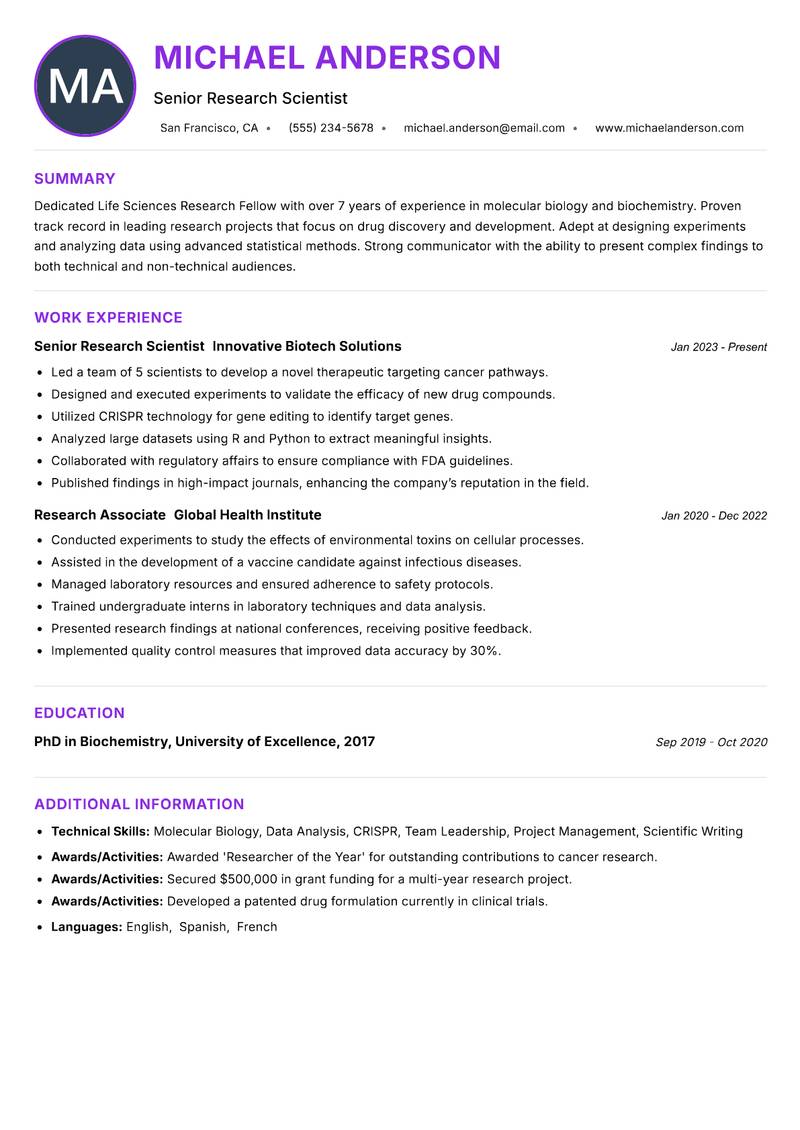
Senior Research Scientist Resume

Dedicated Life Sciences Research Fellow with over 7 years of experience in molecular biology and biochemistry. Proven track record in leading research projects that focus on drug discovery and development. Adept at designing experiments and analyzing data using advanced statistical methods. Strong communicator with the ability to present complex findings to both technical and non-technical audiences. Experienced in collaborating with cross-functional teams to drive projects forward and achieve strategic goals. Passionate about translating scientific research into practical applications that improve human health. Holds a PhD in Biochemistry from a prestigious university, with numerous publications in peer-reviewed journals.

Molecular Biology Data Analysis CRISPR Team Leadership Project Management Scientific Writing
Life Sciences Research Fellow Resume Preview Example
View PDF
  1. Led a team of 5 scientists to develop a novel therapeutic targeting cancer pathways.
  2. Designed and executed experiments to validate the efficacy of new drug compounds.
  3. Utilized CRISPR technology for gene editing to identify target genes.
  4. Analyzed large datasets using R and Python to extract meaningful insights.
  5. Collaborated with regulatory affairs to ensure compliance with FDA guidelines.
  6. Published findings in high-impact journals, enhancing the company’s reputation in the field.
  1. Conducted experiments to study the effects of environmental toxins on cellular processes.
  2. Assisted in the development of a vaccine candidate against infectious diseases.
  3. Managed laboratory resources and ensured adherence to safety protocols.
  4. Trained undergraduate interns in laboratory techniques and data analysis.
  5. Presented research findings at national conferences, receiving positive feedback.
  6. Implemented quality control measures that improved data accuracy by 30%.

Achievements

  • Awarded 'Researcher of the Year' for outstanding contributions to cancer research.
  • Secured $500,000 in grant funding for a multi-year research project.
  • Developed a patented drug formulation currently in clinical trials.
⏱️
Experience
2-5 Years
📅
Level
Mid Level
🎓
Education
PhD in Biochemistry, Universit...

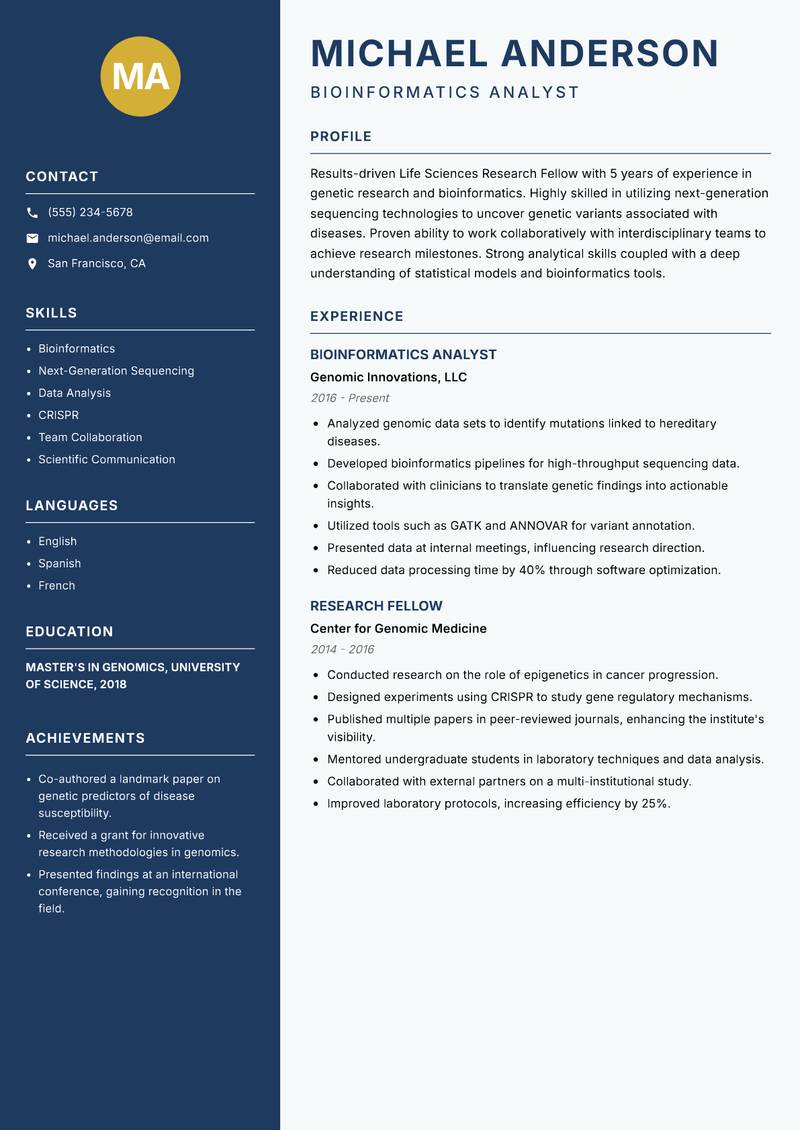
Bioinformatics Analyst Resume

Experienced Life Sciences Research Fellow with 5 years of experience in genetic research and bioinformatics. Highly skilled in utilizing next-generation sequencing technologies to uncover genetic variants associated with diseases. Proven ability to work collaboratively with interdisciplinary teams to achieve research milestones. Strong analytical skills coupled with a deep understanding of statistical models and bioinformatics tools. Committed to advancing genomic medicine through innovative research approaches. Holds a Master's degree in Genomics with a focus on computational biology.

Bioinformatics Next-Generation Sequencing Data Analysis CRISPR Team Collaboration Scientific Communication
Life Sciences Research Fellow Resume Preview Example
View PDF
  1. Analyzed genomic data sets to identify mutations linked to hereditary diseases.
  2. Developed bioinformatics pipelines for high-throughput sequencing data.
  3. Collaborated with clinicians to translate genetic findings into actionable insights.
  4. Utilized tools such as GATK and ANNOVAR for variant annotation.
  5. Presented data at internal meetings, influencing research direction.
  6. Reduced data processing time by 40% through software optimization.
  1. Conducted research on the role of epigenetics in cancer progression.
  2. Designed experiments using CRISPR to study gene regulatory mechanisms.
  3. Published multiple papers in peer-reviewed journals, enhancing the institute's visibility.
  4. Mentored undergraduate students in laboratory techniques and data analysis.
  5. Collaborated with external partners on a multi-institutional study.
  6. Improved laboratory protocols, increasing efficiency by 25%.

Achievements

  • Co-authored a landmark paper on genetic predictors of disease susceptibility.
  • Received a grant for innovative research methodologies in genomics.
  • Presented findings at an international conference, gaining recognition in the field.
⏱️
Experience
2-5 Years
📅
Level
Mid Level
🎓
Education
Master's in Genomics, Universi...

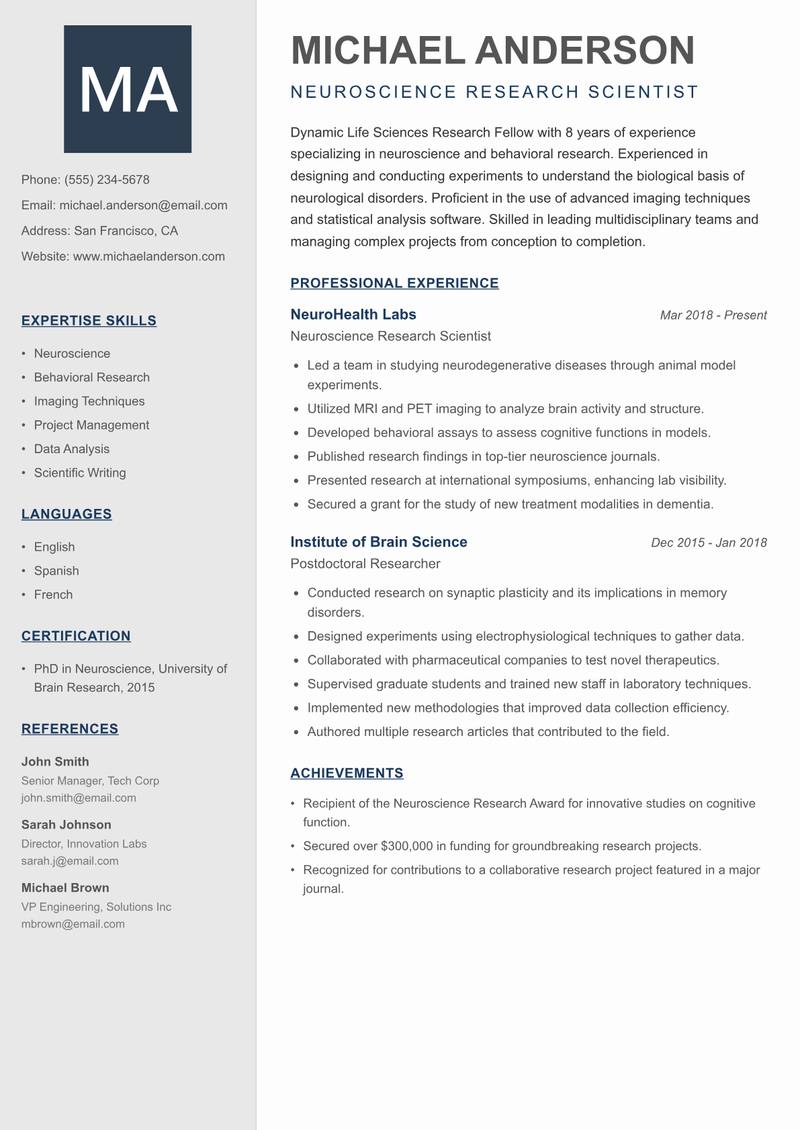
Neuroscience Research Scientist Resume

Dynamic Life Sciences Research Fellow with 8 years of experience specializing in neuroscience and behavioral research. Experienced in designing and conducting experiments to understand the biological basis of neurological disorders. Proficient in the use of advanced imaging techniques and statistical analysis software. Skilled in leading multidisciplinary teams and managing complex projects from conception to completion. Committed to fostering innovation in neuroscience research that translates to clinical applications. Holds a PhD in Neuroscience with a strong publication record in high-impact journals.

Neuroscience Behavioral Research Imaging Techniques Project Management Data Analysis Scientific Writing
Life Sciences Research Fellow Resume Preview Example
View PDF
  1. Led a team in studying neurodegenerative diseases through animal model experiments.
  2. Utilized MRI and PET imaging to analyze brain activity and structure.
  3. Developed behavioral assays to assess cognitive functions in models.
  4. Published research findings in top-tier neuroscience journals.
  5. Presented research at international symposiums, enhancing lab visibility.
  6. Secured a grant for the study of new treatment modalities in dementia.
  1. Conducted research on synaptic plasticity and its implications in memory disorders.
  2. Designed experiments using electrophysiological techniques to gather data.
  3. Collaborated with pharmaceutical companies to test novel therapeutics.
  4. Supervised graduate students and trained new staff in laboratory techniques.
  5. Implemented new methodologies that improved data collection efficiency.
  6. Authored multiple research articles that contributed to the field.

Achievements

  • Recipient of the Neuroscience Research Award for innovative studies on cognitive function.
  • Secured over $300,000 in funding for groundbreaking research projects.
  • Recognized for contributions to a collaborative research project featured in a major journal.
⏱️
Experience
2-5 Years
📅
Level
Mid Level
🎓
Education
PhD in Neuroscience, Universit...

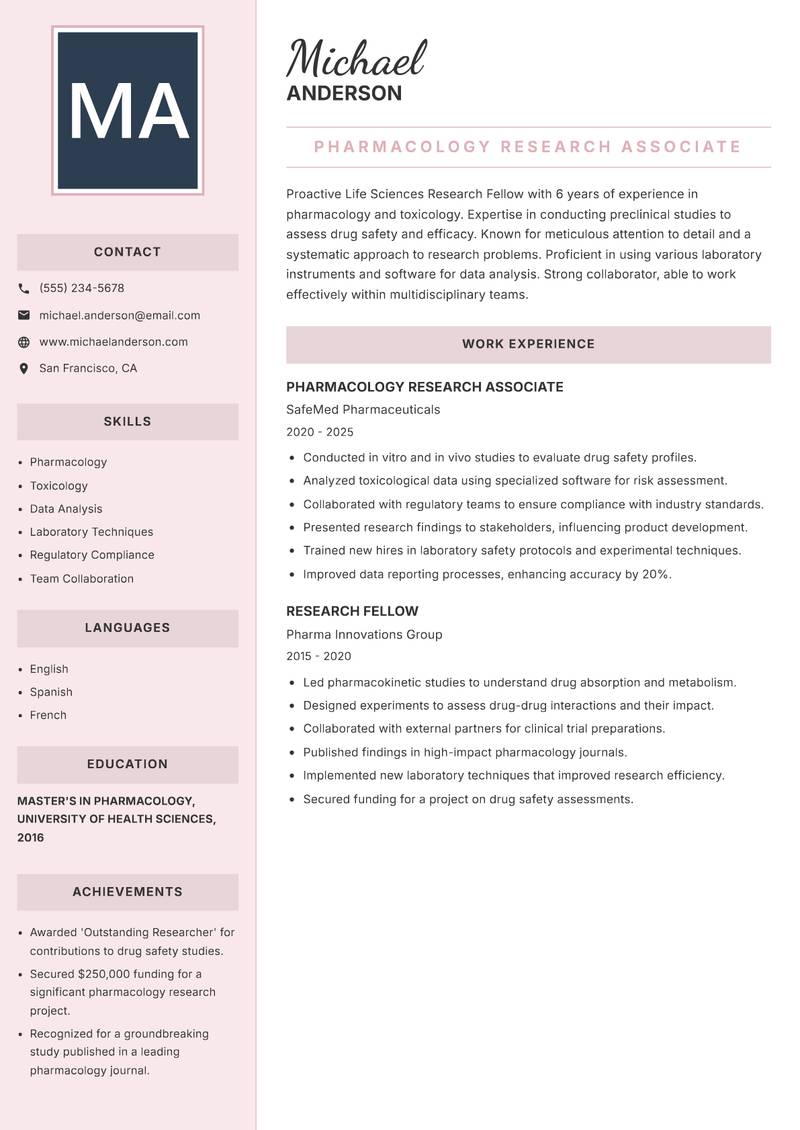
Pharmacology Research Associate Resume

Driven Life Sciences Research Fellow with 6 years of experience in pharmacology and toxicology. Expertise in conducting preclinical studies to assess drug safety and efficacy. Known for meticulous attention to detail and a systematic approach to research problems. Proficient in using various laboratory instruments and software for data analysis. Strong collaborator, able to work effectively within multidisciplinary teams. Holds a Master's in Pharmacology with extensive knowledge of regulatory compliance and good laboratory practices.

Pharmacology Toxicology Data Analysis Laboratory Techniques Regulatory Compliance Team Collaboration
Life Sciences Research Fellow Resume Preview Example
View PDF
  1. Conducted in vitro and in vivo studies to evaluate drug safety profiles.
  2. Analyzed toxicological data using specialized software for risk assessment.
  3. Collaborated with regulatory teams to ensure compliance with industry standards.
  4. Presented research findings to stakeholders, influencing product development.
  5. Trained new hires in laboratory safety protocols and experimental techniques.
  6. Improved data reporting processes, enhancing accuracy by 20%.
  1. Led pharmacokinetic studies to understand drug absorption and metabolism.
  2. Designed experiments to assess drug-drug interactions and their impact.
  3. Collaborated with external partners for clinical trial preparations.
  4. Published findings in high-impact pharmacology journals.
  5. Implemented new laboratory techniques that improved research efficiency.
  6. Secured funding for a project on drug safety assessments.

Achievements

  • Awarded 'Outstanding Researcher' for contributions to drug safety studies.
  • Secured $250,000 funding for a significant pharmacology research project.
  • Recognized for a groundbreaking study published in a leading pharmacology journal.
⏱️
Experience
2-5 Years
📅
Level
Mid Level
🎓
Education
Master's in Pharmacology, Univ...

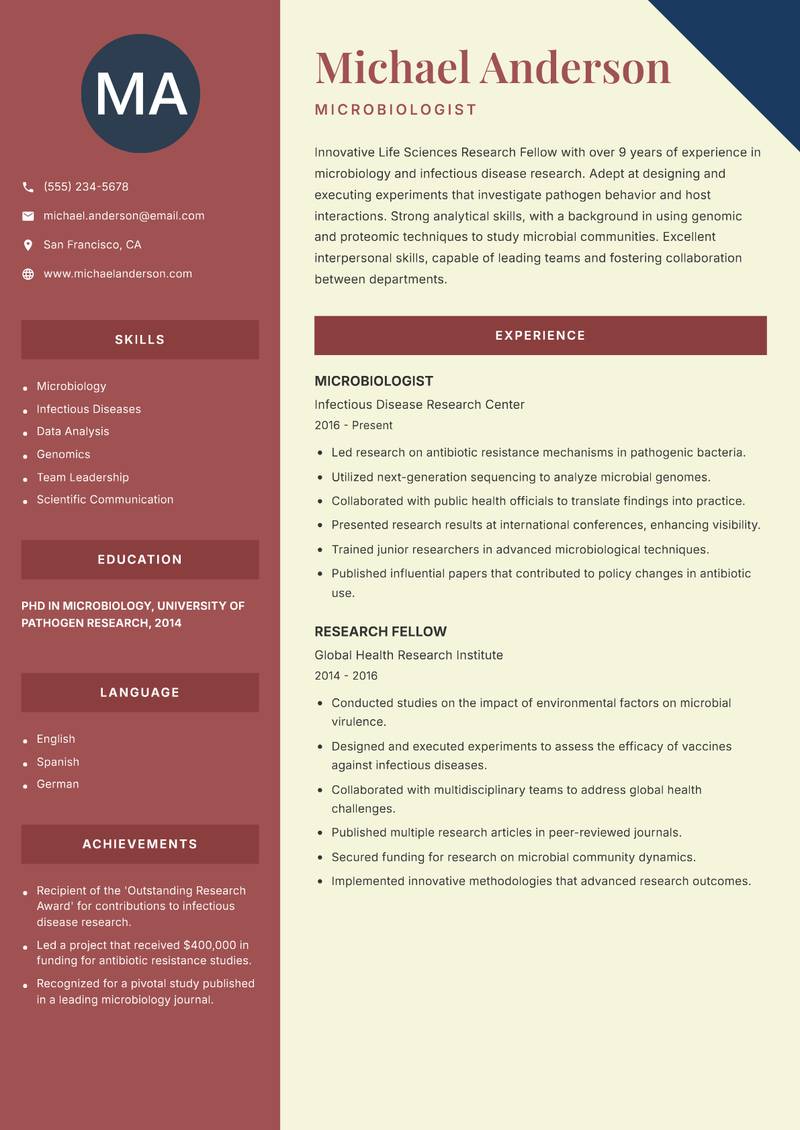
Microbiologist Resume

Innovative Life Sciences Research Fellow with over 9 years of experience in microbiology and infectious disease research. Adept at designing and executing experiments that investigate pathogen behavior and host interactions. Strong analytical skills, with a background in using genomic and proteomic techniques to study microbial communities. Excellent interpersonal skills, capable of leading teams and fostering collaboration between departments. Holds a PhD in Microbiology and has contributed to numerous high-impact publications in the field.

Microbiology Infectious Diseases Data Analysis Genomics Team Leadership Scientific Communication
Life Sciences Research Fellow Resume Preview Example
View PDF
  1. Led research on antibiotic resistance mechanisms in pathogenic bacteria.
  2. Utilized next-generation sequencing to analyze microbial genomes.
  3. Collaborated with public health officials to translate findings into practice.
  4. Presented research results at international conferences, enhancing visibility.
  5. Trained junior researchers in advanced microbiological techniques.
  6. Published influential papers that contributed to policy changes in antibiotic use.
  1. Conducted studies on the impact of environmental factors on microbial virulence.
  2. Designed and executed experiments to assess the efficacy of vaccines against infectious diseases.
  3. Collaborated with multidisciplinary teams to address global health challenges.
  4. Published multiple research articles in peer-reviewed journals.
  5. Secured funding for research on microbial community dynamics.
  6. Implemented innovative methodologies that advanced research outcomes.

Achievements

  • Recipient of the 'Outstanding Research Award' for contributions to infectious disease research.
  • Led a project that received $400,000 in funding for antibiotic resistance studies.
  • Recognized for a pivotal study published in a leading microbiology journal.
⏱️
Experience
2-5 Years
📅
Level
Mid Level
🎓
Education
PhD in Microbiology, Universit...

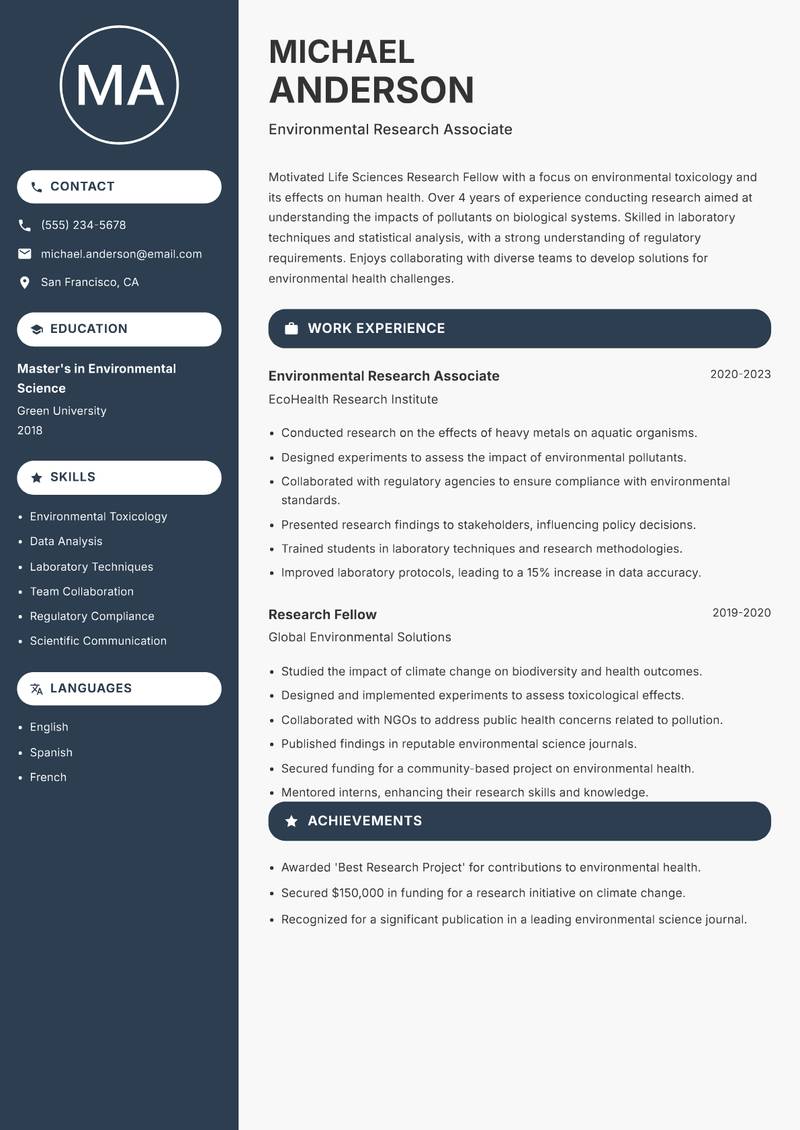
Environmental Research Associate Resume

Driven Life Sciences Research Fellow with a focus on environmental toxicology and its effects on human health. Over 4 years of experience conducting research aimed at understanding the impacts of pollutants on biological systems. Skilled in laboratory techniques and statistical analysis, with a strong understanding of regulatory requirements. Enjoys collaborating with diverse teams to develop solutions for environmental health challenges. Holds a Master's degree in Environmental Science and has contributed to several impactful publications.

Environmental Toxicology Data Analysis Laboratory Techniques Team Collaboration Regulatory Compliance Scientific Communication
Life Sciences Research Fellow Resume Preview Example
View PDF
  1. Conducted research on the effects of heavy metals on aquatic organisms.
  2. Designed experiments to assess the impact of environmental pollutants.
  3. Collaborated with regulatory agencies to ensure compliance with environmental standards.
  4. Presented research findings to stakeholders, influencing policy decisions.
  5. Trained students in laboratory techniques and research methodologies.
  6. Improved laboratory protocols, leading to a 15% increase in data accuracy.
  1. Studied the impact of climate change on biodiversity and health outcomes.
  2. Designed and implemented experiments to assess toxicological effects.
  3. Collaborated with NGOs to address public health concerns related to pollution.
  4. Published findings in reputable environmental science journals.
  5. Secured funding for a community-based project on environmental health.
  6. Mentored interns, enhancing their research skills and knowledge.

Achievements

  • Awarded 'Best Research Project' for contributions to environmental health.
  • Secured $150,000 in funding for a research initiative on climate change.
  • Recognized for a significant publication in a leading environmental science journal.
⏱️
Experience
2-5 Years
📅
Level
Mid Level
🎓
Education
Master's in Environmental Scie...

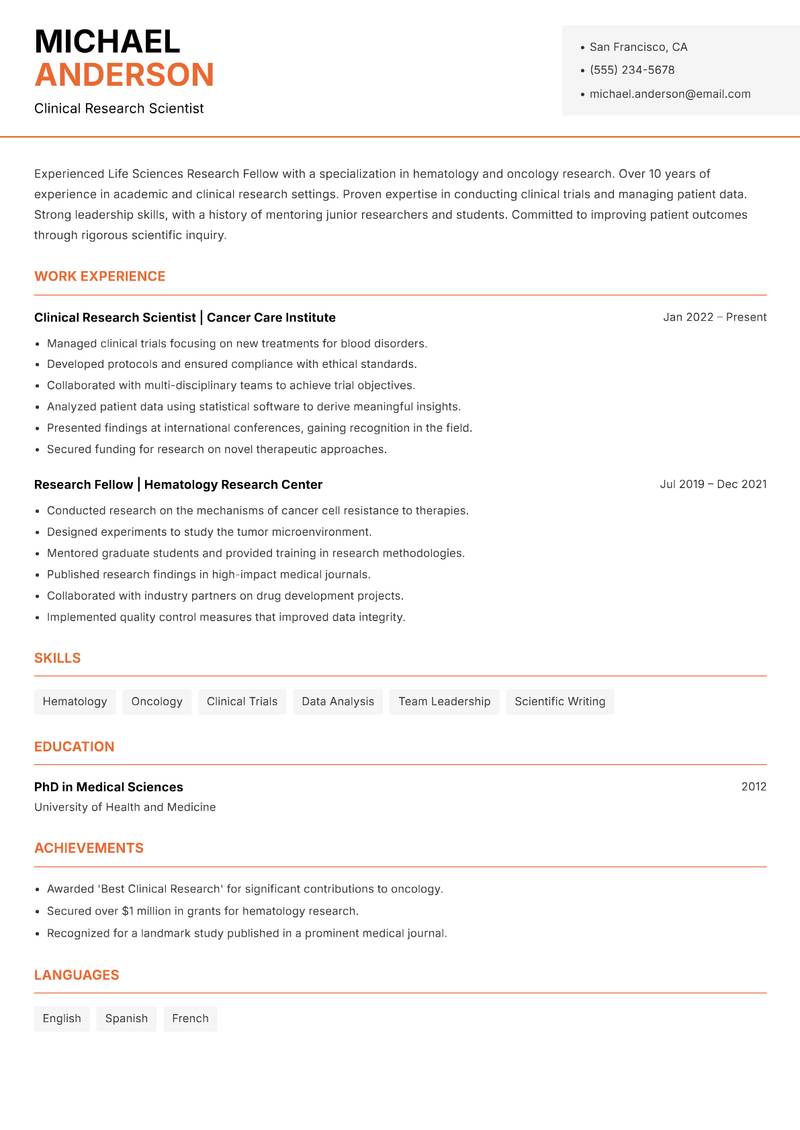
Clinical Research Scientist Resume

Experienced Life Sciences Research Fellow with a specialization in hematology and oncology research. Over 10 years of experience in academic and clinical research settings. Proven expertise in conducting clinical trials and managing patient data. Strong leadership skills, with a history of mentoring junior researchers and students. Committed to improving patient outcomes through rigorous scientific inquiry. Holds a PhD in Medical Sciences and has published extensively in high-ranking medical journals.

Hematology Oncology Clinical Trials Data Analysis Team Leadership Scientific Writing
Life Sciences Research Fellow Resume Preview Example
View PDF
  1. Managed clinical trials focusing on new treatments for blood disorders.
  2. Developed protocols and ensured compliance with ethical standards.
  3. Collaborated with multi-disciplinary teams to achieve trial objectives.
  4. Analyzed patient data using statistical software to derive meaningful insights.
  5. Presented findings at international conferences, gaining recognition in the field.
  6. Secured funding for research on novel therapeutic approaches.
  1. Conducted research on the mechanisms of cancer cell resistance to therapies.
  2. Designed experiments to study the tumor microenvironment.
  3. Mentored graduate students and provided training in research methodologies.
  4. Published research findings in high-impact medical journals.
  5. Collaborated with industry partners on drug development projects.
  6. Implemented quality control measures that improved data integrity.

Achievements

  • Awarded 'Best Clinical Research' for significant contributions to oncology.
  • Secured over $1 million in grants for hematology research.
  • Recognized for a landmark study published in a prominent medical journal.
⏱️
Experience
2-5 Years
📅
Level
Mid Level
🎓
Education
PhD in Medical Sciences, Unive...

Key Skills for Life Sciences Research Fellow Positions

Resume Tips for Life Sciences Research Fellow Applications

Strong Action Verbs for Life Sciences Research Fellow Resumes

Discovered · Synthesized · Sequenced · Expressed · Analyzed · Published · Optimized · Developed · Patented · Validated · Achieved · Administered · Architected · Assessed

Common Mistakes to Avoid

Experience Levels

How to Write a Life Sciences Research Fellow Resume

Browse Life Sciences Research Fellow resume examples built around molecular biology techniques (PCR, CRISPR, western blot), tailored for Life Sciences roles.

A strong Life Sciences Research Fellow resume leads with a focused professional summary that names the exact role and your standout achievement. In the experience section, open every bullet with a strong action verb and quantify the result with numbers wherever possible. Highlight your most relevant competencies — especially Life Sciences Research, Molecular Biology Techniques (PCR, CRISPR, Western Blot), and Cell Culture & In Vitro Models — in a dedicated Skills section positioned early so ATS systems and hiring managers both find it immediately.

For format, most Life Sciences Research Fellow roles suit a reverse-chronological layout: most recent position first, working backwards. Keep to one page for under five years of experience, or two pages for senior candidates with a rich project or leadership history. Use clean, ATS-safe fonts (10–12pt), standard section headings (Summary, Experience, Education, Skills), and avoid tables, text boxes, or multi-column layouts that applicant tracking systems cannot parse reliably.
Frequently Asked Questions

What makes a strong Life Sciences Research Fellow resume stand out to employers?

A standout Life Sciences Research Fellow resume combines role-specific skills with quantified achievements. Name the exact job title in your professional summary, mirror keywords from each job posting, and open every bullet point with a strong action verb followed by a measurable result. Certifications, tools, and domain experience specific to life sciences research fellow roles should appear prominently near the top.

What skills are most important to include on a Life Sciences resume?

Recruiters hiring in Life Sciences consistently look for Molecular Biology Techniques (PCR, CRISPR, Western Blot), Cell Culture & In Vitro Models, Genomics & Sequencing (NGS, Sanger), Bioinformatics & Computational Biology. List these in a dedicated Skills section near the top so both ATS systems and human reviewers spot them fast. Mirror the exact phrasing from each job posting wherever possible — many applicant tracking systems match literal strings rather than synonyms.

What is the best resume format for Life Sciences professionals?

A reverse-chronological format is the standard choice for most Life Sciences candidates — employers expect to see your most recent role first, working backwards. If you are transitioning into Life Sciences from a related field, a hybrid format (brief skills summary at the top followed by chronological experience) can bridge the gap effectively. Keep the document to one page for under five years of experience, or two pages for senior specialists.

How do I make my Life Sciences resume pass applicant tracking systems (ATS)?

Use standard section headings — Summary, Experience, Education, Skills — rather than creative labels that ATS parsers do not recognise. Embed domain keywords such as "Molecular Biology Techniques (PCR, CRISPR, Western Blot)" and "Cell Culture & In Vitro Models" naturally inside your experience bullets rather than cramming them into a standalone keyword list. Avoid tables, multi-column layouts, text boxes, headers, footers, and images — these confuse most modern parsers and can cause your resume to be misread or rejected before a human sees it.

What mistakes do Life Sciences professionals most commonly make on their resume?

The most frequent issue is being vague about techniques — 'molecular biology skills' is meaningless without specifics. Beyond that, generic objective statements, unquantified achievements, and inconsistent date formatting appear across almost every Life Sciences application. Fix these by replacing every vague claim with a measurable outcome — specific numbers and named projects add credibility that adjectives cannot.

How long should a Life Sciences resume be?

One page is appropriate for candidates with under five years of relevant Life Sciences experience. Two pages are acceptable — and sometimes expected — for senior specialists, managers, or professionals with a strong portfolio of projects, publications, or credentials. Avoid padding to reach a page count: every line should directly support your application for the specific role you are targeting.

Should I include a professional summary at the top of my Life Sciences resume?

Yes — a two to three sentence summary is the first section most recruiters read. Open with your title and years of Life Sciences experience, then name your most relevant achievement or specialisation. One proven approach: List specific molecular biology techniques — CRISPR, qPCR, single-cell sequencing — rather than generic 'molecular biology skills' — this level of specificity signals genuine expertise before a recruiter reaches your experience section.

Scroll to view samples